


• it VO
  • fr Français
  • en English
  • ar العربية
A propos
  • Explorations
    • Tout
    • Dossiers
    • Monde
    • Reportages
    Droits des femmes et des filles: en caravane à travers l’Atlas marocain

    Droits des femmes et des filles: en caravane à travers l’Atlas marocain

    En Méditerranée : les droits et les libertés sexuels et reproductifs sous pression

    En Méditerranée : les droits et les libertés sexuels et reproductifs sous pression

    Marche arrière en Italie sur l'introduction du consentement dans la définition du viol

    Marche arrière en Italie sur l'introduction du consentement dans la définition du viol

    600 avortements par jour au Maroc: des chiffres alarmants et des histoires tragiques

    600 avortements par jour au Maroc: des chiffres alarmants et des histoires tragiques

    En Espagne, le droit à l’avortement n’est pas acquis pour toutes

    En Espagne, le droit à l’avortement n’est pas acquis pour toutes

    Les Sujets

    • Femmes artistes
    • Femmes vivant de la rue et dans la rue
    • Femmes et corps
    • Femmes et sport
    • Femmes et cinéma
    • Séries ramadanesques
    • Femmes et guerre
    • Femmes mises à la marge
    • Femmes et information
    • Précarité menstruelle
    • Femmes et prison
    • Femmes rurales
    • Anti-violence
    • Corps en transition
    • Droits sexuels et reproductifs
  • En mouvement
    Amel Hadjadj, fondatrice du Journal Féministe Algérien : «  L’enjeu majeur est celui de la mobilisation, nous avons besoin de plus de membres »

    Amel Hadjadj, fondatrice du Journal Féministe Algérien : « L’enjeu majeur est celui de la mobilisation, nous avons besoin de plus de membres »

    Algérie 2025 : des annonces pour les droits des femmes… mais pour quelles avancées réelles ?

    Algérie 2025 : des annonces pour les droits des femmes… mais pour quelles avancées réelles ?

    Consuelo Catalá: « L’avortement est une insoumission absolue au mandat prioritaire de la société patriarcale »

    Consuelo Catalá: « L’avortement est une insoumission absolue au mandat prioritaire de la société patriarcale »

    Les femmes dans l’histoire de la pensée : héritage occulté, reconnaissance manquée

    Les femmes dans l’histoire de la pensée : héritage occulté, reconnaissance manquée

  • Portraits
    Droit à l'avortement en Tunisie, Selma Hajri : « Les régressions sont très importantes »

    Droit à l'avortement en Tunisie, Selma Hajri : « Les régressions sont très importantes »

    Sur TikTok, une libération de la parole inédite sur l’excision : l’engagement de Tabara Touré, 22 ans

    Sur TikTok, une libération de la parole inédite sur l’excision : l’engagement de Tabara Touré, 22 ans

    Sophie Bessis : « La bataille de l’intime sera longue, notamment dans les pays du Sud ! »

    Sophie Bessis : « La bataille de l’intime sera longue, notamment dans les pays du Sud ! »

    Dis maman, dis papa, qu'est-ce que le consentement ? Un livre jeunesse 100% tunisien pour prévenir les violences sexuelles

    Dis maman, dis papa, qu'est-ce que le consentement ? Un livre jeunesse 100% tunisien pour prévenir les violences sexuelles

  • Créations
    • Tout
    • Expo Arts Visuels
    • Livres, films, séries
    Muganga — la guerre se lit sur le corps des femmes

    Muganga — la guerre se lit sur le corps des femmes

    Malédiction 1, une adaptation théâtrale tunisienne à fleur de rage de King Kong Théorie

    Malédiction 1, une adaptation théâtrale tunisienne à fleur de rage de King Kong Théorie

    Je ne suis pas ta gitane : combattre l’antitziganisme avec humour

    Je ne suis pas ta gitane : combattre l’antitziganisme avec humour

    Des chansons féministes de part et d'autre de la Méditerranée, la rédaction partage sa playlist

    Des chansons féministes de part et d'autre de la Méditerranée, la rédaction partage sa playlist

  • Opinions
    Lettres sous les bombes - Quand une mère perd ses six fils d’un seul coup  (10)

    Lettres sous les bombes - Quand une mère perd ses six fils d’un seul coup (10)

    Lettres sous les bombes – « Pas de gâteau d’anniversaire pour mes enfants » (9)

    Lettres sous les bombes – « Pas de gâteau d’anniversaire pour mes enfants » (9)

    La mort « tonitruante » de Fatima Hassouna

    La mort « tonitruante » de Fatima Hassouna

    Fatima Hassouna, l’œil de Gaza s’éteint

    Fatima Hassouna, l’œil de Gaza s’éteint

  • Multimedia
    Diala Al Hindawi  « Je veux voir ma maison à Damas ! »

    Diala Al Hindawi « Je veux voir ma maison à Damas ! »

    Séisme au Maroc - Reportage par Mahacine Mokdad (4)

    Séisme au Maroc - Reportage par Mahacine Mokdad (3)

    Séisme au Maroc - Reportage par Mahacine Mokdad (2)

  • Contextes
Pas de résultat
Afficher tous les résultats
BLOGS
Medfeminiswiya
  • Explorations
    • Tout
    • Dossiers
    • Monde
    • Reportages
    Droits des femmes et des filles: en caravane à travers l’Atlas marocain

    Droits des femmes et des filles: en caravane à travers l’Atlas marocain

    En Méditerranée : les droits et les libertés sexuels et reproductifs sous pression

    En Méditerranée : les droits et les libertés sexuels et reproductifs sous pression

    Marche arrière en Italie sur l'introduction du consentement dans la définition du viol

    Marche arrière en Italie sur l'introduction du consentement dans la définition du viol

    600 avortements par jour au Maroc: des chiffres alarmants et des histoires tragiques

    600 avortements par jour au Maroc: des chiffres alarmants et des histoires tragiques

    En Espagne, le droit à l’avortement n’est pas acquis pour toutes

    En Espagne, le droit à l’avortement n’est pas acquis pour toutes

    Les Sujets

    • Femmes artistes
    • Femmes vivant de la rue et dans la rue
    • Femmes et corps
    • Femmes et sport
    • Femmes et cinéma
    • Séries ramadanesques
    • Femmes et guerre
    • Femmes mises à la marge
    • Femmes et information
    • Précarité menstruelle
    • Femmes et prison
    • Femmes rurales
    • Anti-violence
    • Corps en transition
    • Droits sexuels et reproductifs
  • En mouvement
    Amel Hadjadj, fondatrice du Journal Féministe Algérien : «  L’enjeu majeur est celui de la mobilisation, nous avons besoin de plus de membres »

    Amel Hadjadj, fondatrice du Journal Féministe Algérien : « L’enjeu majeur est celui de la mobilisation, nous avons besoin de plus de membres »

    Algérie 2025 : des annonces pour les droits des femmes… mais pour quelles avancées réelles ?

    Algérie 2025 : des annonces pour les droits des femmes… mais pour quelles avancées réelles ?

    Consuelo Catalá: « L’avortement est une insoumission absolue au mandat prioritaire de la société patriarcale »

    Consuelo Catalá: « L’avortement est une insoumission absolue au mandat prioritaire de la société patriarcale »

    Les femmes dans l’histoire de la pensée : héritage occulté, reconnaissance manquée

    Les femmes dans l’histoire de la pensée : héritage occulté, reconnaissance manquée

  • Portraits
    Droit à l'avortement en Tunisie, Selma Hajri : « Les régressions sont très importantes »

    Droit à l'avortement en Tunisie, Selma Hajri : « Les régressions sont très importantes »

    Sur TikTok, une libération de la parole inédite sur l’excision : l’engagement de Tabara Touré, 22 ans

    Sur TikTok, une libération de la parole inédite sur l’excision : l’engagement de Tabara Touré, 22 ans

    Sophie Bessis : « La bataille de l’intime sera longue, notamment dans les pays du Sud ! »

    Sophie Bessis : « La bataille de l’intime sera longue, notamment dans les pays du Sud ! »

    Dis maman, dis papa, qu'est-ce que le consentement ? Un livre jeunesse 100% tunisien pour prévenir les violences sexuelles

    Dis maman, dis papa, qu'est-ce que le consentement ? Un livre jeunesse 100% tunisien pour prévenir les violences sexuelles

  • Créations
    • Tout
    • Expo Arts Visuels
    • Livres, films, séries
    Muganga — la guerre se lit sur le corps des femmes

    Muganga — la guerre se lit sur le corps des femmes

    Malédiction 1, une adaptation théâtrale tunisienne à fleur de rage de King Kong Théorie

    Malédiction 1, une adaptation théâtrale tunisienne à fleur de rage de King Kong Théorie

    Je ne suis pas ta gitane : combattre l’antitziganisme avec humour

    Je ne suis pas ta gitane : combattre l’antitziganisme avec humour

    Des chansons féministes de part et d'autre de la Méditerranée, la rédaction partage sa playlist

    Des chansons féministes de part et d'autre de la Méditerranée, la rédaction partage sa playlist

  • Opinions
    Lettres sous les bombes - Quand une mère perd ses six fils d’un seul coup  (10)

    Lettres sous les bombes - Quand une mère perd ses six fils d’un seul coup (10)

    Lettres sous les bombes – « Pas de gâteau d’anniversaire pour mes enfants » (9)

    Lettres sous les bombes – « Pas de gâteau d’anniversaire pour mes enfants » (9)

    La mort « tonitruante » de Fatima Hassouna

    La mort « tonitruante » de Fatima Hassouna

    Fatima Hassouna, l’œil de Gaza s’éteint

    Fatima Hassouna, l’œil de Gaza s’éteint

  • Multimedia
    Diala Al Hindawi  « Je veux voir ma maison à Damas ! »

    Diala Al Hindawi « Je veux voir ma maison à Damas ! »

    Séisme au Maroc - Reportage par Mahacine Mokdad (4)

    Séisme au Maroc - Reportage par Mahacine Mokdad (3)

    Séisme au Maroc - Reportage par Mahacine Mokdad (2)

  • Contextes
A propos
Medfeminiswiya
A propos

Rural women in Algeria: Owning a land is a blessing, keeping one is a struggle

If the Algerian Civil Code grants women the same right as men in terms of buying and selling the property they have acquired or inherited, the more unequal Family Code in terms of suc-cession provides 1/8 for the widow with children, 1/6 for the childless widow. The brother’s share is twice that of the sister.

Ghania Khelifi Ghania Khelifi
7 novembre 2021
dans Non classifié(e)
23 2
0
Partager sur FacebookPartager sur Twitter

Every year in October, the International Day of Rural Women, established in 2008 by the UN, is duly celebrated with its share of announcements and praise for Algerian rural women invested with “authentic” national values, understanding, humble, respectful of traditions and often opposed to the overly westernized city dweller. These sexist clichés praising the modest peasant woman are however contradicted by rural women’s will and ambition to engage in agricultural work. Breeding, beekeeping, craft micro-enterprises and projects developed by women are no longer rare. Rural Algerian women have an incredible desire for prosperity and autonomy.

More than 100,000 of these rural women hold the female farmer’s card and 7.3% are at the head of holdings with an area of between 1 and 5 hectares. They represent almost a quarter of the seven million Algerians living on a farm. Official statistics, which do not take account of the informal activity of women working on small family plots without pay, estimate their presence at 18% out of one and a half million of the national agricultural labor force.

Both in the South and in the North, they have transmitted their knowledge from generation to generation maintaining the land when the men were in the maquis fighting for the country’s independence and then emigrated to France or to work in factories in the cities. Yet, land has long been associated with the honor of men, with their blood. It bears the name of the line and should in no case fall into the hands of strangers to the clan.

However, the intoxication of the re-conquest in the blood of this land despoiled by French colonization has gradually subsided in the face of the challenges of economic profitability. The current complex agricultural system results from trial and error, reforms and measures to ensure food independence and the development of the rural world. The private sphere, that is, 35% of the useful agricultural area, stands alongside the EAC collective farms and the EAI individual farms granted by the State under a 40-year concession. The administration grants credits, supplies seeds and markets strategic crops, including cereals. The bureaucracy and corruption related to this hybrid system are additional constraints for farmers especially female ones.

Atika Terriel Saadi, aged 44 years, knows only too well that “owning land is a blessing, keeping it is a struggle”, as she describes it. She is one of the few farmers to own a forty-hectare farm. With her late husband, Atika was lucky enough to buy back the land of her grandparents in Frenda, about two hundred kilometers away from Oran, capital of western Algeria. To keep her operation afloat, “a real money pit,” she has diversified her activity: breeding cattle and goats, vegetable gardening and cereal growing.
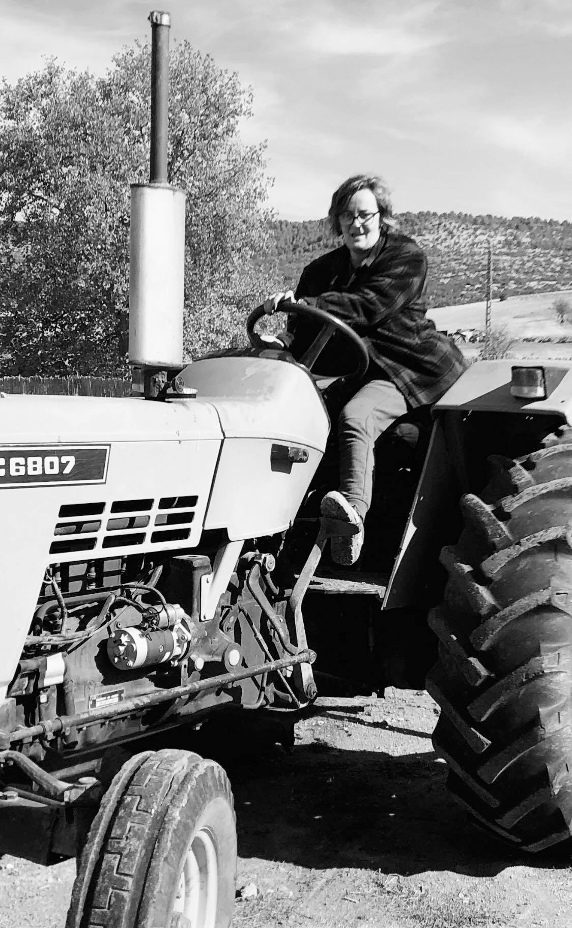
Photo phrom Atika's facebook page


Atika dreams of a “healthy and modern” agriculture and wishes to expand her vegetable gardening transforming it into organic cultivation without however requesting the organic “label” because the Algerian administration is a heavy machine capable of discouraging the most motivated.

“I have no problem with my employees or with my neighbors when I am on my tractor or in the fields,” states Atika Terriel Saadi on her tractor.

“It is the dinosaurs in the offices that look askance when not with lust, as soon as you approach them for a project,” she continues. Yet, women persist in their agricultural dreams.

At the initiative of permaculture training workshops in Algeria, Faycal Anceur, a former journalist, was able to count a significant number of women farmers and academics among his trainees. They were very interested in this technique and some even launched their own project.

Of course, women are not the only ones to suffer from bureaucratic complexity or obstacles to accessing bank loans, but they are more likely to experience precariousness. “Only the big fish succeed in obtaining significant funding,” regrets Atika.

The invisibility of women’s work has not disappeared despite the efforts of some associations to break out their isolation

The Algerian press has indeed written extensively about the scandals of thousands of hectares “granted” to people close to the Algerian authorities, including generals and ministers. If the Algerian Civil Code grants them the same right as men in terms of buying and selling the property they have acquired or inherited, the more unequal Family Code in terms of succession provides 1/8 for the widow with children, 1/6 for the childless widow. The brother’s share is twice that of the sister.

With its backward-looking text, this code is based on the assumption that land should not pass into the hands of the future husband of the women of the clan. For a long time, the sisters did not dare to claim their share so as not to confront their brothers and cause scandal. Giving up your right also allows you to be supported by the family in the event of divorce or widowhood. Another illusion fueled by the patriarchal order because in practice, women work hard to make a living and can be excluded from their share of inheritance. Cultivating a vegetable garden, raising poultry and a few sheep, making pottery, pancakes, weaving carpets and blankets are all tasks undertaken by generations of mothers who have sold their produce to feed their families.

Atika knows this well: “I have seen all these women in the fields from sunrise to sunset. They taught me a lot about working the land with few means.” The invisibility of women’s work has not disappeared despite the efforts of some associations to break out their isolation and provide them with information to manage their assets.

The difficulties of rural areas are multiplied by traditions and the weight of patriarchy on women. The predominantly male public space in the cities is more restrictive with regard to the mobility of women in the villages due to the lack of transport or for fear of a bad reputation. In addition, women do not have access to training and information on financing opportunities or on agricultural techniques that must be sought from institutions.

Despite everything, Atika is always proud to answer, “I am a fellaha” (farmer) when asked about her profession.

Read more: Land rights of women in Algeria, Nadia Ait-Zai.
Ghania Khelifi

Ghania Khelifi

Ancienne directrice de rédaction du quotidien algérien Liberté, journaliste politique, diplômée de La Sorbonne, Ghania Khelifi est également chargée de mission égalité Hommes-Femmes en France où elle vit. Titulaire d’un DESS sur l’œuvre et le parcours de Kateb Yacine, elle a signé la première rétrospective lui étant consacré à Alger en 1991, « Kateb Yacine, poèmes et éclats », au tout début de la décennie noire. Spécialiste de la société algérienne, elle collabore régulièrement à Babelmed.net depuis sa création.

Articles similaires

Laisser un commentaire Annuler la réponse

Votre adresse e-mail ne sera pas publiée. Les champs obligatoires sont indiqués avec *

J'accepte les termes et conditions et la Politique de confidentialité .

Medfeminiswiya

Medfeminiswiya est un réseau féministe qui rassemble des femmes journalistes travaillant dans le domaine des médias et de la production de l’information dans la région méditerranéenne.

Newsletter


    Suivez-nous

    Parcourir les rubriques


    • Explorations
    • Dossiers
    • Reportages
    • En mouvement
    • Portraits
    • Opinions

    • Créations
    • Expo Arts Visuels
    • Livres, films, séries
    • Multimedia
    • Contextes
    • Blogs
    • A propos
    • Notre communauté
    • Nos Partenaires
    • Devenir membre
    • Charte Éditoriale
    • Mentions légales

    © 2025 Medfeminiswiya - Réseau méditerranéen pour l'information féministe

    • it VO
    • fr Français
    • en English
    • ar العربية
    • Explorations
    • En mouvement
    • Portraits
    • Créations
    • Opinions
    • Multimedia
    • Contextes
    • Blogs
    Pas de résultat
    Afficher tous les résultats

    © 2025 Medfeminiswiya - Réseau méditerranéen pour l'information féministe

    Welcome Back!

    Login to your account below

    Forgotten Password?

    Retrieve your password

    Please enter your username or email address to reset your password.

    Log In

    Ajouter nouvelle playlist

    Ce site n'utilise pas de cookies. This website does not use cookies. هذا الموقع لا يستخدم ملفات تعريف الارتباط.