Cette publication est également disponible en :
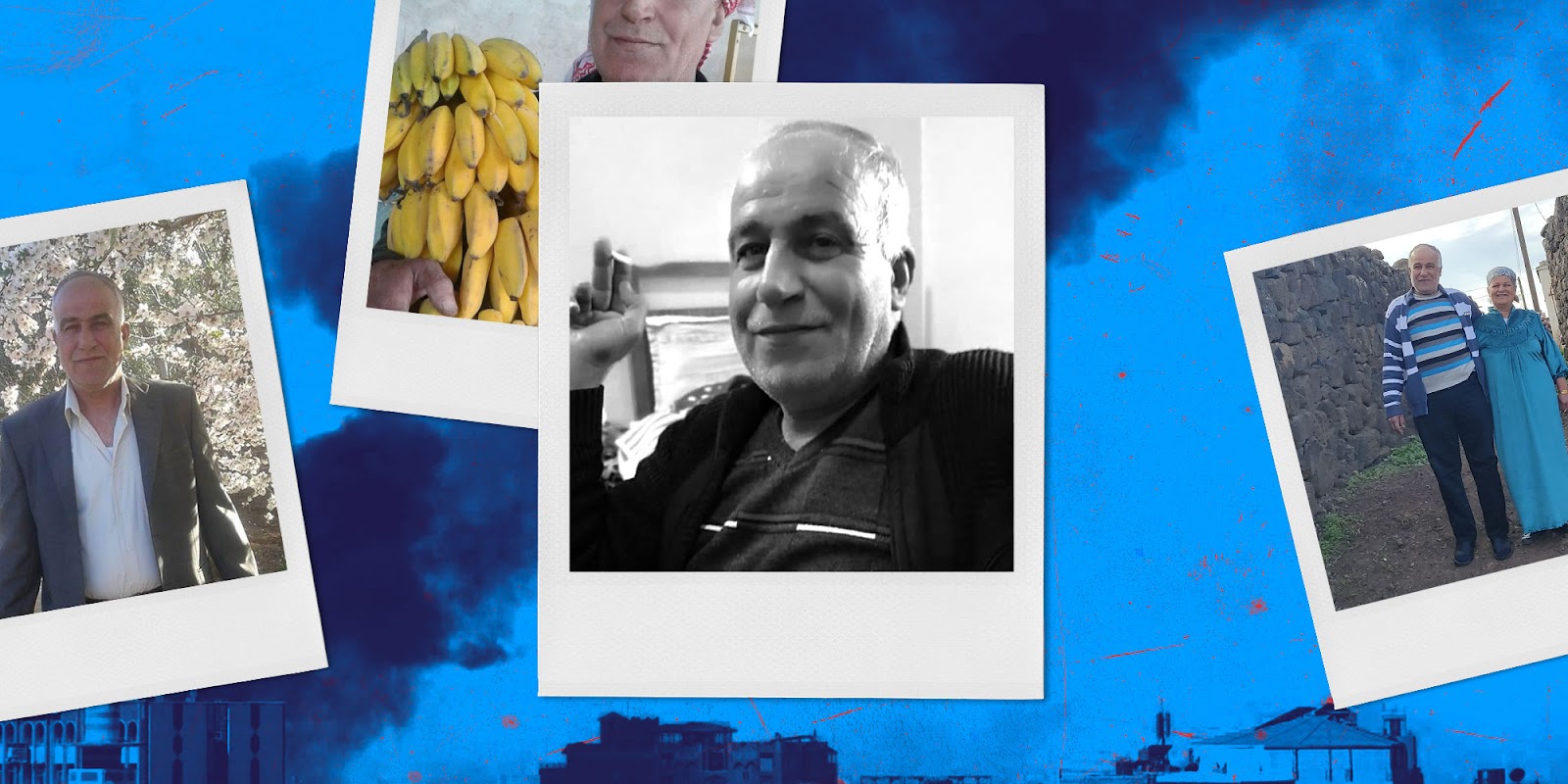
They killed my uncle, Fouad al-Hanna. I never imagined I’d write an obituary for someone in my family who was shot in the midst of sectarian confrontations in Suwayda. Three bullets were fired at him; one pierced his neck and remained lodged there.
Everything was chaotic and foggy, as if we were trapped in an endless nightmare. Even now, I keep convincing myself I’ll wake up from it.
My uncle was hit by three bullets at his front door. He had refused to leave his home in the village of Duwayrah in as-Suwayda. He clung to the toil of his life: his little garden, the orange bushes my grandmother planted, and the olive tree he trusted more than people.
The attack on Suwayda began last Monday. Since then, I haven’t stopped trying to reach my uncle and his wife. As the clashes escalated and armed factions aligned with Damascus attempted to advance toward the city, we begged him to leave. He said: “What about my livelihood? My house?” Then the road was cut off, and leaving became impossible.
Uncle Fouad, whose name means “heart”, was a kind man who loved his land, his home, and the trees he cultivated. He tended lemon trees and visited agricultural projects to plant seasonal vegetables. He had no connection to any armed groups; all he wanted was to stay home. And they killed him for that.
With his deep knowledge of farming, he knew what was dear. He’d visit us bringing fresh corn in crates from his land and would shout joyfully through the door, “Manahel, I brought you fresh yellow corn, oh my goodness!” And during the carob season, he was determined that the fruits from his trees would reach me in Lebanon, always saying, “I picked carob for you from the best tree I have.” He knew his trees well, and they knew him.
My uncle wasn’t just a farmer; he carried life in his hands and gifted it to us as corn, carob, oranges, fresh vegetables, and a warm laugh.

Whenever he came to visit, he brought love and crates full of produce. The land taught him generosity and kindness, so he’d proudly show off his harvest as though he possessed the world. He was truly a son of the earth in every sense, but he was killed on his own land.
I stayed in touch with him until about 3 p.m. last Monday, when we later received a message from his wife: “Your uncle was shot…” Our family is in a distant village, the roads were closed, and my brother, the only man there, couldn’t leave his elderly parents, his wife, and two children.
My uncle’s village, Duwayrah, is a mix of Druze, Christians, and Bedouins. When he was shot, his Bedouin friends took him to the city of Daraa, and from there he was transferred to Damascus due to the severity of his condition. But he passed away after day and a half.
Fouad al-Hanna was killed. He spoke with a Daraa accent, given the geographical closeness. My uncle, whose morning always began with self-brewed Arabic coffee—the best coffee ever. He’d place the kettle alongside it and set up a table in front of his agricultural repair shop, where villagers and friends from nearby villages—Druze, Christians, and Bedouins alike—would gather. They’d talk, laugh, and spend hours with him.

His home and shop were never empty of guests. He never harmed anyone, and no one who knew him would harm him. The person who killed him was certainly a stranger, foreign to the place and foreign to the heart.
He was not alone.
The armed men who stormed Suwayda, committing abuses, killing, and looting—killed dozens more within two days until international and regional pressures forced government-aligned militants to withdraw.
But how did it happen?
The town had begun to be bombed and armed tribal groups from the Daraa side began to advance. Only some Bedouins from the town and our uncle’s family remained. Some Bedouins from other areas came to his house, asked if he needed help, and assured him they would do everything possible to protect them. But as the chaos and bombing intensified, other armed groups began to enter the town from the Daraa side, and things deteriorated rapidly.
Multiple groups entered and asked my uncle who he was and what his sect was, then left.
Later, tribal and foreign Bedouin groups stormed the village. They looted houses and set them on fire. The local Bedouins tried to stop them, which led to clashes.
In the height of this chaos, his wife heard one militant fire his gun at the lock of the shop, then call to his friend, “Come see the loot, look how much stuff is here!”—a sign that he was a stranger to the town. Every Bedouin there knew my uncle’s shop and would never speak of it with surprise or greed. When he came out, they shot him.
His wife called my uncle’s Bedouin friends from the village immediately. They arrived within minutes, provided first aid, and transported him to Daraa, the closest city to the village.
My uncle, Fouad al-Hanna, had been arrested by Assad’s regime in 2012. Back then, my mother sat every evening on our home’s bench, crying unbearable injustice, raising her hands to heaven, begging God to bring him back from the grip of the oppressors. When he returned, he wasn’t the same man we knew. Detention had consumed half his body and taken an unbearable toll on his eyes.

He was arrested by the Assad regime on charges of “terrorism” and disappeared for long months with no one knowing his fate. When we learned where he was, his wife paid a hefty sum to secure his release. His survival at that time was like a miracle. He returned having lost around 50 kg in weight. His fingernails had been torn out, and whip marks were etched into his skin. They hung him by his feet and threatened to rape his sisters. They tortured him in the worst ways imaginable.
Despite all that hell, my uncle emerged from detention and regained a belief in life in ways I still cannot fathom. Perhaps it was because he loved the land. He returned to farming, experimenting with new varieties. He planted a banana tree and told everyone he had managed to harvest its fruit. I’d almost swear that it was his love for life that saved him from the detention. He wanted to live, to cultivate, to harvest, to press olives with his own hands. In all he did, he was telling life: “I am here… I want to live fully.”