• it VO
  • fr Français
  • en English
  • ar العربية
About us
  • In-depth
    • All
    • Features
    • Files
    • World
    Morocco: 600 abortions a day—Alarming figures and tragic stories

    Morocco: 600 abortions a day—Alarming figures and tragic stories

    In Spain, the right to abortion is not guaranteed for all

    In Spain, the right to abortion is not guaranteed for all

    Invisible and vulnerable: Migrant women at the frontlines of Spain’s prostitution debate

    Invisible and vulnerable: Migrant women at the frontlines of Spain’s prostitution debate

    Serbia: Is contraception a luxury or a basic human right?

    Serbia: Is contraception a luxury or a basic human right?

    Rebels, witnesses, victims: Women against the mafia (3/3)

    Rebels, witnesses, victims: Women against the mafia (3/3)

    Trending Tags

    • Women artists
    • Ecofeminism
    • Women living from and on the streets
    • Women and bodies
    • Women and sports
    • Women and cinema
    • Ramadan series
    • Women and war
    • Women Living at the Margins
    • Press Freedom from the Perspective of Women Journalists
    • Period poverty
    • Gynecological violence
    • Women and prison
    • Safe spaces
    • Abortion and SRHR
    • Transgenderism
    • Women in rural areas
  • On the move
    Spain: CEAR and the fight against human trafficking

    Spain: CEAR and the fight against human trafficking

    Gaza: How many journalists must be killed for the world to react?

    Gaza: How many journalists must be killed for the world to react?

    Moroccan activist Ibtissam Lachgar held in solitary confinement, health in crisis

    Moroccan activist Ibtissam Lachgar held in solitary confinement, health in crisis

    Three women for one man’s pay: The plight of female agricultural workers in Egypt

    Three women for one man’s pay: The plight of female agricultural workers in Egypt

  • Portraits
    Sophie Bessis: “The battle for the intimate will be long, especially in the Global South!”

    Sophie Bessis: “The battle for the intimate will be long, especially in the Global South!”

    “Mom, Dad, Can We Talk About Privacy?”—A Tunisian children’s book on protecting kids from sexual violence

    “Mom, Dad, Can We Talk About Privacy?”—A Tunisian children’s book on protecting kids from sexual violence

    Kurdish journalist killed in Turkish drone strike in northeastern Syria

    Kurdish journalist killed in Turkish drone strike in northeastern Syria

    A Filmmaker’s Journey: Inside the Creative World of Margarita Bareikyte

    A Filmmaker’s Journey: Inside the Creative World of Margarita Bareikyte

  • Creations
    • All
    • Reviews
    • Visual Arts
    “La Malédiction (1)”, a theatrical adaptation of King Kong Theory bursting with Tunisian rage

    “La Malédiction (1)”, a theatrical adaptation of King Kong Theory bursting with Tunisian rage

    “Mom, Dad, Can We Talk About Privacy?”—A Tunisian children’s book on protecting kids from sexual violence

    “Mom, Dad, Can We Talk About Privacy?”—A Tunisian children’s book on protecting kids from sexual violence

    The El’Sardines series, a delicate feminist manifesto centered around an ecological mystery

    The El’Sardines series, a delicate feminist manifesto centered around an ecological mystery

    Atlantics, a film by Mati Diop: Filming the embodied resistance of spirits

    Atlantics, a film by Mati Diop: Filming the embodied resistance of spirits

  • Opinion
    Women in Gaza are living their worst nightmares - “ I want to go back to my life before the war, to my privacy, my home ”

    Women in Gaza are living their worst nightmares - “ I want to go back to my life before the war, to my privacy, my home ”

    Messages from life under bombardment—Can a mother cope with losing her six children at once? (10)

    Messages from life under bombardment—Can a mother cope with losing her six children at once? (10)

    Messages from life under bombardment—No cake for my children on their birthdays (9)

    Messages from life under bombardment—No cake for my children on their birthdays (9)

    Messages from life under bombardment – No food or water in Gaza (8)

    Messages from life under bombardment – No food or water in Gaza (8)

  • Multimedia
    "I hope it doesn’t go viral: Journalism and sexist attacks in digital age". A video investigation by Çiçek Tahaoğlu

    "I hope it doesn’t go viral: Journalism and sexist attacks in digital age". A video investigation by Çiçek Tahaoğlu

    Period poverty in Montenegro

    Period poverty in Montenegro

    Period poverty in France (1)

    Period poverty in France (1)

    Period Poverty in Italy

    Period Poverty in Italy

  • Country context
No Result
View All Result
BLOGS
Medfeminiswiya
  • In-depth
    • All
    • Features
    • Files
    • World
    Morocco: 600 abortions a day—Alarming figures and tragic stories

    Morocco: 600 abortions a day—Alarming figures and tragic stories

    In Spain, the right to abortion is not guaranteed for all

    In Spain, the right to abortion is not guaranteed for all

    Invisible and vulnerable: Migrant women at the frontlines of Spain’s prostitution debate

    Invisible and vulnerable: Migrant women at the frontlines of Spain’s prostitution debate

    Serbia: Is contraception a luxury or a basic human right?

    Serbia: Is contraception a luxury or a basic human right?

    Rebels, witnesses, victims: Women against the mafia (3/3)

    Rebels, witnesses, victims: Women against the mafia (3/3)

    Trending Tags

    • Women artists
    • Ecofeminism
    • Women living from and on the streets
    • Women and bodies
    • Women and sports
    • Women and cinema
    • Ramadan series
    • Women and war
    • Women Living at the Margins
    • Press Freedom from the Perspective of Women Journalists
    • Period poverty
    • Gynecological violence
    • Women and prison
    • Safe spaces
    • Abortion and SRHR
    • Transgenderism
    • Women in rural areas
  • On the move
    Spain: CEAR and the fight against human trafficking

    Spain: CEAR and the fight against human trafficking

    Gaza: How many journalists must be killed for the world to react?

    Gaza: How many journalists must be killed for the world to react?

    Moroccan activist Ibtissam Lachgar held in solitary confinement, health in crisis

    Moroccan activist Ibtissam Lachgar held in solitary confinement, health in crisis

    Three women for one man’s pay: The plight of female agricultural workers in Egypt

    Three women for one man’s pay: The plight of female agricultural workers in Egypt

  • Portraits
    Sophie Bessis: “The battle for the intimate will be long, especially in the Global South!”

    Sophie Bessis: “The battle for the intimate will be long, especially in the Global South!”

    “Mom, Dad, Can We Talk About Privacy?”—A Tunisian children’s book on protecting kids from sexual violence

    “Mom, Dad, Can We Talk About Privacy?”—A Tunisian children’s book on protecting kids from sexual violence

    Kurdish journalist killed in Turkish drone strike in northeastern Syria

    Kurdish journalist killed in Turkish drone strike in northeastern Syria

    A Filmmaker’s Journey: Inside the Creative World of Margarita Bareikyte

    A Filmmaker’s Journey: Inside the Creative World of Margarita Bareikyte

  • Creations
    • All
    • Reviews
    • Visual Arts
    “La Malédiction (1)”, a theatrical adaptation of King Kong Theory bursting with Tunisian rage

    “La Malédiction (1)”, a theatrical adaptation of King Kong Theory bursting with Tunisian rage

    “Mom, Dad, Can We Talk About Privacy?”—A Tunisian children’s book on protecting kids from sexual violence

    “Mom, Dad, Can We Talk About Privacy?”—A Tunisian children’s book on protecting kids from sexual violence

    The El’Sardines series, a delicate feminist manifesto centered around an ecological mystery

    The El’Sardines series, a delicate feminist manifesto centered around an ecological mystery

    Atlantics, a film by Mati Diop: Filming the embodied resistance of spirits

    Atlantics, a film by Mati Diop: Filming the embodied resistance of spirits

  • Opinion
    Women in Gaza are living their worst nightmares - “ I want to go back to my life before the war, to my privacy, my home ”

    Women in Gaza are living their worst nightmares - “ I want to go back to my life before the war, to my privacy, my home ”

    Messages from life under bombardment—Can a mother cope with losing her six children at once? (10)

    Messages from life under bombardment—Can a mother cope with losing her six children at once? (10)

    Messages from life under bombardment—No cake for my children on their birthdays (9)

    Messages from life under bombardment—No cake for my children on their birthdays (9)

    Messages from life under bombardment – No food or water in Gaza (8)

    Messages from life under bombardment – No food or water in Gaza (8)

  • Multimedia
    "I hope it doesn’t go viral: Journalism and sexist attacks in digital age". A video investigation by Çiçek Tahaoğlu

    "I hope it doesn’t go viral: Journalism and sexist attacks in digital age". A video investigation by Çiçek Tahaoğlu

    Period poverty in Montenegro

    Period poverty in Montenegro

    Period poverty in France (1)

    Period poverty in France (1)

    Period Poverty in Italy

    Period Poverty in Italy

  • Country context
About us
Medfeminiswiya
About us

Gaza: How many journalists must be killed for the world to react?

Amid the bombing and rubble, Palestinian journalists in Gaza continue to do their job: document. But in Gaza, holding up a camera means becoming a target, and reporting the facts can cost journalists their lives.

Contributor with Medfeminiswiya by Contributor with Medfeminiswiya
11 September 2025
in On the move
56 2
0
Share on FacebookShare on Twitter

This post is also available in: Français (French) العربية (Arabic)

Journalist Ruba al-Ajrami walks with a cameraman amid the rubble – Source: social media.
Par Fidaa Ahmed

On a street in ruins, freelance journalist Ansam al-Qatta’, 34, stands amid the rubble and smoke, leftovers of a recent airstrike. Wearing her press vest, she clutches her notebook and phone, connected to a fragile network she managed to find on the roof of a cracked building. Her eyes watch the sky more than her screen—every rumble of a plane could herald death.

Around her, displaced children and women search through the rubble of their homes. Ansam tries to collect their stories before a missile silences their voices.

Every heartbeat could be the last

“My heartbeat is louder than the sound of the bombing. I go to work knowing that I may not come back,” she says, wiping the dust from her worn helmet.

“We work in the most dangerous place in the world. We risk our lives to transmit voices and images. I have been covering northern Gaza since the beginning of the war. I haven’t fled south, despite the risks. The threats are military but also digital: the Israeli army incites hatred against us on social media,” she continues.

Every colleague lost opens a new wound. “Every time a colleague is killed, I tell myself that I could be next. Sometimes I imagine how my friends would mourn me.” She no longer trusts her equipment to protect her: “Our vests and helmets are worn out. They no longer protect us. On the contrary—they frighten people. Displaced persons are afraid to see us dressed like this because journalists are too often targeted.”

Ansam concludes angrily, “How many of us have to be killed for the world to wake up? Perhaps nothing will change, as long as foreign journalists cannot enter Gaza to tell the story themselves. Israel kills us on live broadcasts, before the eyes of the whole world. International solidarity needs to pick up, become daily, stronger. We are simply asking for an end to the systematic targeting of journalists, whose only crime is showing the truth.”

The massacre at Nasser Hospital

Ansam’s questions echo those of dozens of other colleagues, especially after the massacre on August 25, which was broadcast live: five journalists, including one woman, were killed while documenting the strikes from the Nasser medical complex in Khan Younis, southern Gaza.

People are afraid to see us dressed like this because journalists are too often targeted.

Since then, violations have continued. According to the Government Information Office in Gaza, 248 journalists had been killed as of September 2, 2025.
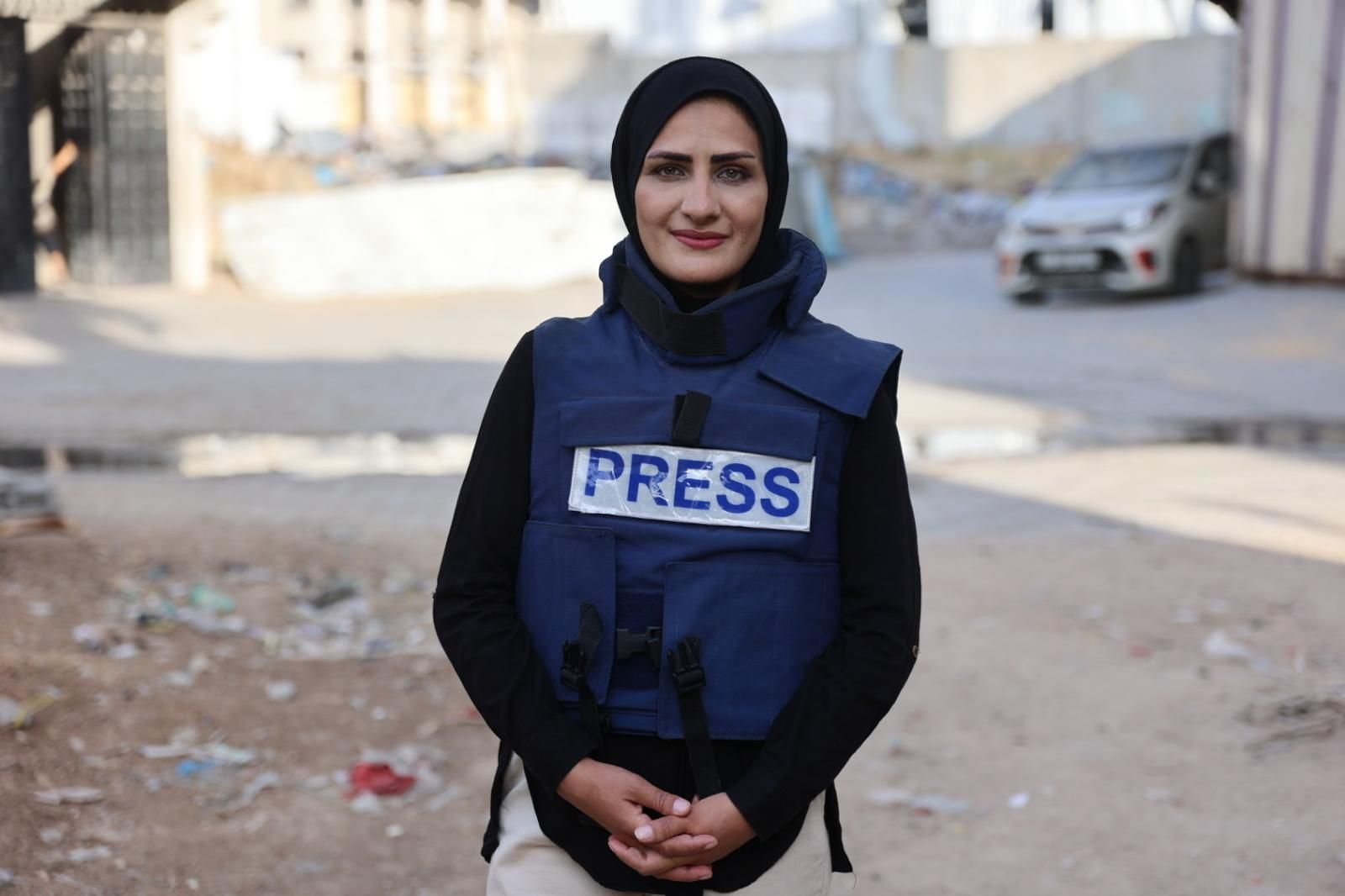
Journalist Ansam al-Qatta’ – Source: social media.

A global campaign to protect journalists: is this enough?

In response, Reporters Without Borders (RSF) and the Avaaz international movement launched a global campaign at the end of August to denounce Israeli attacks on the press in Gaza.

Their warning is clear: “At the rate journalists are being killed in Gaza by the Israeli army, there will soon be no one left to keep you informed.”

The campaign denounces the destruction of homes and offices, the persecution of people even inside hospitals, and the prevention of the wounded from receiving treatment. It calls for an end to impunity and for the protection of journalists in war zones.

“Sometimes, we become the news”

Amid the ruins, freelance photojournalist Yaacoub Salameh, 33, continues his work despite the fear. He has been working with several Arab and international agencies since the beginning of the war. “The risks are increasing every day. I’m not only afraid for myself but for my family and friends. We’ve seen colleagues cover the bombings, only to discover that their loved ones were among the victims. And sometimes it’s the other way around: the families of journalists learn that their son or daughter has become the news.”

Every day is a struggle for survival

“Every moment could be my last. It could have been me instead of my colleagues who were killed. We live in a state of constant suspense: who will survive? Who will die? The occupation wants to destroy the Palestinian narrative by silencing its witnesses.”
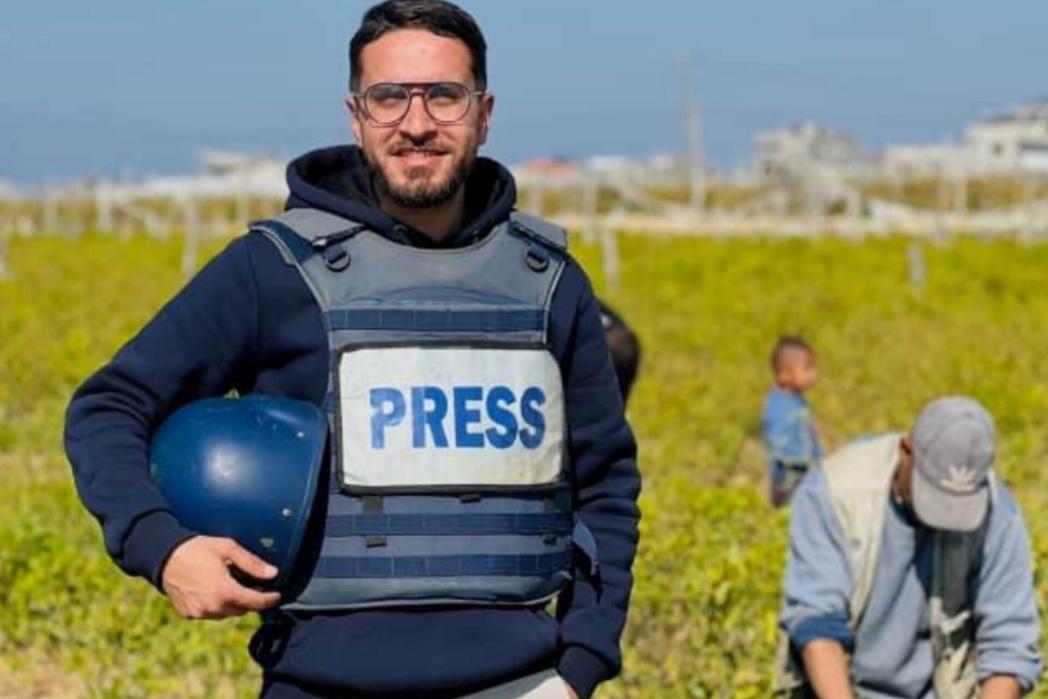
Photojournalist Yaacoub Salameh – Source: social media.

August was the most difficult month for journalists in Gaza. “We are not protected by our agencies, not by international unions, not even by the law. I’ve lost friends like Moaz Abu Taha and Maryam Abu Daqqa. Their absence is painful, both humanly and professionally,” he adds. “If this continues, there will soon be no journalists left alive in Gaza. I hope that support for journalists will continue and not remain so ad hoc.”

Between work and motherhood

For Ruba al-Ajrami, a correspondent for the Turkish channel TRT, covering the war has become both a vocation and a destiny. Since October 7, 2023, she has been working nonstop, as of 9 AM every morning, despite the risks and massacres targeting media professionals.

The occupation wants to destroy the Palestinian narrative by silencing its witnesses.

A mother of four, she reveals an even harsher reality. “My baby was three months old when I decided to start covering the events. My daughter is now two years and two months old: she has grown up in this war. I should have spent more time with her, but my commitment kept me from that.”
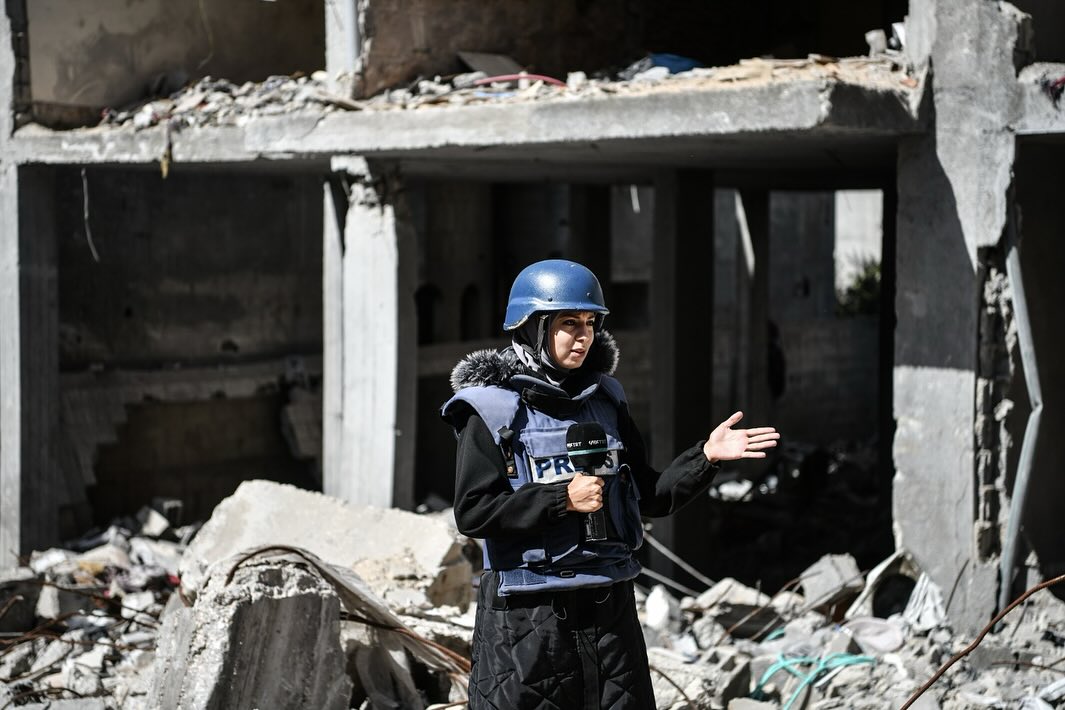
Journalist Ruba al-Ajrami – Source: social media.

She describes this heartbreak. “Being in a dangerous zone while my children are elsewhere in another dangerous zone is unbearable. They cry every time a colleague is targeted. Especially after Maryam was killed, our colleague, mother of one. She worked with us in the south. They’re afraid for me, and I don’t always know how to reassure them.”

Ruba confesses her doubts. “Every time a journalist is targeted, I wonder if I should quit to stay with my children. I often tell myself that I don’t belong only to myself, but to them, too. The world is deaf to the extermination of civilians and the targeting of the press.”

“If this were Ukraine…”

For Sami Abu Salem, Palestinian journalist and International Federation of Journalists (IFJ) Safety Trainer, these killings constitute war crimes: “Journalists are identifiable civilians, known by their profession, and they were deliberately targeted by two successive strikes seven minutes apart.”

“The focus is on Israel, not Palestine,” he laments. “And that illustrates the global injustice against Palestinians in Gaza. Even when journalists are killed, the attention given to them is far less than the scale the tragedy warrants.”

He reminds us of the toll—“In a single day, on August 25, five journalists were killed. On that same day, journalist Hassan Dahhan was killed, then other colleagues were targeted while they were sleeping in their homes. And just two weeks before, Israel killed six journalists.”

Abu Salem emphasizes the devastating effect of these losses on the international visibility of what is happening in Gaza. “In just one month, 22 journalists were killed—a catastrophic figure, exceeding the number of journalists killed during the six years of World War II. This has prompted international organizations to launch campaigns in support of journalists in Gaza—though these initiatives are coming a bit late.”

“Our eyes are not blue, and our skin is not white,” he asserts. “If this were Ukraine, would the global reaction be the same? No way. This illustrates the profound injustice suffered by Palestinian journalists and, beyond that, the Palestinian cause, in an international system that is biased toward Israel and lacks any real countervailing power.”

Contributor with Medfeminiswiya

Contributor with Medfeminiswiya

Share your content with us- Partagez vos contenus avec nous- ِشاركونا المواد الخاصة بكم/ن. راسلونا: info@medfeminiswiya.net

Related posts

Art as a Tool in the Fight Against Patriarchal Values
On the move

Art as a Tool in the Fight Against Patriarchal Values

by Katarina Vujović
20 September 2023
389

The Women’s Rights Center (WRC) is one of the most significant organizations in Montenegro devoted to the fight for a...

On everyday sexism: an interview with feminist philosopher Lorenzo Gasparrini (1/2)
On the move

On everyday sexism: an interview with feminist philosopher Lorenzo Gasparrini (1/2)

by Federica Araco
24 November 2022
378

Many abuses do not make it to the headlines because they leave no visible bruises, and yet, they affect the...

Marseille. Zone d’Occupation Féministe (ZOF) : « Ne me libère pas, je m’en charge »

Marseille. Zone d’Occupation Féministe (ZOF) : « Ne me libère pas, je m’en charge »

15 March 2024
329
And what if women managed money?  An interview with Giovanna Badalassi.

And what if women managed money? An interview with Giovanna Badalassi.

2 May 2022
261

Leave a Reply Cancel reply

Your email address will not be published. Required fields are marked *

J'accepte les termes et conditions et la Politique de confidentialité .

Medfeminiswiya

Medfeminiswiya is a feminist network that brings together women journalists working in the fields of media and content production in the Mediterranean region.

Newsletter


    Follow us

    Browse topics


    • In-depth
    • Files
    • Features
    • On the move
    • Portraits
    • Opinion

    • Creations
    • Visual Arts
    • Reviews
    • Multimedia
    • Country Context
    • Blogs
    • About us
    • Our community
    • Our partners
    • Become a member
    • Editorial charter
    • Disclaimer

    © 2025 Medfeminiswiya - Mediterranean Network for Feminist Information

    • it VO
    • fr Français
    • en English
    • ar العربية
    • In-depth
    • On the move
    • Portraits
    • Creations
    • Opinion
    • Multimedia
    • Country context
    • Blogs
    No Result
    View All Result

    © 2025 Medfeminiswiya - Mediterranean Network for Feminist Information

    Welcome Back!

    Login to your account below

    Forgotten Password?

    Retrieve your password

    Please enter your username or email address to reset your password.

    Log In

    Add New Playlist

    Ce site n'utilise pas de cookies. This website does not use cookies. هذا الموقع لا يستخدم ملفات تعريف الارتباط.