Cette publication est également disponible en :
Photo by Nawaat.
For the fifth consecutive year, the independent Tunisian website Nawaat held its festival on September 26, 27, and 28 at its headquarters in Tunis.
Between concerts, an exhibition paying tribute to the martyrs of the Palestinian press, multimedia installations, theater, and dance, the large and now loyal audience spent three days exploring spaces offering intriguing, challenging, and disturbing artistic forms.
This year, the productions selected for the Innawation section are by three women: Wissal Labidi, actress and theater producer, Oumaima Bahri, dancer, and Yafa Saidi, creator of an immersive chemical-artistic performance.
“La Malédiction (1)”, or Ain Houta, is a theatrical trilogy. A punk-rock performance full of energy and rage, unfolding over three chapters, presented by Wissal Labidi starting September 26. Forty-five minutes of virulent speech that revisits the mechanisms of male domination, set in a dreamlike universe and masterfully staged from start to finish.
“An avant-garde feminist manifesto”
“La Malédiction (1)” is first and foremost a polyphonic text. The play combines excerpts from a Tunisian Arabic adaptation of Virginie Despentes’ King Kong Theory with the voices of Tunisian women who have been victims of gender-based violence and the narration of a news story of unprecedented brutality.
“The initial inspiration for this show came to me when I encountered the avant-garde feminist manifesto King Kong Theory, published in 2006, 11 years before the #MeToo revolution. Reading it changed my life, my whole worldview. After translating it into my native language during the lockdown, I asked myself: What am I going to do with this?”
Labidi then began testing selected excerpts from her translation on her friends and later in private public spaces, restaurants, and cafes.
To her great surprise, her female audience instantly resonated and identified with the anger she displays on stage. Many women come up to her after her readings to share their own stories.
“When I started collecting these testimonies, I thought I could connect these sometimes unbearable experiences to excerpts from Despentes’ book and weave them into the text of the play,” Labidi recalls.
This Is Not My Text
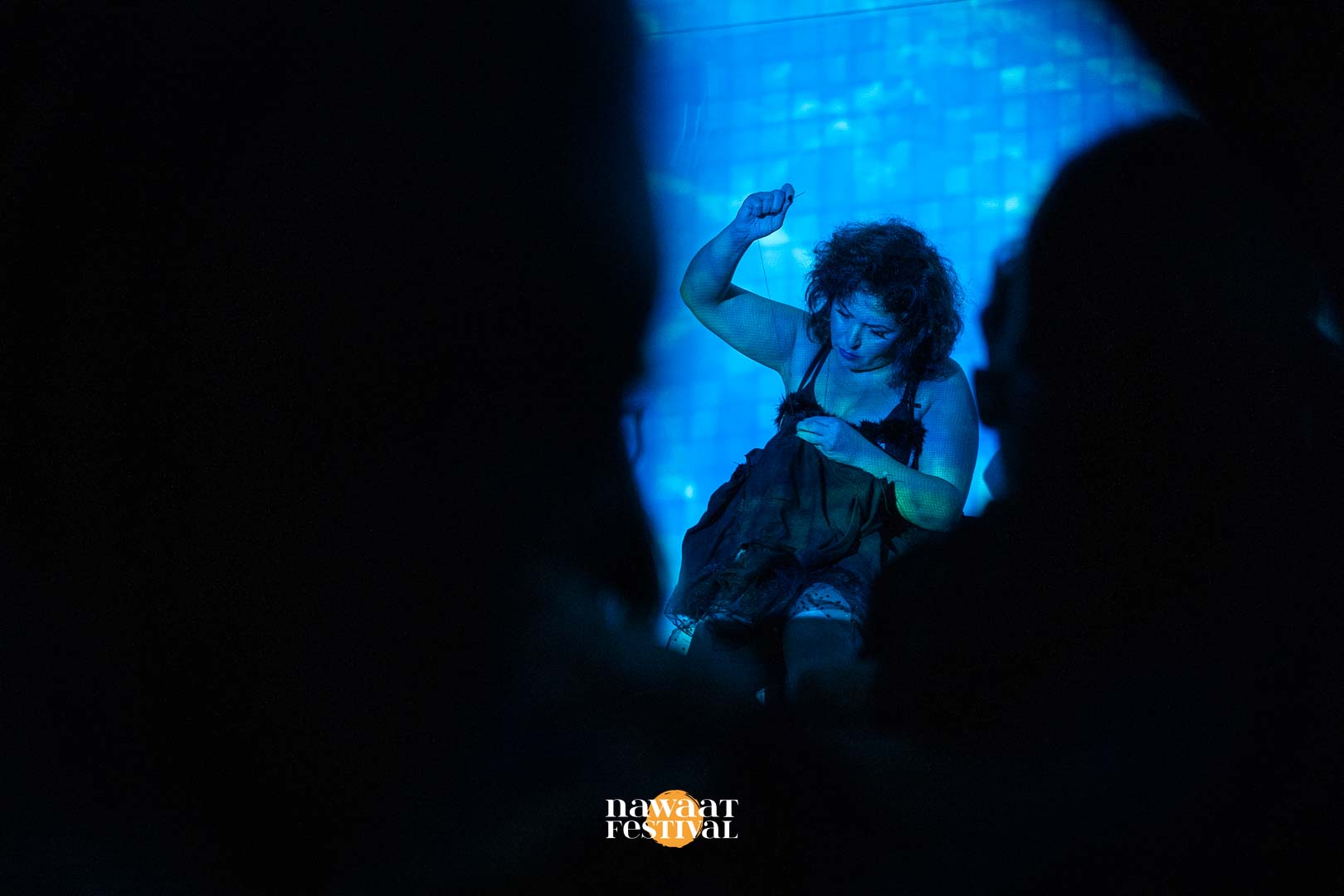
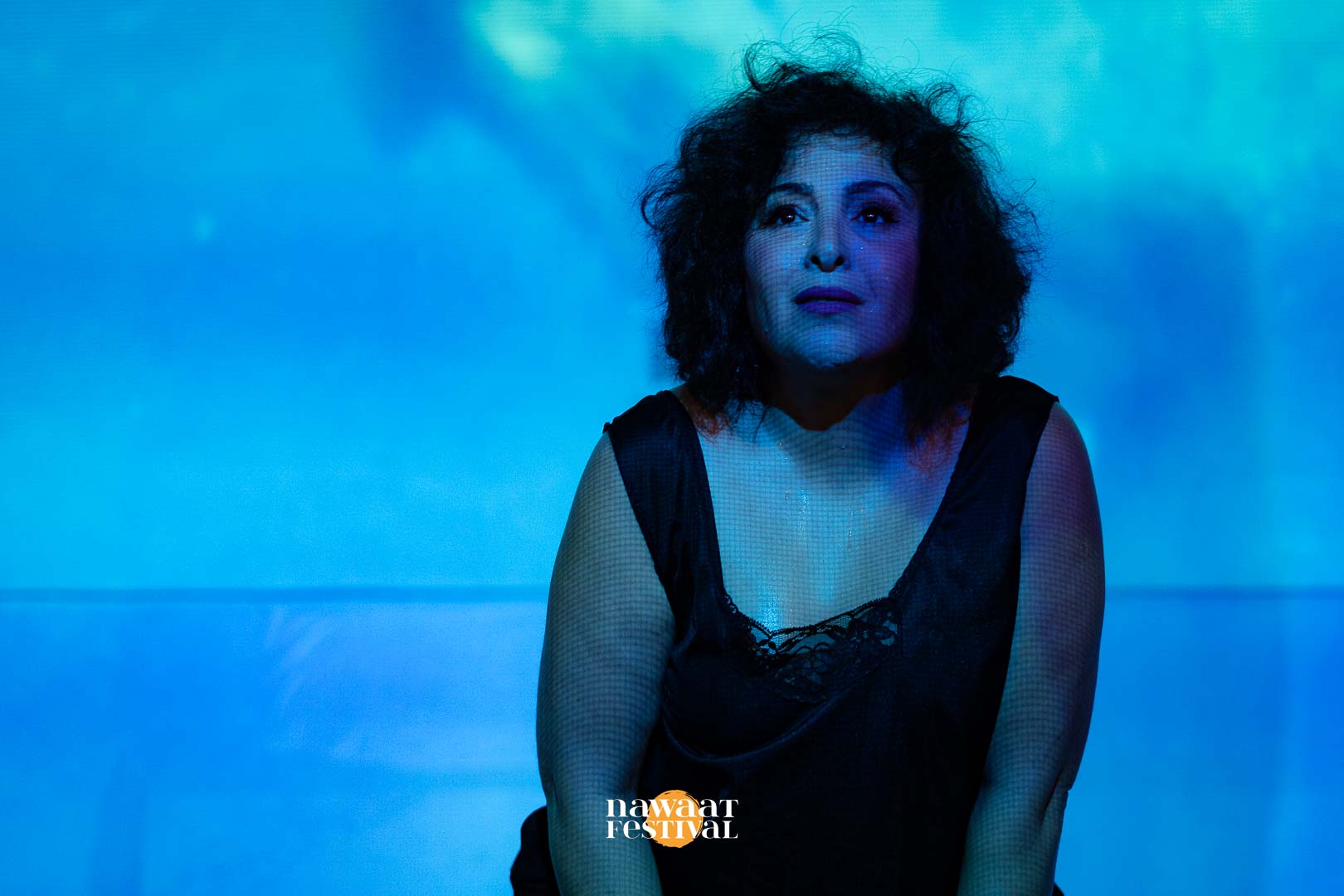
The room hosting “La Malédiction (1)” at the Nawaat Festival is small, with a capacity of just 25 people. On the afternoon of September 26, 2025, every seat was taken. Labidi, standing on a black cylinder and moving like a mechanical doll, dressed in all black, fully embodied the punk aesthetic—very 1980s. The 80s were the era of Virginie Despentes’ youth, a tragic time for the French writer who was raped at the age of 17 while hitchhiking with a friend.
From the outset, Labidi sets the tone with a narrative told in the first-person singular: “As a woman, I’m more King Kong than Kate Moss. I’m the kind of woman you don’t marry, the kind you don’t have children with. I’m talking about my place as a woman who’s always too much of everything she is: too aggressive, too loud, too fat, too brutal, too hairy, too masculine, or so I’m told.”
The actress’s words are rooted in the transgressive language of the street. A shock that smacks the audience right in the face.
In “La Malédiction (1)”, men, like women, are victims of gender stereotypes. Labidi asserts, “There are men who hate fighting, who cry, are shy, vulnerable, sensitive, who like to clean and take care of children…”
Labidi titles this first chapter This Is Not My Text. But the performer says it straight away in the opening sentence: “I too have been humiliated and beaten and had my arm broken in a conflictual intimate relationship.” The autobiographical elements of the Tunisian woman’s story, combined with the French woman’s life experience, demonstrate the extent to which the subject of violence against women unites all women around the world. Like a mise en abyme, the video of a disturbing swimming pool serves as a backdrop for the performer. A metaphor for all the efforts made by women, here and elsewhere, to safeguard achievements that could be lost at any moment. So they row against the current…
The autobiographical elements of the Tunisian woman’s story, combined with the French woman’s life experience, demonstrate the extent to which the subject of violence against women unites all women around the world.
“Rape is civil war”
Rape emerges in the second chapter of “La Malédiction (1)”, entitled We Don’t Rape This Woman Full of Vices.
Rape, writes Despentes and chants Labidi, “is civil war, the political organization through which one sex declares to the other: ‘I take all rights over you, I force you to feel inferior, guilty, and degraded.’”
In this part of her performance, Labidi also shares testimonies she has collected after her public readings. Women have come up to her and confided in her about repeated marital rape, stories of incest, control, violence in the street, at work… here, the intimate becomes more public and political than ever.
“I’m not qualified to advise these women. What I offer them is an empathetic and friendly ear. My role is to document these stories. The artistic movement I adhere to is called ‘documentary theater,’ which is very close to reality,” the artist says.
“I’ll explore other feminist writings”
The last part, The Return of Oedipus, recounts a macabre incident heard on Tunisian radio: a man crushed his wife with his full weight, immobilized her, hit her on the head, and gouged her eyes out with a fork. The screen behind the actress was covered with a multitude of eyes, and her continuous repetition of this story was an attempt to imprint it on our memories. “We must never again trivialize femicides and other tragedies experienced by women within the walls of their homes,” she seemed to be telling us.
When the actress finally went quiet and the show ended in reverent silence, the audience erupted in a standing ovation. Two or three female spectators, their eyes red, blew their noses. Men and women alike were transported by the text and its embodied interpretation. Emotions ran high. The shock was palpable.
Labidi has already thought up the sequel to “La Malédiction (1)”. The same format and the same themes—namely, the status of women in a patriarchal society and the dictates of the feminine ideal—will be adopted in parts Two and Three of the trilogy.
“I’ll explore other feminist writings as radical as King Kong Theory!” she promises with a smile.