Cette publication est également disponible en :
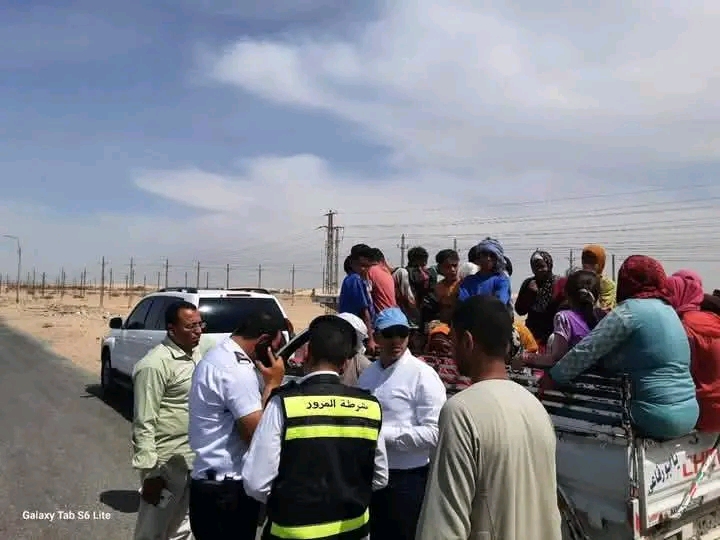
At the end of this past June, Egypt woke up to the news of the tragic death of 18 young women from Kafr El-Sanabseh, a village in the Menoufia Governorate. They died in an accident on the regional ring road while making their way to work at a grape export station. All under 23 years old, these female agricultural workers had set out at sunrise to earn a daily wage of no more than 130 Egyptian pounds (less than three dollars) using unsafe means of transportation. This tragedy exposed the precarious conditions of female agricultural workers, whose lives always seem to be the cheapest—a reality echoing through the aftermath of each of the women’s funerals.
Verbal harassment and low wages
This doesn’t only concern the women of Menoufia who died trying to earn a living wage. Women in other Egyptian villages also face a similar fate, albeit with different details. In Minya, for example, 29-year-old Marwa Mahmoud lives with her four children. Marwa married young, and her husband later abandoned her, forcing her to support their children on her own. She works in the fields under the blazing sun, carrying her baby on her back, for a wage of less than 100 EGP per day—about two dollars.
Hard work isn’t the only challenge that Marwa faces. She also has to endure constant verbal harassment from the agricultural contractor, who has threatened to fire her if she objects. “Every day, he insults me,” she tells Medfeminiswiya, “but I can’t do anything about it. And it’s the same for all the other women who work there.”
Marwa’s story is no exception; she is one of hundreds of women in the villages of Minya who face similar conditions. The suffering also extends north to the Beni Suef Governorate, where Wafaa Saber, a 43-year-old housewife, endures difficult living conditions. At 4:00 AM, she and other women squeeze themselves on to a trosikl, a motorized cargo tricycle, which bumps its way to the field where they work under a scorching sun in temperatures that sometimes exceed 40 degrees Celsius. Wafaa takes her two sons along with her to help harvest the crop, and they are paid the wages of “half a laborer” because of their young age. Every day, she travels from one field to the next, yet her wages do not exceed two dollars a day. “When I come back home, my back hurts from being in the field all day. One needs to make a living,” she says.
Some women choose to work in agriculture from inside their homes, to escape the sun and the risk of harassment. But they still face different challenges. During the hot pepper harvest season, Umm Shahd works with her three children all day, picking and collecting three large bags for just 90 EGP, less than two dollars. During the onion season, she peels a large bag for 40 EGP—less than one dollar. It’s a job that takes up an entire day and leaves a pungent odor on her skin and in her home. “Peeling onions is the worst of the things I do. It makes me and the house smell unpleasant. But life is hard. And I can’t go work in the fields,” Umm Shahd says.
According to the International Labour Organization (ILO), 16.8% of the total number of working women in Egypt in 2023 were working in the agricultural sector.
According to the 2025 Global Gender Gap Report, women’s average income is no more than 18.4% that of men.

Three women for one man’s pay
In the village of Jardou, in the Itsa district of the Fayoum Governorate, Ramadan Abdel Azim runs a warehouse that stores dried mloukhiye, or mallow. Dozens of local women work there, from 8 AM to 4 PM, for a daily wage of 70 EGP (approximately 1.44 dollars). The women sit in groups to pick the mallow leaves before drying them, while others handle the packing and packaging, a grueling work cycle. Ramadan prefers to employ women rather than men. “Women accept lower wages,” he says, “but men won’t work for less than 250 Egyptian pounds, or about $5. With one man’s wage, I can employ three women who produce three times the output of a man.”
According to the 2025 Global Gender Gap Report, women’s average income is no more than 18.4% that of men, and Egypt ranks 145th out of 148 countries in women’s expected earned income—one of the worst rankings globally.
These figures are consistent with data from the Central Agency for Public Mobilization and Statistics for 2023, which indicates that the average monthly wage for men is 5,128 EGP, compared to 4,439 EGP for women—a difference of approximately 13.4% in favor of men.
No legal protection for women working in agriculture
Despite the issuance of Labor Law No. 14 of 2025 which stipulates a minimum wage, insurance protection, and gender equality, these rights are just ink on paper for daily and seasonal women workers who work without formal contracts or a fixed system.
The Menoufia tragedy is not the first of its kind. Over the past four years, a series of similarly tragic accidents have befallen female agricultural workers in Egypt. In August 2022, a grape greenhouse in Minya collapsed, injuring 21 female workers between the ages of 12 and 45. Just three months later, a pickup truck overturned near Samalut in the same governorate, killing one woman and injuring more than 14 others. In December 2023, a similar incident occurred in Mallawi, southern Egypt, where six female workers were injured while heading to the field. But the most serious accident was the disaster of May 2024, when the Nile River swallowed 17 girl workers when the boat they were traveling on sank. This embodied the extent of the disregard for the lives of rural girls seeking a livelihood.
The lawyer Ahmed Tony al-Kayyal tells Medfeminiswiya that the seasonal nature of agricultural work and farmers’ lack of need for a permanent labor force pushes landowners to avoid formal contracts, depriving working women of any legal or social protection during their employment.
Azza Soliman, a human rights activist and director of the Center for Egyptian Women’s Legal Assistance (CEWLA), describes this reality as a “stream of useless laws,” noting that the laws are issued without any real understanding of the conditions under which women in agriculture work—most of whom are unable to join the Small Farmers Union because they are unable to pay the monthly insurance contributions.