• it VO
  • fr Français
  • en English
  • ar العربية
About us
  • In-depth
    • All
    • Features
    • Files
    • World
    Morocco: 600 abortions a day—Alarming figures and tragic stories

    Morocco: 600 abortions a day—Alarming figures and tragic stories

    In Spain, the right to abortion is not guaranteed for all

    In Spain, the right to abortion is not guaranteed for all

    Invisible and vulnerable: Migrant women at the frontlines of Spain’s prostitution debate

    Invisible and vulnerable: Migrant women at the frontlines of Spain’s prostitution debate

    Serbia: Is contraception a luxury or a basic human right?

    Serbia: Is contraception a luxury or a basic human right?

    Rebels, witnesses, victims: Women against the mafia (3/3)

    Rebels, witnesses, victims: Women against the mafia (3/3)

    Trending Tags

    • Women artists
    • Ecofeminism
    • Women living from and on the streets
    • Women and bodies
    • Women and sports
    • Women and cinema
    • Ramadan series
    • Women and war
    • Women Living at the Margins
    • Press Freedom from the Perspective of Women Journalists
    • Period poverty
    • Gynecological violence
    • Women and prison
    • Safe spaces
    • Abortion and SRHR
    • Transgenderism
    • Women in rural areas
  • On the move
    Spain: CEAR and the fight against human trafficking

    Spain: CEAR and the fight against human trafficking

    Gaza: How many journalists must be killed for the world to react?

    Gaza: How many journalists must be killed for the world to react?

    Moroccan activist Ibtissam Lachgar held in solitary confinement, health in crisis

    Moroccan activist Ibtissam Lachgar held in solitary confinement, health in crisis

    Three women for one man’s pay: The plight of female agricultural workers in Egypt

    Three women for one man’s pay: The plight of female agricultural workers in Egypt

  • Portraits
    Sophie Bessis: “The battle for the intimate will be long, especially in the Global South!”

    Sophie Bessis: “The battle for the intimate will be long, especially in the Global South!”

    “Mom, Dad, Can We Talk About Privacy?”—A Tunisian children’s book on protecting kids from sexual violence

    “Mom, Dad, Can We Talk About Privacy?”—A Tunisian children’s book on protecting kids from sexual violence

    Kurdish journalist killed in Turkish drone strike in northeastern Syria

    Kurdish journalist killed in Turkish drone strike in northeastern Syria

    A Filmmaker’s Journey: Inside the Creative World of Margarita Bareikyte

    A Filmmaker’s Journey: Inside the Creative World of Margarita Bareikyte

  • Creations
    • All
    • Reviews
    • Visual Arts
    “La Malédiction (1)”, a theatrical adaptation of King Kong Theory bursting with Tunisian rage

    “La Malédiction (1)”, a theatrical adaptation of King Kong Theory bursting with Tunisian rage

    “Mom, Dad, Can We Talk About Privacy?”—A Tunisian children’s book on protecting kids from sexual violence

    “Mom, Dad, Can We Talk About Privacy?”—A Tunisian children’s book on protecting kids from sexual violence

    The El’Sardines series, a delicate feminist manifesto centered around an ecological mystery

    The El’Sardines series, a delicate feminist manifesto centered around an ecological mystery

    Atlantics, a film by Mati Diop: Filming the embodied resistance of spirits

    Atlantics, a film by Mati Diop: Filming the embodied resistance of spirits

  • Opinion
    Women in Gaza are living their worst nightmares - “ I want to go back to my life before the war, to my privacy, my home ”

    Women in Gaza are living their worst nightmares - “ I want to go back to my life before the war, to my privacy, my home ”

    Messages from life under bombardment—Can a mother cope with losing her six children at once? (10)

    Messages from life under bombardment—Can a mother cope with losing her six children at once? (10)

    Messages from life under bombardment—No cake for my children on their birthdays (9)

    Messages from life under bombardment—No cake for my children on their birthdays (9)

    Messages from life under bombardment – No food or water in Gaza (8)

    Messages from life under bombardment – No food or water in Gaza (8)

  • Multimedia
    "I hope it doesn’t go viral: Journalism and sexist attacks in digital age". A video investigation by Çiçek Tahaoğlu

    "I hope it doesn’t go viral: Journalism and sexist attacks in digital age". A video investigation by Çiçek Tahaoğlu

    Period poverty in Montenegro

    Period poverty in Montenegro

    Period poverty in France (1)

    Period poverty in France (1)

    Period Poverty in Italy

    Period Poverty in Italy

  • Country context
No Result
View All Result
BLOGS
Medfeminiswiya
  • In-depth
    • All
    • Features
    • Files
    • World
    Morocco: 600 abortions a day—Alarming figures and tragic stories

    Morocco: 600 abortions a day—Alarming figures and tragic stories

    In Spain, the right to abortion is not guaranteed for all

    In Spain, the right to abortion is not guaranteed for all

    Invisible and vulnerable: Migrant women at the frontlines of Spain’s prostitution debate

    Invisible and vulnerable: Migrant women at the frontlines of Spain’s prostitution debate

    Serbia: Is contraception a luxury or a basic human right?

    Serbia: Is contraception a luxury or a basic human right?

    Rebels, witnesses, victims: Women against the mafia (3/3)

    Rebels, witnesses, victims: Women against the mafia (3/3)

    Trending Tags

    • Women artists
    • Ecofeminism
    • Women living from and on the streets
    • Women and bodies
    • Women and sports
    • Women and cinema
    • Ramadan series
    • Women and war
    • Women Living at the Margins
    • Press Freedom from the Perspective of Women Journalists
    • Period poverty
    • Gynecological violence
    • Women and prison
    • Safe spaces
    • Abortion and SRHR
    • Transgenderism
    • Women in rural areas
  • On the move
    Spain: CEAR and the fight against human trafficking

    Spain: CEAR and the fight against human trafficking

    Gaza: How many journalists must be killed for the world to react?

    Gaza: How many journalists must be killed for the world to react?

    Moroccan activist Ibtissam Lachgar held in solitary confinement, health in crisis

    Moroccan activist Ibtissam Lachgar held in solitary confinement, health in crisis

    Three women for one man’s pay: The plight of female agricultural workers in Egypt

    Three women for one man’s pay: The plight of female agricultural workers in Egypt

  • Portraits
    Sophie Bessis: “The battle for the intimate will be long, especially in the Global South!”

    Sophie Bessis: “The battle for the intimate will be long, especially in the Global South!”

    “Mom, Dad, Can We Talk About Privacy?”—A Tunisian children’s book on protecting kids from sexual violence

    “Mom, Dad, Can We Talk About Privacy?”—A Tunisian children’s book on protecting kids from sexual violence

    Kurdish journalist killed in Turkish drone strike in northeastern Syria

    Kurdish journalist killed in Turkish drone strike in northeastern Syria

    A Filmmaker’s Journey: Inside the Creative World of Margarita Bareikyte

    A Filmmaker’s Journey: Inside the Creative World of Margarita Bareikyte

  • Creations
    • All
    • Reviews
    • Visual Arts
    “La Malédiction (1)”, a theatrical adaptation of King Kong Theory bursting with Tunisian rage

    “La Malédiction (1)”, a theatrical adaptation of King Kong Theory bursting with Tunisian rage

    “Mom, Dad, Can We Talk About Privacy?”—A Tunisian children’s book on protecting kids from sexual violence

    “Mom, Dad, Can We Talk About Privacy?”—A Tunisian children’s book on protecting kids from sexual violence

    The El’Sardines series, a delicate feminist manifesto centered around an ecological mystery

    The El’Sardines series, a delicate feminist manifesto centered around an ecological mystery

    Atlantics, a film by Mati Diop: Filming the embodied resistance of spirits

    Atlantics, a film by Mati Diop: Filming the embodied resistance of spirits

  • Opinion
    Women in Gaza are living their worst nightmares - “ I want to go back to my life before the war, to my privacy, my home ”

    Women in Gaza are living their worst nightmares - “ I want to go back to my life before the war, to my privacy, my home ”

    Messages from life under bombardment—Can a mother cope with losing her six children at once? (10)

    Messages from life under bombardment—Can a mother cope with losing her six children at once? (10)

    Messages from life under bombardment—No cake for my children on their birthdays (9)

    Messages from life under bombardment—No cake for my children on their birthdays (9)

    Messages from life under bombardment – No food or water in Gaza (8)

    Messages from life under bombardment – No food or water in Gaza (8)

  • Multimedia
    "I hope it doesn’t go viral: Journalism and sexist attacks in digital age". A video investigation by Çiçek Tahaoğlu

    "I hope it doesn’t go viral: Journalism and sexist attacks in digital age". A video investigation by Çiçek Tahaoğlu

    Period poverty in Montenegro

    Period poverty in Montenegro

    Period poverty in France (1)

    Period poverty in France (1)

    Period Poverty in Italy

    Period Poverty in Italy

  • Country context
About us
Medfeminiswiya
About us

Greece and the problems of altruistic surrogacy 2/3

Across Europe, the surrogacy industry is made up of an extensive network of mediation agencies, law firms, fertility clinics, and surrogacy centers operating in close coordination. This three-part series focus on Athens and Thessaloniki in Greece. Behind the legal façade of the surrogacy network, there lies a system thriving on inequality and blurred ethics. Follow the rest of the series for further reading on the research conducted in Spain.

Contributor with Medfeminiswiya by Contributor with Medfeminiswiya
10 July 2025
in Features
78 5
0
Share on FacebookShare on Twitter

This post is also available in: Français (French) العربية (Arabic)

Cover image: Athens Street.  Álvaro Minguito
Queralt Castillo

Despite being legally framed as an altruistic practice, surrogacy procedures in Greece reveal a reality where economic necessity, weak oversight, and international pressure intersect. Foreign couples—mostly from wealthier nations—come to a country where surrogate women, often migrants from Eastern Europe, receive minimal protection and limited support. Though the Greek legal system imposes strict conditions, recent scandals and rising demand suggest that what is marketed as “altruistic” surrogacy may in fact operate much closer to a commercial model.

In the Hellenic country, altruistic surrogacy—surrogacy for which the surrogate mother is not directly compensated—has been legal since 2002 for heterosexual couples residing in the country, and since 2014 for foreign couples—provided there is judicial approval. In 2022, 81 babies were born via this procedure; in 2023, the number dropped to 51.

Chania, Crete. It is August 8th, 2023. While wildfires rage through two of Greece’s most popular islands—Rhodes and Corfu—forcing the evacuation of thousands of tourists by land, sea, and air, another storm is brewing behind the scenes. In the early hours, Crete’s Organized Crime Department, in coordination with other law enforcement bodies, raids the Mediterranean Fertility Center, one of the country’s most prestigious assisted reproduction clinics.

Simultaneously, police search several private residences, discovering nearly 200 pregnant women—most of them foreigners—involved in ongoing surrogacy arrangements. The country is shaken by the magnitude of what appears to be a large-scale operation of human exploitation in the heart of Europe.

Nearly two years later, with legal proceedings still underway, the full extent of the scandal is emerging: embryos created for different couples using identical genetic material, illegal adoptions, trafficking of women, theft and sale of genetic material, fraudulent embryo transfers, falsified documentation, and irregularities in cryopreservation protocols. According to Greek authorities, the network exploited vulnerable women as both egg donors and surrogate mothers, and allegedly defrauded commissioning couples as well. By December 2022, nearly 200 cases of female exploitation had been identified—71 as egg donors, 98 as gestational carriers.

“We already knew”

While the Greek public was stunned by the revelation of a baby trafficking ring operating openly within its borders, not everyone was surprised. Among them was Katerina Fountedaki, Professor of Civil Law at Aristotle University of Thessaloniki and former vice president of EAIYA, the Greek National Authority for Assisted Reproduction.

“We already knew,” she says. Back in 2019, Fountedaki and her team had ordered a temporary shutdown of the Mediterranean Fertility Center after detecting major irregularities. “We submitted a report and revoked the clinic’s license,” she explains.

What followed is now under investigation: Greece’s Health Minister replaced the leadership of EAIYA, and the newly appointed officials ignored the decision, allowing the clinic to continue operating.

Publicity image of the Mediterranean Fertility Center, the clinic closed for alleged trafficking of women and babies, among other serious crimes. Social networks

The Mediterranean Fertility Center case is not the first scandal to hit Greece’s surrogacy industry—but it is the most glaring evidence yet of the loopholes and abuses the current system allows.

The country is shaken by the magnitude of what appears to be a large-scale operation of human exploitation in the heart of Europe.

Lack of transparency

Despite several legal amendments over the years, the core framework of surrogacy procedures in Greece remains unchanged: only heterosexual couples and women can access surrogacy after a court confirms the intended mother is medically unable to carry a pregnancy. Yet opacity persists in key areas—particularly in surrogate compensations and recruitment procedures.

One of the most common irregularities involves under-the-table payments exceeding legal limits. Until 2022, compensation was capped at €10,000, defined as “reasonable expenses” covering IVF treatment, pregnancy, childbirth, and postpartum care. Recent legal reforms raised these limits to €20,000 for a single pregnancy and €25,000 for twins. Still, off-the-record sources claim some surrogates receive as much as €50,000.

“When we created EAIYA, we established an indicative pricing list. We started hearing rumors about private deals between intended parents and surrogates. That likely happened. There are certainly gray areas that need to be addressed,” says Bassil Tarlatzis, IVF pioneer in Greece and president of the Scientific Council at FIVI Fertility & IVF Center in Thessaloniki.

Tarlatzis, who launched Greece’s first IVF unit, served on numerous Ministry of Health committees and helped draft the 2002 surrogacy law and its amendments. In 2005, he became one of EAIYA’s founding members and served as vice president.
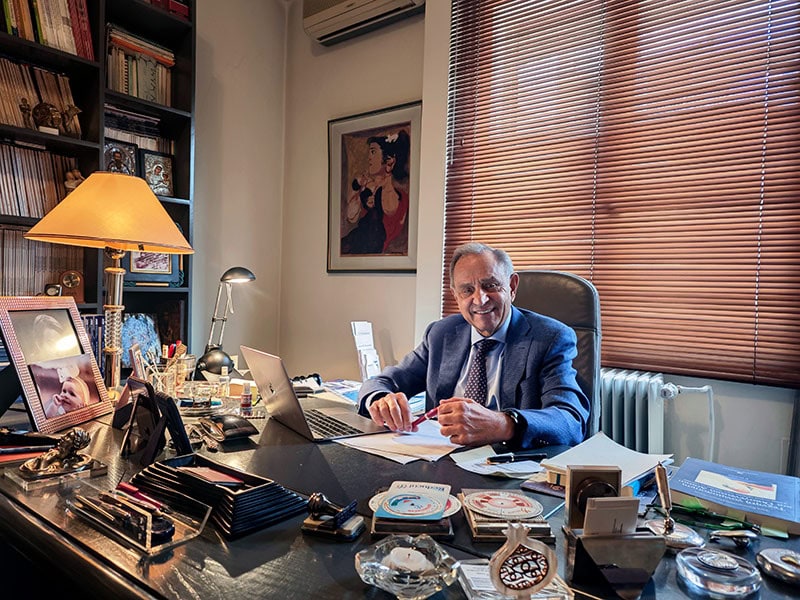
Bassil Tarlatzis, pioneer of medically assisted reproduction in Greece. Queralt Castillo Cerezuela

Also, the recruitment of surrogate mothers remains murky. The Greek law forbids intermediary agencies, and clinics are not allowed to act as matchmakers. Nor can women publicly advertise their services as surrogates. So how do clinics and couples find one another?

“While we do assist patients who wish to pursue surrogacy, we have a specific policy in place. We require that couples who seek surrogacy must bring their own surrogate mother. We do not facilitate the process of finding or matching surrogates. Our role is limited to providing IVF services once a suitable surrogate has been identified by the intended parents,” states the communications director at Embryolab Fertility Clinic, one of the only two clinics—along with FIVI—that agreed to be interviewed for this report.

This contrasts with the discourse from Eirini Dimou, CEO of Embryo Consultants, a company created in the wake of the Chania scandal. “If you want to be a surrogate, you go to a clinic and apply,” she says. This implies clinics themselves may supposedly be acting as matchmakers—despite the legal ban.

There is little public information about surrogate recruitment in Greece, and attempts to interview current or former surrogates have been unsuccessful. However, an academic study offers insight data.

In 2017, Pantelis Ravdas published “Surrogate Motherhood in Greece: Statistical Data Derived from Court Decisions” in the Bioethica journal. Based on the study of 281 court decisions approved between 2003 and 2007, the profiles of the commissioning couples and the surrogate mothers were analyzed.

Only 35% of the surrogates were Greek. The rest came primarily from Poland, Bulgaria, Georgia, Albania, and Romania—81.7% from Eastern Europe. Strikingly, 24% of surrogates had a working relationship with the intended parents, and 19% declined to answer. Many were domestic workers, manicurists, hairdressers, or office staff.

What happens when things go wrong?

Another legal blind spot concerns compensation for medical complications. “Most pregnancies go smoothly, but what happens if the surrogate develops gestational diabetes or placenta previa? Who covers the cost of neonatal care if the baby needs an incubator?” Tarlatzis warns.

“The €20,000 compensation covers a normal pregnancy,” Fountedaki adds. “If complications arise from malpractice, it’s investigated. But if it’s just a complication, the surrogate receives nothing extra. There’s no provision for that.”

Despite its mandate, EAIYA does not monitor surrogate compensation nor provides protections in case of medical complications. “Incidents like these you mentioned are not known to the Authority,” the Authority responded when asked.

In fact, EAIYA only reviews individual cases if requested by the surrogate. It does not track recruitment practices or gather data on surrogates’ backgrounds. No official statistics exist—only outdated academic studies.

The EAIYA also doesn't assess specific cases unless the surrogate mother requests it, nor does it monitor the recruitment of surrogate mothers or their profiles. There is no government data on the origin and socioeconomic status of these individuals.

In other words, the Agency focuses on paperwork: the licensing framework enforces primarily concerns about infrastructure, equipment, staff qualifications, and ISO certification. EAIYA does not have the mandate to audit clinic finances or investigate deeper irregularities.

Regarding the Chania case, EAIYA’s current leadership claims, “The present Authority has no information in its archives with regard to the reasons which were brought forward and as a result thereof the clinic continued its operation.” In response to the scandal, and to the revelation that Greece has no national register of donors or surrogates, EAIYA says it is working on one. As of this writing, the registry has not yet been implemented.

“Most pregnancies go smoothly, but what happens if the surrogate develops gestational diabetes or placenta previa? Who covers the cost of neonatal care if the baby needs an incubator?”

Greece and its surrogacy legal framework

Greece is one of the few European countries—along with Portugal, Cyprus, and the United Kingdom—where surrogacy is permitted, albeit only under altruistic terms. The procedure is regulated by Article 1458 of the Greek Civil Code and has been shaped by a series of legislative updates in 2002, 2005, 2014, and 2022.

Over the years, the legal framework has undergone several amendments. In 2014, the process was extended to include foreign couples. In 2022, the law was modified to increase the compensation for surrogate mothers and to raise the age limit for surrogate candidates to 54.

However, certain core restrictions remain intact: surrogacy is only available to heterosexual couples, judicial approval is mandatory, and intermediary agencies are prohibited. The intending parents must find a surrogate themselves.

Greek law stipulates that only women under the age of 50 who are part of heterosexual couples and are medically unable to carry a pregnancy can access this procedure. This includes women with Mayer-Rokitansky syndrome, congenital uterine malformations, fibroids, or other conditions that render pregnancy impossible or life-threatening.

The surrogate, who must be between the ages of 25 and 54 and cannot have undergone more than two cesarean deliveries, is not allowed to use her own eggs. If she is married, her husband's written consent is required. She is not listed on the child’s birth certificate, and the newborn automatically acquires the citizenship of the commissioning parents.

Click here for the next piece on Spain and the problems of altruistic surrogacy.
This report is part of the investigation into the surrogacy industry developed with funding from Journalismfund Europe and published in Spanish in lamarea.com.

Contributor with Medfeminiswiya

Contributor with Medfeminiswiya

Share your content with us- Partagez vos contenus avec nous- ِشاركونا المواد الخاصة بكم/ن. راسلونا: info@medfeminiswiya.net

Related posts

Croatia: Men Kneeling in Main Squares for Women’s Chastity
In-depth

Croatia: Men Kneeling in Main Squares for Women’s Chastity

by Snježana Pavić
25 September 2023
764

On the first Saturday of every month, groups of men kneel in the main squares of many cities across Croatia...

Single moms in Lebanon: We fight alone
Features

Single moms in Lebanon: We fight alone

by Maya El Ammar
8 June 2021
651

They call them ‘single moms’ usually because they are unmarried mothers. But they are also the mothers who have separated...

Tunisia: 10 years after 14 January 2011, women are still in Revolution

Tunisia: 10 years after 14 January 2011, women are still in Revolution

10 May 2021
562
The transnational network of the surrogacy industry 1/3

The transnational network of the surrogacy industry 1/3

10 July 2025
306

Leave a Reply Cancel reply

Your email address will not be published. Required fields are marked *

J'accepte les termes et conditions et la Politique de confidentialité .

Medfeminiswiya

Medfeminiswiya is a feminist network that brings together women journalists working in the fields of media and content production in the Mediterranean region.

Newsletter


    Follow us

    Browse topics


    • In-depth
    • Files
    • Features
    • On the move
    • Portraits
    • Opinion

    • Creations
    • Visual Arts
    • Reviews
    • Multimedia
    • Country Context
    • Blogs
    • About us
    • Our community
    • Our partners
    • Become a member
    • Editorial charter
    • Disclaimer

    © 2025 Medfeminiswiya - Mediterranean Network for Feminist Information

    • it VO
    • fr Français
    • en English
    • ar العربية
    • In-depth
    • On the move
    • Portraits
    • Creations
    • Opinion
    • Multimedia
    • Country context
    • Blogs
    No Result
    View All Result

    © 2025 Medfeminiswiya - Mediterranean Network for Feminist Information

    Welcome Back!

    Login to your account below

    Forgotten Password?

    Retrieve your password

    Please enter your username or email address to reset your password.

    Log In

    Add New Playlist

    Ce site n'utilise pas de cookies. This website does not use cookies. هذا الموقع لا يستخدم ملفات تعريف الارتباط.