• it VO
  • fr Français
  • en English
  • ar العربية
About us
  • In-depth
    • All
    • Features
    • Files
    • World
    Morocco: 600 abortions a day—Alarming figures and tragic stories

    Morocco: 600 abortions a day—Alarming figures and tragic stories

    In Spain, the right to abortion is not guaranteed for all

    In Spain, the right to abortion is not guaranteed for all

    Invisible and vulnerable: Migrant women at the frontlines of Spain’s prostitution debate

    Invisible and vulnerable: Migrant women at the frontlines of Spain’s prostitution debate

    Serbia: Is contraception a luxury or a basic human right?

    Serbia: Is contraception a luxury or a basic human right?

    Rebels, witnesses, victims: Women against the mafia (3/3)

    Rebels, witnesses, victims: Women against the mafia (3/3)

    Trending Tags

    • Women artists
    • Ecofeminism
    • Women living from and on the streets
    • Women and bodies
    • Women and sports
    • Women and cinema
    • Ramadan series
    • Women and war
    • Women Living at the Margins
    • Press Freedom from the Perspective of Women Journalists
    • Period poverty
    • Gynecological violence
    • Women and prison
    • Safe spaces
    • Abortion and SRHR
    • Transgenderism
    • Women in rural areas
  • On the move
    Spain: CEAR and the fight against human trafficking

    Spain: CEAR and the fight against human trafficking

    Gaza: How many journalists must be killed for the world to react?

    Gaza: How many journalists must be killed for the world to react?

    Moroccan activist Ibtissam Lachgar held in solitary confinement, health in crisis

    Moroccan activist Ibtissam Lachgar held in solitary confinement, health in crisis

    Three women for one man’s pay: The plight of female agricultural workers in Egypt

    Three women for one man’s pay: The plight of female agricultural workers in Egypt

  • Portraits
    Sophie Bessis: “The battle for the intimate will be long, especially in the Global South!”

    Sophie Bessis: “The battle for the intimate will be long, especially in the Global South!”

    “Mom, Dad, Can We Talk About Privacy?”—A Tunisian children’s book on protecting kids from sexual violence

    “Mom, Dad, Can We Talk About Privacy?”—A Tunisian children’s book on protecting kids from sexual violence

    Kurdish journalist killed in Turkish drone strike in northeastern Syria

    Kurdish journalist killed in Turkish drone strike in northeastern Syria

    A Filmmaker’s Journey: Inside the Creative World of Margarita Bareikyte

    A Filmmaker’s Journey: Inside the Creative World of Margarita Bareikyte

  • Creations
    • All
    • Reviews
    • Visual Arts
    “La Malédiction (1)”, a theatrical adaptation of King Kong Theory bursting with Tunisian rage

    “La Malédiction (1)”, a theatrical adaptation of King Kong Theory bursting with Tunisian rage

    “Mom, Dad, Can We Talk About Privacy?”—A Tunisian children’s book on protecting kids from sexual violence

    “Mom, Dad, Can We Talk About Privacy?”—A Tunisian children’s book on protecting kids from sexual violence

    The El’Sardines series, a delicate feminist manifesto centered around an ecological mystery

    The El’Sardines series, a delicate feminist manifesto centered around an ecological mystery

    Atlantics, a film by Mati Diop: Filming the embodied resistance of spirits

    Atlantics, a film by Mati Diop: Filming the embodied resistance of spirits

  • Opinion
    Women in Gaza are living their worst nightmares - “ I want to go back to my life before the war, to my privacy, my home ”

    Women in Gaza are living their worst nightmares - “ I want to go back to my life before the war, to my privacy, my home ”

    Messages from life under bombardment—Can a mother cope with losing her six children at once? (10)

    Messages from life under bombardment—Can a mother cope with losing her six children at once? (10)

    Messages from life under bombardment—No cake for my children on their birthdays (9)

    Messages from life under bombardment—No cake for my children on their birthdays (9)

    Messages from life under bombardment – No food or water in Gaza (8)

    Messages from life under bombardment – No food or water in Gaza (8)

  • Multimedia
    "I hope it doesn’t go viral: Journalism and sexist attacks in digital age". A video investigation by Çiçek Tahaoğlu

    "I hope it doesn’t go viral: Journalism and sexist attacks in digital age". A video investigation by Çiçek Tahaoğlu

    Period poverty in Montenegro

    Period poverty in Montenegro

    Period poverty in France (1)

    Period poverty in France (1)

    Period Poverty in Italy

    Period Poverty in Italy

  • Country context
No Result
View All Result
BLOGS
Medfeminiswiya
  • In-depth
    • All
    • Features
    • Files
    • World
    Morocco: 600 abortions a day—Alarming figures and tragic stories

    Morocco: 600 abortions a day—Alarming figures and tragic stories

    In Spain, the right to abortion is not guaranteed for all

    In Spain, the right to abortion is not guaranteed for all

    Invisible and vulnerable: Migrant women at the frontlines of Spain’s prostitution debate

    Invisible and vulnerable: Migrant women at the frontlines of Spain’s prostitution debate

    Serbia: Is contraception a luxury or a basic human right?

    Serbia: Is contraception a luxury or a basic human right?

    Rebels, witnesses, victims: Women against the mafia (3/3)

    Rebels, witnesses, victims: Women against the mafia (3/3)

    Trending Tags

    • Women artists
    • Ecofeminism
    • Women living from and on the streets
    • Women and bodies
    • Women and sports
    • Women and cinema
    • Ramadan series
    • Women and war
    • Women Living at the Margins
    • Press Freedom from the Perspective of Women Journalists
    • Period poverty
    • Gynecological violence
    • Women and prison
    • Safe spaces
    • Abortion and SRHR
    • Transgenderism
    • Women in rural areas
  • On the move
    Spain: CEAR and the fight against human trafficking

    Spain: CEAR and the fight against human trafficking

    Gaza: How many journalists must be killed for the world to react?

    Gaza: How many journalists must be killed for the world to react?

    Moroccan activist Ibtissam Lachgar held in solitary confinement, health in crisis

    Moroccan activist Ibtissam Lachgar held in solitary confinement, health in crisis

    Three women for one man’s pay: The plight of female agricultural workers in Egypt

    Three women for one man’s pay: The plight of female agricultural workers in Egypt

  • Portraits
    Sophie Bessis: “The battle for the intimate will be long, especially in the Global South!”

    Sophie Bessis: “The battle for the intimate will be long, especially in the Global South!”

    “Mom, Dad, Can We Talk About Privacy?”—A Tunisian children’s book on protecting kids from sexual violence

    “Mom, Dad, Can We Talk About Privacy?”—A Tunisian children’s book on protecting kids from sexual violence

    Kurdish journalist killed in Turkish drone strike in northeastern Syria

    Kurdish journalist killed in Turkish drone strike in northeastern Syria

    A Filmmaker’s Journey: Inside the Creative World of Margarita Bareikyte

    A Filmmaker’s Journey: Inside the Creative World of Margarita Bareikyte

  • Creations
    • All
    • Reviews
    • Visual Arts
    “La Malédiction (1)”, a theatrical adaptation of King Kong Theory bursting with Tunisian rage

    “La Malédiction (1)”, a theatrical adaptation of King Kong Theory bursting with Tunisian rage

    “Mom, Dad, Can We Talk About Privacy?”—A Tunisian children’s book on protecting kids from sexual violence

    “Mom, Dad, Can We Talk About Privacy?”—A Tunisian children’s book on protecting kids from sexual violence

    The El’Sardines series, a delicate feminist manifesto centered around an ecological mystery

    The El’Sardines series, a delicate feminist manifesto centered around an ecological mystery

    Atlantics, a film by Mati Diop: Filming the embodied resistance of spirits

    Atlantics, a film by Mati Diop: Filming the embodied resistance of spirits

  • Opinion
    Women in Gaza are living their worst nightmares - “ I want to go back to my life before the war, to my privacy, my home ”

    Women in Gaza are living their worst nightmares - “ I want to go back to my life before the war, to my privacy, my home ”

    Messages from life under bombardment—Can a mother cope with losing her six children at once? (10)

    Messages from life under bombardment—Can a mother cope with losing her six children at once? (10)

    Messages from life under bombardment—No cake for my children on their birthdays (9)

    Messages from life under bombardment—No cake for my children on their birthdays (9)

    Messages from life under bombardment – No food or water in Gaza (8)

    Messages from life under bombardment – No food or water in Gaza (8)

  • Multimedia
    "I hope it doesn’t go viral: Journalism and sexist attacks in digital age". A video investigation by Çiçek Tahaoğlu

    "I hope it doesn’t go viral: Journalism and sexist attacks in digital age". A video investigation by Çiçek Tahaoğlu

    Period poverty in Montenegro

    Period poverty in Montenegro

    Period poverty in France (1)

    Period poverty in France (1)

    Period Poverty in Italy

    Period Poverty in Italy

  • Country context
About us
Medfeminiswiya
About us

Feminine sexuality in Algeria: Between norms, invisibility, and resistance

In the Algerian collective imagination, female sexuality remains confined to the triptych of marriage, motherhood, and silence. This investigation explores these zones of imposed silence, where pleasure becomes an act of rebellion, particularly for the most invisible women—those with disabilities.

Amel Hadjaj by Amel Hadjaj
17 November 2025
in Files
12 0
0
Share on FacebookShare on Twitter

This post is also available in: Français (French) العربية (Arabic)

In Algeria, talking about sexuality means first confronting a void, one that is statistical, institutional, and symbolic. “Unlike other countries, we have no national survey on sexuality,” notes Dr. Khadidja Boussaïd, a sociologist at the Research Center for Applied Economics for Development (CREAD) at the University of Algiers. “The National Office of Statistics measures consumption, employment, housing… but not sexuality,” adds the researcher, who is also an associate member of the Centre for Gender Studies at the University of Lausanne in Switzerland.

This absence of data is not insignificant; it reflects a political and moral taboo that reduces sexuality to its reproductive function.

Sexuality: An almost uncharted scientific territory

Dr Khadidja Boussaid, by Amel Hadjaj

To shed light on this gap, Dr. Boussaïd cites the few works that have attempted to break this silence.

In the 1980s, sociologist Fatma Oussedik and several other female researchers published Women and Fertility in Urban Areas, a pioneering work on contraception and family planning in which they already addressed issues of sexuality within a context of population control.

Two major figures then paved the way for reflection on “intimate sexuality” in the Maghreb, says Dr. Boussaïd. First, the Tunisian sociologist Abdelwahab Bouhdiba, who wrote Maghrebi Society and the Question of Sexuality (1984), which examines the links between religion, colonization, and the social body. Then, the Algerian anthropologist Malek Chebel, with The Spirit of the Seraglio (1988), which analyzes the taboos and gray areas of desire.

More recently, in 2023, psychiatrist Farid Kacha published That Thing…, in which he explores sexuality at the intersection of biology and psychology through clinical cases. He highlights the absence of sexology as a scientific discipline in Algeria. “The book’s title itself speaks volumes about the taboo surrounding the naming of sexuality,” notes Dr. Boussaïd.

Beyond this research, the scientific void remains. “There are no targeted surveys on sexuality in Algeria, only studies on reproductive health,” she continues. The MICS (Multiple Indicator Cluster Survey) addresses fertility and contraception but ignores pleasure, desire, and intimacy.

This is also a political void: it defines the limits of what society is willing to acknowledge. Reproduction, yes. Pleasure, no.

This is also a political void: it defines the limits of what society is willing to acknowledge. Reproduction, yes. Pleasure, no.

A first survey on sexuality in Algeria is underway 

In 2021, Khadidja Boussaïd decided to break the silence. With psychologist Boukraa Aïssa, she launched the first quantitative survey on sexuality in Algeria: “Sexuality and Gender Relations in Algeria.” Nearly 900 people took part in the survey—a groundbreaking project that is still ongoing, unfinished, and unpublished.

“Sociologically, we don’t speak of sexuality, but sexualities: a phenomenon that is simultaneously individual and social, cerebral and physical,” she explains. The preliminary results are already challenging long-held assumptions: 55% of participants believe that sexuality is not dependent on marriage, and 56% define it primarily as a source of pleasure. These trends reveal a silent shift in perceptions.

“Sexuality doesn’t begin with marriage; it begins with fantasy. As soon as we feel desire, we are sexually alive,” the sociologist insists. In a country where institutions do not yet study these issues, the survey shows that what is believed to be reality is often just a social fantasy: behind the silence, society is already living differently.
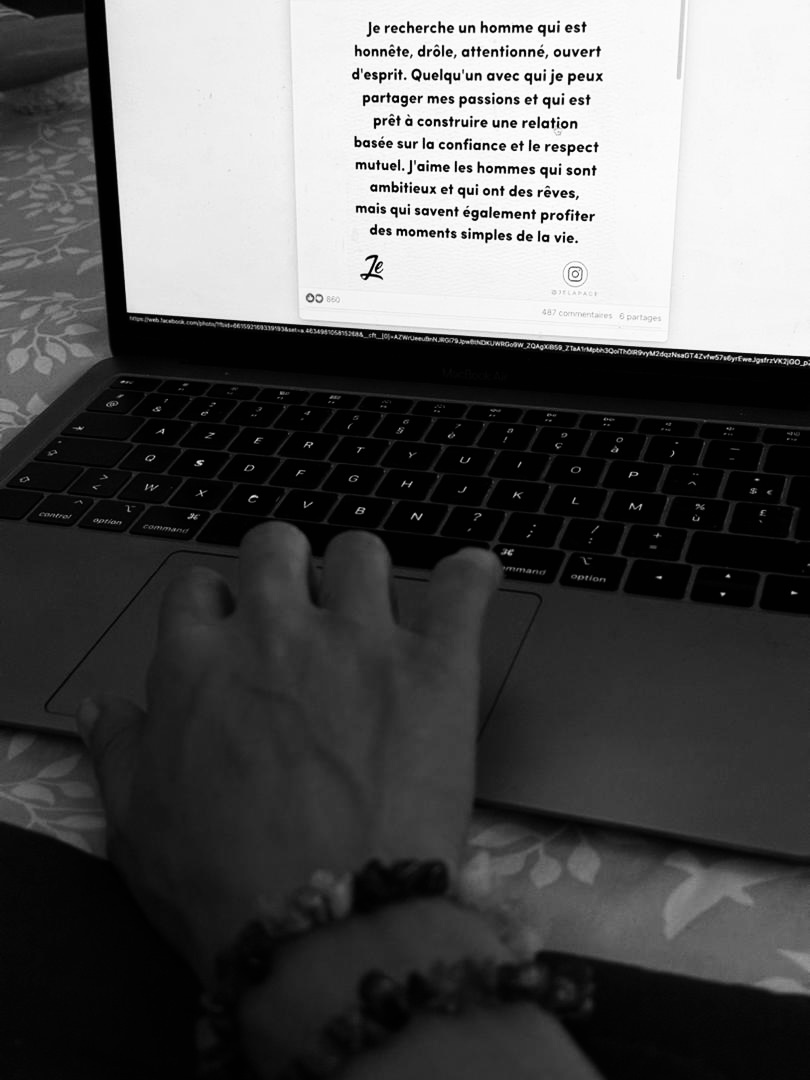
Scroll through typical Algerian dating sites and pages

“We talk about women’s celibacy, never men’s,” Dr. Boussaïd observes. Yet the two are evolving in parallel. Since 1966, the age of first marriage has steadily increased: from 18 to nearly 30 for women and from 23 to 33-35 for men. This delay does not reflect a rejection of relationships or sexuality, but rather a transformation of timelines and expectations. “Women have shifted their social—and therefore biological—clocks.” They are studying longer, working more, and postponing marriage, without giving up on love or desire.

In a country where institutions do not yet study these issues, the survey shows that what is believed to be reality is often just a social fantasy: behind the silence, society is already living differently.

Men, for their part, are facing a crisis in the “provider” model. “They want to continue providing housing, income, and stability, but it’s becoming increasingly difficult.”

Couples are therefore reinventing their lives outside of institutional frameworks, often in secret, sometimes in fear, always in a fragile balance between freedom and constraint.

Living as a couple outside of marriage

Assia, 36, welcomes me into her small, tidy apartment on a quiet street in central Algiers. She has been in a stable relationship with her partner for three years without being married.

“At first, it was very stressful,” she says. “I was afraid of getting pregnant, of being judged, and that everything would fall apart if someone found out about us. I thought that only marriage could protect me.”

Over time, fear has given way to a sense of balance. The couple operates with a discreet code: a message is all it takes to signal a family visit and avoid running into each other. “It’s our way of keeping the peace with the neighbors. We’ve learned to live between the lines.”

Today, Assia speaks of choice. “My relationship suits me because it respects my freedom. I can work late, travel, make my own decisions. It’s not a rejection of marriage, but a refusal to be defined by it. My only concern is the desire for motherhood: I don’t want to get married to have a child and then get divorced.”

“My relationship suits me because it respects my freedom. I can work late, travel, make my own decisions. It’s not a rejection of marriage, but a refusal to be defined by it.”

Her testimony, which she says is shared by several of her friends, describes a generation that doesn’t reject relationships or sexuality but redefines love in a different way.

In a society where everything is codified—modesty (heshma), honor (sharaf), shame (‘ayb)—desire becomes a form of intimate rebellion. And the intimate, Dr. Boussaïd reminds us, is always political. “Sexuality is shaped by images, words, sounds. Cinema, music, religious sermons, and advertising mold our imagination.”

Loving despite multiple stigmas

Nadia joins us for coffee, and with her, another fragment of history is added to Assia’s narrative.

Long, immaculate black hair, vibrant blue-turquoise-yellow clothes, orthopedic shoes. Leaning on her crutch as if it were a scepter, Nadia enters with an energy that shatters the silence, and her radiant laughter precedes her words. Active on social media, she reads and comments on testimonials with a sharp humor that has become her form of resistance. “If men have sex outside of marriage, according to the comments, it’s because they can’t afford to get married, even though married men are also looking elsewhere. And it’s always the women’s fault: not pious, not reserved. We become the ‘loose ones,’ the ‘bad girls.’”

She laments that people can’t simply acknowledge their emotional and sexual needs. Then her voice softens. “With my disability, I’m doubly stigmatized. When a man wants to take things further, his mother refuses. I’ve realized that for many, being in a relationship depends less on who I am than on what they see.” At 39, Nadia prefers virtual exchanges. “Simpler, sometimes endearing, and above all, less humiliating.”

The line between desire and violence is thin. “Very often, people only want to talk to me about sex, even if they don’t know me,” she says. “Some people take advantage of my disability to pressure me into sending photos or saying things I don’t want to say.”

A few minutes later, Assia calls Inès, 27, their friend who also has a disability. Inès hesitates on the phone, then confides, “Since I graduated, I hardly ever go out anymore. I depend on my parents. The internet is my window to the world. I look for people to talk to, sometimes more. But often, it ends badly. Twice I’ve been blackmailed after intimate exchanges.”

She pauses, then continues. “The first time, I thought it was my fault. The second time, I realized it was because I’m a woman and ‘no one would want me in real life.’”

Since then, Inès hides her disability on dating sites. “As soon as I mention the wheelchair, most people block me.” Inès laughs softly. “What surprises me is that on Facebook, I see many disabled men posting marriage ads. They’re looking for a serious, pious woman for a life within the bounds of Islamic law… and everyone congratulates them, encourages them. But when a woman dares to say she want to love or be loved, she’s immediately judged. As if, for us, expressing a desire is already a lack of modesty.”

For researcher Khadidja Boussaïd, these stories are by no means marginal. “People with disabilities, especially women, are among the most excluded from the public sphere. But the digitization of the world and social media offer them symbolic access to this space: they can finally exist, exchange ideas, desire—even if the virtual world remains permeated by the same power dynamics.”

According to the sociologist, social media has redefined life as a couple: it circumvents family taboos while revealing, in the digital space, new power dynamics between genders.

The digitalization of intimacy: A refuge and a battlefield

According to the sociologist, social media has redefined life as a couple: it circumvents family taboos while revealing, in the digital space, new power dynamics between genders.

Encounters now take place on Instagram, Snapchat, or Facebook, often under pseudonyms, in a clandestine world where seduction, flirting, and emotional connection are reinvented—but so are forms of control.

The internet offers unprecedented freedom of expression, especially for women marginalized by age, social status, or disability. But this freedom remains fragile: the virtual world reproduces and amplifies social and gender hierarchies.

In Algeria, digital technology hasn’t eliminated taboos; it has simply displaced them. Behind their avatars, women continue to negotiate their right to pleasure, caught between moral surveillance, a desire for autonomy, and a need for recognition. The virtual world is not a refuge, but an intimate battlefield.

Voices of women with disabilities: Between self-esteem and violence

 In her office in Algiers, Souad*, president of an association for people with disabilities, recalls the moment in 2023 when she too decided to break the taboo by working on the sexuality of women with disabilities. “We talk about functional autonomy, never about emotional or sexual autonomy. Yet these women have the same needs, the same desires, the same rights as everyone else.”

The activities carried out as part of this project revealed two deep wounds. The first has to do with self-esteem: many describe their love stories as trials of validation. “He accepted my disability…” they often say with a mixture of gratitude and resignation. Their desire remains haunted by a painful question: who would agree to love a body deemed imperfect? Love then becomes a favor, not a right.

The second wound is that of sexual violence and blackmail. Some women were abused by partners who invoked “help” or “compassion.” Others have been emotionally blackmailed, their physical or social vulnerability used as a weapon. “These are invisible forms of violence. These women don’t dare speak out, for fear of losing what little freedom they have,” confides Halima*, a participant who herself has a disability, whom we met at the project’s launch workshop in 2023.

These harrowing accounts show that the right to pleasure remains a battleground. Between fear of judgment, the lack of inclusive sex education, and difficulties accessing gynecological care, their bodies remain monitored—sometimes violated.

Souad also notes the frequency of the expression “unnatural,” often uttered by parents who refuse to imagine that their daughters could love or want to get married. For her, the current struggle is clear: to defend the right to remain a woman, despite disability—a woman with needs, emotions, and desires.

For her, the current struggle is clear: to defend the right to remain a woman, despite disability—a woman with needs, emotions, and desires.

The work of Khadidja Boussaïd and the testimonies collected by Souad, a disability rights activist, show that female desire in Algeria—the right to an emotional and sexual life—does not disappear under the norm. It adapts and resists.

From the personal to the political, one idea recurs: sexuality must be recognized as a fundamental right, not a fault.

Inès recounts that at weddings, some women are told, “Inshallah, you'll be next,” as if making a promise for the future. To her, in a wheelchair, they simply say, “May God protect you for your parents.”

Until society learns to talk about desire—and even love—without shame, freedom will remain incomplete, and its margins will continue to define its boundaries.

*Pseudonyms

This article was carried out with the support of the Tunis Office of the Rosa Luxemburg Foundation.
Amel Hadjaj

Amel Hadjaj

Amel Hadjaj is a feminist activist born in 1986, in Constantine, Algeria, the city where she lived and grew until she completed her university studies in medicine. She describes herself as an intersectional feminist and human rights activist. She is the founder and national representative of the “Journal Féministe Algérien”, a foundation created with the objective of informing the public about feminist related news and initiatives in Algeria. Amel also oversees multimedia content creation and the awareness-raising program of the journal. After working for seven years as a market researcher and business consultant, she decided in 2017 to start using her experience as a consultant in several non-profit organizations active in the fields of gender and feminism. Amel is also a blogger and a feminist content creator currently contributing with various online platforms and national and Mediterranean outlets.

Related posts

“Palestinian Women,” the revived history of women militants for the liberation of Palestine
In-depth

“Palestinian Women,” the revived history of women militants for the liberation of Palestine

by Nathalie Galesne
6 February 2024
844

The documentary by Lebanese director Jocelyne Saab, screened at the 27/20 Festival in Tunis, shook the public. What do these...

Palestine: With “liberated” sperm, the impossible becomes possible
In-depth

Palestine: With “liberated” sperm, the impossible becomes possible

by Alaa Murrar
9 January 2023
516

When Palestinian women and men first heard the news of the smuggled sperm, they had a lot of questions. It...

Saying NO to violence is a business

Saying NO to violence is a business

19 September 2023
366
Quand les créations de Zehra Doğan voyaient le jour en prison

Quand les créations de Zehra Doğan voyaient le jour en prison

12 December 2022
313

Leave a Reply Cancel reply

Your email address will not be published. Required fields are marked *

J'accepte les termes et conditions et la Politique de confidentialité .

Medfeminiswiya

Medfeminiswiya is a feminist network that brings together women journalists working in the fields of media and content production in the Mediterranean region.

Newsletter


    Follow us

    Browse topics


    • In-depth
    • Files
    • Features
    • On the move
    • Portraits
    • Opinion

    • Creations
    • Visual Arts
    • Reviews
    • Multimedia
    • Country Context
    • Blogs
    • About us
    • Our community
    • Our partners
    • Become a member
    • Editorial charter
    • Disclaimer

    © 2025 Medfeminiswiya - Mediterranean Network for Feminist Information

    • it VO
    • fr Français
    • en English
    • ar العربية
    • In-depth
    • On the move
    • Portraits
    • Creations
    • Opinion
    • Multimedia
    • Country context
    • Blogs
    No Result
    View All Result

    © 2025 Medfeminiswiya - Mediterranean Network for Feminist Information

    Welcome Back!

    Login to your account below

    Forgotten Password?

    Retrieve your password

    Please enter your username or email address to reset your password.

    Log In

    Add New Playlist

    Ce site n'utilise pas de cookies. This website does not use cookies. هذا الموقع لا يستخدم ملفات تعريف الارتباط.