Cette publication est également disponible en :
September 5, 2025: Ruqayya’s sobs echo from a dimly lit corner of an old building on Rue de la Gare in Tunis. Female activists from the Flotilla support campaign crowd around her, worried. At first, they think she’s in labor pains, or that it’s the fatigue of pregnancy. But her broken sentences, interspersed between people’s attempts to comfort her, say something else—Ruqayya arrived too late, the donation office had closed. She is crying because of a deep frustration, because she was not able to make her modest contribution to the people of Gaza, prisoners of a war and torture machine.
From the narrow corridor, the view widens onto a street teeming with people, then onto an entire city vibrating in unison around a single name: the Sumud—meaning steadfast—Flotilla.
Rue de la Gare: A refuge of hope
In a cramped apartment buzzing with activity, dozens of activists are busy working. Donors are lined up in the street, spilling well beyond the entrance. Young and old, women and men, but also children who have come to break open their piggy banks for Gaza. All have come together in unison. At the building entrance on Rue de la Gare, a portrait of Francesca Albanese, UN Special Rapporteur, dominates the walls and facades covered in Palestinian flags. From the capital and the interior regions, people flocked with a single goal: to support Gaza.
Rihab Abdelkebir, 26, an engineer and doctoral student from Ben Guerdane in southern Tunisia, moved to Tunis a few months ago to devote herself entirely to supporting the Sumud Flotilla and the logistical effort.
“This war is unlike any other. Since October 7, I’ve put aside my family and academic commitments to get fully involved. I even took part in the sit-ins. I came specially from Gafsa to Tunis to be in the thick of the action. The cause transcends anything that might occupy our daily lives.”
“I’m mobilizing for the rights of the Palestinian people. It was necessary to move beyond compassion and take action. Supporting and backing the Flotilla is a form of action.”
Adjusting her Palestinian keffiyeh, she adds, her voice strained: “With the Maghreb land caravan to Gaza, which preceded the Flotilla, I helped welcome people to my town, Ben Guerdane, last June. Today, I continue to support the Flotilla.” Rihab believes that supporting the Palestinian cause is a duty for which no thanks or reward is expected. “Everyone must take part. At least through physical effort. My life is no more valuable than that of any Palestinian. Between us and the occupier, there is blood. Tunisia is not only in solidarity, it is part of this cause. The ties that bind us to the cause are ties of blood and belonging.”*
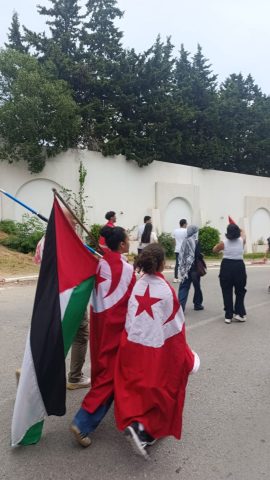
The street is adorned with the four colors of the Palestinian flag, blending with those of the Tunisian flag. Chanted slogans alternate with football fans’ chants transformed into anthems of resistance, sung in unison like a vast symphony combining popular fervor with the spirit of resistance.

In a crowded room dedicated to donations, Amna Souayah, a 26-year-old graduate architect, welcomes arrivals with a smile despite her fatigue, carefully taking note of the details on receipts for both cash and in-kind donations.
“I wasn’t able to accompany the Maghreb land caravan to Gaza last June for personal reasons, but supporting those who take action is a form of action in itself. For more than five months, I’ve dedicated all my time to supporting the Flotilla,” she says. “Opinions around me have been mixed, but my family has always been my main support.”
In the bustling hallway, we meet Aya Ben Tenfous, a 29-year-old engineer involved in the fundraising campaign. She occasionally interrupts the interview to guide a volunteer, telling us: “I quit my job and bought a ticket to join the Maghreb caravan in Zliten, Libya, in June. It was a life-changing experience that shifted my priorities and way of thinking. But I still feel it’s not enough.”
“Even before October 7,” she adds, “I was mainly focused on enriching my personal culture. Then I got involved with the Sumud Caravan and started campaigning with them. When the Flotilla initiative began, I wanted to participate directly, but the age limit (under 35) and the limited number of places kept me from joining. So I put my focus on organizing. My main role was collecting donations.”

Women lead the way to freedom
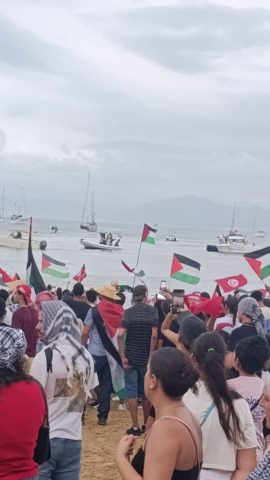
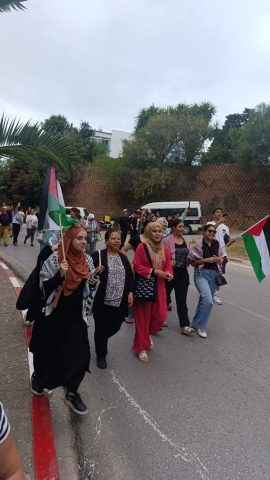
September 7, 2025. The campaign headquarters is located about 20 kilometers from the port of Sidi Bou Said. The departure, postponed from September 7 to September 15, has transformed the streets of the northern suburbs of the capital into a scene of celebration: Palestinian flags, keffiyehs, families from all over the country came to greet the participants and send a message of love and support to Gaza.
The road is blocked, so we have to walk. A dense crowd has gathered to catch a glimpse of the vessels and cheer on the activists. Enthusiasm grows as we approach, in an atmosphere vibrant with fervor and passion.
Farewell to the port
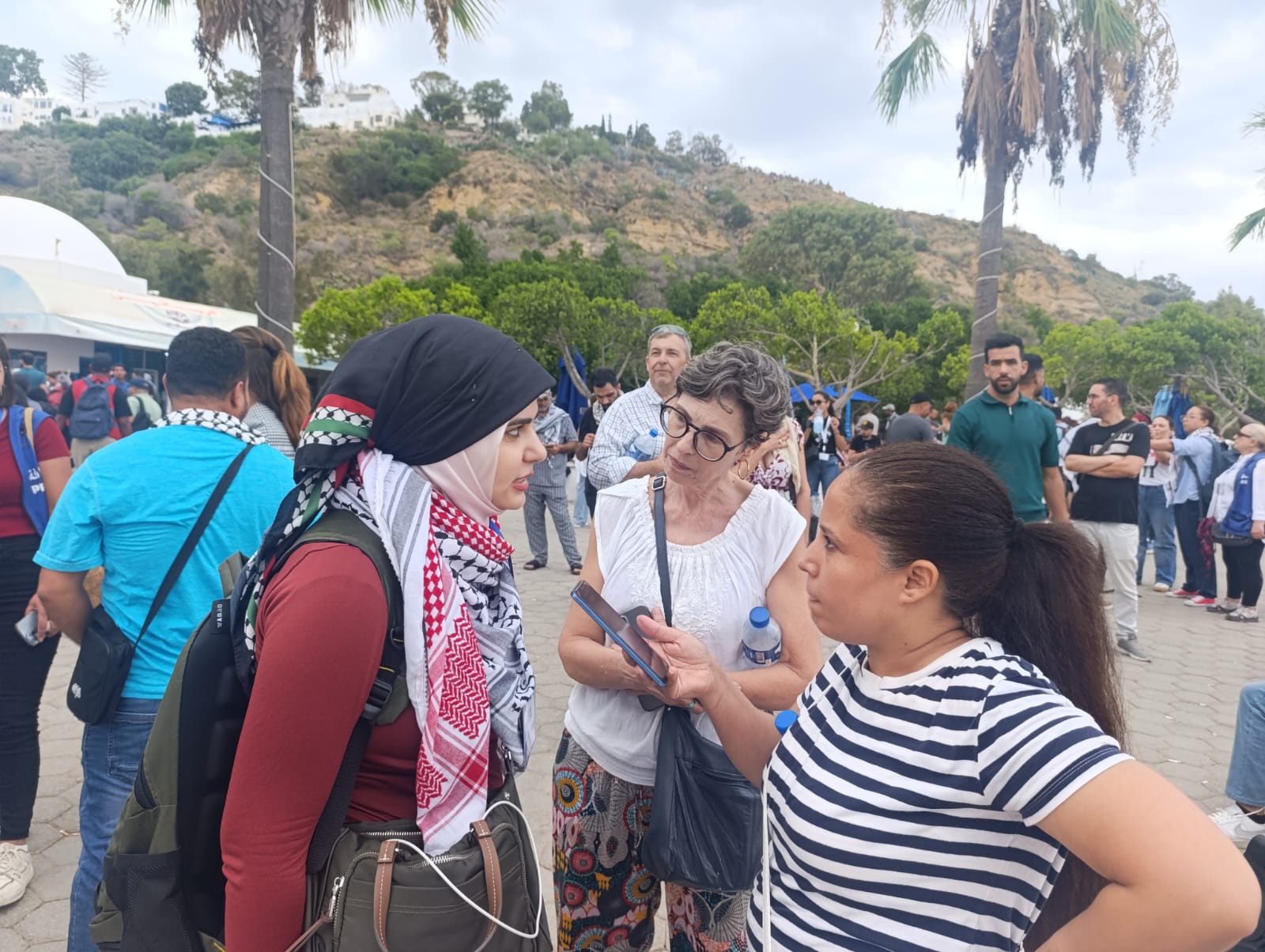
Along the coastal road bordering the port, crowds of people have come to greet the Flotilla. Entire families have traveled from far and wide to witness these solemn moments. Access to the port is restricted to activists and journalists. The Flotilla participants, surrounded by their meager luggage, radiate hope.
Olfa Lamloum, president of the Legal Agenda association and Tunisian activist, is participating in the Flotilla. She explains, “There was both encouragement and fear, especially from my little family. My children were worried; they didn’t want me to leave. When my name was selected, my daughter was devastated. She was in shock.” Lamloum laughs as she says this, leaning against the sidewalk, away from the crowd.
“I didn’t hesitate for a second to join the Flotilla. For 23 months I’ve felt pain, a deep sense of oppression, helplessness. What I’m doing today, I’m doing for myself, for Palestine, for my children, and for my grandchildren,” she confides.
After the Israeli attacks on two Flotilla vessels, the first of which was on the night of September 9 and caused a fire on the largest boat, the Spanish-flagged Alma, and the second targeting the Family ship the following night, doubts set in. The Tunisian Interior Ministry initially denied any incident, before acknowledging that there had indeed been attacks carried out by “an unknown party.”
When we ask Lamloum how these attacks impacted her determination, she brushes a strand of hair away from her face and replies, “I’m not thinking about fear right now. What happened the first two nights was expected… they had already done it in Malta. They thought people would flee. They were wrong.”
Smiling, she notes the prominent role women are playing, even in the names of the vessels, like the one named Shireen Abu Aqleh.
Behind the scenes of the Flotilla: Doctors and lawyers
Away from the spotlight, other women also play a central role. Dr. Warda Mohdawi, a Tunisian physician specializing in burns and disasters, coordinates the protection team in Tunisia. She joined the June 2025 Global March to Gaza (GMTG), an international movement aimed at ending the genocide, opening humanitarian corridors, and breaking the blockade, through a sit-in organized at the Rafah crossing on the Egyptian side, which began on June 15. This action, which coincided with the Maghreb Sumud Caravan, aimed at breaking the blockade of Gaza by land, sea, and air, was severely repressed by the Egyptian authorities, who blocked it and expelled the activists taking part. Mohdawi participated on an individual basis, with no affiliation to any association or organization.
“I didn’t hesitate for a second to join the Flotilla. For 23 months I’ve felt pain, a deep sense of oppression, helplessness. What I’m doing today, I’m doing for myself, for Palestine, for my children, and for my grandchildren.”
Mohdawi says that no one knew she was taking part other than her husband. Even her mother found out only after she’d returned from Egypt. She then joined the GMTG last June.
“My main role is to ensure protection in all its dimensions: medical, security, through vigilance over individuals’ personal data and the safety of crews and ships,” she explains. “When the Flotilla departs, there is what is called the ground protection team, of which I am in charge in Tunisia. Its mission is to ensure constant monitoring of the vessels, protect them, and communicate with families in case of danger.”
A mobile medical team, led by Dr. Amine Bannour, is also following the expedition, under the auspices of the international GMTG network—a decentralized network that coordinates peaceful actions and land and sea caravans and provides legal and media support to break the blockade and ensure the delivery of donations.
Under a light rain that suddenly began to fall to accompany the farewell to the Flotilla, Mohdawi stands beside an old tree and speaks about her connection to the Palestinian cause, explaining how it has shaped her life and future. “I turned to medicine because of Operation Cast Lead (Gaza, 2008-09). I was in my third year of math, but I changed to experimental sciences so that I could later study medicine.” She adds, not without pride, “Today, I am an ambassador for the Samir Foundation, a British organization that supports medical students and the reconstruction of hospitals in the Gaza Strip.”
Confidently and without hesitation, Mohdawi answers our question about how her commitment to the Palestinian cause has impacted her family life. “My family and friends are supportive. They’re committed to the cause. My husband is understanding; we met during the protests of the Tunisian revolution. I feel that I live more in the role of Warda the doctor and activist than as a mother—motherhood sometimes constrains me.”
She specifies that neither marriage nor motherhood are obstacles to her activism. The real challenge lies in understanding her partner and organizing daily life. “My husband has no idea how to manage the household. So I cook enough meals to last the duration of my absence, even if I will be gone for more than a week. I also prepare outfits for my daughter to wear each day and label them for him, because my husband knows nothing about housework. So my daughter never really feels that I am gone too long.”
Women lawyers present
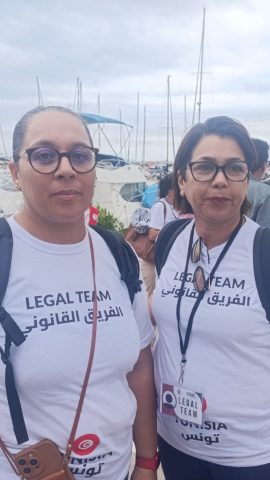
In a port alleyway, two young women have the words “legal team” written on their t-shirts. When asked about their role, one of them (a lawyer) explains, “Our main mission is to offer legal supervision on the ground and monitor Tunisian participants in the Flotilla. We collect signed powers of attorney to forward to our Palestinian colleagues in the Adalah organization, so that they can take charge of cases in the event an activist is arrested by the occupying forces.” She adds, “Legal power of attorney is of paramount importance: without it, the lives of detainees can be put in danger.”
The Tunisian collective is composed of 47 volunteer lawyers, led by Najet Hedrache, an international law specialist who has worked at the International Criminal Court (ICC) on cases related to Israel.
The idea of forming a legal collective first emerged in Spain, where, given the diversity of nationalities among the participants, it was decided that legal collectives would be formed for each group based on nationality.
Hope and memory
On the crowded corniche, Red Crescent ambulances are parked to provide support. Among the volunteers is a woman from Bizerte who has come with her family to wave goodbye to the Flotilla, despite the fact that she is undergoing chemotherapy. Tired but smiling, she tells us, “We came to see the Flotilla, to wave goodbye.”
We leave, not wanting to burden her any further, and think about her illness, which reflects that of an entire nation, her hair loss, which evokes the fall of the regime’s veil of modesty, and her resistance to the disease, which echoes the steadfastness of the Sumud Flotilla’s confrontation against genocide and Zionist arrogance.
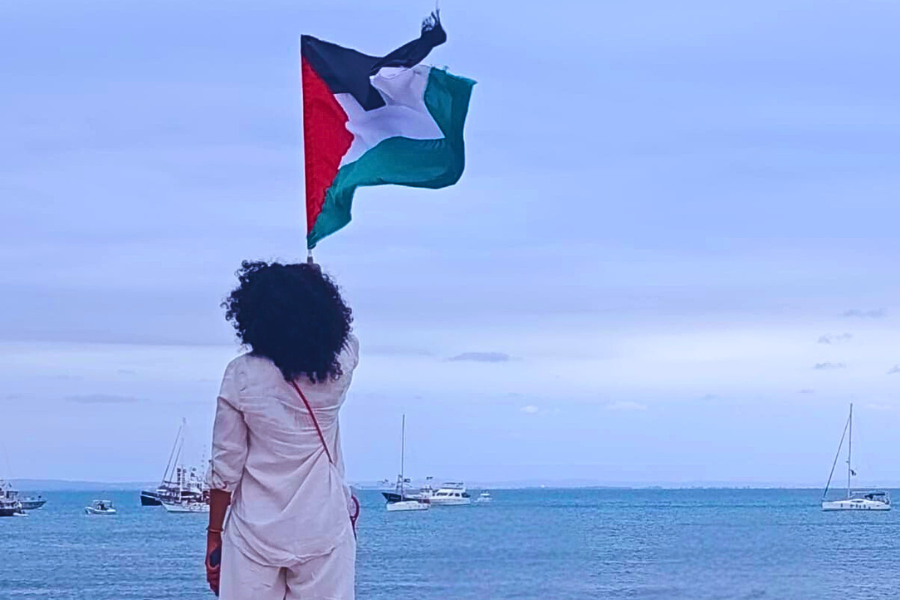
On September 15, 2025, the vessels leave the Tunisian coast, having stopped at the ports of Sidi Bou Said and Bizerte before joining ships from Italy, Spain, and Greece in the Mediterranean. Together, they head east toward Gaza, to break the cycle of death, injustice, and isolation that has persisted for nearly two years.
* Historical reminder: On October 1, 1985, Israel struck Tunisia, bombing the Palestine Liberation Organization (PLO) headquarters in Hammam Chott, near Tunis, killing 68 people, mostly Tunisian and Palestinian civilians, and injuring more than 100 others.