Cette publication est également disponible en : Français (French) العربية (Arabic)
Find all of Rola’s stories here.
March, 21st
Finally, after a two-day interruption due to the rainy weather in Gaza, I was able to connect to the internet again. I’d felt completely cut off from the world and its regularly scheduled programming. Here, whatever calm we find is always disrupted by the sound of drones flying so low it seems like they’re about to land on our heads. Here, we lose our focus with every explosion that shakes the ground under our feet. It happens every hour.
It was at the end of this busy Ramadan day, filled as it was with the difficult tasks we undertake to survive, that I finally had the chance to pick up my phone. I was surprised to see a WhatsApp message from a friend of mine suggesting I write about Mother’s Day in Gaza. I was taken aback. I couldn’t believe it was March 21st already. A day that’s supposed to be filled with joy and the little preparations and gifts that express love and gratitude for mothers.
Mothers without their children
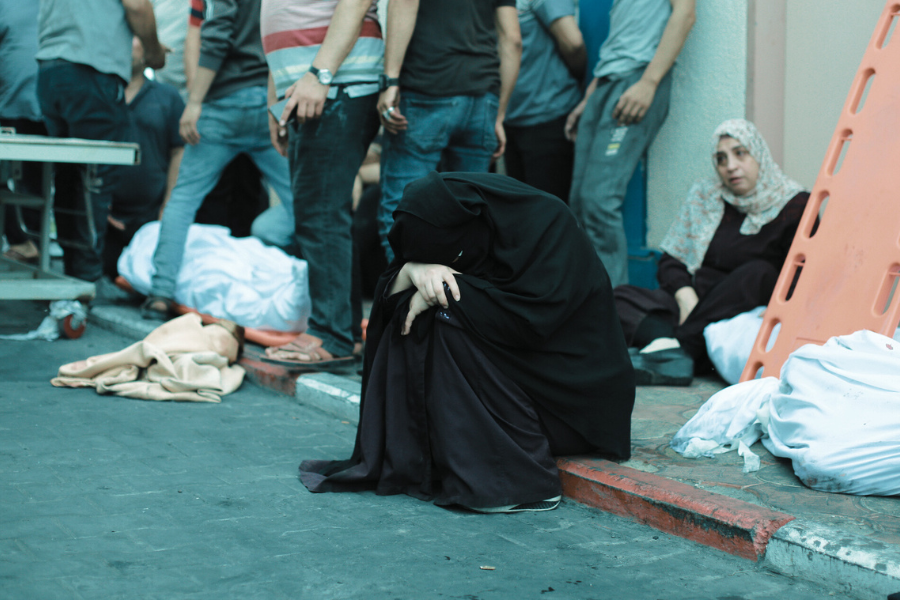
It was supposed to be a day of warmth, with surprises and gifts, love, hugs, and heartfelt wishes. But in Gaza, where people are suffering from ongoing war and destruction, Mother’s Day quietly slipped by, overtaken by the daily suffering. It brought with it a new layer of sorrow, a reminder of endless losses. In Gaza, Mother’s Day is no longer a day of love. It is a day laden with pain, loss, and loneliness.
Since I became a mother eight years ago, Mother’s Day has always been special. My husband and children always used to make sure of it, with their surprises and simple gifts that reflect their love for me. I would also visit my own mother at my parents’ home, and we’d celebrate together, enveloped in warmth and intimacy. But this year, like last year, Mother’s Day was different. Cold. Heavy. Drenched in the tears of grieving mothers, whose hearts are filled with sorrow, helplessness, and mourning.
The genocidal war has caused mass bereavement among the mothers of Gaza. They have not lost one or two children. Hundreds of mothers have lost all of their sons and daughters.
The occupation’s missiles have robbed Gaza’s mothers of their children, with no regard for the long years of waiting that dozens of mothers endured before their children were born, no regard for the way some women fought to become mothers.
Over the years of conflict, Gaza’s mothers have worked tirelessly to raise and care for their children, but those beautiful moments of life have turned into tragedy as the war rages on.
Powerless mothers
Every day, we hear testimonies from mothers who will no longer hear their children call out mama. They have been killed by the occupation. Some of these children died after taking their very first breaths, some a few days after being born, and some before even leaving the womb. These mothers are not only suffering from having lost their children—they will never again hear their laughter, sense their need for them, or smell their scent.
The genocidal war has caused mass bereavement among the mothers of Gaza. They have not lost one or two children. Hundreds of mothers have lost all of their sons and daughters.
In the latest statistics issued in Gaza before the war resumed, the Government Media Office confirmed that 17,000 mothers had lost their children.
According to the Palestinian Ministry of Health in Gaza, the number of children killed by Israel’s genocidal war has risen to 15,613—31% of the total number of deaths in the Strip. These figures are more than just data: they echo thousands of cries of anguish and countless lives irreparably broken.
Imagine what life has become for a mother who suddenly lost her children, whose name has been changed from mother of children to mother of martyrs. What is it that she feels, living in such a bitter reality?
Gazan mothers experienced the worst during the months of aggression, overwhelmed by their inability to fulfil their children’s needs. Needs once taken for granted, like a piece of candy with every meal, have now become out of reach.
How is it that a shawarma sandwich, for example, is now a distant dream for a young child? They have to close their eyes to remember how it tastes—they have no chances of seeing or touching it. But before the genocide, they could have it whenever they craved it.
How is it that mothers now intentionally gather all their children every night so that they may all share the same fate if an Israeli missile strikes them?
Mothers here only pray to be martyred together with their children, so none of them will have to suffer the grief of losing the other.
In Gaza, Mother’s Day was spent in sadness. Mothers without their children, children without their mothers.