



















This post is also available in: Français (French) العربية (Arabic)
Khira is 41 years old. She lives in Algiers, works in communications, and has never wanted to get married.
Until now, she hadn’t given old age a second thought. “When you’re young, you think about freedom, work, travel.” But recent debates have led her to reconsider—“When I hear some officials say that children should be forced to take care of their parents, I think: what about us? Those of us who don’t have children?”
Khira doesn’t regret her choices, but these discussions sometimes stir up anxieties. “Sometimes I wonder, who will be there when I’m old? If I get sick, if I become dependent… will the government have something in place? Or will we remain invisible because we didn’t follow the expected family model?”
Her questioning is also fueled by personal experience. Six years ago, faced with a lack of accessible and qualified caregivers, Khira had to leave her job to care for her mother, who was battling cancer, until her passing. “We talk a lot about family duty, but very little about the concrete conditions of care,” she explains.
She also mentions the very negative social perception surrounding nursing homes. “As if placing someone there necessarily equates to abandoning them. Sometimes, it’s just a solution to guarantee dignified care.”
A proposed law focused on family responsibility
According to press reports in early March 2026, a proposed law being examined by the Algerian National People’s Assembly (APN) aims to amend and supplement Law No. 10-12 of December 29, 2010, concerning the protection of the elderly.
The initiative seeks to introduce legislation in Algeria that would impose criminal penalties on children who fail to care for their elderly parents. The penalties discussed would range from six months to three years in prison, along with fines of up to 300,000 dinars (almost €2,000).
The stated objective of the bill’s proponents is to fill what they consider a legal void regarding the abandonment of elders.
But this approach raises a question: what does it mean to grow old in a society where solidarity is conceived almost exclusively through the lens of the family and, in practice, relies on women?
What does it mean to grow old in a society where solidarity is conceived almost exclusively through the lens of the family and, in practice, relies on women?
The family as the only policy for aging
In the discourse surrounding these types of initiatives, protecting the elderly is often presented as an extension of a moral duty: family solidarity and filial piety. This vision is based on a model where parents grow old surrounded by their children, who are expected to provide them with material and emotional support as a matter of course.
But this model is increasingly fragile. Migration, economic insecurity, and changing lifestyles have profoundly transformed family structures. At the same time, the responsibility for caregiving continues to fall primarily on women: looking after children, the sick, parents, and sometimes in-laws… this is essential care work, but work that is largely invisible and underappreciated. Meanwhile, staying single and not having children are becoming increasingly accepted life paths, making the idea of being cared for in old age by one’s children less and less plausible.
Behind this family morality lies a reality that is rarely mentioned: the exploitation of women’s labor in the name of filial duty. Nesrine, 46, is experiencing this firsthand. Single, she had to give up her job and her personal life to care for her elderly parents, while her brother, though present, refuses to take on this responsibility.
“People keep telling me that it’s my duty. But no one talks about what that actually means,” she explains. “I’m not allowed to work because they say I have to stay with my parents. And if I mention a nursing home, I’m made to appear like I’m abandoning them.”
In a society where care facilities for the elderly remain scarce and stigmatized, caregiving falls largely on the women of the family, often turning morality into an injunction to sacrifice.
Elderly women: the invisible ones
Women are particularly affected by issues related to aging. In many countries, they live longer than men on average and are more likely to reach retirement with fewer financial resources, often due to interrupted careers or greater involvement in informal work.
United Nations research on aging also highlights that poverty in old age often disproportionately affects women, due to inequalities accumulated throughout their lives.
Yet, when these women grow old, public support systems remain limited.
In Algeria, infrastructure dedicated to the elderly is relatively scarce, and home care services remain underdeveloped.
“Old age can also be a source of freedom”
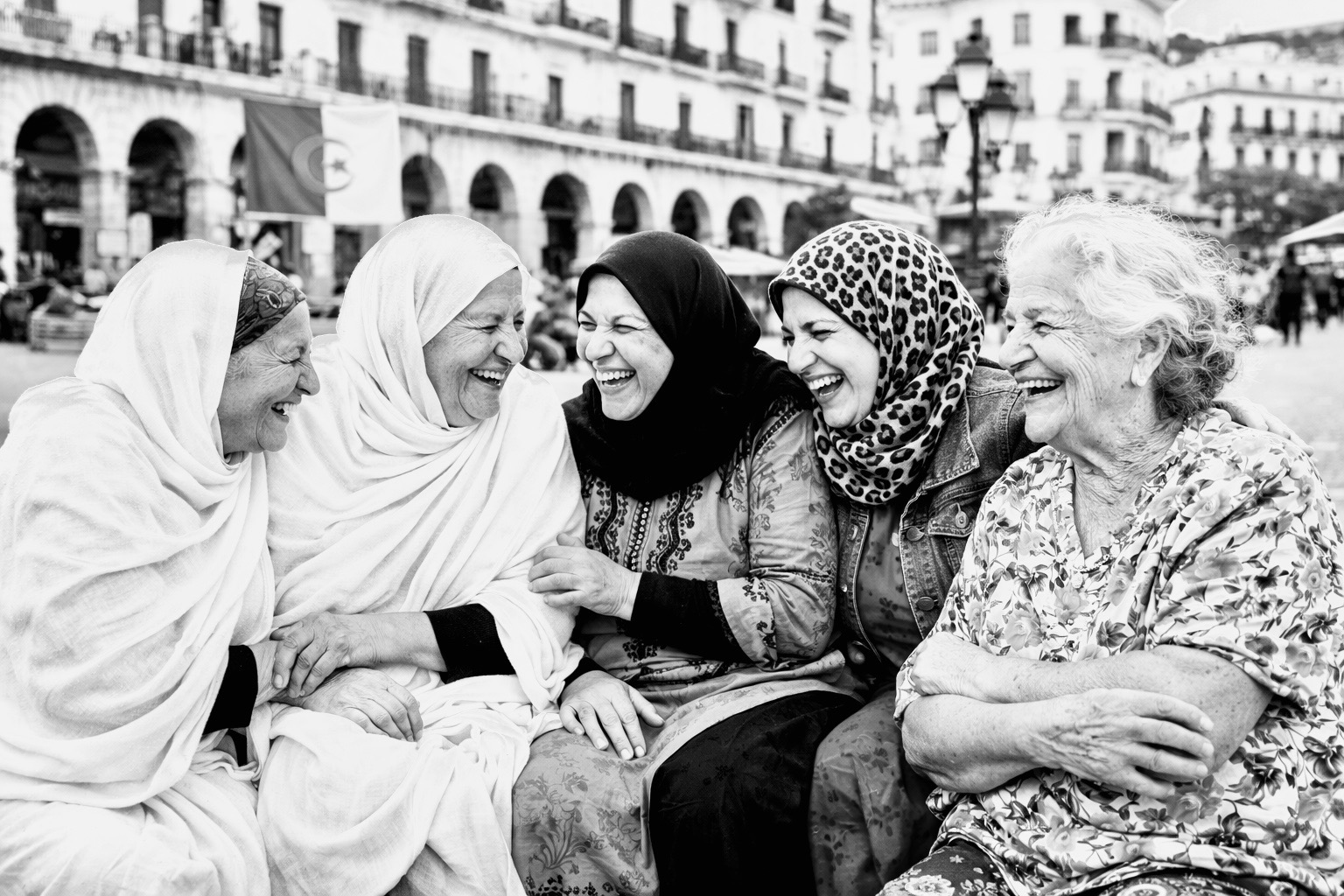
Nadia, 68, never had children. She is a retired teacher and has been living alone for several years. Rather than withdrawing into herself, she chose a different path: joining a small group of retired women who regularly organize trips together.
“We met in a book club. Then we started going on trips for a few days to the seaside, to Ghardaïa, sometimes even abroad. Old age has allowed me to discover Algeria,” she says, “but also to discover myself.”
For her, old age shouldn’t be reduced to dependency. “We often talk about older people as being frail or isolated. But there are also older women who want to continue living, exploring, and being active.” She acknowledges, however, that this freedom is subject to certain conditions.
“I have a small pension and I’m still in good health. But I know that everything can change very quickly. If I ever become dependent, I don’t know what solutions are really available.”
Creating dignified public retirement homes, developing accessible home care services, training and supervising caregivers, creating social spaces for seniors… these are all public policies that remain underdeveloped.
Punishing rather than building
The debate surrounding parental abandonment takes place within a specific context: that of the isolation and vulnerability of some elderly people. But by focusing on the criminalization of children, it often overlooks a crucial point: the collective organization of aging.
Creating dignified public retirement homes, developing accessible home care services, training and supervising caregivers, creating social spaces for seniors… these are all public policies that remain underdeveloped.
Several critical analyses of the criminal justice system have also shown that societies sometimes tend to respond to social problems with punitive solutions rather than structural policies.
Aging with dignity should not depend on the number of children one has had.
In a society where women have long performed the bulk of care work, often unpaid and behind the scenes, it becomes necessary to ask another question: who will take care of those who have spent their lives caring for others—or those who have chosen a different path?
Punishing families will never replace a social policy, because old age is not just a moral issue. It is a political issue and, above all, a collective and state responsibility.