Cette publication est également disponible en :
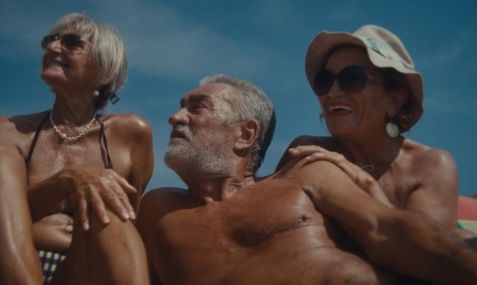
Every day, Joëlle meets her retired friends—Magali, Carmen and Régine—on the popular Bain des Dames beach in Marseille’s 8th arrondissement. Like actors on an open-air stage, they laugh and chat about love, flirting, sex and bodies that are changing with time.
This 30-minute docufiction, at times lightly guided in its staging, won the César for Best Documentary Short Film a month ago. Deeply tanned, tattooed and often topless, the four friends gather on a beach where a wall boldly proclaims in large letters: “Bras mandatory for old women.”
“The beach in Marseille is a public place where women are overrepresented. And even though they dominate the space, some people still feel entitled to tell them what to do and how to do it!” protests Margaux Fournier in an interview with the regional channel of France 3.
With their frank speech, lively banter and jokes delivered in the sing-song accent of Marseille, these women stand out and assert a presence that is both free-spirited and irreverent.
“Since you sleep around so much, you must have condoms!”; “Yeah right, you don’t drink alcohol… You do like your white wine!”; “I like devilish beauty—faces that grab your attention”; and even, “Patrick Bruel—the older he gets, the sexier he is.”
Eroticism

Margaux Fournier films her elderly protagonists—whom she met by chance on the Bain des Dames beach—with tenderness, humor and freshness, capturing them as vividly as they are in real life. Women over 60 rarely appear on screen, especially those who no longer fit—nor have for a long time—into the standards of eternal youth that dominate representations of beauty.
Guided by her female gaze—a perspective in which a woman filmmaker adopts the viewpoint and lived experience of female characters—the director sometimes lingers in close-ups on tanned skin, a breast, a buttock, feet or ageing arms. Yet nothing about these images feels voyeuristic. Her intention is quite the opposite: to reveal the beauty of ageing, and even the sensuality that can emerge from it.
She also plays with the codes of romantic comedy, using slow motion and music to signal a beachside crush among these women.
Beyond their spicy conversations, quick wit and sharp sense of self-irony, these women—often labeled simply as grandmothers—claim a fierce freedom: the freedom to undress, to live as they please, and to enjoy a sexual life without commitment. A stance that runs counter to the dominant narrative that treats menopause as an expiration date.
Reconciliation
Yet behind the laughter of some of them lie tears—and blows. During a scene about cosmetic surgery, Joëlle confides: “I feel extremely uncomfortable in my own skin. I can’t look at myself in the mirror.” In a one-on-one interview with the director, she reveals that her husband used to beat her before taking his own life when she asked for a divorce. “You wouldn’t think I’d been through all that, would you?” Joëlle laughs.
Women over 60 rarely appear on screen, especially those who no longer fit—nor have for a long time—into the standards of eternal youth that dominate representations of beauty.
This leads the director to remark in an interview with Vanity Fair: “Talking about women’s bodies very often leads to talking about violence.”
The film ends on a hopeful note—an invitation to build community together and to reconcile generations—through a shared dance bringing together people aged 17 to 70 to the infectious rhythm of the song L’Envie by Johnny Hallyday.
The film also succeeds in dismantling another stereotype: Marseille is not only about drugs, trafficking and mafia-style score-settling. The city also knows how to sing and dance under the triumphant sun of the Mediterranean.