Cette publication est également disponible en :
Seventy-year-old Amina never imagined she would return to the role of a mother after so many years. With grey hair and wrinkles etched into her hands, she wakes up early every morning to attend to her grandchildren: she prepares their breakfast before school, braids her youngest granddaughter’s hair, and helps another grandson get dressed, all while rocking a child who hasn’t yet turned two. She sings him lullabies to help him fall asleep.
“Mama or teta?”
This woman, Amina Abu Nasr, who was displaced from Beit Hanoun in northern Gaza to the Deir al-Balah displacement camps two years ago, plays the role of both mother and father to her three grandchildren after they lost their parents. “The children have become my responsibility,” she says. “They have no one but me, and I have no one but them. I lost two of my sons, and their wives, during the war. I take care of these children and have truly come to understand what people say—that the only thing more precious than a child is a grandchild. I try to support them despite the pain and sorrow inside me, despite all the loss and grief.”
“I’m taking care of them at my age,” she continues, “when I myself need someone to take care of me. To make them food I need to light a fire, which is exhausting. Sometimes the youngest cries, and I can’t find anything to feed him. I don’t always understand what he wants. I ask a neighbor in the camp to help me with him sometimes.”
Her eldest son, Mahmoud, was killed while on his way to the Zikim crossing point north of Gaza to get a bag of flour for his children during the famine. “He came back to me carried on people’s shoulders,” she recalls. His wife, who was suffering from breast cancer, died due to the siege and lack of treatment.
Her second son was killed while collecting firewood east of Deir al-Balah, and his wife was wounded by shrapnel while walking in the street.
Hundreds of elderly men and women in the Gaza Strip have become the sole providers for their grandchildren after the death of one or both parents or the injury of the head of the household.
The most difficult thing a grandmother faces with her grandchildren isn’t just dividing meals or queuing for water and at community food distribution points, or even when one of them falls ill. It’s the children’s innocent, harsh questions:
“Why isn’t daddy with us?”
“Is he mad at us?”
“Are you mama or teta?”
She swallows back tears and gives short answers, trying to shield them from the full truth. She tells them that their parents are heroes who went to heaven and that they loved them, that they are safe with their grandmother who loves them too. She knows words aren’t enough, but they are all she has.
Her body can no longer endure what it once could. She suffers from high blood pressure, joint pain, and constant fatigue, but she puts off her treatment, just like she puts off everything else that has to do with her to care for her young grandchildren. She fears illness not because it’s painful but because it might leave her grandchildren without any support, once again. It’s like exhaustion is a luxury she is not entitled to.
The story of Amina Abu Nasr, known as Umm Mahmoud, is not an isolated case but one of many stories of grandmothers forced into the role of mothers.
According to estimates by local humanitarian organizations, hundreds of elderly men and women in the Gaza Strip have become the sole providers for their grandchildren after the death of one or both parents or the injury of the head of the household. And all of this is happening under inhumane conditions: in makeshift tents, destroyed homes, overcrowded shelters, with shortages of food and water compounded by the untreated illnesses of old age.
The number of orphaned children in the Gaza Strip exceeds 57,000, all of whom have lost one or both parents. Some are the sole survivors of their families.
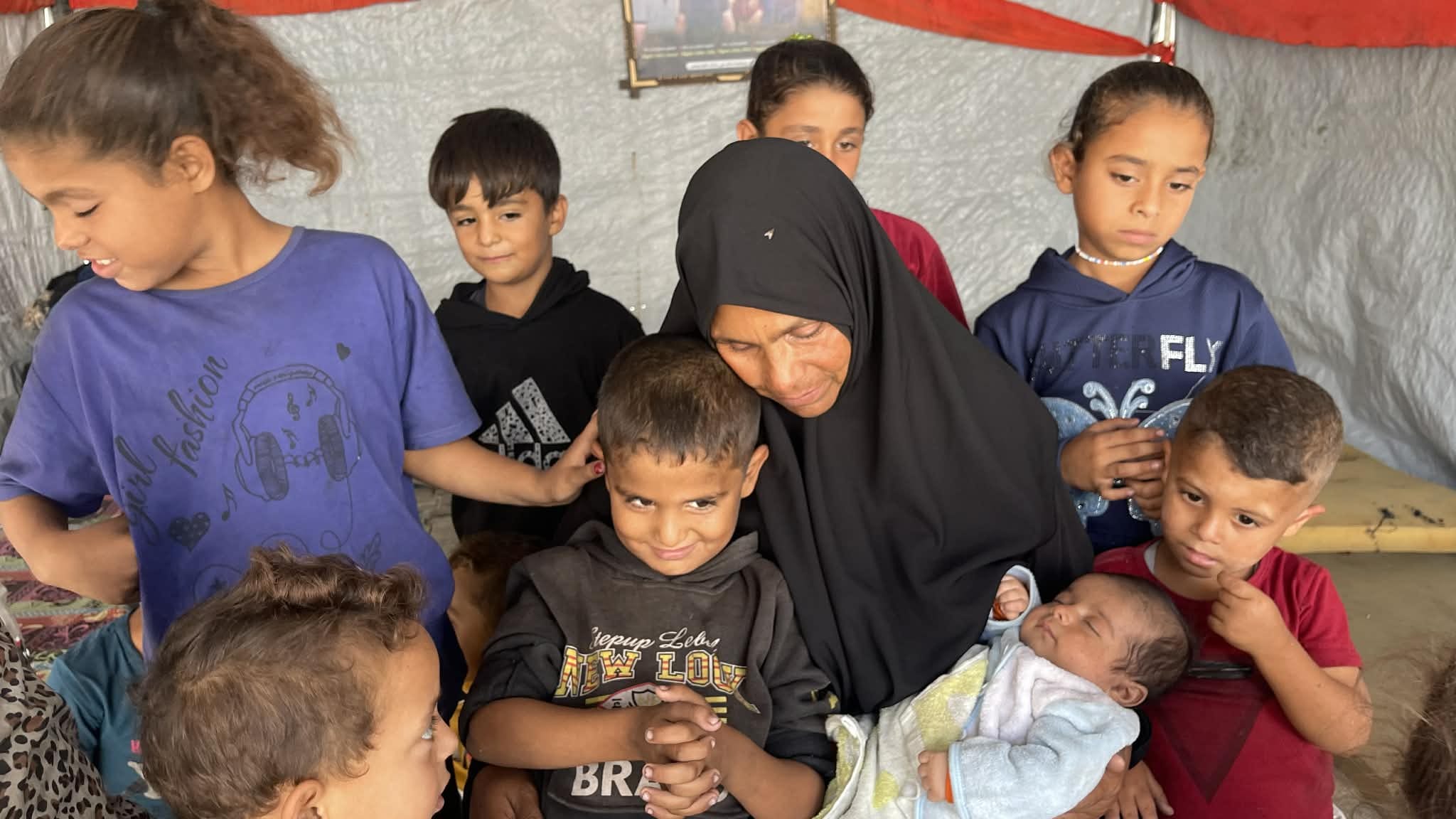
Today, Fayza Alyawa supports 36 of her grandchildren after Israel killed four of her children.
A grandmother to 36 grandchildren
Seventy-year-old Fayza Alyawa sits on the ruins of her destroyed home in the Shuja’iyya neighborhood of eastern Gaza, surrounded by her grandchildren.
Today, Fayza supports 36 of her grandchildren after Israel killed four of her children: Rasha, Na’ila, Muhammad, and Ezzat. She has been displaced more than 22 times, and after the latest ceasefire in Gaza, she returned to her destroyed home, despite the lack of resources and the dangerous living and security conditions.
Warplanes are constantly flying overhead and firing around them, as they live in a “yellow zone” directly adjacent to the Israeli occupation forces east of Gaza. There is no water or electricity, and there are no alternative energy sources. So she is forced, every day, to walk long distances towards the center of Gaza to fetch water for her grandchildren.
She says her heart aches with fear every time she goes out, not for herself, but for the children she leaves behind. “My husband is sick and elderly, and he can’t bear any additional burdens. I’m supporting him, too.”
“Every day I wake up early and go from one aid organization to another, searching for assistance to support these children.”
She never expected the roles would be reversed like this. Like many in Palestinian society, she was accustomed to grandchildren being a source of support for their grandparents, but now she is forced to be their support, despite her advanced age and illness.
“My oldest grandchild is only 16, and my youngest is not yet five months old,” she says.
Among the challenges she faces, the hardest moments seem to be when the baby cries. Milk is scarce, and she cannot afford diapers. When the baby keeps crying, she feels utterly helpless. She remembers the baby’s mother, her daughter Na’ila, and breaks down silently, unable to do anything about the situation.
“Every day I wake up early and go from one aid organization to another,” she continues, “searching for assistance to support these children. I can’t work, and neither can my husband. Sometimes I receive some help from humanitarians or charitable organizations.”
According to Al Mezan Center for Human Rights, the elderly constitute approximately 5% of the population of the Gaza Strip and were among the most affected groups during the war. Around 4,731 elderly men and women were killed, and nearly 12,000 others were injured. Their suffering was exacerbated by the targeting of the health sector and the severe shortage of medicine. The Ministry of Health warehouses experienced a 54% shortage, while UNRWA facilities, which provide services to about 54,000 elderly men and women suffering from chronic illnesses, suffered a 70% shortage. This led to an increase in deaths and heart attacks.
The number of victims of the Israeli war on the Gaza Strip has reached approximately 72,000, according to the Palestinian Central Bureau of Statistics. The Government Media Office reported that 556 people were killed in the Gaza Strip during the 115 days following the implementation of the agreement, 99% of whom were civilians, including 288 children, women, and elderly people.
The impact of shifting traditional roles
Dr. Suha Shehadeh, a psychologist and social worker from Gaza, says, “The war turned life upside down, forcing grandparents into roles they weren’t prepared for. After the loss of a parent, the elderly became fully responsible for their grandchildren.”
This shift in traditional roles has profound effects on the structure of the Palestinian family, impacting both grandparents and grandchildren. It has multiple implications for parenting, as grandparents sometimes tend towards strict discipline or overprotection to compensate for the absence of the parents. This can limit children’s independence and affect their decision-making abilities.
On the educational front, older adults often struggle to keep up with modern teaching methods and technology, which can weaken their ability to provide effective educational guidance to children.
These children grow up with a generation decades older than them, with no balanced parental role model. This fosters a sense of premature responsibility or isolation and exacerbates the psychological stress resulting from parental loss. The trauma of loss and ongoing anxiety impacts their learning and social behavior.