Cette publication est également disponible en : Français (French) العربية (Arabic)
The court’s decision comes after Lachgar, a radical feminist and abolitionist activist, was prosecuted for blasphemy due to the photo and caption she posted on her X account. The public prosecutor accused her of offending Islam and opened an investigation into the matter.
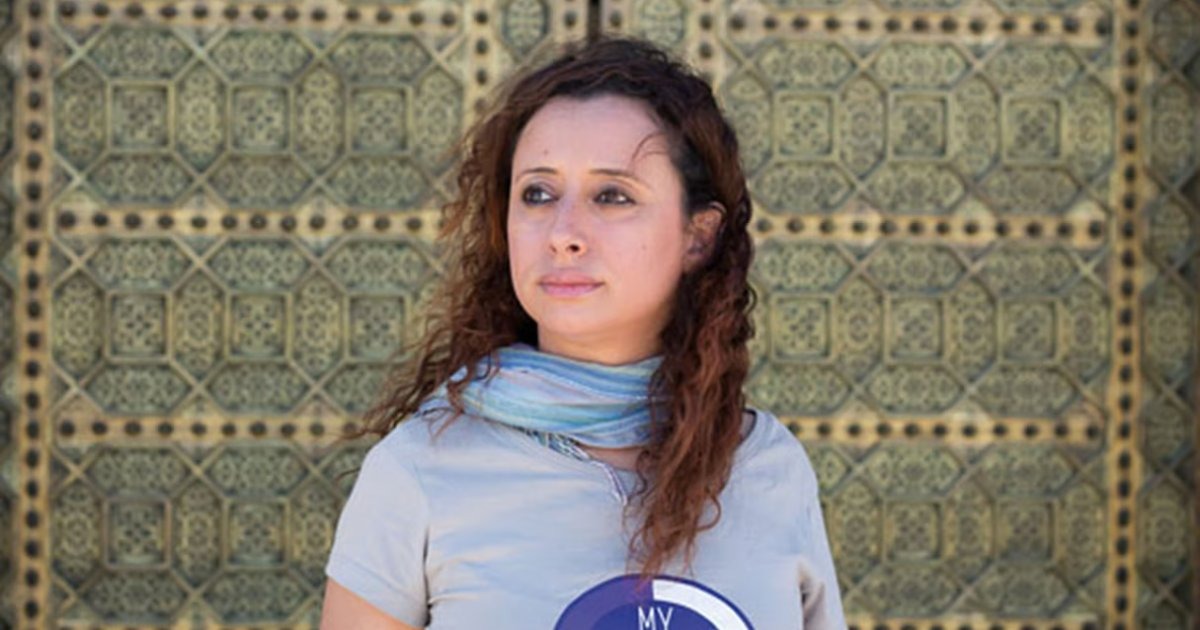
It’s worth noting that Ibtissam “Betty” Lachgar, one of Morocco’s most prominent human rights activists, was arrested in Rabat in August. She co-founded the Alternative Movement for Individual Liberties (MALI) in 2009; MALI defines itself as a global, feminist, secular civil disobedience movement that is against all forms of discrimination and supports equal rights. It advocates for individual freedoms and rights in Morocco.
The phrase “Allah is lesbian” or “Allah is gay” has strong roots in historical feminist and queer feminist movements, which emerged between the 1970s and 1990s as part of broader movements challenging patriarchal systems in religion and society.
A political stance, not a religious offense
Lachgar’s case began at the end of July, when she posted a photo of herself on her X account wearing a t-shirt that reads “Allah is lesbian.” Allah is written in Arabic on the t-shirt.
A few days later, things picked up after the former Minister of Justice and Liberties, Mustafa Ramid, published a post calling for Lachgar to be held accountable. This created a significant media uproar, prompting the Public Prosecution to act quickly and issue a decision to arrest Lachgar and directly put her on trial.
During the sentencing hearing, local media reported that Lachgar told the judge she did not intend to offend Islam. She pointed out that the controversial shirt she had worn was part of a feminist campaign organized in Europe against patriarchal ideologies, and that the photo she had posted was from May 2025 during her participation in a demonstration in London.
“I was not referring to Allah in Islam specifically—the concept of God varies from one religion to another, in Islam, Judaism, and Christianity—nor did I wear the shirt in Morocco. I wasn’t even in Morocco when I posted the photo,” Lachgar emphasized, insisting that this falls within freedom of expression.
As for describing “Allah” as a homosexual, as written on the t-shirt, Lachgar clarified that “homosexuality is not a negative attribute; on the contrary, it carries a positive connotation in this context.”
According to Agence France-Presse, the Moroccan activist’s defense team intends to appeal the initial ruling.
The defense team of three lawyers asserted that the prison administration has not yet provided any justification regarding the decision to place Lachgar in solitary confinement.
Critical health condition and demands for release on humanitarian grounds
Since the start of the trial sessions, it was decided that Lachgar would be placed in pretrial detention in Al-Arjat prison on the outskirts of Rabat. Naima el-Guellaf, a member of Lachgar’s defense team, has claimed that her client was “placed in solitary confinement and prevented from mixing with other inmates, which has caused her psychological state to deteriorate.”
The defense team of three lawyers asserted that the prison administration has not yet provided any justification regarding the decision to place Lachgar in solitary confinement.
Despite her critical health condition, she was not allowed to be prosecuted while at liberty. According to lawyer Naoufal Bouamri, head of the Moroccan Association for Human Rights, Lachgar suffers from cancer and requires urgent surgery, which was scheduled for September. Without it, she risks having her left arm amputated.
Bouamri warned that “Ibtissam’s health and psychological condition require, from a legal and humanitarian perspective, that she be monitored as a free woman. Legal alternatives like keeping her from travel or providing bail would allow her to undergo treatment in appropriate conditions.”
Lachgar was prosecuted under Article 267-5 of the Penal Code, which punishes anyone who offends Islam with imprisonment from six months to two years and a fine of 20,000 to 200,000 dirhams, or either of these two penalties.
And the penalty increases to imprisonment from two to five years and a fine of 50,000 to 500,000 dirhams, or either of these two penalties, if the aforementioned acts are committed though speeches, shouting, or threats made in public places and gatherings, or through any means that ensures publicity—including electronic, print, and audiovisual media.
Feminism, human rights, solidarity
The arrest of Moroccan activist Ibtissam Lachgar has sparked mixed reactions and a wave of solidarity from a number of human rights and feminist activists who called for her immediate and unconditional release, emphasizing that freedom of opinion and expression is a fundamental right that cannot be waived under any circumstances.
In this context, the Federal League for Women’s Rights expressed its deep concern and condemnation of the harassment and arrest Lachgar has been subjected to. It warned that the continued harassment of human rights defenders and attempts to silence their voices constitutes a serious regression from the human rights gains that Morocco has accumulated over decades.
Moroccan journalist Hajar Raissouni was prosecuted in the summer of 2019 on charges related to extramarital sex that resulted in an illegal pregnancy and abortion—charges she previously denied—and this was considered by international organizations to be a violation of privacy and an example of the lack of respect for individual freedoms in the country. She has also denounced Lachgar’s continued detention.
Raissouni, who currently resides outside of Morocco, described the matter as a “grave and unjustifiable mistake,” stating that “staying silent about this arrest is an indirect normalization of authorities’ exploitation of the persecution of activists.” She emphasized, “I have never condoned arresting people or depriving them of their freedom in response to them voicing their position or opinion—even if I disagree with them.”
“What have we gained from Ibtissam’s arrest? What danger did she really pose by expressing her opinion—even if it was in a provocative manner?”
Despite the criticism and attacks Raissouni faced on social media, particularly on her Facebook page, she maintained her position. “I will continue to demand her release, because we are not living in the Inquisition. What have we gained from Ibtissam’s arrest? What danger did she really pose by expressing her opinion—even if it was in a provocative manner?”
Other activists have different views on how to best defend women’s and minority rights in contexts as specific and complex as Morocco’s, where social and cultural norms are a decisive factor in shaping attitudes toward these issues.
Moroccan journalist Nora Fouari, known for her bold stances on freedoms, believes that using radical or provocative rhetoric could lead to a clash with prevailing mentalities in society and create collective rejection that might weaken the intended impact of the message. “This has brought Islamists and conservatives out of their shells. They’ve launched a widespread attack on modernists and defenders of individual freedoms, thus helping consolidate the negative stereotypes surrounding these people,” she adds.
Disappointments
The verdict against Ibtissam Lachgar shocked human rights circles and activists who had hoped for her release or that she would at least be able to benefit from the alternative penalties that entered into force in Moroccan courts on August 22.
As part of this new approach, Moroccan courts have begun to convert prison sentences in misdemeanor cases into alternative punishments, such as community service or judicial supervision. This comes within the context of reforms aimed at reducing overcrowding in prisons and promoting restorative justice.
This situation raises questions about the possibility of implementing these judicial alternatives in a comprehensive manner, particularly in legal cases related to fundamental freedoms such as that of Ibtissam “Betty” Lachgar.