• it VO
  • fr Français
  • en English
  • ar العربية
About us
  • In-depth
    • All
    • Features
    • Files
    • World
    Morocco: 600 abortions a day—Alarming figures and tragic stories

    Morocco: 600 abortions a day—Alarming figures and tragic stories

    In Spain, the right to abortion is not guaranteed for all

    In Spain, the right to abortion is not guaranteed for all

    Invisible and vulnerable: Migrant women at the frontlines of Spain’s prostitution debate

    Invisible and vulnerable: Migrant women at the frontlines of Spain’s prostitution debate

    Serbia: Is contraception a luxury or a basic human right?

    Serbia: Is contraception a luxury or a basic human right?

    Rebels, witnesses, victims: Women against the mafia (3/3)

    Rebels, witnesses, victims: Women against the mafia (3/3)

    Trending Tags

    • Women artists
    • Ecofeminism
    • Women living from and on the streets
    • Women and bodies
    • Women and sports
    • Women and cinema
    • Ramadan series
    • Women and war
    • Women Living at the Margins
    • Press Freedom from the Perspective of Women Journalists
    • Period poverty
    • Gynecological violence
    • Women and prison
    • Safe spaces
    • Abortion and SRHR
    • Transgenderism
    • Women in rural areas
  • On the move
    Spain: CEAR and the fight against human trafficking

    Spain: CEAR and the fight against human trafficking

    Gaza: How many journalists must be killed for the world to react?

    Gaza: How many journalists must be killed for the world to react?

    Moroccan activist Ibtissam Lachgar held in solitary confinement, health in crisis

    Moroccan activist Ibtissam Lachgar held in solitary confinement, health in crisis

    Three women for one man’s pay: The plight of female agricultural workers in Egypt

    Three women for one man’s pay: The plight of female agricultural workers in Egypt

  • Portraits
    Sophie Bessis: “The battle for the intimate will be long, especially in the Global South!”

    Sophie Bessis: “The battle for the intimate will be long, especially in the Global South!”

    “Mom, Dad, Can We Talk About Privacy?”—A Tunisian children’s book on protecting kids from sexual violence

    “Mom, Dad, Can We Talk About Privacy?”—A Tunisian children’s book on protecting kids from sexual violence

    Kurdish journalist killed in Turkish drone strike in northeastern Syria

    Kurdish journalist killed in Turkish drone strike in northeastern Syria

    A Filmmaker’s Journey: Inside the Creative World of Margarita Bareikyte

    A Filmmaker’s Journey: Inside the Creative World of Margarita Bareikyte

  • Creations
    • All
    • Reviews
    • Visual Arts
    “La Malédiction (1)”, a theatrical adaptation of King Kong Theory bursting with Tunisian rage

    “La Malédiction (1)”, a theatrical adaptation of King Kong Theory bursting with Tunisian rage

    “Mom, Dad, Can We Talk About Privacy?”—A Tunisian children’s book on protecting kids from sexual violence

    “Mom, Dad, Can We Talk About Privacy?”—A Tunisian children’s book on protecting kids from sexual violence

    The El’Sardines series, a delicate feminist manifesto centered around an ecological mystery

    The El’Sardines series, a delicate feminist manifesto centered around an ecological mystery

    Atlantics, a film by Mati Diop: Filming the embodied resistance of spirits

    Atlantics, a film by Mati Diop: Filming the embodied resistance of spirits

  • Opinion
    Women in Gaza are living their worst nightmares - “ I want to go back to my life before the war, to my privacy, my home ”

    Women in Gaza are living their worst nightmares - “ I want to go back to my life before the war, to my privacy, my home ”

    Messages from life under bombardment—Can a mother cope with losing her six children at once? (10)

    Messages from life under bombardment—Can a mother cope with losing her six children at once? (10)

    Messages from life under bombardment—No cake for my children on their birthdays (9)

    Messages from life under bombardment—No cake for my children on their birthdays (9)

    Messages from life under bombardment – No food or water in Gaza (8)

    Messages from life under bombardment – No food or water in Gaza (8)

  • Multimedia
    "I hope it doesn’t go viral: Journalism and sexist attacks in digital age". A video investigation by Çiçek Tahaoğlu

    "I hope it doesn’t go viral: Journalism and sexist attacks in digital age". A video investigation by Çiçek Tahaoğlu

    Period poverty in Montenegro

    Period poverty in Montenegro

    Period poverty in France (1)

    Period poverty in France (1)

    Period Poverty in Italy

    Period Poverty in Italy

  • Country context
No Result
View All Result
BLOGS
Medfeminiswiya
  • In-depth
    • All
    • Features
    • Files
    • World
    Morocco: 600 abortions a day—Alarming figures and tragic stories

    Morocco: 600 abortions a day—Alarming figures and tragic stories

    In Spain, the right to abortion is not guaranteed for all

    In Spain, the right to abortion is not guaranteed for all

    Invisible and vulnerable: Migrant women at the frontlines of Spain’s prostitution debate

    Invisible and vulnerable: Migrant women at the frontlines of Spain’s prostitution debate

    Serbia: Is contraception a luxury or a basic human right?

    Serbia: Is contraception a luxury or a basic human right?

    Rebels, witnesses, victims: Women against the mafia (3/3)

    Rebels, witnesses, victims: Women against the mafia (3/3)

    Trending Tags

    • Women artists
    • Ecofeminism
    • Women living from and on the streets
    • Women and bodies
    • Women and sports
    • Women and cinema
    • Ramadan series
    • Women and war
    • Women Living at the Margins
    • Press Freedom from the Perspective of Women Journalists
    • Period poverty
    • Gynecological violence
    • Women and prison
    • Safe spaces
    • Abortion and SRHR
    • Transgenderism
    • Women in rural areas
  • On the move
    Spain: CEAR and the fight against human trafficking

    Spain: CEAR and the fight against human trafficking

    Gaza: How many journalists must be killed for the world to react?

    Gaza: How many journalists must be killed for the world to react?

    Moroccan activist Ibtissam Lachgar held in solitary confinement, health in crisis

    Moroccan activist Ibtissam Lachgar held in solitary confinement, health in crisis

    Three women for one man’s pay: The plight of female agricultural workers in Egypt

    Three women for one man’s pay: The plight of female agricultural workers in Egypt

  • Portraits
    Sophie Bessis: “The battle for the intimate will be long, especially in the Global South!”

    Sophie Bessis: “The battle for the intimate will be long, especially in the Global South!”

    “Mom, Dad, Can We Talk About Privacy?”—A Tunisian children’s book on protecting kids from sexual violence

    “Mom, Dad, Can We Talk About Privacy?”—A Tunisian children’s book on protecting kids from sexual violence

    Kurdish journalist killed in Turkish drone strike in northeastern Syria

    Kurdish journalist killed in Turkish drone strike in northeastern Syria

    A Filmmaker’s Journey: Inside the Creative World of Margarita Bareikyte

    A Filmmaker’s Journey: Inside the Creative World of Margarita Bareikyte

  • Creations
    • All
    • Reviews
    • Visual Arts
    “La Malédiction (1)”, a theatrical adaptation of King Kong Theory bursting with Tunisian rage

    “La Malédiction (1)”, a theatrical adaptation of King Kong Theory bursting with Tunisian rage

    “Mom, Dad, Can We Talk About Privacy?”—A Tunisian children’s book on protecting kids from sexual violence

    “Mom, Dad, Can We Talk About Privacy?”—A Tunisian children’s book on protecting kids from sexual violence

    The El’Sardines series, a delicate feminist manifesto centered around an ecological mystery

    The El’Sardines series, a delicate feminist manifesto centered around an ecological mystery

    Atlantics, a film by Mati Diop: Filming the embodied resistance of spirits

    Atlantics, a film by Mati Diop: Filming the embodied resistance of spirits

  • Opinion
    Women in Gaza are living their worst nightmares - “ I want to go back to my life before the war, to my privacy, my home ”

    Women in Gaza are living their worst nightmares - “ I want to go back to my life before the war, to my privacy, my home ”

    Messages from life under bombardment—Can a mother cope with losing her six children at once? (10)

    Messages from life under bombardment—Can a mother cope with losing her six children at once? (10)

    Messages from life under bombardment—No cake for my children on their birthdays (9)

    Messages from life under bombardment—No cake for my children on their birthdays (9)

    Messages from life under bombardment – No food or water in Gaza (8)

    Messages from life under bombardment – No food or water in Gaza (8)

  • Multimedia
    "I hope it doesn’t go viral: Journalism and sexist attacks in digital age". A video investigation by Çiçek Tahaoğlu

    "I hope it doesn’t go viral: Journalism and sexist attacks in digital age". A video investigation by Çiçek Tahaoğlu

    Period poverty in Montenegro

    Period poverty in Montenegro

    Period poverty in France (1)

    Period poverty in France (1)

    Period Poverty in Italy

    Period Poverty in Italy

  • Country context
About us
Medfeminiswiya
About us

Imposed Gender Segregation

This news has been favorably received by parts of the populations of several Muslim countries, including Algeria, which consider the mixing of genders to be a danger to society.

Wiame Awres by Wiame Awres
6 October 2023
in Opinion
62 2
0
Share on FacebookShare on Twitter

This post is also available in: Français (French)

Even though the common experiences of female activists have led them to opt for gender segregation as a tool for the development of political analysis and strategies of struggle, this is still an isolated practice and represents the very opposite of imposed gender segregation.

Last month, Kuwait put an end to coeducation in universities. Despite student protests, classes this year will be single-sex. And this news has been favorably received by parts of the populations of several Muslim countries, including Algeria, which consider the mixing of genders to be a danger to society. Yet the single-sex organizations which were already established in multiple locations did not result in any sort of decrease in violence against women.

In Algeria, as soon as a queue forms in bakeries, at the post office, or in front of any counter, it is separated into two: one for women, one for men. People go in turn—a woman, then a man, then a woman again. When the men’s line is longer, two men pass for every woman.

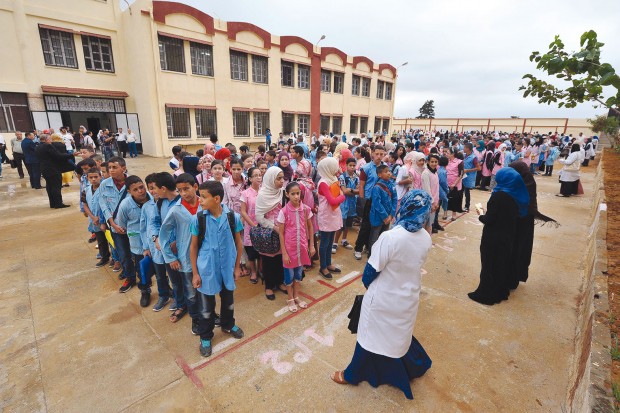
Gender segregation and all kinds of marked separation between the sexes is practiced from childhood. In primary school, girls have to wear pink aprons, boys have to wear blue ones, and white aprons are not allowed. In addition to this separation through color, there are even pink and blue lines in schoolyards to designate where girls and boys should respectively gather.

Asma, who has a 9-year-old daughter enrolled at a school in Algiers, was summoned by the Arabic teacher just a few days into the school year because her daughter was sitting with a boy: “I have no problem with my daughter sitting with a classmate of hers—who also happens to be a neighbor of ours. Stopping her from doing so would imply that she’s doing something wrong. The teacher considered this abnormal, and I had to complain to the principal for him to intervene. Still, my daughter later told me that the teacher had changed her place to sit her with a girl.” The boy’s parents were not summoned.

Boys and girls continue to be separated throughout middle and high school. Even if classes are mixed, certain teachers or principals can impose the separation of male and female students: by separating their desks, forbidding them to hang out together during recess, and calling their parents—especially the girls’.

Hakima, who is 18, recounts how she was harassed by several female supervisors at her high school in Blida because she was talking to boys during recess: “I had some friends who were boys, and I used to hang out with one of them. The supervisors always spoke to me with contempt, it’s like they were looking for the slightest pretext to punish me. One of them even called my parents and insisted that my father be the one to show up to school. She told him that he needed to watch me more closely, that she was afraid for me because of my behavior. Fortunately, my father didn’t believe her. She kept asking me to button up my apron even though there was only one button that was open. If I ever had lip gloss on, she made me take it off. And if I was talking to a boy, she always told us to move farther apart, even though we were absolutely never standing close together.”

Yet the male gaze has gone nowhere, despite this gender segregation. Videos of women dancing together in single-sex spaces are posted and spread online with millions of views.

In recent years, a number of places such as restaurants, swimming pools, spas, beaches, campsites, and hotels have started to put up signs stating that the establishment is “family friendly” or “prohibited for couples.” Some beaches, including those located in the capital, are only populated by men even though access is not formally prohibited for women; there have been more and more private beaches emerging for women. Men and women have to resort to private spaces to be able to spend time together peacefully, and this is becoming increasingly common. But Yasmine, who is in her thirties, prefers single-sex spaces: “When I go to the private beach reserved for women, I know I’ll be left alone, that there won’t be any men looking at me. It’s either that or I’m not going to the beach.”

During wedding celebrations, the separation between genders is clearly marked: there is a room for women and another for men. Otherwise, people stay outside. Mixed parties, which used to be more common in the early 2000s, are increasingly rare today. Yet the male gaze has gone nowhere, despite this gender segregation. Videos of women dancing together in single-sex spaces are posted and spread online with millions of views. Monitoring agencies have been set up to counter this and take phones away from female guests or even to keep track of any woman filming during a party.

There have been several calls on social media to create different transportation networks for women and men, or to organize seating arrangements in a way that is gender segregated. The motivation behind this separation would be to prevent “fitna” (temptation). But it is true that for women, using public transportation is a real ordeal considering how widespread sexual harassment is. Djamila, a 30-year-old woman from Oran, sees only a temporary solution in this: “I spend a lot of money on taxis. I can’t stand the comments men make anymore, or how insistent they are. Just this month, a man touched my backside on the bus. I do my best to sit next to women when I can, but it’s not always possible, and the presence of any man has become a potential danger.”

Even when it comes to medical care, many women have asserted their preference for female doctors. And it is not uncommon for men to refuse to have their wives go see a male doctor. In medical practices, there are separate waiting rooms for women and men. In mosques, the large room is for men, while the small room, often isolated, is for women to use. The only exception is Masjid al-Haram, the Great Mosque of Mecca, where men and women pray together, but not side by side—men go to the front, while women pray behind them. Everything is done to keep the sexes separate. When the space itself cannot be divided, the hijab hides women from view.

This non-mixing is largely imposed by religious discourse, broadcast excessively by television channels and on social media. This past September, imam Chemseddine Bouroubi posted a video in which he clearly announces that it is strictly haram (religiously forbidden) for women to consult a male gynecologist, unless it is vitally necessary. Numerous fatwas issued by Sheikh Ferkous, a Salafist preacher, formally prohibit the mixing of men and women, even going so far as to prohibit women from working because it is up to their guardians to provide for their needs; if this is not possible, then they must be veiled. He also argues that “when a woman needs to leave her home to run some errands, like seek treatment, do groceries, or go to the mosque (…), she may only go out after the authorization and approval of her guardian or husband” (Fatwa n. 451 of Sheikh Ferkous).

Yet the more non-mixing is imposed, the more voyeurism intensifies, and violence is increasingly acted out against women.

These types of prohibitions abound everywhere on the internet, and society has set up an organization to apply these instructions. According to these imams, the mixing of genders is morally dangerous and is the cause of one the greatest scourges: sexual relations. Yet the more non-mixing is imposed, the more voyeurism intensifies, and violence is increasingly acted out against women. We can see the result of this in many cities: streets completely devoid of women, and if women do appear in these public spaces, it is only to head from one private space to another, hidden under their hijabs.

Gender segregation is just another method of excluding women. We hear a man’s voice calling to prayer five times a day and never hear any female voice giving the adhan (the call to prayer) in any mosque in Muslim countries. Women’s tajweed (chanted reading of the Quran) is also restricted in mixed spaces, while men’s isn’t. Even when one family is praying together, it’s the man who recites the prayer, never the woman.

Society thus creates veritable gender segregation such that men and women cannot speak to each other unless strictly necessary. They cannot socialize, cannot shake hands. Any relationship between the sexes becomes suspicious, and male excesses are justified by women’s clothes or behavior: this includes street harassment, rape, physical violence. Men and women are either separated by space or the hijab, but this model is based on a lie: that men cannot control themselves, and that if they are tempted, it’s the woman’s fault. A man’s actions are always justified. He is always relieved of responsibility or accountability. Even children are not spared in this equation, in the face of pedophiles. What should we do, then, hide little girls and boys away?

Wiame Awres

Wiame Awres

Wiame Awres est militante féministe et cofondatrice du site "Féminicides Algérie" qui recense, depuis 2020, les féminicides en Algérie. Elle est également réalisatrice de films documentaires.

Related posts

مصر: مسيحيات يُعاملن كمسلمات في قوانين الميراث
Opinion

مصر: مسيحيات يُعاملن كمسلمات في قوانين الميراث

by Shaimaa El Youssef
30 December 2024
902

ينصُّ القانون الكنسي المسيحي على المساواة بين الجنسين في توزيع الإرث بين الورثة، سواء كانوا ذكوراً أم إناثاً. ومع ذلك،...

Opinion

Pair the word hijab with compulsory so we can have a proper discussion about it

by Contributor with Medfeminiswiya
5 October 2022
424

Many feminists insist on the importance of choosing our words to better take people’s feelings into account – and there...

France : Le voile, un plafond de verre pour les femmes musulmanes

France : Le voile, un plafond de verre pour les femmes musulmanes

31 March 2025
341
The exhausted feminist tools and quick-fix solutions

The exhausted feminist tools and quick-fix solutions

28 June 2022
247

Leave a Reply Cancel reply

Your email address will not be published. Required fields are marked *

J'accepte les termes et conditions et la Politique de confidentialité .

Medfeminiswiya

Medfeminiswiya is a feminist network that brings together women journalists working in the fields of media and content production in the Mediterranean region.

Newsletter


    Follow us

    Browse topics


    • In-depth
    • Files
    • Features
    • On the move
    • Portraits
    • Opinion

    • Creations
    • Visual Arts
    • Reviews
    • Multimedia
    • Country Context
    • Blogs
    • About us
    • Our community
    • Our partners
    • Become a member
    • Editorial charter
    • Disclaimer

    © 2025 Medfeminiswiya - Mediterranean Network for Feminist Information

    • it VO
    • fr Français
    • en English
    • ar العربية
    • In-depth
    • On the move
    • Portraits
    • Creations
    • Opinion
    • Multimedia
    • Country context
    • Blogs
    No Result
    View All Result

    © 2025 Medfeminiswiya - Mediterranean Network for Feminist Information

    Welcome Back!

    Login to your account below

    Forgotten Password?

    Retrieve your password

    Please enter your username or email address to reset your password.

    Log In

    Add New Playlist

    Ce site n'utilise pas de cookies. This website does not use cookies. هذا الموقع لا يستخدم ملفات تعريف الارتباط.