• it VO
  • fr Français
  • en English
  • ar العربية
About us
  • In-depth
    • All
    • Features
    • Files
    • World
    In Mediterranean Region: Sexual and Reproductive Rights Under Pressure

    In Mediterranean Region: Sexual and Reproductive Rights Under Pressure

    Morocco: 600 abortions a day—Alarming figures and tragic stories

    Morocco: 600 abortions a day—Alarming figures and tragic stories

    In Spain, the right to abortion is not guaranteed for all

    In Spain, the right to abortion is not guaranteed for all

    Invisible and vulnerable: Migrant women at the frontlines of Spain’s prostitution debate

    Invisible and vulnerable: Migrant women at the frontlines of Spain’s prostitution debate

    Serbia: Is contraception a luxury or a basic human right?

    Serbia: Is contraception a luxury or a basic human right?

    Trending Tags

    • Women artists
    • Ecofeminism
    • Women living from and on the streets
    • Women and bodies
    • Women and sports
    • Women and cinema
    • Ramadan series
    • Women and war
    • Women Living at the Margins
    • Press Freedom from the Perspective of Women Journalists
    • Period poverty
    • Gynecological violence
    • Women and prison
    • Safe spaces
    • Abortion and SRHR
    • Transgenderism
    • Women in rural areas
  • On the move
    Spain: CEAR and the fight against human trafficking

    Spain: CEAR and the fight against human trafficking

    Gaza: How many journalists must be killed for the world to react?

    Gaza: How many journalists must be killed for the world to react?

    Moroccan activist Ibtissam Lachgar held in solitary confinement, health in crisis

    Moroccan activist Ibtissam Lachgar held in solitary confinement, health in crisis

    Three women for one man’s pay: The plight of female agricultural workers in Egypt

    Three women for one man’s pay: The plight of female agricultural workers in Egypt

  • Portraits
    Sophie Bessis: “The battle for the intimate will be long, especially in the Global South!”

    Sophie Bessis: “The battle for the intimate will be long, especially in the Global South!”

    “Mom, Dad, Can We Talk About Privacy?”—A Tunisian children’s book on protecting kids from sexual violence

    “Mom, Dad, Can We Talk About Privacy?”—A Tunisian children’s book on protecting kids from sexual violence

    Kurdish journalist killed in Turkish drone strike in northeastern Syria

    Kurdish journalist killed in Turkish drone strike in northeastern Syria

    A Filmmaker’s Journey: Inside the Creative World of Margarita Bareikyte

    A Filmmaker’s Journey: Inside the Creative World of Margarita Bareikyte

  • Creations
    • All
    • Reviews
    • Visual Arts
    “La Malédiction (1)”, a theatrical adaptation of King Kong Theory bursting with Tunisian rage

    “La Malédiction (1)”, a theatrical adaptation of King Kong Theory bursting with Tunisian rage

    “Mom, Dad, Can We Talk About Privacy?”—A Tunisian children’s book on protecting kids from sexual violence

    “Mom, Dad, Can We Talk About Privacy?”—A Tunisian children’s book on protecting kids from sexual violence

    The El’Sardines series, a delicate feminist manifesto centered around an ecological mystery

    The El’Sardines series, a delicate feminist manifesto centered around an ecological mystery

    Atlantics, a film by Mati Diop: Filming the embodied resistance of spirits

    Atlantics, a film by Mati Diop: Filming the embodied resistance of spirits

  • Opinion
    Women in Gaza are living their worst nightmares - “ I want to go back to my life before the war, to my privacy, my home ”

    Women in Gaza are living their worst nightmares - “ I want to go back to my life before the war, to my privacy, my home ”

    Messages from life under bombardment—Can a mother cope with losing her six children at once? (10)

    Messages from life under bombardment—Can a mother cope with losing her six children at once? (10)

    Messages from life under bombardment—No cake for my children on their birthdays (9)

    Messages from life under bombardment—No cake for my children on their birthdays (9)

    Messages from life under bombardment – No food or water in Gaza (8)

    Messages from life under bombardment – No food or water in Gaza (8)

  • Multimedia
    "I hope it doesn’t go viral: Journalism and sexist attacks in digital age". A video investigation by Çiçek Tahaoğlu

    "I hope it doesn’t go viral: Journalism and sexist attacks in digital age". A video investigation by Çiçek Tahaoğlu

    Period poverty in Montenegro

    Period poverty in Montenegro

    Period poverty in France (1)

    Period poverty in France (1)

    Period Poverty in Italy

    Period Poverty in Italy

  • Country context
No Result
View All Result
BLOGS
Medfeminiswiya
  • In-depth
    • All
    • Features
    • Files
    • World
    In Mediterranean Region: Sexual and Reproductive Rights Under Pressure

    In Mediterranean Region: Sexual and Reproductive Rights Under Pressure

    Morocco: 600 abortions a day—Alarming figures and tragic stories

    Morocco: 600 abortions a day—Alarming figures and tragic stories

    In Spain, the right to abortion is not guaranteed for all

    In Spain, the right to abortion is not guaranteed for all

    Invisible and vulnerable: Migrant women at the frontlines of Spain’s prostitution debate

    Invisible and vulnerable: Migrant women at the frontlines of Spain’s prostitution debate

    Serbia: Is contraception a luxury or a basic human right?

    Serbia: Is contraception a luxury or a basic human right?

    Trending Tags

    • Women artists
    • Ecofeminism
    • Women living from and on the streets
    • Women and bodies
    • Women and sports
    • Women and cinema
    • Ramadan series
    • Women and war
    • Women Living at the Margins
    • Press Freedom from the Perspective of Women Journalists
    • Period poverty
    • Gynecological violence
    • Women and prison
    • Safe spaces
    • Abortion and SRHR
    • Transgenderism
    • Women in rural areas
  • On the move
    Spain: CEAR and the fight against human trafficking

    Spain: CEAR and the fight against human trafficking

    Gaza: How many journalists must be killed for the world to react?

    Gaza: How many journalists must be killed for the world to react?

    Moroccan activist Ibtissam Lachgar held in solitary confinement, health in crisis

    Moroccan activist Ibtissam Lachgar held in solitary confinement, health in crisis

    Three women for one man’s pay: The plight of female agricultural workers in Egypt

    Three women for one man’s pay: The plight of female agricultural workers in Egypt

  • Portraits
    Sophie Bessis: “The battle for the intimate will be long, especially in the Global South!”

    Sophie Bessis: “The battle for the intimate will be long, especially in the Global South!”

    “Mom, Dad, Can We Talk About Privacy?”—A Tunisian children’s book on protecting kids from sexual violence

    “Mom, Dad, Can We Talk About Privacy?”—A Tunisian children’s book on protecting kids from sexual violence

    Kurdish journalist killed in Turkish drone strike in northeastern Syria

    Kurdish journalist killed in Turkish drone strike in northeastern Syria

    A Filmmaker’s Journey: Inside the Creative World of Margarita Bareikyte

    A Filmmaker’s Journey: Inside the Creative World of Margarita Bareikyte

  • Creations
    • All
    • Reviews
    • Visual Arts
    “La Malédiction (1)”, a theatrical adaptation of King Kong Theory bursting with Tunisian rage

    “La Malédiction (1)”, a theatrical adaptation of King Kong Theory bursting with Tunisian rage

    “Mom, Dad, Can We Talk About Privacy?”—A Tunisian children’s book on protecting kids from sexual violence

    “Mom, Dad, Can We Talk About Privacy?”—A Tunisian children’s book on protecting kids from sexual violence

    The El’Sardines series, a delicate feminist manifesto centered around an ecological mystery

    The El’Sardines series, a delicate feminist manifesto centered around an ecological mystery

    Atlantics, a film by Mati Diop: Filming the embodied resistance of spirits

    Atlantics, a film by Mati Diop: Filming the embodied resistance of spirits

  • Opinion
    Women in Gaza are living their worst nightmares - “ I want to go back to my life before the war, to my privacy, my home ”

    Women in Gaza are living their worst nightmares - “ I want to go back to my life before the war, to my privacy, my home ”

    Messages from life under bombardment—Can a mother cope with losing her six children at once? (10)

    Messages from life under bombardment—Can a mother cope with losing her six children at once? (10)

    Messages from life under bombardment—No cake for my children on their birthdays (9)

    Messages from life under bombardment—No cake for my children on their birthdays (9)

    Messages from life under bombardment – No food or water in Gaza (8)

    Messages from life under bombardment – No food or water in Gaza (8)

  • Multimedia
    "I hope it doesn’t go viral: Journalism and sexist attacks in digital age". A video investigation by Çiçek Tahaoğlu

    "I hope it doesn’t go viral: Journalism and sexist attacks in digital age". A video investigation by Çiçek Tahaoğlu

    Period poverty in Montenegro

    Period poverty in Montenegro

    Period poverty in France (1)

    Period poverty in France (1)

    Period Poverty in Italy

    Period Poverty in Italy

  • Country context
About us
Medfeminiswiya
About us

Feminism in Algeria: a brief overview

Women who then dared to claim equal rights were treated as “westernised”, “prostitutes”, “disbelievers” and “girls of the French party”. The argument that the Family Code was in contradiction with the Constitution in its Article 29, which provides for equality before the law was no longer even enforceable.

Ghania Khelifi by Ghania Khelifi
6 January 2021
in Algeria, Algeria, Country Context
254 17
0
Share on FacebookShare on Twitter

This post is also available in: Français (French) العربية (Arabic)

Historical context

In 1984, the patriarchal system won one of its finest victories in Algeria. The Family Code adopted by an almost exclusively male national assembly came into force. All relations between family members will be governed by this text, the inferior status of Algerian women in their private life was now enshrined. The collectives of women supported by the moudjahidates (fighters in the national liberation war) were strongly mobilized against this “gift” made by the conservatives of the single party FLN (National Liberation Front) to the Islamists. Sit-ins in front of the assembly, demonstrations and marches failed to repeal this law.
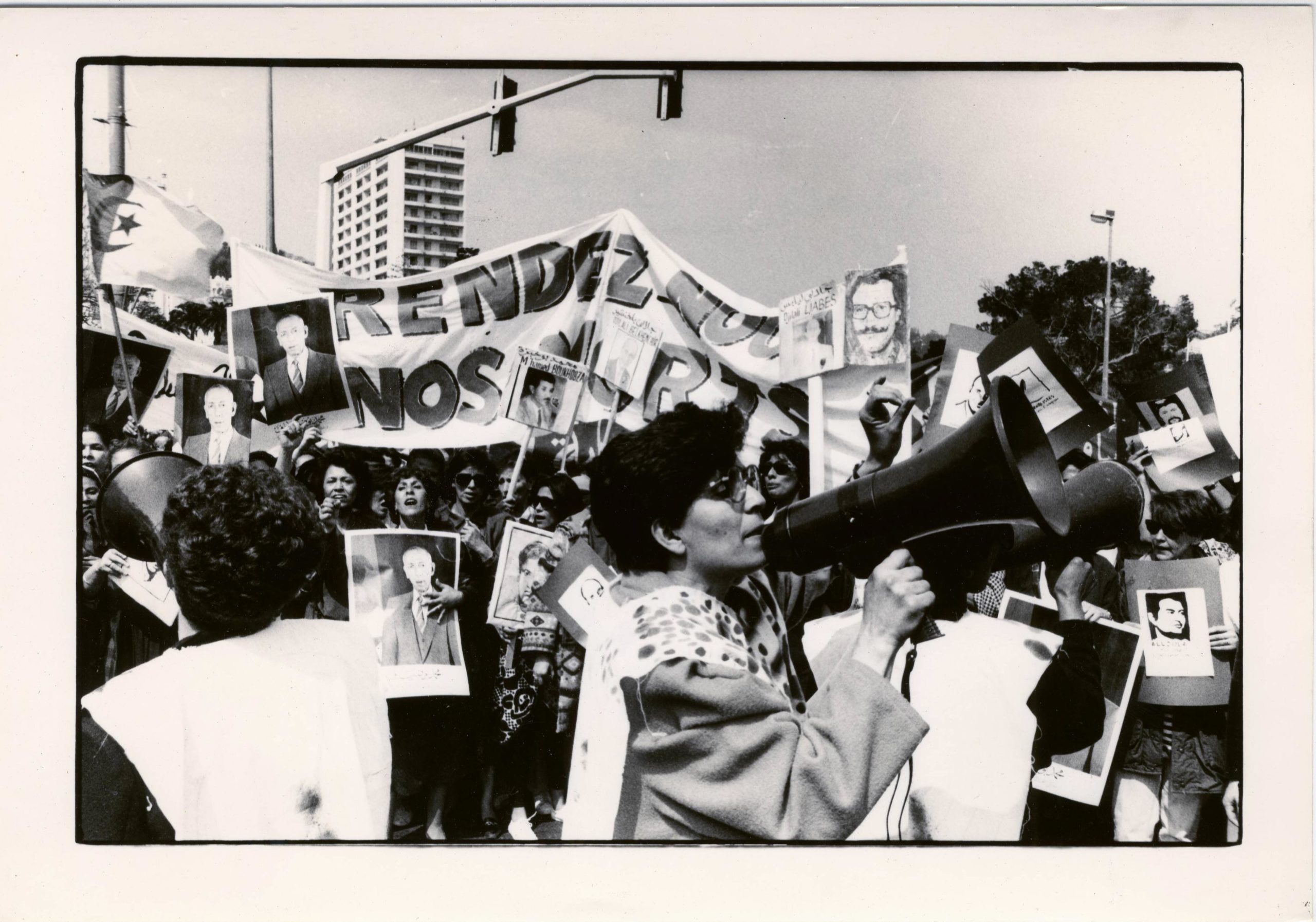
Gathering to denounce Islamist attacks, women's movement. Algeria, 22/03/1994. Foreground: Zazi Sadou RAFD Archives

In the 1980s, Algeria went through an unprecedented economic crisis and social instability that gave birth to a repressed popular revolt that ended in bloodshed on 5 October 1988. The Islamists were the big winners of this deliquescence of the regime in place and its violence against the people. The fruit was ripe and it was picked by the FIS (Front du salut islamique - Islamic Salvation Front), which won the local elections in 1990. Women who then dared to claim equal rights were treated as “westernised”, “prostitutes”, “disbelievers” and “girls of the French party”. The argument that the Family Code (of infamy according to feminists) was in contradiction with the Constitution in its Article 29, which provides for equality before the law was no longer even enforceable since the Islamists recognize the Koran as the only constitution. Yet, the Code is based on Sharia law and therefore becomes untouchable.

As during the war of liberation from French colonialism, Algerian women paid the price of resistance to Islamist extremism.

From the beginning of the 1990s, citizen and more particularly feminist demands entered their freezing phase. What was later called the black decade was doomed to survive the attacks and massacres perpetrated by armed Islamist groups.

Far from being blind, terrorism has primarily targeted intellectuals, artists, activists for the rights of citizens and, of course, feminists. As during the war of liberation from French colonialism, Algerian women paid the price of resistance to Islamist extremism. They have suffered rapes, kidnappings, torture and assassinations because they refused to give up their work, to wear the veil, to deliver their children to the maquis, to condone obscurantism and violence and for having played the role of political and community activists.

Popular resistance eventually triumphed over the armed groups, but the seeds of regression were already well sown. The law of national reconciliation led by former President Abdelaziz Bouteflika gave pride of place to supposedly repentant extremists but ignored the plight of women raped by them. A sordid bargaining with the religious authorities then followed for the recognition of these victims as such.

The feminist movement in Algeria

Despite everything, hope is reborn with President Bouteflika who promises, among other smoke and mirrors, to give more space to women. In 2005, a reform of the code somewhat loosened the grip. Upon marriage, the guardian is no more than a representative of the wife, polygamy is subject to more restrictions, freedom to travel without the consent of the husband is granted, transmission of nationality by the mother dust off the law that remains unequal and discriminatory in its essence. Nonetheless, the taboo was lifted, the code was not a sacred text, even though we know that government initiatives often target the opinions of its Western partners.

That same year, Algeria signed the International Convention on the Elimination of All Forms of Discrimination Against Women but with reservations in the name of “respect for national laws, traditions, religion or culture.” The disappointment is great but activists do not give up. In 2012, their determination to emerge from the shadows forced the government to concede a new law to “increase the chances of women having access to better representation in elected assemblies”. The candidates are taking advantage of this quota policy to invest the benches of the national popular assembly with a record rate of 31.6%.

While the legal arsenal is gradually evolving, the reality of Algerian women is far from improving.

While the legal arsenal is gradually evolving, the reality of Algerian women is far from improving. The burden of traditions and religion sometimes erodes the advances of the law. Women are candidates but in “unwinnable” places on the electoral lists, they are executives and civil servants (20% of workers and two thirds of graduates) but never leaders, they are free but their bodies do not belong to them. Virginity before marriage, “reputation”, and the “values” of a good Muslim woman are all chains that forbid them to share public space with men and to lead their lives freely.

Forms of discrimination against women

The power of the patriarchy in Algeria manifests itself daily through street harassment, intra-family violence and femicides. It was not until 2015 that under pressure from women's rights activists, the legislator criminalized domestic violence, street harassment in public places, theft between spouses and the theft of a woman's property by her husband. Unfortunately, as often happens, the Algerian power takes back with one hand what it gives with the other. The “forgiveness clause” stipulates that legal proceedings are abandoned in the least serious cases if the wife “forgives” the abusive spouse and they are maintained but alleviated in serious cases.

Still, the phenomenon of femicide in all social categories is growing at the rate of one hundred to two hundred victims per year. The law and the police services do not protect women in danger due to a lack of training and resources, but more generally because they condone the violence of the spouse. The family home is under the authority of men who are the guarantors of its cohesion and its “honor”. This is the dominant mindset. Women are always reluctant to file a complaint against the father of their children or against a brother, or an uncle. It is considered as improper and she risks banishment. Without emergency accommodation structures and protection mechanisms, the victims sometimes try to resist until death.

Highlights

Feminists and especially young activists are changing mentalities, shaking up prejudices and Omerta thanks to the social networks they have invested to give visibility to these crimes with the aim of raising awareness. They are also on the streets demanding full citizenship. Never before have women of all ages and all walks of life been that numerous as in the Hirak protests of 22 February, 2019. They voiced their own demands for freedom alongside men. It is the start of a new stage in the long march of Algerian women towards equality. This time, they are determined to shout as loud as possible until they are heard.

Tags: Algeriaequalityfeminism
Ghania Khelifi

Ghania Khelifi

Ghania, a Sorbonne graduate, is the former editor-in-chief of the Algerian daily newspaper “Liberté” and a political journalist. She is also in charge of gender equality missions in France where she resides. Ghania holds a postgraduate degree on the work and career of Kateb Yacine, and was the first to sign the retrospective devoted to him, titled “Kateb Yacine, poèmes et éclats”, back in 1991 in Algiers, at the very beginning of Algeria’s “Black Decade.” Ghania has also been regularly contributing to babelmed.net since its creation as a specialist in Algerian society and its fabric.

Related posts

Feminism in Montenegro: a brief overview
Country Context

Feminism in Montenegro: a brief overview

by Paula Petričević
9 April 2021
978

When it comes to gender equality in Montenegro, the key legislations are the “Law on Gender Equality” adopted in 2007...

Feminism in Palestine: a brief overview
Country Context

Feminism in Palestine: a brief overview

by Contributor with Medfeminiswiya
9 April 2021
826

In return for their heroic role and their partnership with men in all areas of the liberation struggle, women are...

Feminism in Greece: a brief overview

Feminism in Greece: a brief overview

15 February 2022
2.2k
Women in Gaza cut off from accessing maternal health supplies as aid blockade enters fourth week

Women in Gaza cut off from accessing maternal health supplies as aid blockade enters fourth week

27 March 2025
28

Leave a Reply Cancel reply

Your email address will not be published. Required fields are marked *

J'accepte les termes et conditions et la Politique de confidentialité .

Medfeminiswiya

Medfeminiswiya is a feminist network that brings together women journalists working in the fields of media and content production in the Mediterranean region.

Newsletter


    Follow us

    Browse topics


    • In-depth
    • Files
    • Features
    • On the move
    • Portraits
    • Opinion

    • Creations
    • Visual Arts
    • Reviews
    • Multimedia
    • Country Context
    • Blogs
    • About us
    • Our community
    • Our partners
    • Become a member
    • Editorial charter
    • Disclaimer

    © 2025 Medfeminiswiya - Mediterranean Network for Feminist Information

    • it VO
    • fr Français
    • en English
    • ar العربية
    • In-depth
    • On the move
    • Portraits
    • Creations
    • Opinion
    • Multimedia
    • Country context
    • Blogs
    No Result
    View All Result

    © 2025 Medfeminiswiya - Mediterranean Network for Feminist Information

    Welcome Back!

    Login to your account below

    Forgotten Password?

    Retrieve your password

    Please enter your username or email address to reset your password.

    Log In

    Add New Playlist

    Ce site n'utilise pas de cookies. This website does not use cookies. هذا الموقع لا يستخدم ملفات تعريف الارتباط.