This post is also available in:
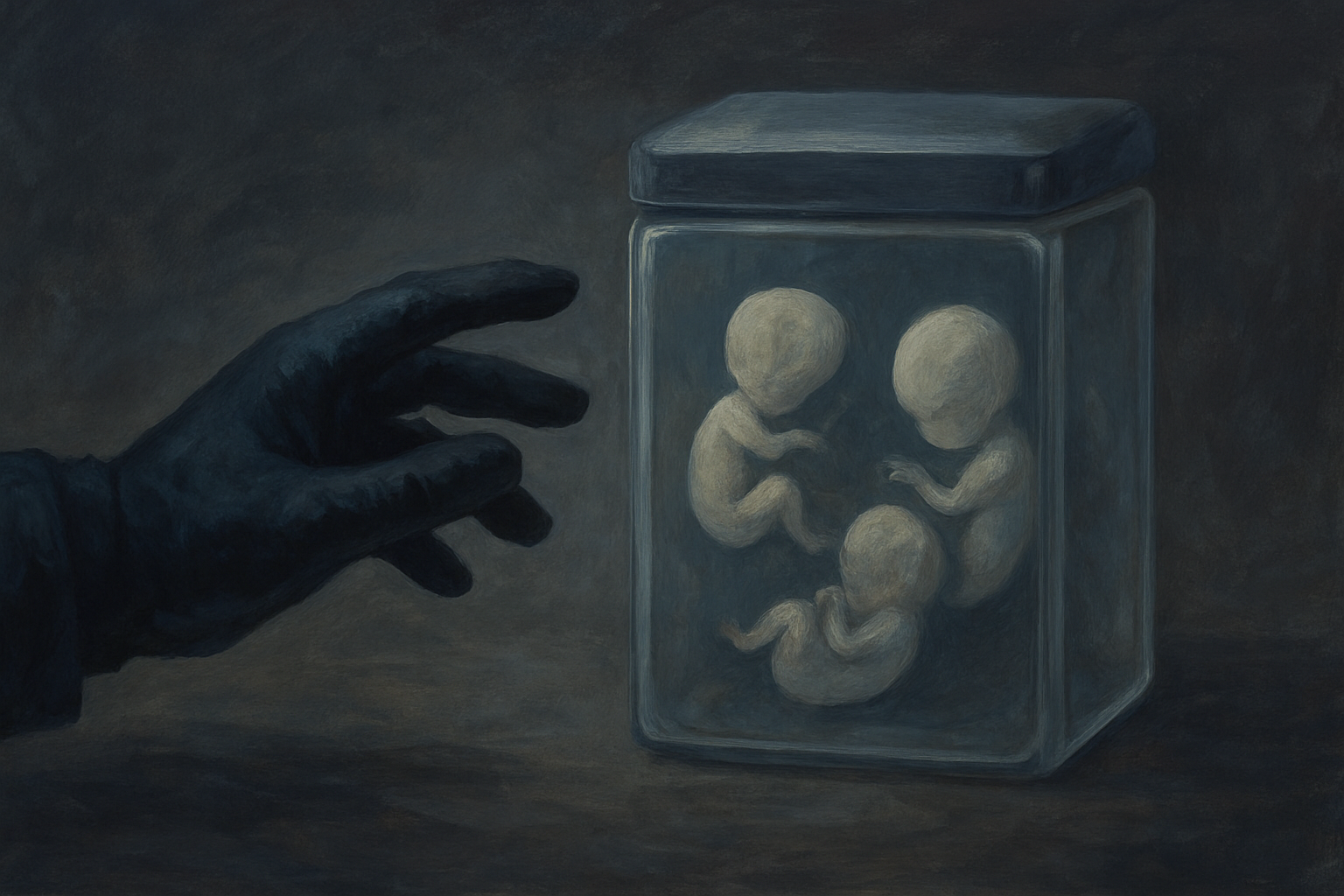
In December 2023, two months after the Israeli war on Gaza began, Israeli airstrikes targeted the Al-Basma IVF center, the largest fertility clinic in the Strip. The explosion destroyed the clinic’s walls and medical equipment and also obliterated more than 4,000 embryos and over 1,000 samples of sperm and unfertilized eggs stored in five liquid nitrogen tanks in the embryo unit. Since the beginning of the war, all nine fertility centers in Gaza have ceased operations. Al-Basma was the most advanced among them.
This war, which preemptively sentenced embryos to death, has also killed 68,159 civilians, including 12,400 women and 18,592 children, not to mention the tens of thousands missing, among them at least 5,000 women and children, according to the Palestinian Central Bureau of Statistics.
Testimonies from the heart of loss: Ahmad and Rania
Amid Israeli threats and evacuation orders, collecting testimonies from those who lost their embryos in the bombings of Gaza’s fertility centers was not easy. Among them are Ahmad Jarbou’, 30, and Rania Mohammad, 26, residents of Rafah, now displaced in the al-Mawasi area of Khan Yunis.
Ahmad and Rania married in 2017 but could not conceive due to a health condition affecting Ahmad. Their treatment journey began in 2018 and was fraught with difficulties, as doctors struggled to find viable samples because of his condition.
Their long, exhausting, and costly treatment involved several unsuccessful implantation attempts. Beyond the emotional strain, the couple also faced severe financial burdens from the cost of IVF procedures and medication, as well as the hardship of constant travel from Rafah in the south to Gaza City—several times a week—for tests and consultations.
Rania, who was initially reluctant to speak due to ongoing depression, finally said, “During the treatment, we lived through conflicting emotions: hope, fear, sadness. We were constantly anxious, especially after doctors warned us from the beginning that it might not work.”
Ahmad added, “I was about to lose hope. I saw more than eight doctors between Rafah and Gaza, and I was exhausted. Everything we had saved went toward treatment and medication, until we were completely drained. We had to pause for a while until we could afford the treatment again. And then we tried once more.”
A friend then referred him to a clinic in Gaza City run by Dr. Suhail Matar. There, Ahmad underwent a new treatment with different medications and techniques that improved his condition, allowing the extraction of viable samples. He and Rania then underwent IVF, and the procedure succeeded.
“We had two embryos in a promising condition for implantation. We were waiting for the day with so much anticipation… but then the war began. And just one week later, Israel bombed the clinic and destroyed it. Our two embryos were gone,” Ahmad said.
“The news was devastating. We couldn’t believe it at first. For me, it would’ve been easier to die than to hear that my embryos were killed. I would’ve rather died so that our child—the one we’d been waiting for—could live. We had so much hope. We had prepared the baby’s room and clothes. We dreamed and lived with the certainty that our child would come. When we heard the news, it felt like our dream had been completely shattered,” he continued.
Rania, who rarely speaks, added quietly, “We were in a terrible mental state. When we heard the news, we lost our dream of becoming parents. There was no psychological support or help. Gaza is being annihilated—the situation is catastrophic. Israel killed our children even before they were born. Israel killed their very cells…”
Speaking with Rania was painful. She didn’t want to go into detail. She had suffered the grief of losing her two unborn children, and her fragmented words and long silences spoke louder than anything else. She didn’t want to continue.
Rania was still trying to give her husband hope, though, telling him they were young and could try again. But Ahmad knows there are no IVF centers left in Gaza.
“Israel killed our children even before they were born. Israel killed their very cells.”
Four embryos and shattered hope: Zeinab’s story
We also spoke with Zeinab, 38, who asked not to reveal her full name or photo. Married for 14 years without children, she said, “I always knew I wanted to be a mother, but I never imagined it would be this hard. Years of treatment, hormone injections, strict diets, calculating every aspect of our lives. My husband tried to convince me that life could go on without children—I know that—but I insisted on continuing treatment until the end. We tried many times and didn’t succeed.”
Eventually, the couple found a reputable clinic and began a long and rigorous treatment plan. Zeinab recalled, “The fertilization worked. We had four embryos. Four babies, four attempts, four chances to become parents. But Israel, with a single missile, the push of a button, ended our dream before it began. It killed our embryos, just as it killed others.”
The loss of her four embryos left Zeinab in shock. “I can’t describe my pain,” she said, her voice breaking. “In Gaza, there are mothers who have lost their children—what can I say? That I mourn a child who was never born? I cry for a dream, a name I had already chosen, a life I had imagined. I mourn my unborn child—and the tens of thousands of children Israel has killed in this genocidal war.”
This, she said, was her last chance at motherhood. She is not young, and all the clinics have been destroyed. Reconstruction will not come soon.
Zeinab concluded, “I ask myself now—maybe it’s better not to bring a child into this cruel world, to be killed, mutilated, orphaned, or starved. Now I have no frozen embryo, no place to try again. Simply, painfully, I will never be a mother—by Israeli decision.”
Motherhood may not be everyone’s dream, but some women live their entire lives hoping to achieve it. For these women, this dream symbolizes new life, continuity, and unconditional love. But in Gaza, this hope is now shrouded in the dark shadows of siege, war, and insecurity.
“I mourn my unborn child—and the tens of thousands of children Israel has killed in this genocidal war.”
Targeting life before it begins: The massacre of frozen embryos
New vocabulary has emerged in the Palestinian tragedy. Doctors have coined the term WCNSF: Wounded Child, No Surviving Family, referring to injured children who have lost all their relatives in the bombings. Another new term—“martyr embryo”—has appeared for those denied even the chance of life.
In February 2024, Médecins Sans Frontières (MSF) officially used the acronym WCNSF in a briefing before the UN Security Council on the humanitarian situation in Gaza. The organization stated, “Medical teams have added a new acronym to their vocabulary: WCNSF— wounded child, no surviving family.”
Dr. Bahaeldeen Ghalayini, founder of the Al-Basma IVF center in Gaza which completely destroyed, told Sky News Arabia, “The destruction was not collateral damage due to the war. It was a direct targeting of civilian medical centers. The occupation did not spare any health facility, be it a hospital, a clinic, a private center, so it came as no surprise that Al-Basma was destroyed in this way. The UN report confirmed the targeting was deliberate. The first shell struck directly at the embryo lab, destroying it completely and killing thousands of embryos and samples. A second shell followed, hitting the nearby accounting office just meters away from the cryogenic storage unit.”
Dr. Ghalayini explained that the consequences go far beyond material losses; he spoke of the “deadly psychological and physical impact on thousands of women. We’re talking about nearly 5,000 women enrolled in the center’s IVF programs, many of whom had already reached the embryo-formation stage after months of costly, complex treatment. These are not easy processes—physically, emotionally, or financially. Each IVF attempt costs a couple between 3,000 and 4,000 euros.”
According to a report by the UN Independent International Commission of Inquiry, the destruction of Al-Basma (founded in 1997), along with its maternity and reproductive care facilities, constitutes an act amounting to genocide.
In March, the UN Commission of Inquiry reported that Israeli authorities had “destroyed in part the reproductive capacity of the Palestinians in Gaza by systematically destroying reproductive healthcare facilities,” deeming these actions “genocidal acts.” The report, prepared by experts mandated by the UN Human Rights Council, added that Israel simultaneously imposed a siege preventing access to essential humanitarian assistance, including medications necessary for safe pregnancies, deliveries, and neonatal care.
In Gaza, everything is at risk. Everything is under threat. In this wounded, fragile corner of the world, a war has been waged not only against bodies but against souls and dreams, against life before it even begins, against children before they are born.
According to World Bank data, the total fertility rate in the Palestinian territories (West Bank and Gaza) was 3.31 children per woman in 2023. But that figure has sharply declined since the Israeli assault on Gaza. According to a report by the Palestinian Central Bureau of Statistics issued in July 2025, the Strip recorded a “significant decline in birth rates” as a result of the war, though it did not give an exact number.
A study published by the British medical journal The Lancet found that births in Gaza during the first six months of 2025 fell by 41% compared to the same period in 2022—a shocking indicator of the scale of the humanitarian catastrophe wrought by this war.
The Israeli assault has not only destroyed existing life but also targeted everything that gives hope, bombing fertility clinics and reproductive health centers specializing in infertility treatment and fetal care, centers whose coordinates were known to the army. This destruction is not random; it reflects a systematic policy aimed at erasing Palestinian existence itself, in what can only be described as a full-fledged campaign of ethnic cleansing.
This article was carried out with the support of the Tunis Office of the Rosa Luxemburg Foundation.