Cette publication est également disponible en :
Many may not know that freedom of expression is a right guaranteed by law in Syria, specifically by Article 3 of the Media Law issued in 2003, which states:
“The practice of media work is based on the following basic rules:
Freedom of expression and fundamental freedoms guaranteed in the Constitution of the Syrian Arab Republic, the Universal Declaration of Human Rights and the relevant international conventions ratified by the Syrian government.”
This freedom, however, is not absolute, according to many other legal texts such as penal and cybercrime laws and even the Media Law itself. The Criminal Court of First Instance in the Justice Palace specializes in trying those who violate the penal, media, and cybercrime laws, and some cases may reach the criminal court.
But the aforementioned laws are not the only texts that impede, in purely legal terms, media work. There are also the procedures and practices that are not explicitly visible to the public, such as disciplinary penalties included in the provisions of the Labor Law, which we discuss in detail in the following.
Warnings and wage deduction as “light” penalties
The Syrian journalist Janette (a pseudonym) could not hold back her tears when the head of her department gave her a warning for raising her voice when they were discussing a case she wanted to write about. All she wanted was to report on a topic she thought was totally normal: there was a book she wanted to critique. She didn’t know that the writer of this book was someone considered offensive. Her colleagues said that if she wrote that piece, it would look like she was polishing his image. And when she defended her idea, her boss attacked her. Immediately, he used his disciplinary power to send her, through the legal affairs of the Syrian press institution where she works, a warning and a threat of severe punishment if she continues to “raise her voice during discussions.”
About this incident, Janette tells Medfeminiswiya, “I didn’t care about the warning itself. It’s the power to control, to not give me a chance to discuss what I thought. It felt like I was a schoolgirl being put in her place.”
Dalal Ibrahim had a different experience. “I was never directly punished, but the threat of punishment was constantly dangled above our heads. It stressed us out even more, on top of everything else that’s stressful about our work. Using a normal word when translating a text takes hours of discussion, only for an entire translated article to be deleted without any convincing reasons or clear criteria for rejecting or accepting material,” she explains.
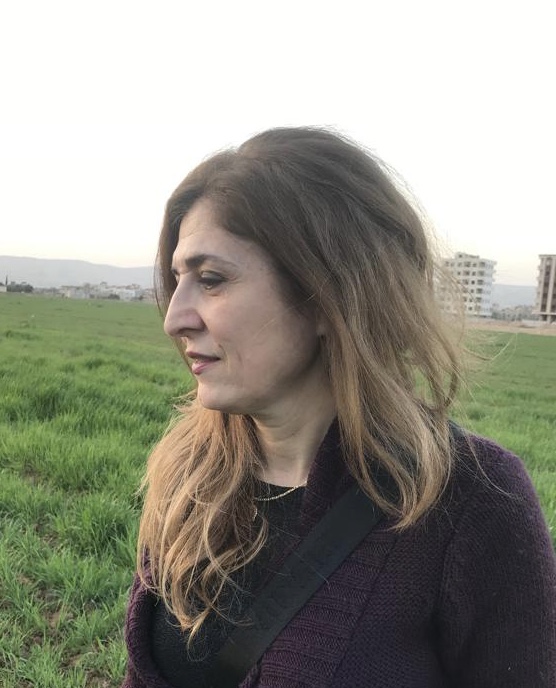
Balsam Khadija describes to us her own negative experience in the journalism field, asserting that she is not alone in her suffering but that she and all her female colleagues are controlled and pushed to settle for half-solutions so as not to be transferred or made to work inconvenient hours—especially since they have families who need their care. This is exactly what lead Khadija to submit to the status quo after long, futile confrontations over the years. Her “big head,” as the editor-in-chief put it, prevented her from signing up for external courses or trainings that could develop her tools and skills.
Khadija says, “There is no doubt that fear of punishment and our boss’s power affect how women perform in the media sector, especially in public-sector institutions, or even in the private sector where nepotism prevails over competence and who deserves the job versus who doesn’t.” “The editor-in-chief did not allow me to write for a long time,” she adds, “because I was asking for my rights and discussing logistical matters, or how to write the news, or even how to search for it outside our small circles. But this is all subject to his mood, as we have consistently come to learn.” She concludes her idea by recalling that “Once, the manager assigned me the evening shift from seven to nine o’clock. It was purely arbitrary, and back then I lived in a dangerous area. When I confronted him, he said: ‘If you don’t like it, quit.’”
Arbitrary transfers and suspending from writing
Delving deeper into the widespread violations in the media sector, Medfeminiswiya also spoke to Syrian writer Lina Dayoub, who describes how her angles were constantly dismissed on the Society page “for many reasons, including the fact that I used the word gender, or sex, or other such terms.” She continues, “When I first started out, I was arbitrarily transferred to another governorate because I refused an offer that was not appropriate for my profession. But I filed a lawsuit against the general manager and won it, and ever since, I’ve been in a position of confrontation. They label me the “combatant,” the “militant,” or even the “troublemaker.” All of these have stuck to me, but I still choose confrontation and do not regret, all these years later, having lost what could have been considered profit: like a manager or editor-in-chief position, or even travels and training courses. Everything I was deprived of, I now see as a gain. I’m satisfied having fought for my ideas and won.”
The last confrontation took place not long ago, when Dayoub commented on the work of a minister, and this comment was not well received by officials. Thus, they banned her from writing. “Why these restrictions in our work? Do we really need more restrictions, on top of the laws that already impede media work?” she asks.
Wage deduction and curtailment
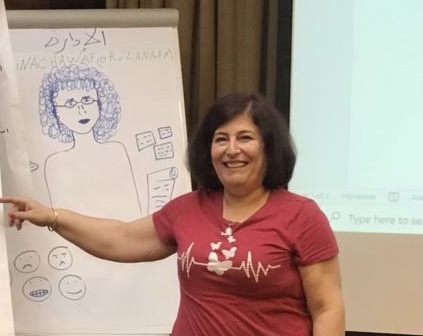
Deduction and curtailment are penalties that affect not only women in the media sector, but men too. Fawaz Khayyo, for example, was stopped from developing many angles or columns, as were Salman Izzedine and Ali Dayoub. Maan Aqel and Waad al-Muhanna were also banned from working on their investigative pieces. Al-Muhanna is a fierce vocalist against the theft of antiquities from Syria.
He talks about his own story with disciplinary punishment (apart from the lawsuits filed against him in court), saying, “The war against me in the media can be divided into two parts: an internal one and an external one. The internal one was spearheaded by the managing editor, then the editor-in-chief, and it escalated to the point of actual physical blows. They often deleted investigative pieces from their pages before printing, and there were topics I wasn’t allowed to work on. As for the external war, it’s waged by ministers and governors, especially the Governor of Damascus or the Directorate-General for Antiquities, in communication with the Minister of Information. They all stopped me from writing. One of the excuses the Minister of Information came up with at the time was to ask the editor-in-chief to transfer me to the archives, and the answer was that I was an engineer at the newspaper.”
Al-Muhanna also tells us that “in 2005, I submitted a huge dossier on antiquities to the newspaper, but the institution heads got in the way of its being published. The Director of Antiquities had to bribe all the editors so that the investigation would not be published (however, it was later published in Kollona Shoraka). Among the disciplinary punishments I was subjected to were salary deductions and stopping me from writing.”
It is impossible to find official figures that determine the number of disciplinary penalties that have affected, or are affecting, workers in the media sector in Syria
Disciplinary penalties: Light and severe penalties

In order to understand the types of penalties that exist today, we have relied on the explanations of lawyer Feryal Hassan, who explained to us that workers in the public or private sector in Syria are subject to the Workers Code that applies to all institutions, including private magazines, government newspapers, and private and public television. They are also subject to disciplinary penalties. According to Article /68/, the penalties that may be imposed on workers are classified into two categories. First, the light penalties, which include:
- Alerts, which consist of written notifications detailing the violations committed by the workers and drawing attention to the need to avoid committing them in the future.
- Warnings, which are reprimands directed at the workers, warning them of more severe penalties to be imposed in case the violation continues or is repeated.
- Wage deduction, which consists of deducting a maximum amount of /5/ percent of the worker’s monthly wage for a period of no less than one month and no longer than six months. The wage on the date the penalty is imposed is considered the amount from which the deduction will be calculated.
- Delaying promotion, which consists of delaying promotions the workers are entitled to, and so for a period of six months. This is imposed after the worker has been imposed three light penalties from those mentioned above within one year, or five light penalties over the course of two consecutive years.
- Withholding promotion, which consists of depriving workers of their promotion bonus.
As for severe penalties, they include the following:
- Disciplinary transfers, which consist of transferring workers to lower positions while keeping the same wages.
- Disciplinary dismissal, which consists of dismissing workers and liquidating their rights in accordance with the laws in force. The dismissed worker may not be reinstated according to the aforementioned, regardless of the capacity of reinstatement, unless at least two years have passed since dismissal.
- Expulsion, which consists of categorical deprivation of the job. The rights of the expelled worker are liquidated in accordance with the insurance law.
In Syria, it is impossible to find official figures that determine the number of disciplinary penalties that have affected, or are affecting, workers in the media sector. As for the media institutions themselves, it is very difficult to differentiate between ordinary employees and those working in the sector, because they are considered to be workers subject to the “basic worker’s code” even though they do also belong to the Journalists Union, which is authorized to defend them within and outside their institutions. Between the text and its application—and the arbitrariness thereof—the rights and freedoms of Syrians working in this field are stagnating, waiting for someone to bring them into the light.