Cette publication est également disponible en :
The night was short, marked by the flow of words and Nebiha’s story, her memories, her torments, her trials and her hopes.

I got up well before dawn to observe the truck drivers picking up female farm workers. A high-risk task, which the oldest girls of Nebiha experienced during school holidays, while high school girls went to pick olives or fruits in the large areas that belonged to the investors-operators.
According to statistics from the “Forum tunisien pour les droits économiques et sociaux” (Tunisian Forum for Economic and Social Rights), over the past five years traffic accidents related to the makeshift transport of groups of seasonal workers in rural areas have resulted in 47 deaths and 667 injuries.
In April 2019, a tragedy shook the Tunisian public opinion. It was the death of thirteen workers, including eight women, in a road accident in Sabbala, not far from here, in the same governorate of Sidi Bouzid. An entire family including a mother and her two daughters had been decimated there. Uninsured, unorganized, exposed to insecticides, underpaid, always paid half the amount men received for the same work, they are thousands to take the road to the fields every day, crammed up on top of each other, risking their lives. However, today, these armies of women ensure the food security of Tunisians at a time when men are increasingly deserting a sector marked by stigmatization and the greatest precariousness.
Moreover, Law 51 on rural transport adopted in 2019 by Parliament aimed at protecting day laborers against such disasters seems unsuited to the context of these regions.
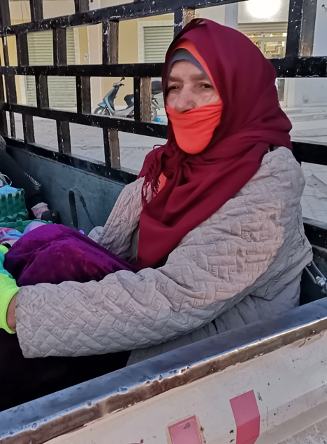
Accompanied by Nisrine Amri and Intissar Akrouti who are my guides, it was still dark at 5am when I arrived at the informal station of Regueb where the car attendants stop. Informal transporters drive vehicles – covered 404 or Isuzu- often at the end of their life. It is freezing cold on this morning of 14 December, when the weather forecast showed almost negative grades.
Everything in the appearance of the hundreds of women already installed in the containers of truckers showed their efforts to protect themselves against the cold, but also against men’s looks and harassment. With Himalayas of clothing on their backs, their silhouette thus disguised erased any “suspicion” of femininity. Like a camouflage outfit worn to face a battlefield.
Indignation, distress and anger of agricultural workers
With a hood over the head, above which they cover their skull with a cap in addition to a scarf-hijab, they try to protect themselves from bad weather and the harmful insecticides. Covered with a large and old coat, their body is totally invisible. Below, they wear jogging pants worn over a loose dress. Their attire is completed with woollen stockings and plastic boots or worn-out shoes belonging to their husband or son.
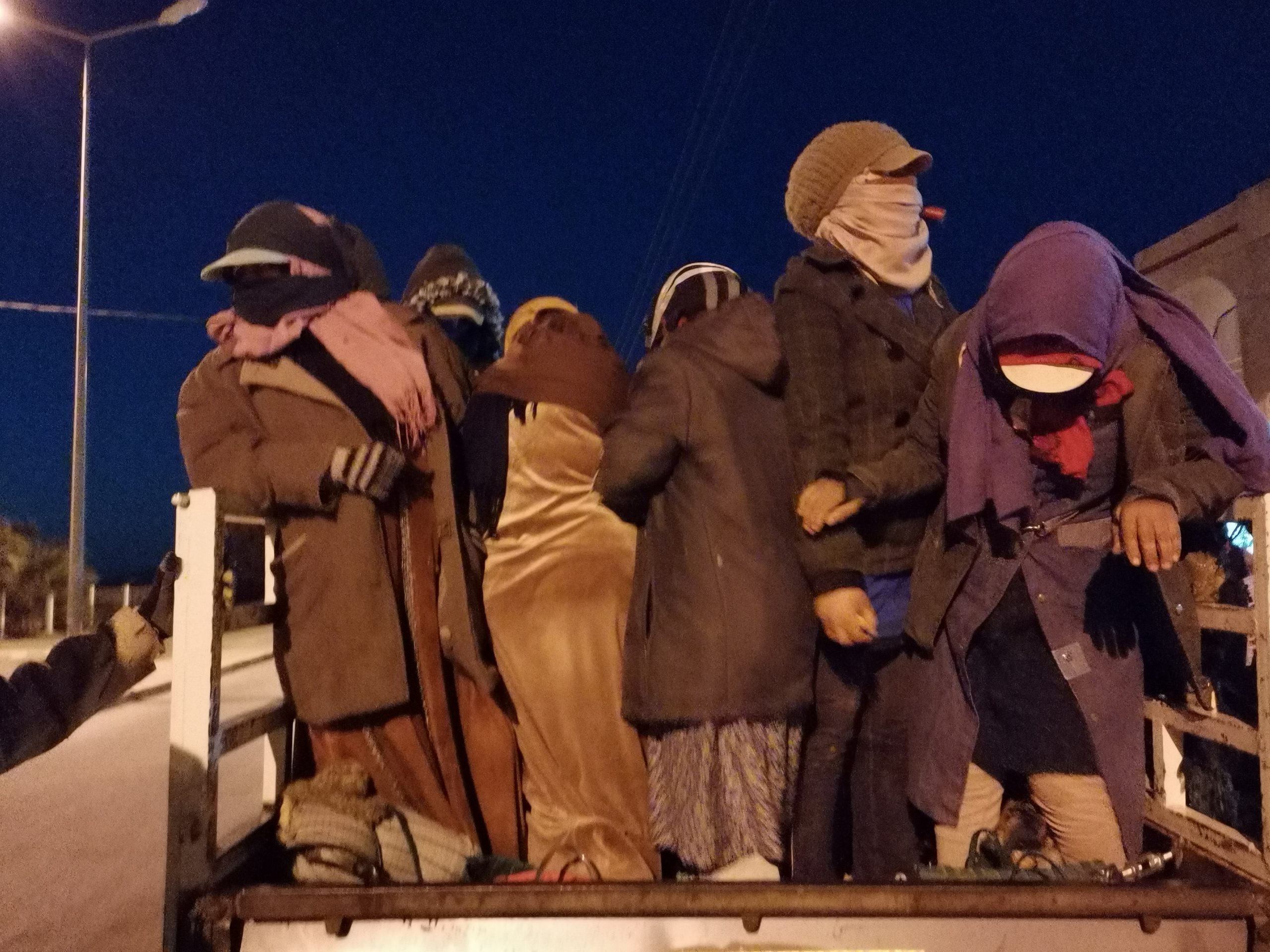
Saloua, well into her thirties, in a car piled up with more than twenty women, protested at the sight of us: “You have been submitting us to surveys and studies for five years and talking about us in the media. What have we gained? Nothing at all. We continue to receive miserable pay. A whole day working work for 10 dinars (3.06 Euros), except during the olive harvest, between October and January, when the prices rise a little. But what can we do with such a sum, especially if we subtract transport costs? What can be done with such an amount when the price of the bottle of butagaz reaches 8 dinars (2.45 Euros), the kilo of sugar 1 dinar, 400 (0.45 Euros) and the packet of milk 1 dinar, 400?”
We were surrounded by several women. Their words expressed distress and anger.
“My husband and my son are unemployed. In Regueb, there are very few job opportunities apart from agriculture. But my son refuses to commit to it, believing that the amount of pay offered by the landowners is not worth the effort. I also work to get him enough to buy a pack of cigarettes, I’m afraid he’ll commit suicide like so many young people from Soug Ejjdid near where we live,” laments Salha, 42.
Khamissa, a small, 60-year-old woman, all puny and stunted, wrapped in a blanket, does not have the strength to move from her seat in a half-full car: “With frozen limbs, a runny nose, exhausted from fatigue after several kilometers standing up due to lack of space, this is how we arrive on the farms. Along the road, clinging to each other, up to thirty per car, we fall with each jolt. At each meeting with agents of the National Guard, we tremble with fear. Perhaps the driver will be arrested, or would this be the episode of a new accident following a chase between the police and the driver? Have some empathy for us! Will our rights ever be respected?”

“Rather die of Coronavirus than starvation”
Clandestine drivers with uninsured journeys, they actually play several other roles. Recruiters of the day laborers, they are the main intermediaries in the whole process of employing women. Each one of them has his network of workers. After having negotiated the price of their “jornata” (working day), they place the workers in the farms and are considered as their guarantors. A traffic that is similar to human trafficking in all respects.
Every day in the early morning, the driver picks up the women, drops them off at their place of work, picks them up in the afternoon, advances them money to buy flour, semolina or oil. It is also up to him to pay them every Sunday, the day before the weekly “souk” of Regueb, after having collected their wages from the operator and taken their due, namely the price of transport fixed on average at 3 dinars per day.
Mohammed Ennaji Ezzariî is both a driver and farmer on a perimeter of 14 ha. Well dressed in his brand new burnous, he waits for the last latecomers before driving 25 km to arrive on his land. Mohammed Ennaji Ezzariî is one of the few landowners to transport his workers himself: “I pay them a dinar more than the others (31 Euros). I can’t do much more otherwise I risk turning all the farmers against me. Men? Of course they are paid more than women. They are stronger and more persevering! In addition, no man agrees to work for 10 dinars!”
Zouhair Jellali, another driver present at the station will be heading towards the lands of Naceur Lahmar, one of the most important investors in the region with 25 women on board in a few minutes, at 6:30am. Equipped with processing and packaging units and large fridges, he exports his fruit to many countries, including Russia.
Zouhair Jellali believes that agricultural workers are activists in distress: “The price of fuel oil is expensive and the distances are great. In the end, I don’t earn much either, especially given the arduous nature of my job: waking up at 3am, risking confrontation with the police at every turn, suffering the dangers of the road. However, above all, these women deserve better treatment, they who do not stop toiling, including during periods of confinement. They have chosen to rather die of the Coronavirus than starvation.”
The women met at the Regueb station all claimed more “dignified” travel conditions and less “unfair” remuneration*. Complaints expressed in a station facing the Cantonal Court of the city.
But it is still dark when the death trucks leave and the shadow of the night covers a long chain of discriminations with the veil of duplicity.
Friendship, solidarity and sisterhood
Zouhair Jellali accepts that we follow him to the places where “his” seasonal workers are working. However, he first calls the head of the operating sector, the manager flatly refuses any exchange with the press and any possible taking of images. We are faced with this refusal three more times, on three other fields. We end up returning to Sidi Ameur, where Farid Amri, first cousin of Nesrine, a 28-year-old small farmer cultivates his father’s land olive trees and carrots on a few perimeters. It’s 7am and Farid has not arrived yet. Two women, Sana and Amel, pick up armfuls of branches to light the fire and warm up before starting their work.
With a smiling and beautiful face, Sana is 32 years old. She lives a kilometer away with her husband, also a member of the Amri. She also follows the same litany of daily chores carried out at dawn: milking the two cows, tending the vegetable garden, taking care of the baby and her two children before they leave for school, preparing breakfast for the husband. However, Sana does not have to endure the drudgery of transport, nor the obligation to subtract the price of the driver from her 15 daily dinars. In addition, a bond of friendship, solidarity and mutual support has been woven between her teammates and her.

“Despite the fact we are going through an ordeal, with the uprooting of carrots and their cleaning when it is freezing and our fingers are frozen by the cold and the humidity of the early morning, much of the atmosphere that reigns in the group is joyful and good-natured. An atmosphere that lightens the heaviness of our load as desired.”
Sana shows a large pot covered with a wooden board: “All together, last week, on wood, we cooked some delicious dishes. Macaroni with vegetables and meat, a stew of peas with mutton and a “kounafa”, another stew usually prepared with fennel that we replaced with carrots from this field. A real treat, spicy and fragrant with a thousand and one spices! After having tasted financial independence and the pleasure of being among ourselves, we, as women, can hardly be satisfied with the mere family life.”
A daily worker in Regueb, her husband is convinced that his wife’s true place is in her home rather than on the land.
“Why do you come home upset when outside you seem so happy and full of energy. Tomorrow you stay at home!” he threatens me each time a conflict occurs between us under the pressure of my irritation inherent to the abundance of domestic duties,” explains Sana. “So I take it upon myself and stop my tantrums. Because the next day at dawn, I cannot not go back to the fields,” she continues.
From their place of servitude, the agricultural workers of Regueb also draw the power of the bond of sisterhood that cements their “jornata” a momentum of autonomy and emancipation.