• it VO
  • fr Français
  • en English
  • ar العربية
About us
  • In-depth
    • All
    • Features
    • Files
    • World
    Morocco: 600 abortions a day—Alarming figures and tragic stories

    Morocco: 600 abortions a day—Alarming figures and tragic stories

    In Spain, the right to abortion is not guaranteed for all

    In Spain, the right to abortion is not guaranteed for all

    Invisible and vulnerable: Migrant women at the frontlines of Spain’s prostitution debate

    Invisible and vulnerable: Migrant women at the frontlines of Spain’s prostitution debate

    Serbia: Is contraception a luxury or a basic human right?

    Serbia: Is contraception a luxury or a basic human right?

    Rebels, witnesses, victims: Women against the mafia (3/3)

    Rebels, witnesses, victims: Women against the mafia (3/3)

    Trending Tags

    • Women artists
    • Ecofeminism
    • Women living from and on the streets
    • Women and bodies
    • Women and sports
    • Women and cinema
    • Ramadan series
    • Women and war
    • Women Living at the Margins
    • Press Freedom from the Perspective of Women Journalists
    • Period poverty
    • Gynecological violence
    • Women and prison
    • Safe spaces
    • Abortion and SRHR
    • Transgenderism
    • Women in rural areas
  • On the move
    Spain: CEAR and the fight against human trafficking

    Spain: CEAR and the fight against human trafficking

    Gaza: How many journalists must be killed for the world to react?

    Gaza: How many journalists must be killed for the world to react?

    Moroccan activist Ibtissam Lachgar held in solitary confinement, health in crisis

    Moroccan activist Ibtissam Lachgar held in solitary confinement, health in crisis

    Three women for one man’s pay: The plight of female agricultural workers in Egypt

    Three women for one man’s pay: The plight of female agricultural workers in Egypt

  • Portraits
    Sophie Bessis: “The battle for the intimate will be long, especially in the Global South!”

    Sophie Bessis: “The battle for the intimate will be long, especially in the Global South!”

    “Mom, Dad, Can We Talk About Privacy?”—A Tunisian children’s book on protecting kids from sexual violence

    “Mom, Dad, Can We Talk About Privacy?”—A Tunisian children’s book on protecting kids from sexual violence

    Kurdish journalist killed in Turkish drone strike in northeastern Syria

    Kurdish journalist killed in Turkish drone strike in northeastern Syria

    A Filmmaker’s Journey: Inside the Creative World of Margarita Bareikyte

    A Filmmaker’s Journey: Inside the Creative World of Margarita Bareikyte

  • Creations
    • All
    • Reviews
    • Visual Arts
    “La Malédiction (1)”, a theatrical adaptation of King Kong Theory bursting with Tunisian rage

    “La Malédiction (1)”, a theatrical adaptation of King Kong Theory bursting with Tunisian rage

    “Mom, Dad, Can We Talk About Privacy?”—A Tunisian children’s book on protecting kids from sexual violence

    “Mom, Dad, Can We Talk About Privacy?”—A Tunisian children’s book on protecting kids from sexual violence

    The El’Sardines series, a delicate feminist manifesto centered around an ecological mystery

    The El’Sardines series, a delicate feminist manifesto centered around an ecological mystery

    Atlantics, a film by Mati Diop: Filming the embodied resistance of spirits

    Atlantics, a film by Mati Diop: Filming the embodied resistance of spirits

  • Opinion
    Women in Gaza are living their worst nightmares - “ I want to go back to my life before the war, to my privacy, my home ”

    Women in Gaza are living their worst nightmares - “ I want to go back to my life before the war, to my privacy, my home ”

    Messages from life under bombardment—Can a mother cope with losing her six children at once? (10)

    Messages from life under bombardment—Can a mother cope with losing her six children at once? (10)

    Messages from life under bombardment—No cake for my children on their birthdays (9)

    Messages from life under bombardment—No cake for my children on their birthdays (9)

    Messages from life under bombardment – No food or water in Gaza (8)

    Messages from life under bombardment – No food or water in Gaza (8)

  • Multimedia
    "I hope it doesn’t go viral: Journalism and sexist attacks in digital age". A video investigation by Çiçek Tahaoğlu

    "I hope it doesn’t go viral: Journalism and sexist attacks in digital age". A video investigation by Çiçek Tahaoğlu

    Period poverty in Montenegro

    Period poverty in Montenegro

    Period poverty in France (1)

    Period poverty in France (1)

    Period Poverty in Italy

    Period Poverty in Italy

  • Country context
No Result
View All Result
BLOGS
Medfeminiswiya
  • In-depth
    • All
    • Features
    • Files
    • World
    Morocco: 600 abortions a day—Alarming figures and tragic stories

    Morocco: 600 abortions a day—Alarming figures and tragic stories

    In Spain, the right to abortion is not guaranteed for all

    In Spain, the right to abortion is not guaranteed for all

    Invisible and vulnerable: Migrant women at the frontlines of Spain’s prostitution debate

    Invisible and vulnerable: Migrant women at the frontlines of Spain’s prostitution debate

    Serbia: Is contraception a luxury or a basic human right?

    Serbia: Is contraception a luxury or a basic human right?

    Rebels, witnesses, victims: Women against the mafia (3/3)

    Rebels, witnesses, victims: Women against the mafia (3/3)

    Trending Tags

    • Women artists
    • Ecofeminism
    • Women living from and on the streets
    • Women and bodies
    • Women and sports
    • Women and cinema
    • Ramadan series
    • Women and war
    • Women Living at the Margins
    • Press Freedom from the Perspective of Women Journalists
    • Period poverty
    • Gynecological violence
    • Women and prison
    • Safe spaces
    • Abortion and SRHR
    • Transgenderism
    • Women in rural areas
  • On the move
    Spain: CEAR and the fight against human trafficking

    Spain: CEAR and the fight against human trafficking

    Gaza: How many journalists must be killed for the world to react?

    Gaza: How many journalists must be killed for the world to react?

    Moroccan activist Ibtissam Lachgar held in solitary confinement, health in crisis

    Moroccan activist Ibtissam Lachgar held in solitary confinement, health in crisis

    Three women for one man’s pay: The plight of female agricultural workers in Egypt

    Three women for one man’s pay: The plight of female agricultural workers in Egypt

  • Portraits
    Sophie Bessis: “The battle for the intimate will be long, especially in the Global South!”

    Sophie Bessis: “The battle for the intimate will be long, especially in the Global South!”

    “Mom, Dad, Can We Talk About Privacy?”—A Tunisian children’s book on protecting kids from sexual violence

    “Mom, Dad, Can We Talk About Privacy?”—A Tunisian children’s book on protecting kids from sexual violence

    Kurdish journalist killed in Turkish drone strike in northeastern Syria

    Kurdish journalist killed in Turkish drone strike in northeastern Syria

    A Filmmaker’s Journey: Inside the Creative World of Margarita Bareikyte

    A Filmmaker’s Journey: Inside the Creative World of Margarita Bareikyte

  • Creations
    • All
    • Reviews
    • Visual Arts
    “La Malédiction (1)”, a theatrical adaptation of King Kong Theory bursting with Tunisian rage

    “La Malédiction (1)”, a theatrical adaptation of King Kong Theory bursting with Tunisian rage

    “Mom, Dad, Can We Talk About Privacy?”—A Tunisian children’s book on protecting kids from sexual violence

    “Mom, Dad, Can We Talk About Privacy?”—A Tunisian children’s book on protecting kids from sexual violence

    The El’Sardines series, a delicate feminist manifesto centered around an ecological mystery

    The El’Sardines series, a delicate feminist manifesto centered around an ecological mystery

    Atlantics, a film by Mati Diop: Filming the embodied resistance of spirits

    Atlantics, a film by Mati Diop: Filming the embodied resistance of spirits

  • Opinion
    Women in Gaza are living their worst nightmares - “ I want to go back to my life before the war, to my privacy, my home ”

    Women in Gaza are living their worst nightmares - “ I want to go back to my life before the war, to my privacy, my home ”

    Messages from life under bombardment—Can a mother cope with losing her six children at once? (10)

    Messages from life under bombardment—Can a mother cope with losing her six children at once? (10)

    Messages from life under bombardment—No cake for my children on their birthdays (9)

    Messages from life under bombardment—No cake for my children on their birthdays (9)

    Messages from life under bombardment – No food or water in Gaza (8)

    Messages from life under bombardment – No food or water in Gaza (8)

  • Multimedia
    "I hope it doesn’t go viral: Journalism and sexist attacks in digital age". A video investigation by Çiçek Tahaoğlu

    "I hope it doesn’t go viral: Journalism and sexist attacks in digital age". A video investigation by Çiçek Tahaoğlu

    Period poverty in Montenegro

    Period poverty in Montenegro

    Period poverty in France (1)

    Period poverty in France (1)

    Period Poverty in Italy

    Period Poverty in Italy

  • Country context
About us
Medfeminiswiya
About us

“Mom, Dad, Can We Talk About Privacy?”—A Tunisian children’s book on protecting kids from sexual violence

The 26-year-old Swiss writer of Tunisian origin Raja Sabta el-Amri has launched a children’s book series titled Mom, Dad, Can We Talk About, which addresses social and educational issues. The first book in the series, published in spring 2025, is titled What Is Consent? and is available in three languages (Tunisian colloquial Arabic, French, and English), and also in Braille. There are also a sign language version and an audio version. It targets children as young as four. An interview.

Louise Aurat by Louise Aurat
4 August 2025
in Creations, Portraits, Reviews
73 2
0
Share on FacebookShare on Twitter

This post is also available in: Français (French) العربية (Arabic)

What Is Consent? is the first book in this series, and it will be followed by other books on corruption, stray animals, recycling, and biodiversity. Why did you choose consent as a starting point here?

Society in Tunisia is undergoing profound transformations, but we don’t pay attention to their impact on children. I’ve noticed a huge gap in awareness about sexual violence against children—it’s still a taboo topic, not only in Tunisia but even in Switzerland and France, where it’s difficult to talk about incest or domestic violence.

My first idea was to teach children to say “no.” Consent is a sensitive topic, so we addressed it indirectly, through issues like harassment, sexual assault, and domestic violence, in a simplified, age-appropriate way.

Each book in this series contains environmental, feminist, or anti-colonial messages. I was told I had to start with a light topic. But this book about consent is the foundation of the entire project: I cannot help parents or educators instill concepts of diversity, respect for others, and conservation of the environment and animals without first teaching children self-respect.

The story is based on questions asked by the two young protagonists: How do I know that I want to withdraw my consent? and What should I do if someone invades my privacy? What I want to ask is, how did you go about writing this book?

It took me three years to write it. I collaborated with Dr. Khadija Bouzghaia Bagbag, a child psychiatrist, to ensure age-appropriate content. During our first meeting, she explained to me that the best way to address complex issues is to let children ask their own questions, and then build dialogue. This was the core methodology of the project.

I cannot help parents or educators instill concepts of diversity, respect for others, and conservation of the environment and animals without first teaching children self-respect.

I also watched many documentaries about sexual violence and consent and borrowed about 30 books from the library, from which I extracted approximately 70% of the questions children might ask. As I moved forward with the work, new needs emerged—the book went beyond the story itself. We added a section listing the relevant authorities’ phone numbers and a practical guide for parents, as well as an interactive section allowing children to draw scenarios in which their consent was not respected.

Image from the publisher’s collection

Because it was important for you to present a comprehensive book that’s accessible to a wide readership, it has been published in three languages: colloquial Tunisian Arabic, English, and French. This is in addition to the Braille, sign language, and audio versions. Are there any differences in content across these?

No, the content is the same in all the book’s versions. But the audio version is somewhat clearer due to the absence of images. The book is primarily aimed at a Tunisian audience, but it’s suitable for any child from a non-Western culture. The girl with a unibrow and curly hair doesn’t only represent Tunisian girls.

I also wanted to immortalize elements of Tunisian culture that children today don’t recognize anymore, like the Berber tattoos that adorned grandmothers’ faces.

It’s an entirely Tunisian project. I wanted to make a difference in the field of children’s literature in Tunisia. When I was young, I didn’t see any beautiful books for Tunisian children. Which is logical: making them is expensive, it requires a lot of effort, and it doesn’t generate profit. In the youth library in Lausanne, where I grew up, the books available to me were so pretty, colorful, hardback, and varied. When I visited Tunisia, I found only small, low-quality books, bland and unattractive. So I wanted to change this.

On a technical level, publishing this book in Tunisia was a major achievement in balancing quality and price. But it’s also going to be exported abroad. I’m delighted to see Arab names on children’s bookshelves, which are usually dominated by non-Arab publishing houses and authors.

The Mom, Dad, Can We Talk About series is an ambitious project. You also proposed the idea of distributing the book to associations for free. Did you receive external financial support?

No, I didn’t receive any funding. I ate rice and was penniless for months, slept on the floor without a bed. I started the project four years ago and finished my studies in February 2025. My first real paycheck was in May. Before that, I’d been juggling exhausting student jobs and various internships.

I never wanted anyone to work with me for free. The opposite—I made sure they were paid above average. I worked night and day to achieve this. I was offered funding, but it was tied up in geopolitical affairs I didn’t want to be associated with.

The 26-year-old writer lives between Switzerland and Tunisia. She was still a master’s student in politics and public administration at the University of Lausanne when she launched the Mom, Dad, Can We Talk About project. 

So far, I’ve financed the project with my own money. I hope it will eventually fund itself with the revenue it makes. Financially, I’m working at a loss, but I see it as a “gift to my country.” Until I can effect deeper change through my studies and career, I can’t stand idly by.

What was the reaction after the first copies sold?
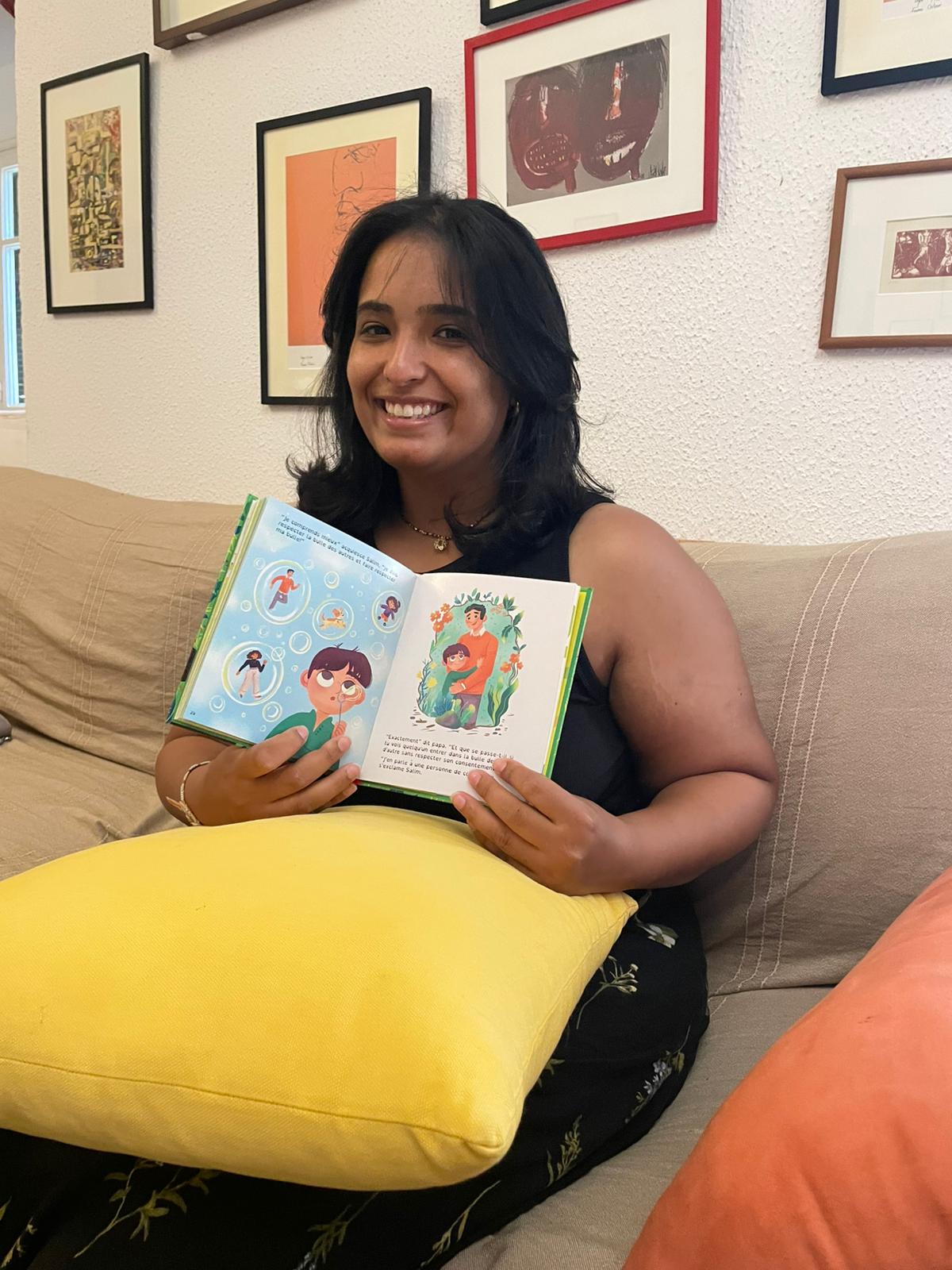
The 26-year-old author has lived between Switzerland and Tunisia. She was still a master’s student in politics and public management at the University of Lausanne when she launched the project Dis maman, dis papa. Photo credit: Louise Aurat.

Honestly, I didn’t expect this success. In Tunisia, books are more about entertainment, it’s more that than in-depth educational books that focus on values. When I launched it at the Tunis International Book Fair, I said to myself, If we sell three copies a day for four days, I’ll be happy. We sold 55 copies!

What was even more wonderful were the reactions people had. A mother bought the book to read with her daughter. When they got to the interactive part, the girl drew herself in the bathroom. Her mother asked her what that meant, and the little girl confided that she was uncomfortable with the way the woman who works in the bathroom had touched her. The girl was able to express in words an uncomfortable situation she hadn’t dared talk about before. To me, this alone proves the book has achieved its goal. I imagine it will later enable this child to recognize dangerous situations before they become serious problems.

The audiobooks in French, Tunisian, and English are available for free here.
Louise Aurat

Louise Aurat

Louise Aurat is a French journalist. An Arabist, she worked in Alexandria, Egypt, between 2021 and 2023 for various French newspapers and magazines (Reporterre, Réforme, Middle East Eye). She is currently based in Djerba, Tunisia.

Related posts

Amel Zen « Il est temps de dire les choses sans détours »
Creations

Amel Zen « Il est temps de dire les choses sans détours »

by Ghania Khelifi
11 March 2024
395

La chanteuse algérienne creuse son sillon avec cette nouvelle création « Ya mra » dédiée non seulement au combat des...

And what if women managed money?  An interview with Giovanna Badalassi.
On the move

And what if women managed money? An interview with Giovanna Badalassi.

by Cristiana Scoppa
2 May 2022
261

“Contrary to popular belief, women have always had a relationship with money,” states Badalassi, who condemns the “totally outdated” comment...

An interview with Tesh Sidi: Migrants in Parliament and inclusion by identity

An interview with Tesh Sidi: Migrants in Parliament and inclusion by identity

22 January 2025
233
تمييز الرجال على موائد الطعام في الدراما والرواية المصرية

تمييز الرجال على موائد الطعام في الدراما والرواية المصرية

13 May 2024
231

Leave a Reply Cancel reply

Your email address will not be published. Required fields are marked *

J'accepte les termes et conditions et la Politique de confidentialité .

Medfeminiswiya

Medfeminiswiya is a feminist network that brings together women journalists working in the fields of media and content production in the Mediterranean region.

Newsletter


    Follow us

    Browse topics


    • In-depth
    • Files
    • Features
    • On the move
    • Portraits
    • Opinion

    • Creations
    • Visual Arts
    • Reviews
    • Multimedia
    • Country Context
    • Blogs
    • About us
    • Our community
    • Our partners
    • Become a member
    • Editorial charter
    • Disclaimer

    © 2025 Medfeminiswiya - Mediterranean Network for Feminist Information

    • it VO
    • fr Français
    • en English
    • ar العربية
    • In-depth
    • On the move
    • Portraits
    • Creations
    • Opinion
    • Multimedia
    • Country context
    • Blogs
    No Result
    View All Result

    © 2025 Medfeminiswiya - Mediterranean Network for Feminist Information

    Welcome Back!

    Login to your account below

    Forgotten Password?

    Retrieve your password

    Please enter your username or email address to reset your password.

    Log In

    Add New Playlist

    Ce site n'utilise pas de cookies. This website does not use cookies. هذا الموقع لا يستخدم ملفات تعريف الارتباط.