About us
  • it VO
  • fr Français
  • en English
  • ar العربية
No Result
View All Result
Medfeminiswiya - Mediterranean feminist media
  • On the move
  • In-depth
  • Files
  • Artistic Creations
  • Interviews
  • Opinions
  • World
Medfeminiswiya - Mediterranean feminist media
  • On the move
  • In-depth
  • Files
  • Artistic Creations
  • Interviews
  • Opinions
  • World
No Result
View All Result
Medfeminiswiya - Mediterranean feminist media
Home In-depth

Everything you always wanted to know about menstruation

Chaimae Zouhiriby Chaimae Zouhiri
8 March 2023
Everything you always wanted to know about menstruation

How many menstrual cycles does a woman have on average in her life? How many tampons/pads does she use over almost four decades? In which country are sanitary pads and tampons available for free?

This post is also available in: Français (French) العربية (Arabic)

Do you know… 

How many menstrual cycles does a woman have on average in her lifetime?

The duration of menstruation varies greatly between women and at different ages in life. On average, a woman has her first period between 10 and 15 years old. Menopause occurs between the ages of 45 and 55, except in the case of early menopause. Basically, menstruation is a certainty in a woman’s life (not counting periods of pregnancy) for a good 40 years. For every period, we are talking about 3 to 7 days of bleeding. A woman will approximately have 400 periods in her life, or the equivalent of 2400 days.

How many tampons/pads does a woman use in her lifetime?  

Assuming an average menstrual period of five days per month, this means that a woman menstruates for about 2400 days of her life. A woman uses more or less 6 tampons per day, which will make a total of 30 per month and 360 per year. Multiplied by the approximately four decades between the first menstruation and the menopause, that is 14,400 tampons.

What plastics are used to produce sanitary pads? 

Conventional sanitary towels are mainly made of plastic (Polyethylene). One pad contains the equivalent of about 4 plastic bags. The massive presence of plastics in hygiene products can also be problematic for the vaginal flora, as it encourages the growth of bacteria.

Disposable sanitary towels also contain absorbent substances, such as acrylic polymers, but also perfumes, which often irritates the vaginal mucosa, and other odour neutralisers, such as silver nanoparticles. There are also various chlorinated adhesives (glues) and bleaches that are used to give the sanitary protection pads a “perfect” white appearance.

In which country in the world are sanitary pads and tampons available for free? 

In November 2020, Scotland became the first country to provide free tampons and pads. In other parts of the world, tampons and sanitary pads are provided for free to female students, such as in New Zealand and Kenya. After becoming the first country to abolish the ‘tampon tax’, the Kenyan government started distributing free sanitary pads to girls in public schools in April 2018.

What are the alternatives to disposable sanitary pads?

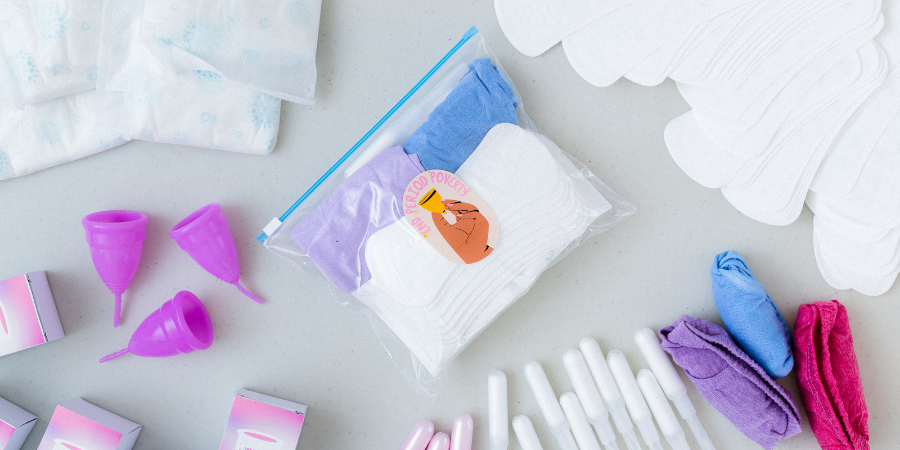
There are healthy and effective alternatives to disposable sanitary pads. These include menstrual pants, menstrual cups, washable pads and menstrual sponges. 

What is the average lifespan of a washable sanitary pad?

The answer to this question is extremely subjective as it is linked to the unique characteristics and needs of every woman (length of menstruation, type of flow, particular habits, sensitivities, etc.). As a guide, for a normal flow of average duration, it is estimated that approximately 10-15 washable pads will be required. If used correctly, a washable pad can last up to 4 or 5 years. A great saving for your pocket and the environment!

What is a menstrual cup?

The menstrual cup looks like a cup, as its name suggests. It is flexible, a few centimeters high and ends in a small stem. The menstrual cup arrived the market in the thirties, at the same time as disposable pads, but has only recently gained popularity. Menstrual cups come in different sizes and materials: silicone, latex or thermoplastic elastomer (TPE). The menstrual cup is placed inside the vagina like a tampon. The difference is that the cup does not absorb blood, it collects it. The user must therefore empty the cup and rinse it before putting it back in place. Durable and economical, the cup has many advantages: it can be used between 3 and 10 years and costs around 35 euros, or the equivalent of a year’s worth of tampons.

Tags: Period poverty
Chaimae Zouhiri

Chaimae Zouhiri

Formée à l’Université de Sienne en « Langues pour la communication d'entreprise », Chaimae Zouhiri est rédactrice web à Medfeminiswiya. Née au Maroc, elle est arrivée en Italie à l'âge de 11 ans. Elle a effectué plusieurs stages à l'étranger, ce qui lui a permis de se rapprocher d’autres cultures, d’en avoir la passion, et surtout de connaître des gens de toutes sortes. Elle souhaite ardemment collaborer à la diffusion des histoires de femmes, et à leurs combats, dans le monde entier.

Leave a Reply Cancel reply

Your email address will not be published. Required fields are marked *

J'accepte les termes et conditions et la Politique de confidentialité .

Related articles

Related posts

In-depth

World Press Freedom Index 2026: A worrying situation in the Mediterranean

by Olfa Belhassine
2 May 2026

Related posts

In-depth

World Press Freedom Index 2026: A worrying situation in the Mediterranean

by Olfa Belhassine
2 May 2026

JOIN OUR NEWSLETTER

Original content. Feminist journalism. Straight to your inbox.

    Related posts

    Croatia: Men Kneeling in Main Squares for Women’s Chastity
    In-depth

    Croatia: Men Kneeling in Main Squares for Women’s Chastity

    by Snježana Pavić
    25 September 2023

    Related posts

    Giving birth with an open womb or when Caesarean section becomes the norm in Egypt
    Abortion and SRHR

    Giving birth with an open womb or when Caesarean section becomes the norm in Egypt

    by Contributor with Medfeminiswiya
    27 September 2021

    Popular articles

    Thirty and single… so what?
    On the move

    Thirty and single… so what?

    by Pascale Sawma
    1 March 2022
    Israel to Palestinian journalists: Be silent… or else!
    In-depth

    Israel to Palestinian journalists: Be silent… or else!

    by Alaa Murrar
    29 November 2023
    Giving birth with an open womb or when Caesarean section becomes the norm in Egypt
    Abortion and SRHR

    Giving birth with an open womb or when Caesarean section becomes the norm in Egypt

    by Contributor with Medfeminiswiya
    27 September 2021
    On the move
    In-depth
    Files
    Artistic Creations
    Interviews
    Opinions
    World
    On the move
    In-depth
    Files
    Artistic Creations
    Interviews
    Opinions
    World

    Medfeminiswiya is a feminist network that brings together women journalists working in the fields of media and content production in the Mediterranean region.

    • About us
    • Country Context
    • Our community
    • Become a member
    • Our partners
    • Editorial charter
    • Disclaimer

    Follow us :

    JOIN OUR NEWSLETTER

    Original content. Feminist journalism. Straight to your inbox.

      © 2026 Medfeminiswiya – Mediterranean Network for Feminist Information

      Back to top

      Welcome Back!

      Login to your account below

      Forgotten Password?

      Retrieve your password

      Please enter your username or email address to reset your password.

      Log In

      Add New Playlist

      No Result
      View All Result
      • On the move
      • In-depth
      • Files
      • Artistic Creations
      • Interviews
      • Opinions
      • World
      • it VO
      • fr Français
      • en English
      • ar العربية

      © 2026 Medfeminiswiya - Mediterranean Network for Feminist Information

      Ce site n'utilise pas de cookies. This website does not use cookies. هذا الموقع لا يستخدم ملفات تعريف الارتباط.