Cette publication est également disponible en :
For the past six years I have been wandering about hospitals and doctors’ offices in the search for someone who can diagnose me and help me solve a bothersome, and apparently incomprehensible, gynecological disorder. The investigations carried out until now reveal that everything is anatomically perfect but the symptoms persist. The opinion of specialists on their cause is dramatically discordant and pending a univocal response and resounding scientific evidence. I keep going, fumbling between official protocols and exotic alternative treatments.

Although no one has yet managed to figure out what is wrong with me, they seem to agree on one point: my ovaries will resume functioning like two Swiss watches when I will “finally” decide to procreate.
So, unfailingly, at the end of each visit I am asked whether and when I intend to have children and, above all, why I still don’t have any at my age.
I am a 41-year-old single and becoming a mum has never been my priority.
Is it perhaps an anomaly to be corrected? Is my body really rebelling against an “unnatural” choice by begging me to fix it, while I can?
The mother of all questions
I have never had a dogmatic position about not having children and maybe in other circumstances I could have had them: but it did not happen and I am fine with it. I do not rule it out a priori, but without doubt I would first like to build a healthy and nourishing relationship with someone with whom, eventually, I will be able to share such an important and irreversible project.
“Although no one has yet managed to figure out what is wrong with me, they seem to agree on one point: my ovaries will resume functioning like two Swiss watches when I will “finally” decide to procreate”
Between one dysfunctional relationship and another, I have created a lifestyle that fulfils me and that I would only be willing to change if it was really worth it. When discussing the issue with my friends who have dreamed of being mothers since childhood, I soon realized that, more than a life goal, it was one of the many possibilities for a future I imagined dotted with friends, loves, travels and exciting experiences.
 Between one dysfunctional relationship and another, I have created a lifestyle that fulfils me and that I would only be willing to change if it was really worth it. When discussing the issue with my friends who have dreamed of being mothers since childhood, I soon realized that, more than a life goal, it was one of the many possibilities for a future I imagined dotted with friends, loves, travels and exciting experiences.
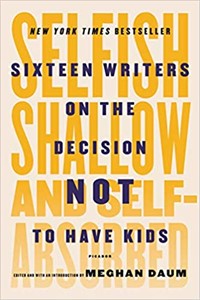
In defence of this choice, the American writer Megan Daum published Selfish, Shallow and Self-Absorbed: Sixteen writers on the decision not to have kids. “There is a big debate on the fertility crisis and how modern women can find a way to ‘have it all’, namely, a successful career and an average of 2 or 3 children each before the biological clock starts ticking”, writes the editor in the introduction. “However, now, the conversation is moving on to whether it is necessary to ‘have it all’ and, in a somewhat controversial way, whether children are truly necessary for a fulfilled live.” (Editor’s comments were translated by Medfeminiswiya).
Instrumentalising motherhood as a safe conduct for happiness and personal fulfilment, in effect, disservices women and society in general.
 In The mother of all questions, the American writer Rebecca Solnit tells about the fateful question asked by a British journalist during an interview. “The interviewer’s question was indecent, because it presumed that women should have children, and that a woman’s reproductive activities were naturally public business. More fundamentally, the question assumed that there was only one proper way for a woman to live”. Indeed, the point is not so much to demonstrate that not having children is a legitimate and respectable decision just like having children, but to ask why those who do not have one are still seen as the crazy variable of an equation that is wrong, pitied or judged, depending on the context.
But why is it that some people do not feel the “sacred natural biological” instinct to procreate?
In “Le dee dentro la donna. Una nuova psicologia femminile” [1] the Jungian psychiatrist and analyst Jean Shinoda Bolen identifies in the seven goddesses of the Olympic pantheon powerful unconscious archetypes that condition us in our behavior and life choices, radically differentiating us from one another. “What one type of woman achieves may not make sense for another, depending on the goddess who acts in her,” she writes. Not all of them harbor the spirit of Demeter, the Roman Ceres, goddess of crops, children’s nurse and mother, who finds her reason for existence in devoting herself to her children. And in all the others there is nothing wrong.
The words to say it
In Italy, the most common term to refer to a “non-mother” is nullipara: a woman, or female animal, of a fertile age who has never given birth. In the Anglo-Saxon world the most used word is “childfree” and refers to men and women without children by choice, while “childless” refers to those who did not have them regardless of their will.
It is very difficult to enclose such a varied universe in a single term without slipping into limiting or derogatory meanings, such as “rami secchi” (deadwood), a popular expression that alludes to the dryness of those who do not bear fruit.
The documentary makers Nicoletta Nesler and Marilisa Piga propose an ironic alternative: lunàdigas, “lunatic”, this is how Sardinian shepherds call the still fertile sheep that, for unfathomable reasons, stop breeding.

In 2015, the two directors collected dozens of testimonies of lunàdigas of all ages and backgrounds, such as the astrophysicist Margherita Hack and the partisan Lidia Menepace, accompanied by the “Monologhi impossibili” (Impossible dialogues) of Carlo A. Borghi on famous women without children of myth and history.
In 2016, the award-winning film of the same name was released (in streaming here): since then, the community has been growing steadily and includes a free permanent archive with stories from across the world and a blog with reflections, stories and reviews on the subject.
(Un)strange non-mothers
According to the latest report by the National Institute of Statistics, in Italy, over a period of twelve years, there has been a decline in births from 577,000 to 404,000: 30% less. In 2020, the total fertility rate further decreased to 1.24 children per woman, the lowest rate since 2003.
But why do we make fewer children with regard to other countries that resemble us? Our precarious welfare certainly does not help, especially where basic services such as counselling centers and nursery schools are also scarce, but for Barbara Stefanelli and Alessandra Coppola, curators of the Corriere della Sera PodCast Mama non mama, the issue is much more complex.
The journalist Lilli Gruber was also involved in their collective stories “about motherhood”. “We always assume that a woman who has no children has given up something, that she is less fulfilled, less happy, less complete. Of course, we use a different reasoning for a man: it is a very anachronistic and also a very pernicious assumption”, she stated in a recent interview.
“I didn’t have children for a precise choice. I should have been a different person from who I am. It was not a question of commitment or attempts but of choices and priorities: you must first of all want your children,” Gruber said.
In “Madri e no. Ragioni e percorsi di non maternità” [2]Flavia Gasparetti addresses the phenomenon as a complex space of confluence of multiple representations and projections, demonstrating how many of these are based on dangerous stereotypes and cultural traps.
“Those who are parents today believe they know how we live, what our priorities and pleasures are, what our days are made of,” she writes in the introduction. “Because when they thinks of us they think of themselves, of how it was and how their days were before taking that leap into the unknown, leaving us behind. How do we explain to these people that we are not left behind, that we too are moving forward on a parallel path that is certainly different but not without wealth, difficulties, rewards and sacrifices?”
“The common narrative wants women without children to be sadder and more isolated. In reality this is not the case. Perceived happiness obviously drops in people who wanted children and failed to have any…”
The author analyses the main narratives that have helped create a mystified vision of motherhood, making it the event that ennobles a woman’s life par excellence. One of these is the metaphor of the biological clock, a “media construct” first used by the American journalist Richard Cohen in an article published in the Washington Post in 1978.
Cohen criticized those who after college decided to pursue a career instead of becoming wives and mothers. He stressed they would soon regret this choice realizing that unlike men, their fertility had an expiration date.
Gasparetti explains that until then, this expression described the natural circadian rhythms of the human body but, today, it is so widespread that we are now used to considering it as a concrete biological event, such as menarche or menopause. “The reason why we liked it so much is that it had the effect of loading women with this high sense of responsibility, with all that goes with it.”
That theory began to spread in the media and popular culture in the early 1980s, after a decade of profound changes that had radically questioned the roles of women in society, the working world and the traditional family. A new narrative was required to restore order in priorities and, although scientifically bizarre, it was ideologically very effective.
There is no doubt that a forty-year-old has less chance of getting pregnant than a 20-year-old but, according to the American Society for Reproductive Medicine, in most cases, infertility depends on gynecological diseases such as endometriosis and polycystic ovaries, not on age.
Another cliché to dispel is the one related to the maternal instinct. “Admitting that it does not exist would mean admitting that women can choose both to have children and not to have any”, explains Gasparetti, quoting Simone de Beauvoir who spoke of maternal “feeling” instead.
With regard to the infamous syllogism “children = happiness”, she adds: “The common narrative wants women without children to be sadder and more isolated. In reality this is not the case. Perceived happiness obviously drops in people who wanted children and failed to have any. Nevertheless, in general, greater satisfaction is found in terms of less stress and extent of the social network. […] Children certainly give a very strong meaning to the life of a parent, but you can live a meaningful life in many ways.” It would be so relaxing not to have to prove it to anyone anymore!
In her article, Rebecca Solnit wisely suggested: “There are many questions in life worth asking, but perhaps if we’re wise we can understand that not every question needs an answer.” An ironic alternative is proposed by Michela Andreozzi, author of “Non me lo chiedete più. #childfree. La libertà di non avere figli e non sentirsi in colpa” [3], which she explained in a recent interview: “I am convinced that my mum and many other mothers are superheroes. But I look terrible in superhero jumpsuit! ”.