
Cette publication est également disponible en :
“He was like my shadow; a monster that waited for me one day at the corner of the street, ready to kill me. He grabbed my hair and pulled me to the ground until he managed to get me into the car. I was able to warn my mother, but it was too late. He hit the gas as fast as I felt my pulse. I was screaming and begging him to let me go. I was wailing for my children. I still don’t know how it happened, but he suddenly stopped and let me out of the car. Now that I tell the story, I don’t know how I made it out alive.” This is how Laura – a fictitious name to preserve her safety and that of her family – remembers one of the most terrifying episodes of her life, clouded by the violence that her ex-partner and father of her children, exerted on her.
To escape from her abuser, Laura had to cross a whole ocean to travel from Central America to Spain, where she hoped to get away from this ordeal which until this day keeps her up at night. But soon enough, life dealt her another blow. She came to Europe with the false promise of a job in domestic work that would allow her to get back on her feet. In reality, Laura was caught in a network that traffics women and girls for the purpose of sexual exploitation.
“We combed each other’s hair and sometimes we even joked that if they put us in jail, we wouldn’t care… we were already living in a prison”
“The first time I had to prostitute myself I couldn’t stop crying. The tears rolling down my cheeks today as I remember it, are nothing compared to how long I wept on that day. I pleaded God for forgiveness time and again. I felt dirty but no amount of water could wash away the pain, guilt, or shame,” confesses Laura while wiping her tears away.
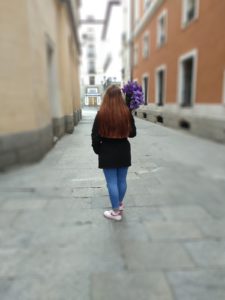
After having to do it time after time, she met other women who, like herself, were mothers separated from their children by thousands of miles and deceived by the empty promise of a decent job that would allow them to offer their children a better future.
The 25-year-old woman describes how all the girls she met were living in a room with bunk beds where they remained locked up all day. She lived with strangers who soon became her greatest support and consolation. “We combed each other’s hair and sometimes we even joked that if they put us in jail, we wouldn’t care… we were already living in a prison.”
 She speaks in the past because luckily the young woman also managed to escape the trafficking network, thanks to the support of a team of “Doctors of the World” who advised her to solicit international protection and access the State’s reception system, through the NGO Rescate, an association specialized in matters of gender that offers psychosocial and legal support and runs seven reception facilities for asylum seekers who have fled their countries for reasons related to gender. In other words, Rescate provides care and shelter to women who are victims of harmful traditional, cultural and/or religious practices, such as female genital mutilation or forced or early marriage; the restriction of sexual and reproductive rights, such as forced abortion, forced sterilization, forced pregnancy, virginity tests, sexual violence; rape and violence in armed contexts; femicide; abuse by partners or ex-partners; human trafficking networks; and discriminatory laws against women and LGBTQ individuals. But although we are talking about people who have first-hand experiences of all sorts of abuse, above all they are survivors of the most horrible crimes against humanity.
In Spain, Law 12/2009 regulating asylum and subsidiary protection, contemplates and expressly includes in the definition of a refugee, persecution for reasons of gender or sexual orientation, thus expanding the definition specified in the 1951 United Nations Convention on the Status of Refugees. Although official statistics on asylum do not break down this information, Laura is one of many women who, escaping from gender violence, found refuge in the Mediterranean country.
“Despite everything, every day I try to remind myself that no one can clip my wings and I am the one who decides how high I can fly. I’m alive. As painful as it is, I want to tell my story to keep other women from having to go through the same thing. I want to tell it so that my children continue to have a mother and grow amid respect. They are the strength that keeps me going forward,” says Laura with total conviction, while uncovering the lotus flower she has tattooed on her body, a symbol for being “the only one capable of sprouting in the middle of the shrubs.”
Loneliness or the absence of support: a wall facing migrant women victims of abuse
In 2018, Brenda left her native Argentina to Spain in search of job opportunities. She landed with a tourist visa, and when it expired, she fell into an irregular status and had no choice but to learn to live with the fear and constant uncertainty of getting deported to her country. At that time when her feelings of loneliness and lack of support were soaring, she met the person who became her partner, but also her greatest torment to a point where he undermined her self-esteem by putting her through psychological and emotional abuse.
Precariousness, or the absence of a support network, can form a thick barrier preventing women from getting out of spirals of violence inflicted upon them
Shortly after they met, Brenda’s partner offered to register them as common-law partners -a term that applies to the union of two people who want to live together in a stable manner, similar to a conjugal relationship, and who decide to register and officialize their relationship. This would help Brenda obtain a residency permit and therefore legally sort out her status in Spain, avoid problems with the police, and rid herself of the fear of being deported to Argentina.
Her partner’s offer ended up becoming an instrument of blackmail, control and manipulation. “My residency card includes his ID. For him, this meant I was his possession,” explains Brenda.
Despite the constant humiliation and abuse she reports to have suffered, Brenda admits she tried to escape on several occasions, but regrets that “she had nowhere to go, or no one to call.” The support network in Spain was almost non-existent and she did not want her family in Argentina to know anything about what she was going through. Until one day, during the strictest sanitary confinement to stop the spread of Covid19 between March and May 2020, Brenda decided to call 016, the number authorized by the Ministry of Equality, through the Government Delegation against Gender Violence, which provides information, legal advice and immediate psychosocial assistance by specialized personnel for all forms of violence against women. During the period of confinement, this line service saw a 60% increase in calls for help.
“They told me to gather my things and go to the nearest police station to report him, but I was afraid to do it alone. They asked if I had suffered physical violence, I said no; but I told them about how he put me through psychological, economic and emotional abuse and that I couldn’t take it anymore. They couldn’t help me,” laments the young woman.
Eventually, Brenda left home one day with her suitcase and took refuge with other friends and colleagues who had been starting a mutual support group called the “Latin American Feminist Network.”
 Precariousness, or the absence of a support network, can form a thick barrier preventing women from getting out of spirals of violence inflicted upon them. But with the support of Rescate, through the Sabina project in Malaga and Madrid, wounds can be healed.
“It is a program designed to support migrant women who also suffer or have suffered from different forms of gender-based violence. We offer prevention and accompaniment to women who do not have a support network, who live in isolation, and face discrimination, abuse, precariousness and labor exploitation,” explains Bárbara, a psychologist in the program who highlights the importance of “vital tools these women own to get ahead, despite all their accumulated suffering.”
Today, Brenda who calls herself a feminist, wants to break the silence because she knows that what she has experienced “can happen to anyone.” She is now speaking up about all her painful memories and believes in the “healing effect” of sharing and the power it holds to help and inspire other migrant women going through similar situations.