
Cette publication est également disponible en : Français (French) العربية (Arabic)
Eylül Ali
The women artists hidden in Istanbul’s most famous street
In Gezi Park, next to Taksim Square, stands Peace, a marble sculpture carved in 1974 by Lerzan Bengisu. She worked in stone and bronze at a time when few women artists were even hired, let alone recognized for works displayed in public spaces. Yet her name often goes unmentioned, like those of many women artists whose traces in the city are easy to overlook.
In May 2013, Gezi Park became the birthplace of the nationwide Gezi protests, which lasted more than two months. What began as resistance to government plans to redevelop one of Istanbul’s few remaining green spaces into a shopping complex grew into a broader movement against the loss of public spaces and rising authoritarianism. The park survived, and Bengisu’s sculpture still stands there today.
Yet urban redevelopment and gentrification have continued to transform Beyoğlu, the district surrounding İstiklal Street. Beneath its commercial facades, however, lie histories of women artists who once lived and worked there. Feminist storytellers are retracing their steps, uncovering the street’s layered memories.
In 2022, I joined a memory walk led by the feminist storytellers of Curious Steps, who began with a deceptively simple question: How does gender shape the way we perceive the city, our relationship with it, and our collective memory? Organized with Meşher gallery, the walk accompanied the exhibition I–You–They: A Century of Artist Women, which brought together work by women artists whose contributions have often been overlooked in art history.
We began at Narmanlı Han, once a hub of artists’ studios and workshops near the Tünel end of İstiklal Street, now transformed into a commercial space filled with shops and cafés. From there, we visited ten sites along the street where women artists had worked in the early and mid-1900s. Some buildings remain; others have disappeared. At each stop, the storytellers introduced us to the women who had occupied these spaces, their artistic practices, and the lives they led. The walk transformed my perception of a street I thought I knew and gave me a deeper sense of belonging to the city. Among the many stories we heard, two have stayed with me.
How does gender shape the way we perceive the city, our relationship with it, and our collective memory?
The woman who photographed Istanbulites for half a century
Born in 1911 in Sivas to a wealthy Armenian family, Maryam Şahinyan fled her hometown with her family during the Armenian Genocide of 1915.¹ Having lost their property and livelihood, they settled in Istanbul and began rebuilding their lives.
Maryam left school to help her father in his photography studio, where she learned the craft from him. By 1937, partly due to his illness, she had taken over the business and assumed financial responsibility for her family. In the conservative social climate of the time, many women preferred to be photographed by another woman, helping Maryam establish herself.
For nearly five decades, until 1985, she worked at Foto Galatasaray, maintaining her distinctive photographic practice. Although the studio moved three times, it remained within the Galatasaray neighborhood of Beyoğlu.
Şahinyan left behind an extraordinary archive of approximately 200,000 photographic negatives. After 20 years in storage, the archive was recovered and digitized by a team led by artist and researcher Tayfun Serttaş, following a three-year restoration process. It was eventually brought to public attention through an exhibition and a photobook in 2011.
Her photographs capture a remarkable cross-section of Istanbul society: Armenian nuns, Greek women, theater groups, musicians, and gender-diverse people appear among the thousands of portraits she produced. Her studio became a space where people from different communities could have their lives and identities documented. In her essay Indivisible Singleness, Crowded Loneliness, Karin Karakaşlı writes, “Istanbul’s truly cosmopolitan diversity fully manifests in the thousands of images, probably due to Maryam’s position in the city as well as [her] trustworthiness she must have exuded.”
Through her lens, Şahinyan preserved glimpses of a city whose social and cultural diversity would undergo profound change.
The woman who built her life around art
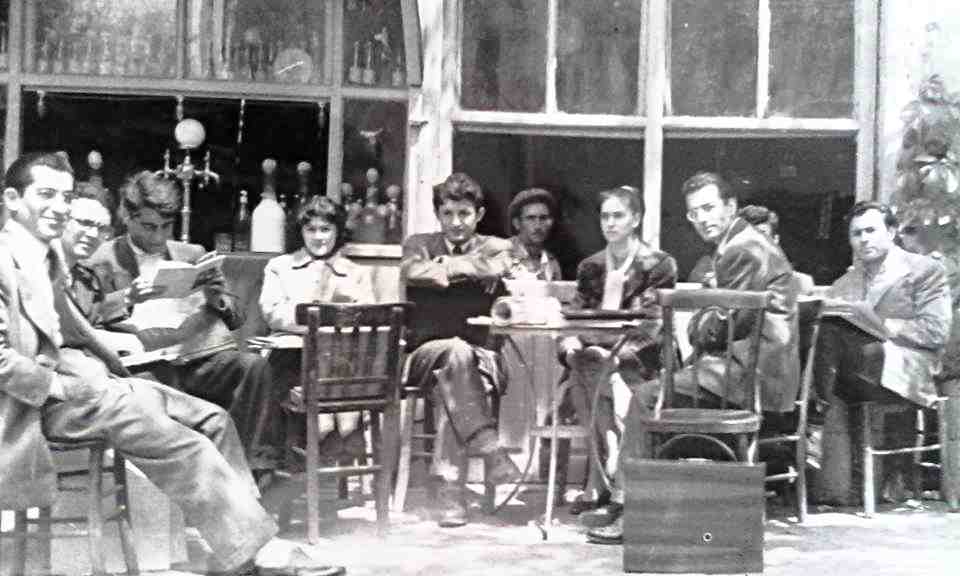
Born in Istanbul in 1922, İvi Stangali was raised by her mother, Marika, who became a tailor after her husband’s death. Marika opened a boutique on İstiklal Street and became well known in Beyoğlu’s fashion scene. A bright and hardworking student, İvi was expected by her family to pursue her education abroad. Instead, she chose to stay in Istanbul and study art.
Between 1942 and 1949, she studied under Bedri Rahmi Eyüboğlu, one of the leading figures in Turkish painting, at the Academy of Fine Arts. After graduating, she continued working closely with him as an artist and assistant until 1964.
Inspired by local motifs and the tradition of miniature painting, Stangali depicted the street life of Beyoğlu and developed a distinctive style as an illustrator. During the 1950s, when literary publications frequently featured illustrations, her drawings accompanied numerous books.
Her contribution to Istanbul’s artistic community extended beyond her own work. She was among the founders of the Onlar Group (Group of Ten), which explored how traditional and local artistic forms could be brought into dialogue with modern painting. Against a backdrop of debates about Eastern and Western artistic traditions, Stangali helped sustain the group by coordinating meetings and maintaining communication among its members.
In 1963, İvi gave birth to her daughter, Maya, whom she raised as a single mother. When Maya was just 11 months old, İvi’s name appeared on a list of Greek nationals ordered to leave Turkey amid escalating tensions over Cyprus. ²
In October 1964, İvi and her daughter were deported to Greece. They were among the thousands of people forced to leave during a campaign that ultimately expelled more than 12,000 Greek nationals from Turkey. Those expelled were permitted to take only 20 kilograms of luggage and approximately 20 US dollars.
Unable to carry her paintings with her, İvi arranged for around 50 works to be sent to Athens by train. They never arrived.
The loss was devastating. Separated from the city, colleagues, and artistic community around which she had built her life, Stangali produced very little art during the 35 years she spent in Athens. She died there in 1999.
Her forced displacement also marked the beginning of a longer erasure from art history. As art historian Seza Sinanlar Uslu observes in her article A Forgotten Name in the History of Turkish Painting, “even today, when photographs of the duo working together are republished, captions stating ‘Bedri Rahmi with an assistant’ […] continue to obscure İvi’s name and contribute to erasing İvi Stangali.”
Writing women artists back into history
Maryam and İvi came from different artistic backgrounds, but their stories share important threads. Both belonged to Istanbul’s non-Muslim communities. Both experienced the consequences of nationalist violence and forced displacement, though at different stages of their lives. And both pursued artistic careers and financial independence at a time when women’s lives were shaped by restrictive gender expectations. Yet their artistic legacies followed very different paths.
İvi’s exile interrupted a prolific artistic career, and the loss of her paintings deprived later generations of much of her work. Maryam’s archive survived, preserving a visual record of Istanbul’s communities, but might have remained unknown without the researchers who recovered it. These divergent fates show how an artist’s legacy depends not only on what she creates, but also on what survives and is remembered.
Researcher Banu Karaca, whose work examines cultural memory and the politics of forgetting, draws attention to both the structural violence imposed on Stangali and the silence of those who knew her. In a podcast episode on displaced artists, she argues that “bringing Ivi and exiled artists to the production of artistic knowledge also means transforming art history itself. And this, in turn, means reconstructing the imaginaries of life and coexistence in this geography.” Their stories invite us to question who enters art history and who is left out.
In Gezi Park, Bengisu’s Peace sculpture still stands, its name contrasting with the violence and displacement that shaped the lives of the women remembered here. Along İstiklal Street, women’s studios have disappeared or taken on new functions. But their stories remain. Sometimes, through whispers passed from one person to another, they find their way back into the city’s collective memory.