Cette publication est également disponible en : Français (French) العربية (Arabic)
Suzanne: From clandestine resistance to the battle over memory
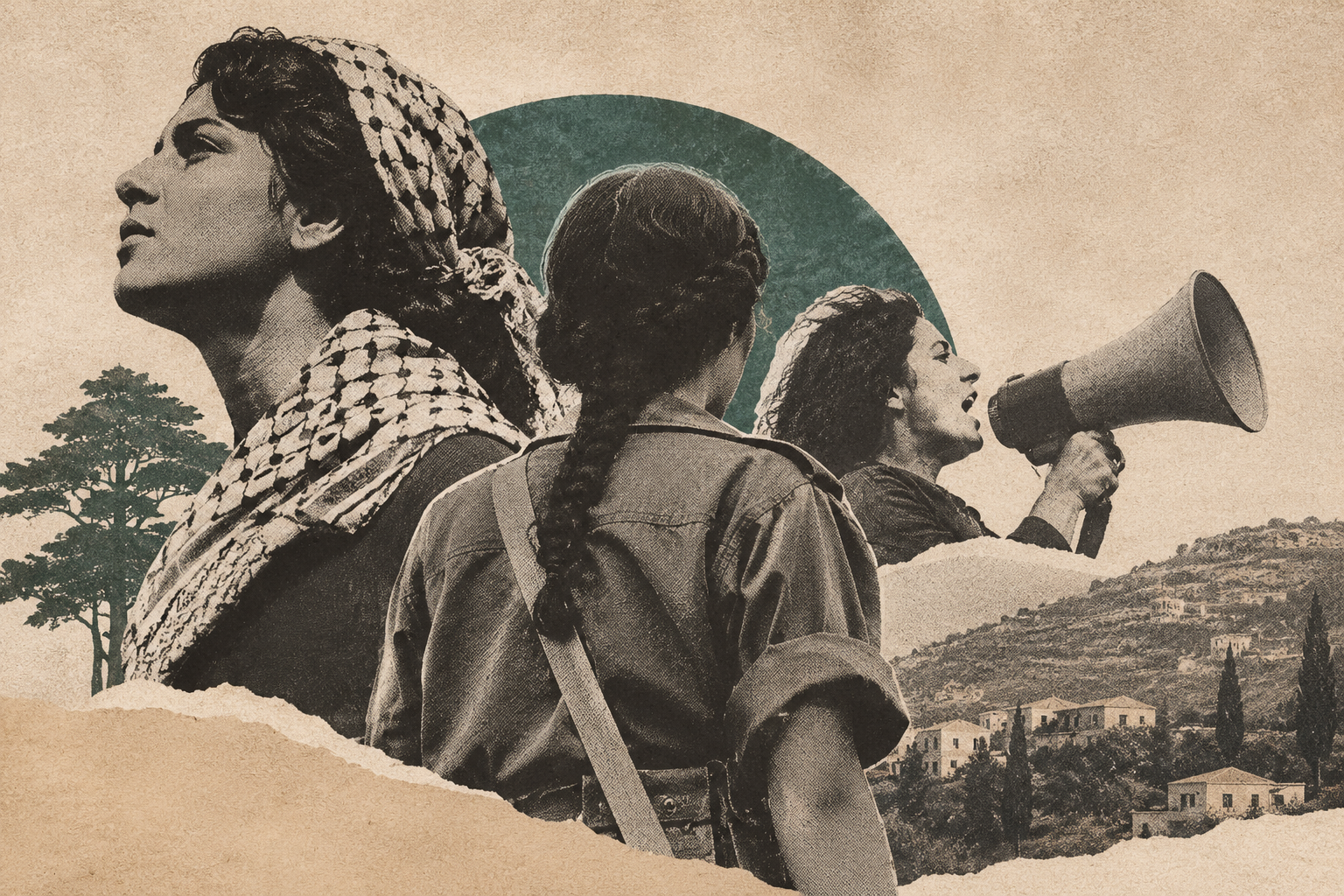
On the balcony of her home in southern Lebanon, Suzanne (a pseudonym she used during her years in the resistance) slowly sips her coffee. Now in her sixties, her calm demeanor belies the story she carries: that of a 15-year-old girl who traded her colorful dresses for a military uniform and spent years carrying concealed messages, handling weapons, and navigating checkpoints, all while mastering the art of appearing to be an ordinary girl.
Her uncle was the person who influenced her most. Through him, she learned about several Sudanese revolutionaries and heard stories of their lives and executions. These accounts first introduced her to the idea of revolution.
Her political awareness of the Palestinian cause developed through reading books, visiting refugee camps, and witnessing the living conditions of Palestinians. She still remembers a slogan often chanted at home: “In the name of workers and peasants, we nominated Nicolas Shawi.”
In 1975, when Suzanne was 15, she attended a military training course for girls known as the “Flowers” (al-Zahrat), organized by Fatah, one of the largest Palestinian political factions. She later joined the Socialist Action Party (1), affiliated with the Popular Front for the Liberation of Palestine, a left-wing Palestinian political and military organization.
“In 1976, I helped dig drainage and sewage channels in the Shatila Palestinian refugee camp. I saw people trying to make a revolution, and I became increasingly convinced that I had to be part of that struggle,” she recalls.
“I took my freedom. Nobody gave it to me,” Suzanne says.
She later joined the Lebanese Communist Party (2), a decision her brother opposed because he considered the party atheist. He thought what she was doing was dangerous. Her uncle was her only supporter, although he was abroad at the time. She remembers his words: “God and the Prophet are with you, and I say to you: Lenin and I are with you.”
“I saw people trying to make a revolution, and I became increasingly convinced that I had to be part of that struggle. […] I took my freedom. Nobody gave it to me.
In 1981, she attended a military training course that lasted about a month. The young women formed a military unit tasked with guarding a headquarters in the Sfeir area of Beirut’s southern suburbs. She continued her military activities before moving into communications, after her superiors recognized her ability to manage operational centers.
Following Israel’s invasion of Lebanon in 1982, the groups dispersed. Suzanne eventually resumed resistance activities within the Lebanese National Resistance Front, an organization established by several left-wing parties to fight the Israeli occupation.
She carried grenades in a paper bag
Suzanne began by carrying messages to southern Lebanon, sometimes hiding them in her hair. She later moved on to transporting and concealing weapons, learning how to use them, and training others to use them, as well as scouting Israeli military positions and identifying targets.
“The first operation I took part in was at Ali al-Taher Hill in southern Lebanon, as part of a group of three people and a commander, all of whom were later killed,” she recalls.
She remembers one particular mission when she was carrying a paper bag containing grenades and suddenly came upon an Israeli checkpoint. She managed to conceal the bag and pass through the checkpoint. She had told her friend she was going out for ice cream, which the two of them actually did afterward.
Suzanne was arrested on one occasion by the Lebanese Forces (3). Later, a group of collaborators pursued her and placed her under surveillance, but she managed to evade them. She was subsequently arrested with two comrades near the Kuwaiti embassy. “We were interrogated and subjected to blackmail. Later, I was also questioned by the Lebanese Communist Party itself,” she says.
As disagreements within the Lebanese Communist Party intensified, Suzanne felt that her role was diminishing and that her contributions were no longer appreciated. “My reaction was to go in the opposite direction. I left my work, the party, everything, and turned to the other end of the religious spectrum. I started wearing the abaya,” she shares. She started to feel that she wanted to live on her own terms, free from political party affiliations.
Suzanne insists that she did not participate in the Lebanese Civil War and never fired at a Lebanese person from the opposing side, even during clashes with the Amal Movement (4). “My work was directed against Israel,” she stresses.
According to Suzanne, women’s roles changed after 1990 as left-wing parties declined. Some women shifted toward humanitarian and social work, and their political participation became more closely associated with cultural, political, and social seminars.
Today, however, what concerns her most is how women’s experiences have been documented. “A book called Guerrilla Warfare in Lebanon, by Hamza al-Ansari, was written about our experiences, but those who put it together left out so much. They left out our feelings. They talked about what happened, but not how we felt. When I read what had been written about me, I couldn’t find my emotions in it.”
She fears that the absence of women’s testimonies will erase part of their collective memory, particularly as war has destroyed many libraries and documents in southern Lebanon. “I’m afraid future generations won’t know who we were,” she laments, explaining that she has shared her stories with her daughter so that she can preserve and pass them on.
“[They] left out so much. They left out our feelings. They talked about what happened, but not how we felt. When I read what had been written about me, I couldn’t find my emotions in it.”
From carrying out operations to questioning who leads
Suzanne falls silent and reaches for her cup of coffee. It has gone cold. She concludes, “I want those who come after me to know the role women played in the resistance, and for their feelings to remain part of history rather than be erased from its pages.”
Suzanne’s story raises questions that extend beyond individual experience to the broader experiences of women in society. Researcher and political activist Nemat Badr Eddine, born in 1981 and holder of a master’s degree in international relations and diplomacy, offers her perspective on the experiences of women and the evolution of their roles from the 1980s to the present.
Badr Eddine ran in Lebanon’s 2018 parliamentary elections in the South III electoral district. She has been active in the civil protest movement and in opposition to the sectarian political system. She also writes for the Lebanese newspaper Al-Akhbar and other publications.
“Women participated directly in resistance operations,” Badr Eddine explains. “Among them was Soha Bechara, born in 1967, who helped plan and carry out an operation against the occupation and was subsequently imprisoned. Another was Lola Abboud, a communist from the town of Qaraoun, who carried out an operation against the occupation during which she was killed.”
Other women transported weapons, distributed political statements, and participated in political mobilization. They rejected normalization with the occupation and raised their children to oppose it. They also assumed household and social responsibilities in the absence of husbands involved in the resistance. Some women were subjected to imprisonment, torture, and starvation because of their political and social involvement and their support for the resistance.
“Some organizations allowed women to participate in operations,” Badr Eddine adds, “but taking part in carrying out an operation did not necessarily mean being included in its planning or being given a leadership role.”
Layal: Military participation and the limits of independence
Sitting at home with a photograph of her late son behind her, Layal (a pseudonym) recounts her story. Her involvement in resistance work began with the Israeli invasion of Beirut in 1982, when she started working alongside her brother. She helped deliver supplies to areas where the Lebanese Communist Party was carrying out operations and guided young men along routes they weren’t familiar with.
“With time, I began to feel that I was following someone else’s lead rather than working independently. My brother was afraid for my safety and would not let me participate in direct missions. Despite everything I was doing, I felt I wasn’t contributing enough and that I needed to become directly involved.”
In the early 1980s, she moved into military activities.
Layal remembers that women could reach places that men had difficulty accessing. They helped transport people, supplies, and information, even though society was not particularly accepting of women’s involvement in such activities.
Layal was captured by Israeli forces when she was 20 years old. Torture, beatings, and electric shocks left deep psychological scars. Recalling one of her most painful memories, she says, “When you’re left with menstrual blood running down your legs, and you remain that way for days, it’s hard to describe how it feels. It was a horrible, deeply painful experience, perhaps the one that affected me most. Even today, I cannot put that feeling into words.”
Layal was released in 1987 and subsequently returned to political work within the Lebanese Communist Party. “I never thought of people who join the resistance as people who have nothing else in their lives,” she says. “My son, for example, was preparing a PhD in human resources before he was killed. We are people who work, study, and live our lives, while also believing in resistance as a choice.”
“After my son was killed, I struggled a great deal. My memory is no longer what it used to be, and there are many things I can no longer remember or talk about the way I would like to,” she concludes.
Women could reach places that men had difficulty accessing. They helped transport people, supplies, and information, even though society was not particularly accepting of women’s involvement in such activities.
Social and patriarchal constraints and the priorities of political organizations
Following the liberation of southern Lebanon from Israeli occupation in 2000, women’s roles changed. Their involvement became more closely tied to building and sustaining a social environment supportive of the resistance through education, culture, and religion, and through work in healthcare, educational, and social institutions. Yet this participation did not translate into equal representation in municipal councils or party leadership positions.
“Drawing on my 26 years of political experience, I distinguish between recognizing women’s participation and the tasks they perform, and recognizing them as independent political actors who take part in planning and developing strategies,” explains researcher and political activist Nemat Badr Eddine. “The first two levels have been achieved, but women have not gained the same access to the third: decision-making and positions of power. Soha Bechara’s experience illustrates this. She has primarily been portrayed as an individual heroine rather than as part of a broader collective participation of women in the resistance.”
Several overlapping factors help explain why women’s experiences have received limited attention in historical accounts of the resistance. These include the secrecy surrounding clandestine activities, fears for the safety of families, social and patriarchal constraints, and the priorities of political organizations. The emphasis on military operations and individual male heroism also raises questions about how much space has been given to documenting women’s roles and experiences, and what has been left out of written memory.
In this context, Suzanne’s call to document women’s feelings goes beyond simply recovering memories. It raises a more fundamental question about women’s right to tell the history they helped make.