Cette publication est également disponible en : Français (French) العربية (Arabic)
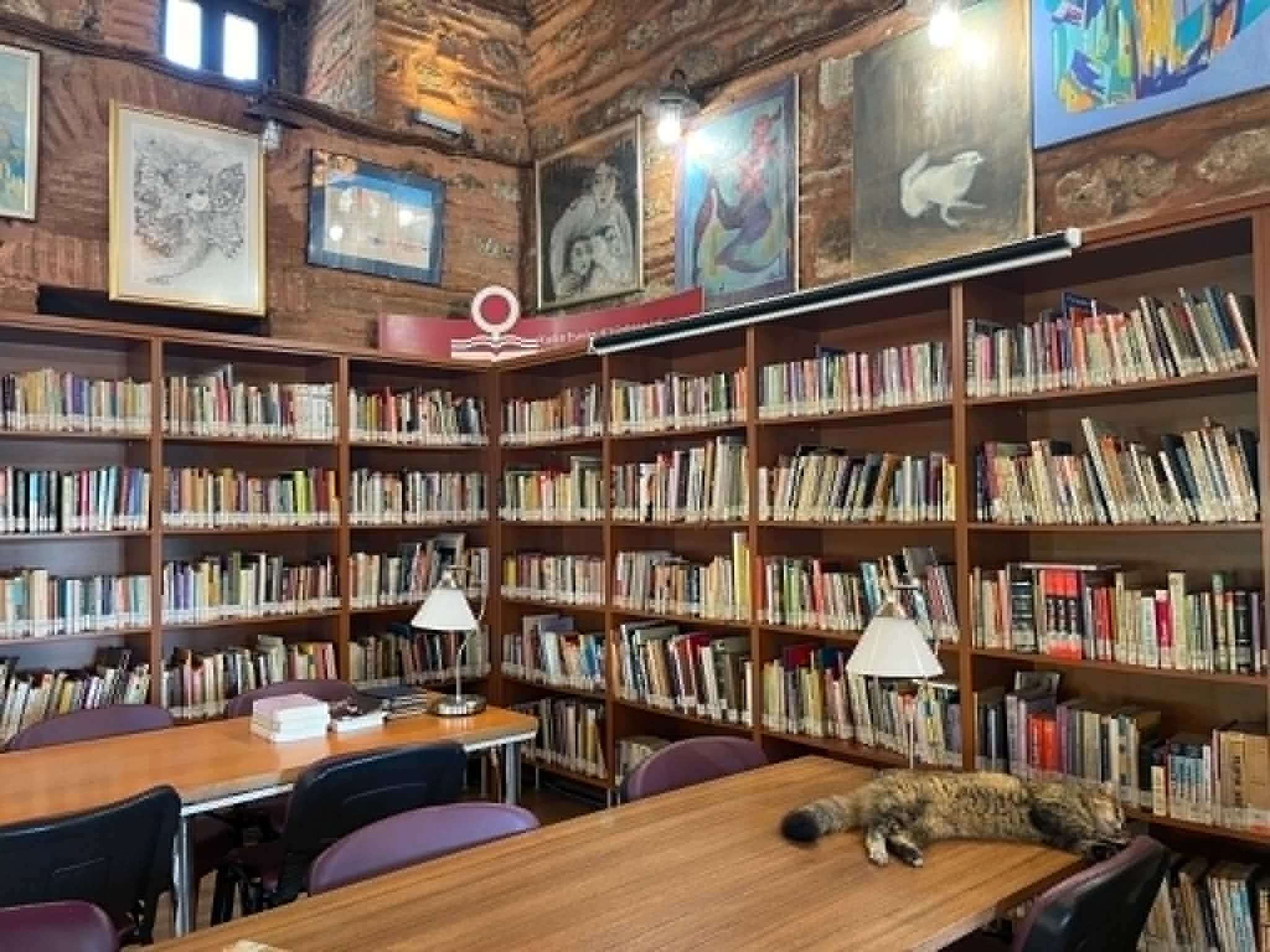
Without asking what brings me here, the library’s caretaker gestures for me to climb the stone staircase. On the landing, I instinctively turn right and enter a welcoming room, its wooden shelves filled with books and walls beautifully decorated with paintings, all by women artists. The building, said to have once served as a warehouse during the Byzantine era, has been completely restored. Road expansion has left it a few hundred meters from the southern shore of the Golden Horn, the estuary that meets the Bosphorus and around which the sprawling Turkish city of Istanbul extends. Its present role as a documentation and archival center suits it perfectly.
The reading room is empty this Monday morning, except for an affectionate cat that follows me everywhere. I wander freely among the shelves, enveloped in silence. Most of the books are in Turkish, but there are also titles in English, German, and French. I pick up Season of Figs: Memories of a Turkish Childhood by Niyaz Martin Wilson at random. Born in Istanbul in the 1930s, the author and educator recounts memories of her childhood, particularly her education at an American school for girls. About ten minutes later, a library employee interrupts my reading. Our exchange consists of broad smiles and a few words in English; we have no common language. Determined to help me despite this barrier, he returns shortly afterwards with several documents tracing the history of this institution, the only one of its kind in Türkiye.
Bringing women out of the shadows
The Women’s Library and Information Centre Foundation (WLICF) was founded in 1990 by five women academics and writers: Aslı Davaz, Füsun Akatlı, Füsun Ertuğ, Jale Baysal, and Şirin Tekeli. They came together with a shared purpose: to bring to light women’s histories and memories that had remained invisible, and sometimes been erased, by creating a space dedicated to preserving them.
The library houses an extensive collection that has continued to grow over the years. It includes classics of Turkish gender studies, more than 10,000 women’s magazines published between 1869 and 2016, hundreds of academic theses and dissertations, and thousands of scholarly articles. Its primary sources range from postcards dating back to the late nineteenth century depicting everyday life, to more than a thousand biographies of women artists, archives of various feminist organizations spanning a century of activism, and audio recordings, including interviews with members of the Dinarsuspor women’s football team.
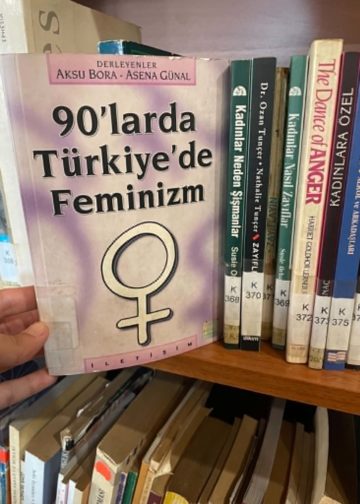
The emergence of this project in the 1990s was closely linked to the momentum of the feminist movement at the time. In 1986, the country witnessed one of its first mass feminist mobilizations: a petition gathering 7,000 signatures demanding the implementation of the United Nations Convention on the Elimination of All Forms of Discrimination against Women (CEDAW). Another milestone came in 1987, with a march against domestic violence that would eventually lead to the establishment of a women’s shelter in Istanbul in 1990.
Other campaigns were organized during this period, notably against sexual violence and Article 438 of the Turkish Penal Code, which provided for reduced sentences for rapists if the victim was a sex worker. Alongside this activist agenda, 1990 also saw the establishment of the first women’s research and education center at Istanbul University.
The emergence of this project in the 1990s was closely linked to the momentum of the feminist movement at the time.
From running the library to donating archives: a collective endeavor
One of the WLICF’s distinctive features is its commitment to serving the public, despite being a private initiative supported financially through a combination of public and private patronage. Open to visitors on weekdays from 8:30 AM to 5 PM, the library operates largely thanks to the dedication of volunteers, who are always welcome.
I meet Elif Yaren Gaş, a political science student who, after volunteering for a year, now works in a paid position cataloguing and digitizing some of the archives.
She rolls her chair away from her desk to retrieve a thick folder from behind her. It contains the personal archives of Fatmagül Berktay, a political scientist born in 1950 whose research has notably examined the position of women within monotheistic religions.
“She was one of three women activists who attended the Fourth World Conference on Women, organized under the auspices of the United Nations in Beijing in 1995, and whose experiences we focused on in our latest project,” the young woman explains, leafing through meticulously organized reading notes, correspondence, and speeches. Here, too, volunteers contributed to the collection process over a period of three months.
Sometimes, however, archives find their way directly to the WLICF. To date, 127 women have donated their personal collections. The first to take this step was Hasene Ilgaz (1902–2000), a teacher and member of parliament who remained highly active throughout her life, both in politics and in civil society, through her involvement in dozens of associations. Numerous personal documents, including photographs, newspaper clippings, and letters, trace her journey as an activist while bearing witness to a century of history.
One of the WLICF’s distinctive features is its commitment to serving the public, despite being a private initiative supported financially through a combination of public and private patronage.
A wide range of activities
A space for memory, research, and raising awareness, the library also comes alive each month through cultural events, including book presentations and discussions with invited guests. This year, for example, a tribute was dedicated to the suffragist Nezihe Muhiddin (1889–1958), one of the founders of the Turkish Women’s Union.
On the ground floor, visitors can purchase books published by the WLICF, including a bibliography of women’s periodicals (1928–1996), from Hanımlar to Roza, and a bibliography of women’s literature (1955–1990). Publishing is another important dimension of the institution’s work.
By compiling and organizing archival materials in this way, the library makes them more accessible and, as its team points out, they “can open up new avenues for research.” And therein lies one of the central missions of this feminist library: to forge connections between the past and the future.