Cette publication est également disponible en : Français (French) العربية (Arabic)
You trained as an architect before turning to geography to study women’s memory in urban spaces. How did this subject become central to your academic journey?

I initially studied architecture, but then I became interested in pursuing research. I enrolled in a master’s program at the École des Hautes Études en Sciences Sociales (EHESS) before beginning a PhD in geography. At first, I was primarily interested in monuments, memory, and counter-monuments: how do we create a site of memory? How are certain events commemorated in public space, particularly through architecture?
Gender gradually became part of my research through my political engagement. At the time, anti-femicide posters played an important role in my journey. I was living on the outskirts of Paris and regularly traveling to the 11th arrondissement for an internship. On my way from the metro to my workplace, I would see these posters pasted on walls. They struck a chord with me, stirring feelings of injustice and anger that I did not yet quite know how to express.
I began asking myself how I could become politically involved and take that engagement further. The posters became a subject of research during my master’s degree, and I subsequently wanted to broaden my inquiry to other ways in which women’s memory is inscribed in the city. My thesis therefore brings together three subjects: streets named after women, anti-femicide posters, and the MonumentalEs project.
Your research focuses in particular on street names, or odonyms. Why are they such an important subject for understanding collective memory?
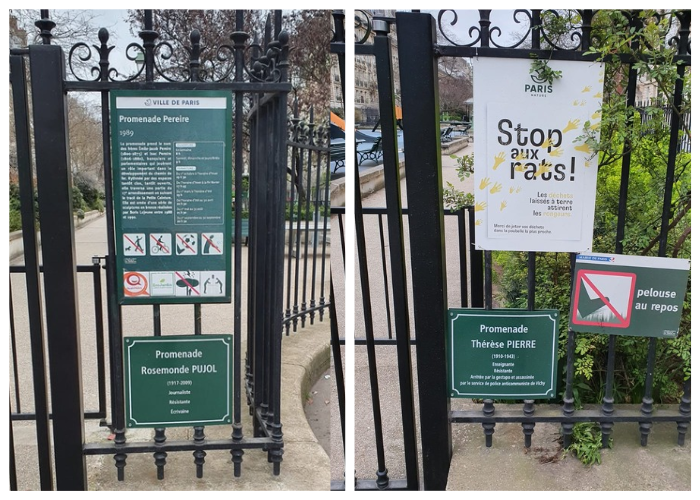
Street names are a particular form of memorial inscription because they are part of our everyday lives. They help us find our way around, but they also commemorate people, events, and values. We encounter them every day on street signs, in our postal addresses, or on our GPS devices, often without even paying attention to them.
Unlike a monument, which we can choose to stop at, choose to look at, or simply pass by, a street name is embedded in our everyday movements. Through repetition, it eventually becomes part of our knowledge of the city. I didn’t grow up on Avenue Foch or Avenue du Général-Leclerc, but I always knew who Foch and Leclerc were, partly because their names were present in urban space.
Street names therefore help shape collective memory, but they also introduce us to figures with whom we can identify. Naming streets after women is not simply about symbolically redressing the erasure of women who played a role in history. It is also about making visible the lives, experiences, and values that can inspire present and future generations.
When certain figures remain absent from collective memory, it helps perpetuate the belief that their actions were less important. The way we tell the story of the past affects what we consider possible or legitimate in the present. Analyzing how women’s memories are spatially inscribed in the city is a way of examining the gender inequalities at work in society.
A quote by sociologist Marion Charpenel illustrates this well: “If history has long served as an instrument for legitimizing men’s power by excluding women from the national narrative, feminist memory emerges as a necessary counter-history through which to challenge present-day forms of domination.”
When certain figures remain absent from collective memory, it helps perpetuate the belief that their actions were less important. The way we tell the story of the past affects what we consider possible or legitimate in the present.
Naming more streets after women is often presented as progress in itself. When did you realize that the problem was not simply how many women were being honored, but also how they were being honored?
I remember it very clearly. At the beginning of my PhD, I had a fairly positive view of this policy of naming more streets after women. I wanted to analyze how women’s memory was gradually finding its place in the city. I began by working with the Paris street-name database, which includes information about street locations, lengths, and naming dates.
The further I progressed with my statistical analysis, the more I realized there was a problem. From 2001 onward, when Paris began actively pursuing a policy of naming more streets after women, streets bearing women’s names were often dead ends or pathways, while those named after men were more likely to be boulevards and avenues. Streets named after women were also shorter and had fewer street signs.
I remember going to my thesis supervisor and telling him, essentially, that the City of Paris’s public messaging did not match what I was finding in the data. The figures could be presented in a way that suggested progress toward gender parity, but as soon as you looked at how those names were distributed across urban space, the inequalities became apparent again.
Does this hierarchy also extend to the choice of women who are commemorated? Do all women have the same chances of becoming part of public memory?
No, and we need to pay attention to how selection criteria can reproduce inequalities. There are notable differences between the male and female figures who are honored. Men are often commemorated for their political or military roles, while women are more frequently associated with art, culture, literature, or activities considered less controversial. This clearly shows that commemoration is never neutral: it depends on what a society considers a historical contribution worthy of remembrance. There is also a hierarchy among women themselves. Gender inequalities intersect with those related to social class, race, and other power relations.
The question of consensus is also important. Institutions tend to favor figures considered uncontroversial, but who defines that consensus? Which political positions are considered acceptable, and by whom? A figure may have played a major historical role while remaining controversial in the eyes of the institutions responsible for deciding whether to commemorate them. In Paris, there was the case of Gisèle Halimi, who was not inducted into the Panthéon despite calls from the City of Paris and numerous feminist collectives, because of her political positions during the Algerian War. This shows how a woman who absolutely played a major historical role can be excluded from the Panthéon because she is not considered sufficiently uncontroversial in relation to the objectives set, in this case, by the presidency.
You describe women’s memories as spatially fragmented. What does this fragmentation look like in Paris?
When we map streets named after women, we see that their presence is not evenly distributed. Some areas remain largely unaffected, particularly neighborhoods associated with political power or concentrations of wealth. We also find clusters of streets named after women in areas that ultimately receive little foot traffic.
This fragmentation is spatial, but it is also political. It reveals where certain memories are accepted and where they remain marginalized. Marginalized groups are often commemorated wherever there is still room, whether in physical space or within the categories of memory considered legitimate.
We can, for example, question the contrast between major educational institutions named after men and nursery schools named after women. This is not to say that naming a nursery school after a woman has no value. It is important. But we must also ask why certain prestigious spaces seem to continue favoring male figures.
In fact, until recently, nursery schools did not have their own names, and the municipality decided to give them names to increase the number of tributes to women. We therefore have a situation in which women’s names are assigned wherever there is still room, in spaces that, for a long time, were not considered important enough to be named.
Women can thus be present in the city without their memory truly transforming its most symbolic places. This is what leads me to distinguish between women’s memory in the city and women’s memory becoming an integral part of the city’s own memory.
Between 2017 and 2020, the MonumentalEs project inscribed the names of 169 women on street furniture in the Place du Panthéon, home to France’s national mausoleum. How does this initiative relate to your research?
The MonumentalEs project was part of a broader City of Paris program called Réinventons nos places (Reinventing Our Squares), which aimed to redesign seven public squares across Paris. The Place du Panthéon was one of them. Before the redevelopment, much of the square was taken up by car parking. One of the project’s aims was to reclaim space for everyday use.
The MonumentalEs collective worked on ways to design a more inclusive public space, particularly from a gender perspective. But during the final phase of the project, members of the collective pointed out a contradiction: the square was being redesigned without really taking into account the fact that the Panthéon, right next to it, is a major site of predominantly male remembrance.
It was in this context that the idea of engraving the names of 169 women on street furniture was proposed. Since women were so poorly represented inside the Panthéon, the aim was to make their names visible outside, as close as possible to the monument and to the everyday activities taking place in the square.
The names are inscribed on benches, where people sit, talk, and spend time. Memory is not simply confined to a monument that people visit; it becomes part of a space they use in their everyday lives.
Finally, what does the French term matrimoine (women’s heritage) help us understand that patrimoine (heritage) tends to obscure?
Originally, matrimoine was understood as the counterpart to patrimoine: patrimoine referred to property inherited from the father, while matrimoine referred to property inherited from the mother. Beginning in the 17th century, members of the Académie Française removed the term from dictionaries and gradually replaced it with patrimoine, which came to encompass property inherited from both parents.
Feminist movements reclaimed the word, particularly from the 2010s onward, giving it a broader meaning: women’s cultural heritage, and especially their contributions to artistic and cultural history. The term patrimoine appears to naturally encompass the heritage of an entire society. Yet when we examine how that heritage has been constructed, we see that certain figures have been valued far more than others. Using the term matrimoine makes this asymmetry visible and reminds us that collective history is not neutral.
Ultimately, the challenge is to understand how gender inequalities are expressed spatially: in the ways bodies occupy the city, in the figures we choose to commemorate, and in how long the traces of their presence remain visible.