Cette publication est également disponible en : Français (French) العربية (Arabic)
Behind the harmless folklore of the fairytale witch lies the first major mass femicide of modern history. In France, between the 14th and 17th centuries, nearly 80% of those executed for witchcraft were women. Their names? Jeanne de Brigue, Catherine de Fernandez, Marguerite Joly… in addition to the thousands of unnamed women tortured and burned alive in the name of Christianity.
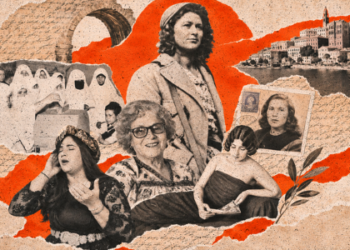
The witch trials of the Middle Ages and the Renaissance relied entirely on public rumor, conspiracy theories, and accusations unsupported by factual evidence. Their real crime was that they had escaped the social, moral, and patriarchal control of their time. Whether healers, custodians of ancestral knowledge, widows, unmarried women, or financially independent, these women were perceived as threats to the male-dominated order, the King, and the Church. They were accused of making pacts with the Devil, inducing abortions, or flying on broomsticks. But in reality, it was their independence, freedom of thought, and autonomy over their own bodies that were being criminalized.
Underlying accusations of witchcraft, an assault on women’s freedom
The year 1609 marked a particular peak in this systemic hatred, especially in the Basque Country, a territory spanning parts of Spain and France.
Commissioned by King Henry IV, the magistrate Pierre de Lancre led a brutal crusade in the province of Labourd, driven by a patriarchal intolerance that knew no bounds. He sentenced at least 80 people to death for witchcraft, according to surviving archives, most of them women, including a ten-year-old girl.
Today, we understand that it was Basque cultural practices, along with the freedom enjoyed by women in the region, that were demonized and condemned, within the context of an economic and political power struggle between the royal court and the Basque Country. Furthermore, Pierre de Lancre’s convictions of these women relied on confessions extracted through physical and psychological torture; his actions were a deliberate assault on an entire population, intended to consolidate royal and male authority and Christianize the Basque population.
This new interpretation of history continues to be advanced and enriched by numerous historians and sociologists, including François Bordes, as well as associations such as Sorcières en Foire in Burgundy and Journées Sorcières in Occitanie.
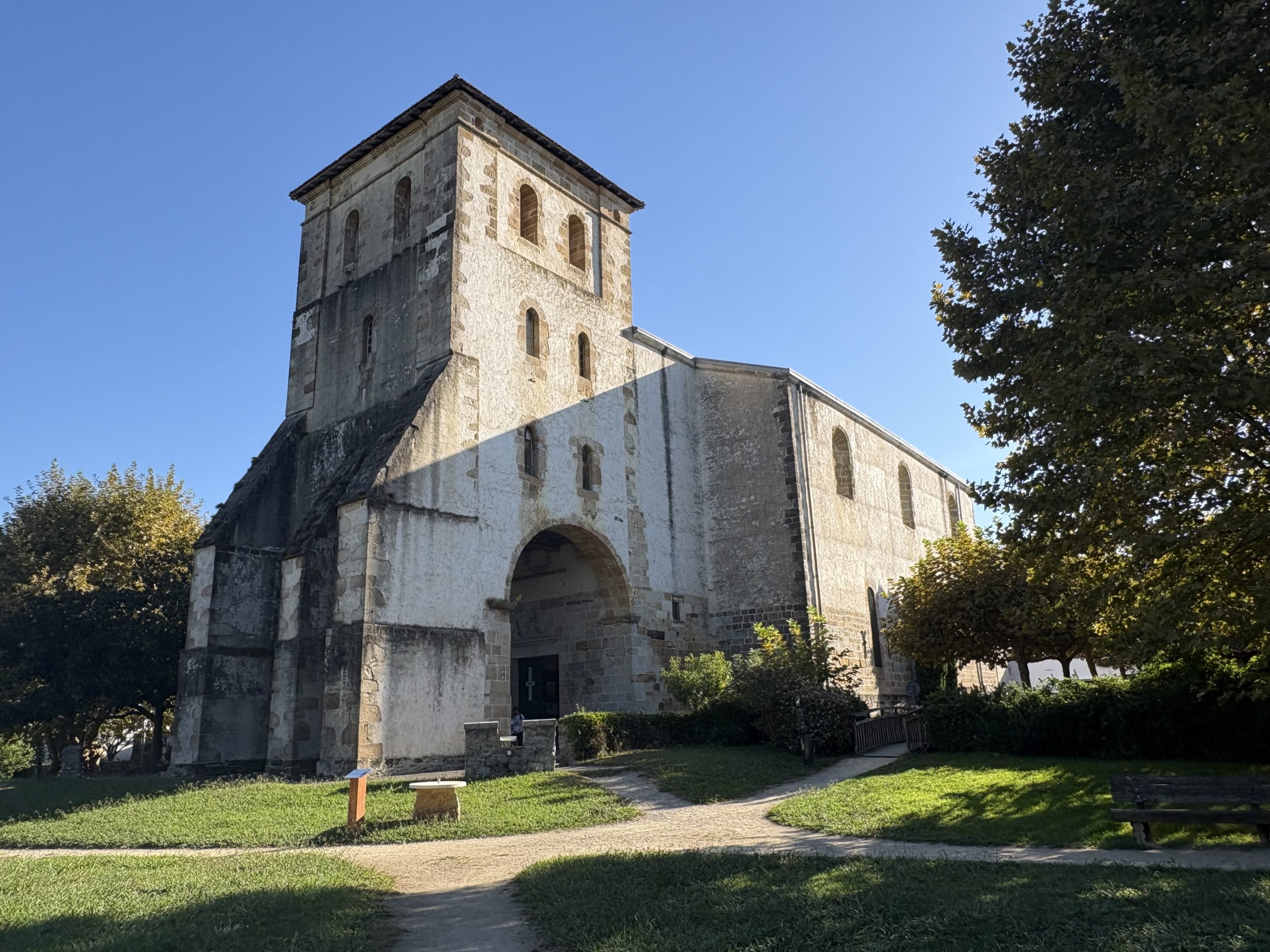
In the face of state denial, resistance is being organized at the local level. In Saint-Pée-sur-Nivelle, a memorial now restores dignity and a measure of justice to more than 80 people, predominantly women, convicted of witchcraft in 1609.
Saint-Pée-sur-Nivelle: Righting the wrongs suffered by “our ancestors” through remembrance
In the face of state denial, resistance is being organized at the local level. In Saint-Pée-sur-Nivelle, a municipality of approximately 7,000 inhabitants in the Pyrénées-Atlantiques department, a memorial now restores dignity and a measure of justice to more than 80 people, predominantly women, convicted of witchcraft in 1609, some of whom were imprisoned, tortured, executed, and burned at the stake.
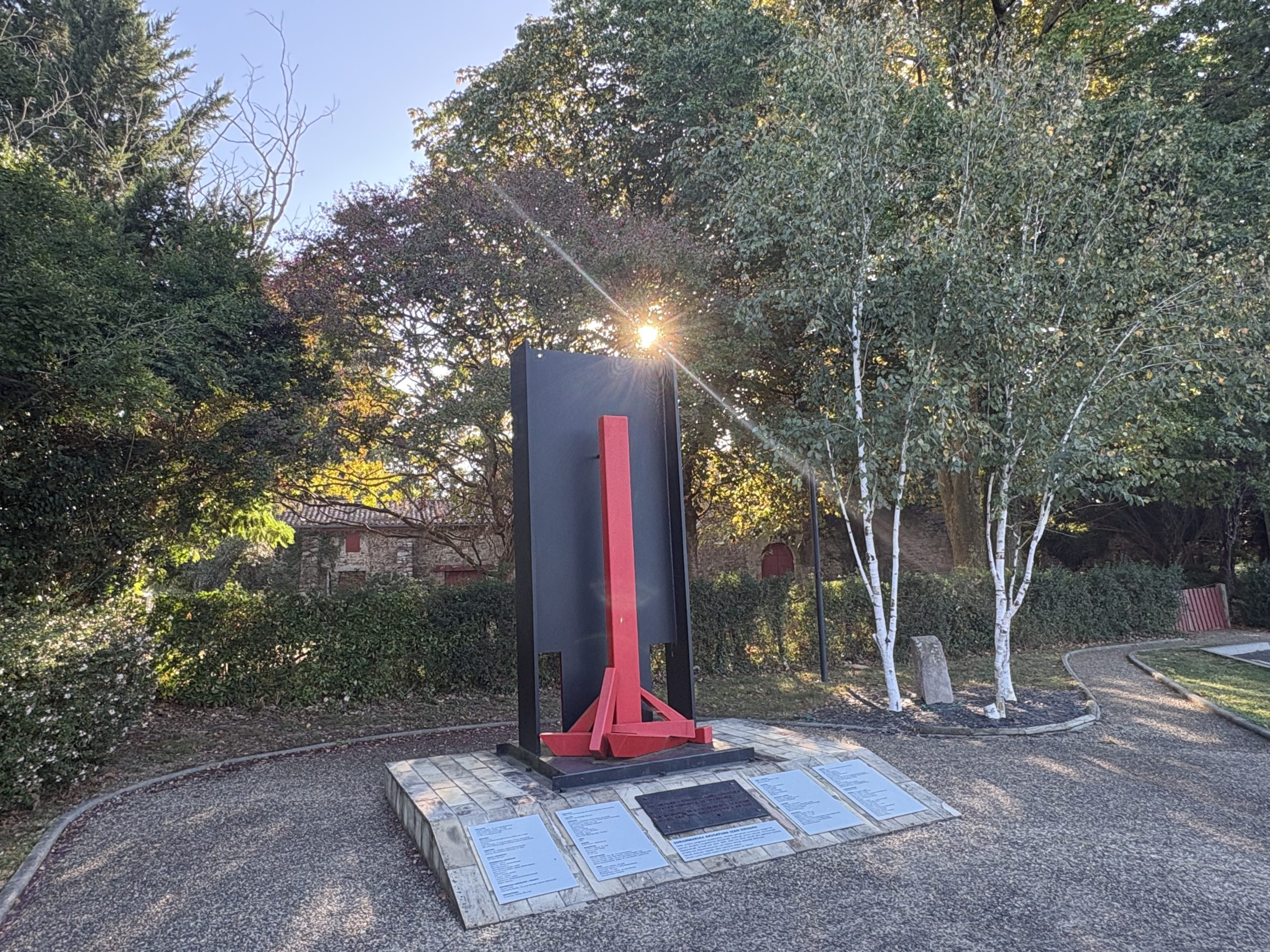
Yet arriving in the village today, visitors encounter a peaceful place, where doors and shutters painted in the region’s characteristic burgundy red brighten the streets. Nothing suggests the horror of the mass atrocity committed here. But this is a town that has dared to place the horrors of its past on public display, erecting a red-and-black memorial in the village’s largest parking area. A pyre made of clay and mirror-polished brass, one that will never burn, stands permanently in a patch of greenery, paying tribute to innocent victims.
This rehabilitation project did not come “from above.” It emerged from a grassroots initiative launched in 2009 by the association Lapurdi 1609, with the support of the municipal administration at the time, led by Mayor Christine Bessonart. Together, they reframed these crimes as gender-based violence and abuses of institutional power. To give tangible form to their struggle against forgetting, they enlisted one of the Basque Country’s most prominent artists, Nestor Basterretxea.
Outraged by the fanaticism and oppression, the sculptor volunteered his services to the association, working alongside blacksmith and poet Jean-Michel Bedaxagar. Their collaborative work, the Oroitmina memorial (“Pain of Memory”), which the artist donated to the municipality, has stood in the village square since 2010.
More than a simple historical tribute, the monument is a powerful political statement. As Lapurdi 1609 explains, “Centuries have passed, and this memorial seeks to recall this dark chapter of history. But above all, it is a call for vigilance against all forms of injustice and the abuses that a centralized authority, detached from the concerns of the people, can commit.”
For the association, the monument restores a place in public space to “these persecuted ancestors” and allows Saint-Pée-sur-Nivelle to begin healing the wounds of collective trauma, urging future generations to remain vigilant against the oppression that continues to target minorities and women.
Even today, descendants of victims, as well as tourists, gather around the sculpture to honor these women who were falsely accused, as a representative of the village’s tourist office explains. “More than 400 years later, it is still a taboo subject,” she says. “There are still descendants of these falsely accused women living in the village today. For them, these women are not just forgotten figures from history; they are their own ancestors, members of their own families, and you can clearly sense how difficult it is for them to talk about it. It has left a lasting mark on people’s minds in the Basque Country, and here in Saint-Pée-sur-Nivelle.”
“There are still descendants of these falsely accused women living in the village today. For them, these women are not just forgotten figures from history; they are their own ancestors, members of their own families, and you can clearly sense how difficult it is for them to talk about it.”
During guided tours of the village, she also explains the symbolism embedded in the commemorative sculpture. “You have to walk all the way around the memorial to see all its different sides. It’s a way of reminding us that we need to examine everything carefully before forming an opinion. Even the hidden sides of History have something to tell us…”
France’s institutional amnesia runs counter to European and global efforts at remembrance
Yet this local urgency to preserve historical memory is met with deafening silence from the French state. While the writings of Mona Chollet and the research of Isabelle Cambourakis demonstrate how witch hunts have had a lasting impact on gender inequalities and the stigmatization of women’s knowledge, the Ministry of Justice, which we consulted on the matter, appears to remain entrenched in a form of bureaucratic indifference.
Indeed, when asked about the possibility of symbolically rehabilitating these victims, the ministry responded with a legal dismissal. It first pointed out that “rehabilitation,” as defined under Article 133-13 of the French Criminal Code, is a strictly defined legal mechanism, intended for living individuals who have already served their sentences. The ministry added that regional courts under the Ancien Régime would occasionally overturn such convictions on appeal, though it concedes that there are “no consolidated official figures” on this.
More importantly, the ministry’s political position on the duty to rehabilitate these women was made unequivocally clear when it declared: “To date, there has been no institutional consideration of this issue in France.”
It would seem that, apart from the exceptional case of Joan of Arc in 1456, France refuses to make a meaningful gesture toward the victims of these historical femicides. Yet this institutional amnesia sets the country apart. In Catalonia, the regional parliament has officially rehabilitated more than 700 victims, explicitly describing their persecution as “misogynistic persecution” and “femicides.” Scotland followed suit in an effort to restore the honor of the 2,558 women executed there, with Switzerland and the United States, in Salem, subsequently taking similar steps.
For historians and human rights activists, these rehabilitations are not merely exercises in anachronistic repentance. They represent an essential acknowledgment for the descendants and families of those condemned, while serving as a condemnation of the mass violence and patriarchal structures that enabled it. By refusing to acknowledge the wrongs of the past, the French state is once again missing an opportunity to condemn the systemic roots of violence against women.
Until this political and institutional reckoning takes place, and for as long as the national authorities continue to look the other way, the duty to pursue universal, grassroots justice will remain alive in defiant municipalities such as Saint-Pée-sur-Nivelle.