Cette publication est également disponible en : العربية (Arabic)
Throughout their years in exile, Syrian women were never merely numbers in humanitarian aid records. In Turkish cities that welcomed large numbers of Syrians fleeing the brutality of the Assad regime, such as Gaziantep in the southeast, women fought difficult battles to overcome language barriers and integrate into the labor market. Many started from scratch, establishing small businesses or securing stable employment that gave them financial independence.
Returning to Syria today would mean giving up that independence and starting over, from “below zero” this time. Sawsan Mohammad, a teacher from Damascus, explains, “Despite improvements in security, I cannot return and settle permanently. Living conditions are difficult, and there are no stable job opportunities that would allow me to provide a decent life for myself and my family. I used to work as a teacher, and I hope to return to my profession and contribute to rebuilding my country when the conditions are right.”
Iman Saleh, from the city of Homs, shares this concern. “The main reasons I haven’t returned are the lack of job opportunities for my children and the destruction of infrastructure,” she says. “There needs to be significant change, most importantly when it comes to security and employment opportunities, so I can live a dignified life.”
According to data from the United Nations High Commissioner for Refugees (UNHCR), more than 1.6 million Syrian refugees have returned to Syria from neighboring countries since the political transition in December 2024. In Türkiye, meanwhile, the Ministry of Interior reports that more than 2.2 million Syrians remain under temporary protection, while approximately 700,000 returned voluntarily, safely, and in an orderly manner between December 8, 2024 and mid-2026.
As for those returning specifically from Türkiye, the Turkish Directorate General for Migration Management publishes aggregate figures without providing a gender breakdown.
The fall of the Assad regime does not mean recovery
Although UN data indicates that Syrian women account for approximately 52% of all those returning from neighboring countries, UN reports warn that women, particularly those who are the sole providers for their families, face additional challenges upon returning. These include inadequate services, limited access to livelihoods, and persistent protection risks in certain areas.
For some women, temporary visits offered an opportunity to assess conditions on the ground, but what they encountered proved more shocking than expected. Amal Antabli, originally from Aleppo, moved to Türkiye in 2013. “After the liberation of Syria, I went back to visit my beloved city of Aleppo,” she recalls. “But the visit revealed major practical challenges. My apartment is on an upper floor and needs renovation, but the elevator is out of service, making it difficult to live there.”
For some women, temporary visits offered an opportunity to assess conditions on the ground, but what they encountered proved more shocking than expected.
Amal, who obtained Turkish citizenship along with her family, adds, “The city needs extensive infrastructure rehabilitation. Electricity supply is unreliable, and access to water and the internet remains difficult. Permanent return is still a difficult decision until the basic necessities of life are available.”
This physical destruction extends to other vital sectors. Fatima Hammoud, who arrived in Türkiye from Deir ez-Zor in 2015, identifies the primary obstacles to return as “the destruction of the city alongside the severe deterioration of the healthcare sector and the security situation, particularly the widespread presence of weapons.”
Mothers without legal protection
Beyond the physical rubble, women, particularly those who are divorced, face legal obstacles that make returning far more complicated than a personal decision.
Samira al-Ali, a lawyer specializing in migration and refugee affairs in Türkiye, explains that many mothers encounter legal difficulties when considering returning to Syria. In many cases, procedures require mothers to obtain a legal power of attorney or a notarized travel authorization from the father before they can take their children to Syria.
For Syrian women registered under temporary protection in Türkiye who wish to return voluntarily to Syria with their children, the process begins at the Directorate for Migration Management in the province where they are registered, after scheduling an appointment through the migration management system.
The procedures are then completed at the directorate, which issues a voluntary return form and a travel permit valid for 15 days, allowing the person to reach the designated border crossing and complete the departure procedures.
If a married mother wishes to return to Syria with her children without their father, because he does not want to return with her, she must obtain his formal written consent authorizing her to take the children to Syria. This consent document must be drawn up and notarized.
Samira adds that some separated fathers refuse to grant this authorization due to family disputes or as a means of coercion and extortion. This leaves mothers facing two equally painful options: either return alone and leave their children behind, or remain in Türkiye to preserve family stability.
She argues that this legal imbalance exposes shortcomings in certain personal status laws that continue to fail to protect women’s freedom of movement and their right to make decisions regarding their own futures and those of their children.
“The Syrian refugee woman is no longer the weakest link, whose life is dictated by the decisions of male family members,” al-Ali explains. “Over the years of displacement, she has transformed into an economic and social actor.”
“As long as the legislative environment in Syria remains inadequate to protect women’s rights as workers, and returning means stripping them of the financial independence they have worked so hard to build in Türkiye, remaining in the host country, despite all its challenges, remains the more rational and safer choice for their stability and their children’s futures,” she continues.
“The Syrian refugee woman is no longer the weakest link, whose life is dictated by the decisions of male family members. Over the years of displacement, she has transformed into an economic and social actor.”
Legislative shortcomings also extend to labor rights. Fatima Hammoud highlights a fundamental issue in the transitional justice process: “Those dismissed from their jobs for supporting the revolution have not been reinstated with their full rights; if they do return, it is under new contracts – that came as a shock to us.”
It is worth noting that the various employment and contracting arrangements within the Syrian public sector have created significant disparities in wages and working conditions. In 2025, public sector salaries ranged from the equivalent of approximately USD 120 to USD 150 per month, while some newly contracted workers received higher salaries. These different forms of employment contracts and disparities in wages raise questions about equal rights and job security.
For other women, returning is impossible until they learn the fate of their forcibly disappeared loved ones.
“I had been thinking about returning to Syria to look for my son, who was arrested in 2013 while on his way to the institute where he was studying,” says Iman Saleh. “We have heard nothing of him since. But the idea of returning was not easy. Beyond the pain of his disappearance, I discovered that the home I had left behind in Syria had been destroyed by airstrikes. The sight of the destruction stirred up painful memories, including my son’s disappearance and the deaths of my parents, making the decision to return even harder.”
Rights before return
Rajaa al-Talli, a feminist activist and founder of the Center for Civil Society and Democracy (CCSD) in Gaziantep, Türkiye, believes that many Syrian women’s decisions to postpone their return are shaped not only by economic conditions and access to services, but also by the kind of state they aspire to live in.
“Many Syrian women believe in the necessity of a democratic, pluralistic, and decentralized state in Syria – one that guarantees the rule of law, equality, and human rights, including women’s rights, as well as the separation of religion and state,” Rajaa explains.
“Many Syrian women have experienced, in their countries of refuge, how the law can protect their fundamental rights, however difficult their circumstances may be. Syria’s laws must therefore be developed to ensure the protection of women and strengthen their meaningful participation in decision-making across all levels and sectors.”
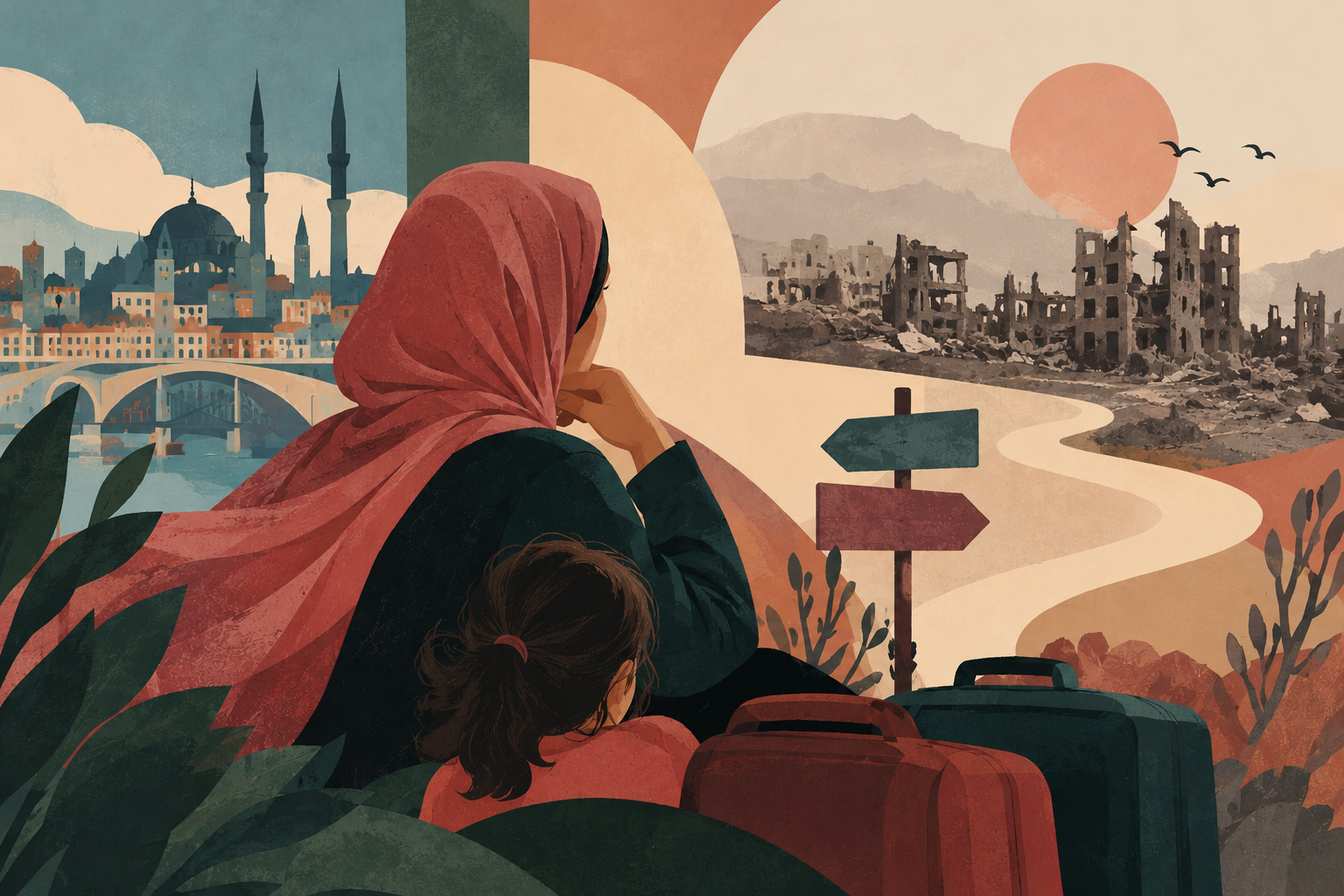
The voices of Syrian women today are clear and unequivocal. They are not merely victims refusing to return out of comfort or privilege. They are decision makers charting a clear roadmap for a dignified return. Until those conditions are met, their suitcases will remain unpacked, and women will continue to carve out futures for themselves far from the rubble.