Cette publication est également disponible en : Français (French) العربية (Arabic)
The clock reads nine in the morning inside a tent in the Nuseirat camp in central Gaza. Rima is getting ready for her daily workout. For a few seconds, she stands in front of a small, palm-sized mirror hanging from a rusty nail on the wooden pole supporting the tent’s roof. The cracked glass splits the reflection of her face into scattered lines, as if the war had not just destroyed homes but also extended into the images through which people see themselves. Rima adjusts her hijab then bends down to tighten the laces on her sneakers.
She picks up her water bottle and puts in her earphones, not to listen to music, but to escape the noise of the camp. She walks between the tightly packed tents, crosses a crowded market full of activity, and makes her way through the rubble toward the gym. She walks briskly, not because she’s late for her workout, but because she knows that the coming hour is the only time in her day that will belong entirely to her.
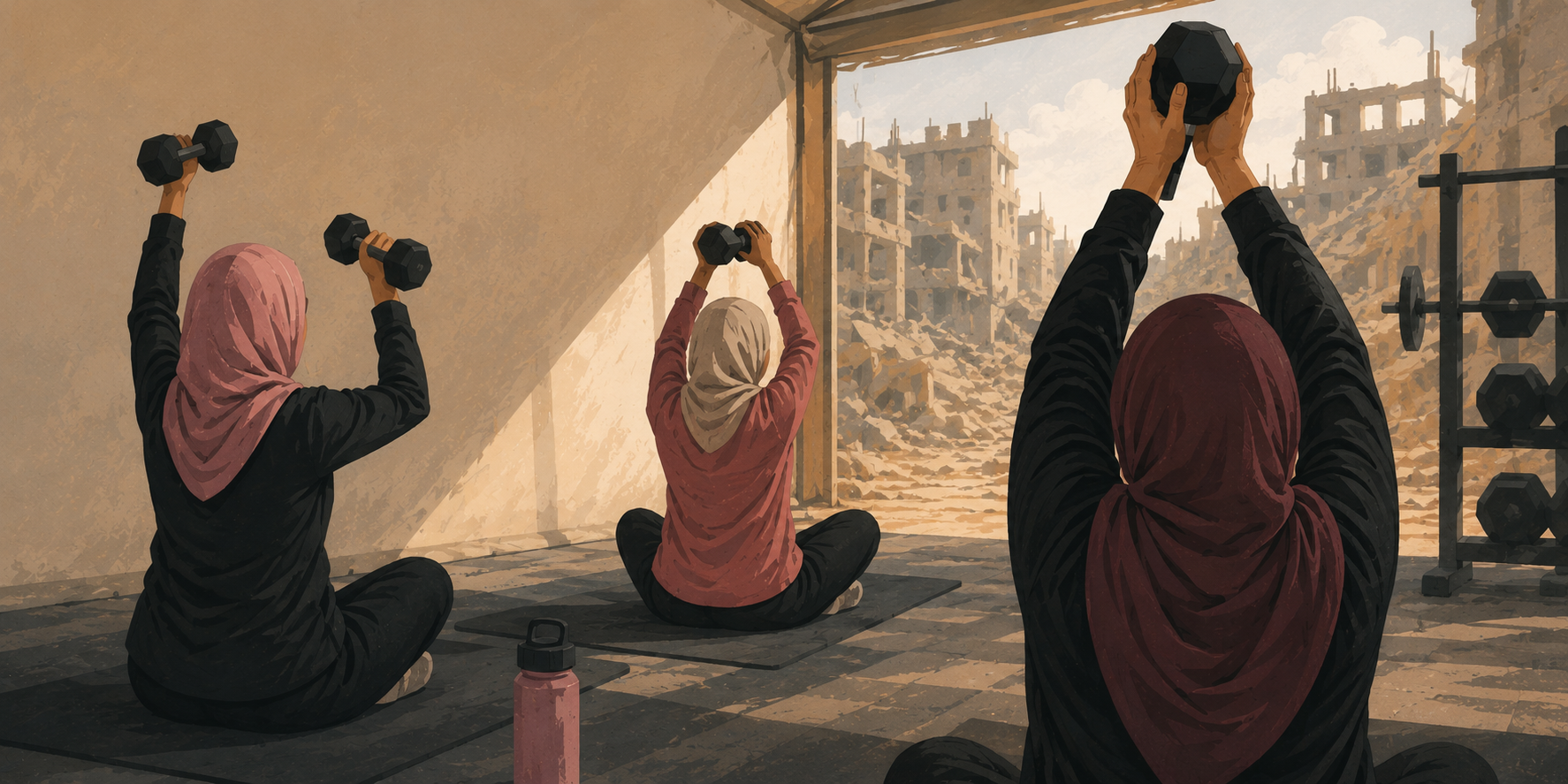
She enters the gym she’s a member of, which has reopened in Nuseirat, central Gaza, after years of war.
Here, everything changes for her. The noise disappears behind the heavy metal door, replaced by quiet music, the scraping of shoes on the rubber floor, and the trainer’s voice asking the women to line up.
Some of the exercise equipment bears the marks of repeated use, some has been repaired multiple times, and some was even salvaged from under the rubble.
The women exchange greetings in hushed tones, not asking each other about weight loss or calorie intake but about their sleep the night before, how it was in this sweltering summer heat that turns tents into ovens, about their children, about the hardships of displacement, the Israeli violations, and the daily bombardment. Here, exercise doesn’t begin with the body, but with the struggle to save the spirit.
The trainer raises her hand and says, “Come on girls, let’s begin.” The bodies move slowly during the first minutes, as if waking from a long period of exhaustion. But with each exercise, the tension in their tired faces begins to soften, and laughter starts to slip in between repetitions. One woman laughs after losing her balance, while another encourages her friend to finish the final round, as the trainer claps, urging them, “You can do it… keep going!”
When looking at all of this, it’s hard for a visitor to believe that most of these women are living a daily reality weighed down by war, displacement, and anxiety.
The death toll in the Gaza Strip has risen to 73,110, as Israeli violations of the ceasefire continue. More than 38,000 women and girls have been killed since the start of the Israeli war, according to UN Women, an average of 47 women and girls per day.
“The hour I spend at the gym brings me back to myself. I mend my spirit here, and I feel that I am still a woman, not just a survivor trying to manage another day.”
“The gym has become my only refuge”
Rima Hassan, 29, a university graduate who has been displaced from northern Gaza, says, “Before the war, I used to work out to stay fit, but now I exercise so that I don’t collapse, to better cope with the psychological trauma and the effects of the war, loss, famine, and the pressure we have endured. I find in it a means of survival.”
She pauses for a moment, wipes the sweat from her forehead, then continues, “The hour I spend at the gym brings me back to myself. I mend my spirit here, and I feel that I am still a woman, not just a survivor trying to manage another day. We women in Gaza have completely different relationships with our bodies than we did three years ago. We don’t think of working out as a project to look better, and we don’t care about what our bodies look like for the sake of ‘style’—we need to consider things like our bodies’ ability to endure fatigue, to carry water containers, light wood fires for cooking, run when we are being displaced, walk long distances because of the lack of transportation. Back pain, muscle stiffness, and mental exhaustion have all become part of our daily lives. But here, I’m starting to reconnect with my body, like I’m rediscovering it all over again.”
“In displacement camps,” she adds, “there’s no privacy, not even in the simplest things, like working out. Even clothes have become part of the concerns of life in displacement; I can’t wear what’s suitable for the summer heat or what allows me to move comfortably. I always feel like I have to consider the place and the people around me. That’s why the gym has become my only refuge, a place where I can wear my workout clothes freely, move without hesitation, and feel that my body is no longer confined like it is outside the walls of this place.”
Rima, who lost her fiancé during the war on Gaza, says she sees exercise as a form of therapy that helps her cope with the pain of loss. She feels she has become more resilient to life’s challenges and societal pressures, and that she has also come to appreciate the way her body has changed. However, she says she sometimes needs nutritional supplements and foods like fish, fruits, and vegetables, which she cannot afford due to their high prices and the family’s difficult living conditions. She lives with her family of seven, and her father is unemployed. They rely on food from soup kitchens (takiyyas) and aid provided by community organizations.
“We reopened this gym after three years of war, not as a luxury, but because of the need to create a space of freedom and relief for women in Gaza.”
A space where women can reconnect with their bodies
While Rima talks to us from inside the gym, the trainer moves around between the women, correcting the positions of their shoulders and knees. She knows most of them by name and remembers their stories well.
“We reopened this gym after three years of war,” says the 32-year-old trainer, Bisan Hassouna, “not as a luxury, but because of the need to create a space of freedom and relief for women in Gaza. At first, women came here silent and exhausted, their bodies weakened, especially since they had just come out of a time of famine and malnutrition. Today, they have become more active and engaged. They laugh more, and sometimes they cry more. Sometimes, after the session ends, they don’t leave; they sit here for another half hour to talk and share their stories. The gym is no longer just a place for working out, but a social space as well, for psychological release.”
During the break, the participants sit in a small circle. One drinks water, trying to catch her breath, while another replays a video she recorded of herself during the workout. A third asks the trainer about an exercise that might help relieve her lower back pain. Another woman smiles at her friend and says, “I want a sculpted body,” to which her friend replies, “More sculpted than we were during the famine?” Everyone bursts into laughter and finds a moment of humor and irony in the grimness of their reality.
The trainer calls them back in, “Last round.” They all stand up, as if returning to movement is also a temporary return to life.
It’s time to leave. Outside the workout area, Rima gets ready to return to her tent, but now with lighter steps and renewed energy. She changes out of her workout clothes and says before leaving, “I’ll be back tomorrow… I wish we could sleep at the gym.” The trainer asks, “Do you really love working out that much?” She laughs and replies, “Not because I want a better body… but because I want to remember, even for just one hour, that I’m still alive.”