
Cette publication est également disponible en : Français (French) العربية (Arabic)
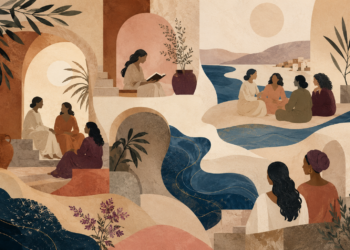
Every Thursday evening, women arrive one by one at Layla’s house (a pseudonym). One places a small plate of homemade sweets on the table as soon as she arrives. Another takes off her shoes at the door and apologizes for being late. A third quickly sends a WhatsApp message to reassure her family: “I’ve arrived at Layla’s.”
Inside the house located in the city of Latakia, in a dimly lit living room, the gathering appears no different from any ordinary women’s get-together in Syrian society. Cups of coffee and maté fill the table, leaving just enough space for everyone’s phones to remain within easy reach. Conversations about work, children, and rising prices are punctuated by brief laughter, attempts to alleviate the burden of difficult days.
A dangerous world outside
But the story here goes beyond just a women’s social gathering, says Layla, a 43-year-old unmarried working woman. “We didn’t choose to meet at home because we wanted to or because it’s nicer. We chose it because our safety comes first.” These home gatherings were unheard of a year ago, as the women used to meet in cafés, in bars, by the sea, or in public parks. Today, Layla’s home has become one of the few places where they feel they can speak freely without constantly having to monitor their voices or behavior.
After the fall of the Assad regime on December 8, 2024, many Alawite women in Syria found themselves navigating an entirely new landscape of daily life. The collapse of the regime was not merely a political shift, but the beginning of a period marked by fear and uncertainty. Given the Alawite community’s historical association with the Assad family and former state institutions, and in the absence of a clear path to transitional justice, retaliatory rhetoric and practices escalated in some areas, holding the Alawite community responsible for decades of regime rule despite the wide political and social divisions within Alawite society itself.
Reuters documented at least 33 cases of disappearance or abduction of Alawite women and girls following the fall of the regime.
These fears deepened after the massacres that took place in the Syrian coastal region in March 2025 at the hands of elements affiliated with and loyal to the new regime. The United Nations stated that “massacres and violations amounting to war crimes” had occurred in the Syrian coastal region, resulting, according to Reuters, in the deaths of approximately 1,500 people, in addition to the displacement of tens of thousands of civilians.
In the months that followed, kidnappings and disappearances of women, particularly Alawite women, increased. In July 2025, Amnesty International reported documenting at least 36 cases of abductions of Alawite women and girls between February and July of that year, while Reuters documented at least 33 cases of disappearance or abduction of Alawite women and girls following the fall of the regime.
Despite repeated demands to reveal the fate of those abducted and hold those responsible accountable, many families and human rights organizations continue to report a lack of meaningful investigation results and weak official responses.
In a report published in February of this year entitled “Abduction in Syria: Alawite Women Most Targeted Amidst Transitional Government Inaction,” Syrians for Truth and Justice (STJ) called on the Syrian government to end its policy of denial and fulfill its legal obligation to protect civilians. Given the fragility of law enforcement institutions and persistent security concerns, many women have come to rely on informal protection networks built by families and local communities, ranging from home gatherings to support groups and constant phone calls.
For Nour al-Ahmad, an independent Syrian journalist and feminist activist who has covered the disappearances and abductions of Alawite women, “Alawite women are resorting to these alternative spaces because they have lost trust in the authorities. The new Syrian authorities have officially acknowledged only one abduction case, while other cases have been attributed to women ‘running away with a lover or romantic partner.’”
She adds, “This defamation and character assassination by the authorities and their supporters has made women and their families afraid to report any abduction or attempted abduction, so they instead seek out spaces where they feel their stories will be believed and taken seriously.”
A house that made room for everyone
When Layla hosted the first gathering at her home after the coastal massacres of March 2025, she hadn’t planned anything more than a casual evening with a few friends. “At first, there were only four or five of us,” she says. “Each of us brought something simple, and we sat and talked for two hours.” Two weeks later, they met again, and then a third time. Over time, more women began to join. Some were old friends, and others had been introduced to the group through mutual acquaintances.
In a corner of the living room, Rana (a pseudonym), a mother of three in her late thirties, sits on the floor leaning against a sofa. “The strange thing is,” she says, “we didn’t come together to talk about fear, but in the end, we always find ourselves going back to it.” Layla nods in agreement and finishes Rana’s sentence, “Maybe it’s because there aren’t many places left where we can talk about it.”
For the women who attend these gatherings, the point is not simply to find a safe place but to be with people who understand what you’re going through without requiring explanation. It’s enough for one woman to say, “I don’t take that road anymore,” or “My family doesn’t like me going out at night anymore,” for the others to understand exactly what she means.
“Sometimes we spend three hours together without discussing politics at all, and yet we leave feeling relieved. Maybe because just being together has become a kind of support in itself,” Layla says.
The hours they spent together weren’t so much about finding solutions to their problems as they were about ensuring that none of them had to face their fears alone.
“You there yet?”
Midway through the gathering, Hiba’s phone (a pseudonym) rings several times. Hiba is a 22-year-old student at Latakia University. She glances quickly at the screen before setting it back on the table. It doesn’t seem urgent, but she apologizes and opens one of the messages anyway. “It’s definitely the group,” Layla says, laughing. Hiba nods and smiles. Months ago, Hiba, Layla, and Rana, along with dozens of other women, joined a closed WhatsApp group connecting women from different cities and villages along the Syrian coast. The group has no distinctive name and is not described as either feminist or political, but every member knows exactly why it was created and why it remains active to this day.
Hiba opens the chat and begins scrolling through the messages. One woman asks about the safest route to Latakia. Another requests the number of a trustworthy driver. A third sends a picture of a missing girl she received only minutes earlier. Every so often, a short message appears, no more than a single word: “Arrived.”
Hiba pauses at this word and comments, “It’s probably the most frequently written word in the group,” then adds, “Not long ago, no one would ask if you’d made it somewhere safely or not. Now, if you’re even a little late, people start contacting you to make sure you’re okay.”
Over recent months, the number of such groups has grown, becoming for many women something resembling both a safety network and a parallel virtual community. Alongside photos of missing girls and women and warnings about dangerous roads, members exchange recipes, job postings, and sometimes simple “good morning” messages.
“We don’t spend all our time talking about the situation,” Hiba says. “On the contrary, actually, it’s the ordinary things that help keep us going.”
The groups do more than exchange information; often, the conversation moves from the screen to a phone call. Hiba says she keeps a short list of women she can call almost anytime: “Sometimes I don’t need anything… I just want to hear someone’s voice.” But sometimes these calls act as an emergency hotline, with women contacting each other whenever they sense danger.
The impact of this reality has not only instilled fear in women but has also reshaped everyday life. Hiba now shares her live location with her family when she’s on the move, while other women avoid moving around alone or going out at night except when absolutely necessary. The question, “Where are you?” has become a routine part of the daily calls and messages between women and their families.
Over recent months, the number of such groups has grown, becoming for many women something resembling both a safety network and a parallel virtual community.
Between safe spaces and withdrawal from public life
But these experiences raise questions that go beyond how women cope with fear. They also point to the conditions that have forced this adaptation and to the role of those charged with protecting them. The women interviewed did not withdraw from public life by choice, nor did they originally intend to create alternative women’s spaces. Rather, under the weight of fear and a diminished sense of security, many found themselves rearranging the details of their daily lives and searching for places and people who could restore a sense of safety they could no longer find elsewhere.
“What makes the experience of Alawite women unique is the intersection of gender-based violence with violence linked to sectarian identity. This makes the fear shaping their daily lives more complex than simply fear of crime or restrictions on women’s freedom; it’s also fear fueled by belonging to a community that feels targeted,” journalist Nour al-Ahmad explains.
As the gathering comes to an end, some women start getting ready to leave. One gathers her belongings while another checks her phone to confirm the safest route home. They exchange quick goodbyes and promises to meet again the following week. Before one woman leaves, another reminds her, “Tell us as soon as you arrive.”
The hours they spent together weren’t so much about finding solutions to their problems as they were about ensuring that none of them had to face their fears alone.