Cette publication est également disponible en : Français (French) العربية (Arabic)
Women-only spaces, including subway cars, gyms, and other environments designed to offer women greater safety, can provide opportunities for personal development, confidence-building, and participation in public life. This trend has become increasingly widespread, particularly with the influence of global feminist movements, whether through private initiatives or programs led by international organizations.
For example, over the past decade, UN Women has led the global initiative “Safe Cities and Safe Public Spaces for Women and Girls,” which has operated in places like Cairo and Morocco.
This shift has revived longstanding sociological and human rights debates about whether women truly choose these spaces freely. Do women genuinely opt for them willingly, or are they driven toward them by socialization, tradition, and the weight of a patriarchal system that has left them no safe public spaces?
Answering this question requires unpacking the factors that shape these experiences by addressing questions such as: Who holds the power? What purpose do these spaces serve? And do women truly possess the right to choose?
From this perspective, women-only spaces are a multidimensional phenomenon, their human and social impact determined by the context in which they emerge, the purposes they serve, and the aspirations behind them.
Cultural particularity or gendered compliance?
At many Syrian weddings and social events, the separation of women and men may seem like a mutual agreement or at least a shared preference. But this simplistic interpretation is misleading, because the question isn’t whether women chose this, but rather whether this consent stems from genuine freedom or from a social order that makes other choices carry far greater costs for women.
What if women adhere to these rules of separation because violating social norms could mean stigmatization, criticism, ostracism, or even death? This would mean that their choice was not made from a place of freedom. And so compliance becomes a means of adapting to reality rather than an expression of personal desire. What appears to be a personal choice may, at its core, be a response to deeply entrenched social and cultural pressures that define the limits of what women, and men, can choose. This separation may even be a tool for controlling women’s very existence.
Turkish researcher and academic Deniz Kandiyoti explains this implicit form of compliance through the concept of patriarchal bargaining. Kandiyoti is famous for changing the way researchers understand the relationship between women and the patriarchal system, not only in Türkiye, but in many Asian and Middle Eastern societies. Kandiyoti, author of the book Women, Islam, and the State (published in 1991), believes that women may resort to strategies that appear on the surface to be free choices but which in reality are attempts to navigate social constraints and minimize their costs, thus transforming apparent conformity into a structural submission to an imposed reality, a defense mechanism dictated by context rather than a completely independent and free will.
Do women genuinely opt for them willingly, or are they driven toward them by socialization, tradition, and the weight of a patriarchal system that has left them no safe public spaces?
Restricting recreational and expressive spaces
In stark contrast to socially negotiated forms of gender separation, separating women from men in the workplace or imposing restrictions on women’s presence in certain spaces stands out as one of the clearest forms of gender-based discrimination.
Perhaps the most prominent recent example comes from Syria. On June 2, 2026, the Directorate of Sports and Youth in Hama issued a circular banning the advertisement and operation of belly dancing classes in homes and private gyms, threatening to close down any violating establishments on the grounds of violating laws, regulations, and tradition. Human rights activists argued that such decisions go beyond regulating public activity as they clearly impose restrictions on recreational and expressive spaces designated for women.
Modern human rights scholarship and sociological studies reject this type of institutional gender segregation because it stems from a place of coercion and control, and its implicit goal is to prevent women from participating in the public sphere.
In her book The Veil and the Male Elite: A Feminist Interpretation of Women’s Rights in Islam (published in 1993), which is a re-examination of Islamic texts and heritage related to women and political power, Moroccan sociologist and writer Fatema Mernissi summarizes this kind of segregation by stating: “At its core, the harem is not merely a set of physical walls, but a carefully drawn political and social boundary designed to keep women outside the sphere of decision-making and production, turning the public realm into an exclusive male privilege.”
Thus, the segregation of women in the workplace, education, or other spaces can also limit their access to opportunities, resources, and development. It’s important to remember that segregationist policies that produce unequal opportunities are incompatible with the principles of the Convention on the Elimination of All Forms of Discrimination against Women (CEDAW).
On the other hand, it is no secret that the authorities’ use of the pretext of “traditions and regulations” as a legal justification for recreational or expressive spaces frequented by women is not, as they claim, aimed at protecting society. The authorities are exercising patriarchal control that restricts women’s bodily autonomy and limits their right to assemble and engage in activities central to their psychological and physical wellbeing.
When privacy becomes a tool of empowerment
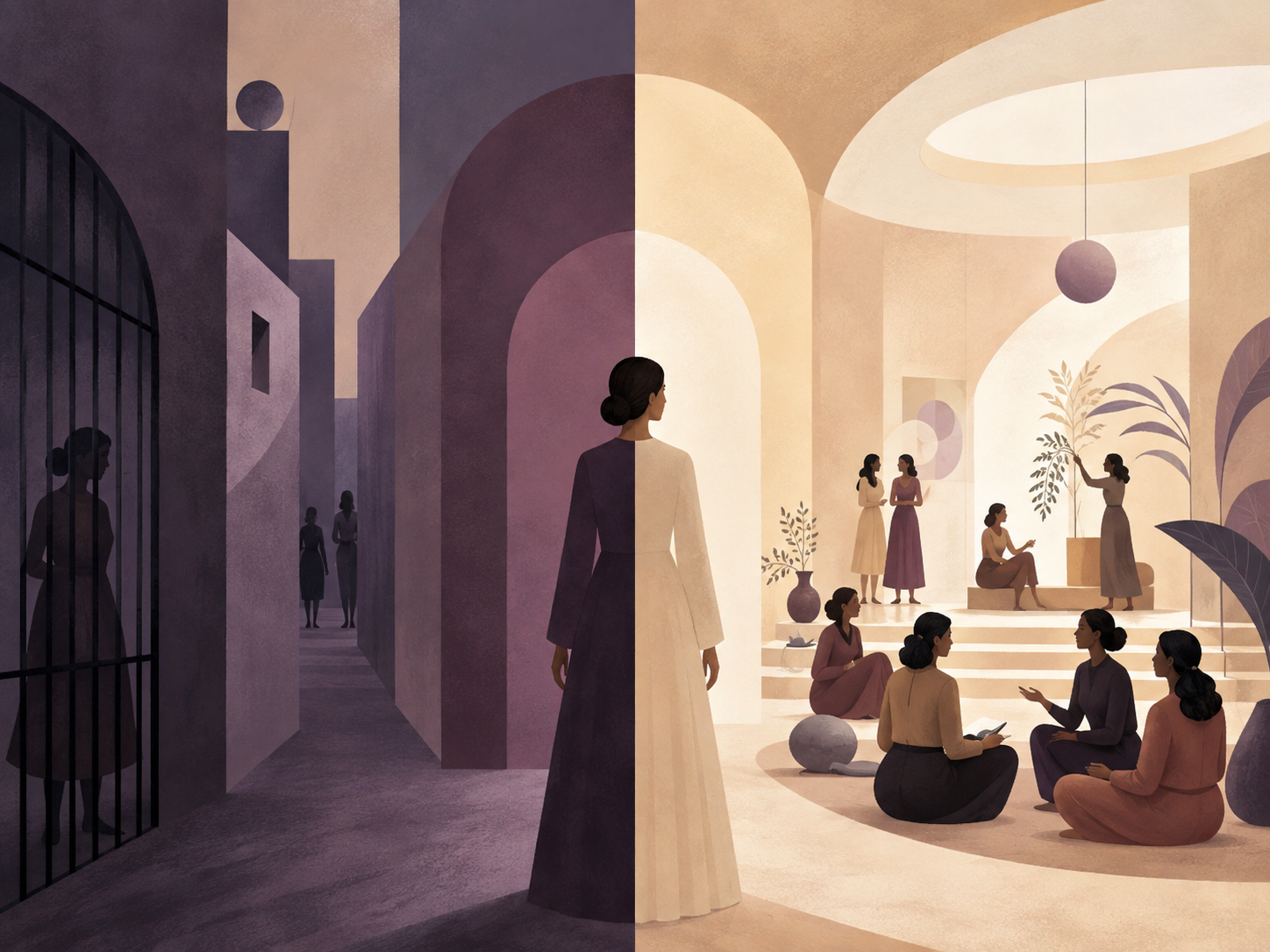
But not all women-only spaces constitute a form of exclusion. The fundamental difference lies between exclusion when it is imposed and voluntarily chosen safe spaces: imposed segregation keeps women out of public space, while safe spaces chosen voluntarily offer them a sense of security and privacy, and a greater opportunity for participation and self-development.
This idea was articulated by Virginia Woolf in A Room of One’s Own (published in 1929), considered one of the most important foundational texts of modern feminist thought. She linked women’s creative freedom to having an independent space where they could think and work. As she famously wrote, “A woman must have money and a room of her own if she is to write fiction.” The room, here, is not meant to isolate women from the world, but is rather a condition for building the self before engaging with it.
Not all women-only spaces constitute a form of exclusion. The fundamental difference lies between exclusion when it is imposed and voluntarily chosen safe spaces.
Nancy Fraser, an American philosopher and leading theorist of contemporary feminism and critical theory, approaches the idea from another angle in her essay “Rethinking the Public Sphere: A Contribution to the Critique of Actually Existing Democracy.” Fraser argues that historically marginalized groups structurally need parallel and private spaces, even if temporary, to formulate their shared discourse, articulate common experiences, and strengthen their capacity for self-empowerment.
In that sense, then, women-only transportation or women’s gyms and cultural clubs are not considered exclusionary as long as they do not deprive women of their right to access public spaces and instead provide them with an additional option that grants them greater safety and comfort. The intellectual and productive independence that women cultivate within their own spaces represents an accumulation of knowledge and experience that cannot remain confined behind closed doors. Over time, such spaces can contribute to creating fairer environments for work and production, gradually reshaping the symbolic balance of power in society.