Cette publication est également disponible en : Français (French) العربية (Arabic)
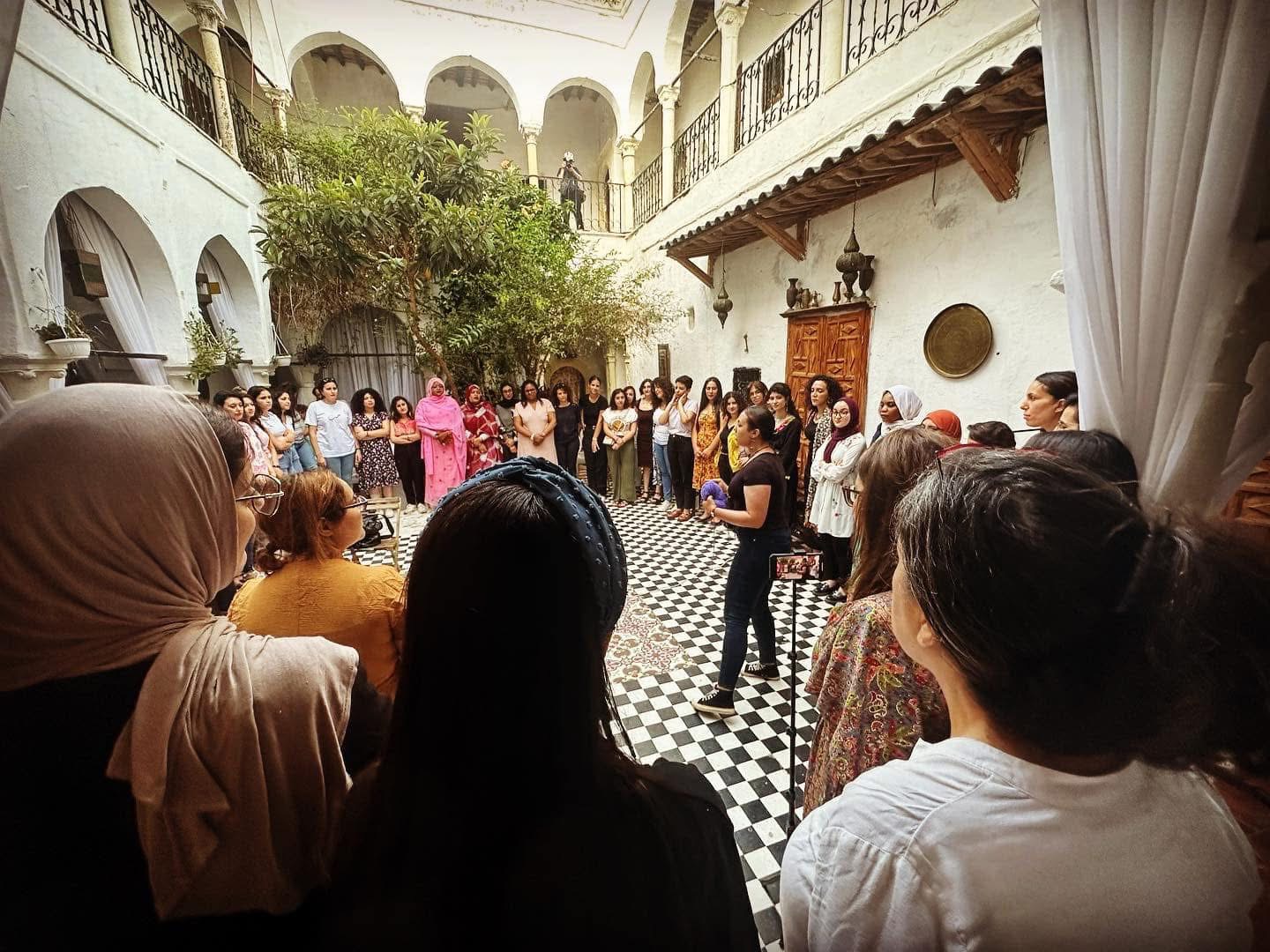
I first learned about voluntarily single-sex spaces in 2013, when I joined my first feminist collective, Sawt Nssa, in Constantine, Algeria.
At the time, I knew nothing about the debates surrounding this practice. Yet single-sex spaces were not unfamiliar to me: I had grown up with them, without ever giving them a name.
They were in the cafés we didn’t go to. In the stadiums where our presence was almost the exception. In the streets that, after nightfall, seemed to suddenly switch owners. They were everywhere women learned, from a very young age, that their place had to be negotiated, curtailed, or justified.
But that kind of gender segregation wasn’t a choice. It drew the invisible boundaries of our freedoms. When I joined Sawt Nssa, I experienced the opposite form of this. For the first time, I was entering a space that we had chosen, conceived, and built for ourselves. This difference may seem subtle, but it is deeply political: the separation no longer served to keep women away; it enabled us to exist fully.
There, I discovered what it means to have a voice that matters: to see an idea through to the end without being interrupted, to no longer censor my own sentences before even speaking them, to be listened to without having to prove that what I was experiencing was real.
That’s where I discovered what it truly means to feel safe—not physical safety, but political safety: the kind that allows you to think out loud, to hesitate, to make mistakes, and to learn without fear of condescension or ridicule.
“I thought I simply lacked confidence…”
Above all, I came to understand why, up until then, my voice would tremble whenever I spoke at film clubs, student debates, or mixed activist spaces. For a long time, I had really believed that I lacked the necessary skills. Looking back, I realized there’s a difference between lacking confidence and having grown up in a society where certain voices are considered more legitimate than others. That’s also where I discovered what it truly means to feel safe—not physical safety, but political safety: the kind that allows you to think out loud, to hesitate, to make mistakes, and to learn without fear of condescension or ridicule.
I have never experienced this space as one built against men, but as one designed for women. Over time, I came to understand that this experience had a name: voluntary single-sex organizing.
A society that accepts single-sex spaces… under certain conditions
I have seen spaces that are predominantly male, yet their single-sex nature is never questioned. But as soon as women choose to create a space for themselves—a book club, a workshop, a moment of collective reflection—the issue of exclusion immediately comes up. I have encountered this same logic in certain community and feminist circles.
For years, we were told that modern feminism must necessarily be mixed gender. That we had to “involve men.” That single-sex spaces were outdated. Yet, in some of these so-called mixed spaces, there were rarely more than one or two men. One was an employee of the organization, participating as part of his job. The other would remain on the sidelines for much of the meeting, only to speak up when the debate became truly political. It was often at that moment that he would explain to us what we had not yet understood about feminism.
I also remember a recurring scene: that moment when people would take several minutes to thank a man for attending a meeting. As if his presence were some kind of exceptional commitment. Meanwhile, the women present had often had to rearrange their days, find ways to manage their family responsibilities, and make considerable efforts just to be there. This discrepancy has always puzzled me. Not because a committed man doesn’t deserve recognition, but because this recognition revealed an implicit hierarchy: a man’s presence in a feminist space was sometimes perceived as an act of activism in and of itself, while the presence of women seemed to be taken for granted.
And the paradox is even more striking when this happens in the very name of feminism.
We were told that a few all-women meetings threatened democracy. That the struggle had to be mixed. But where were these staunch defenders of mixed spaces when our public spaces actually existed?
The Hirak: When our autonomy became the real subject of debate
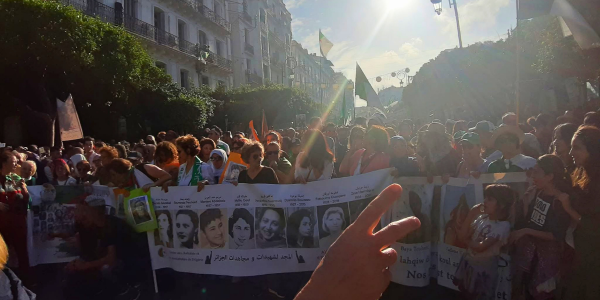
Then came the popular movement of 2019. Like many other feminists, we formed collectives, organized a feminist bloc at the protests, and created more spaces for discussion about women’s place in society. Our organizing meetings were women-only. They focused on our strategies, our disagreements, our safety, and our collective decisions. This was our internal workspace: the place where we could develop our political positions among women. But our public actions were open. The feminist bloc at the protests welcomed men who wanted to support our demands. Our conferences, campaigns, and initiatives were not closed off. Yet it was our internal organization that drew the harshest criticism.
We were told that a few all-women meetings threatened democracy. That the struggle had to be mixed. But where were these staunch defenders of mixed spaces when our public spaces actually existed? Where were they when we needed to defend women’s rights against the pressure and attacks of those who challenged our demands?
Mixed gender participation suddenly became a necessary and absolute principle as we gained autonomy. It had seemed less urgent when it came to taking a stand and publicly championing equality. The problem, then, was not our lack of openness. It was our ability to organize without waiting for external validation.
The experience of the Hirak confirmed what many of us had already observed in mixed activist spaces. On paper, all voices were equal. In reality, power dynamics persisted: men spoke more, negotiated more, and more easily occupied decision-making spaces.
Feminist demands were often put off until later. There was always a national emergency, a higher priority. Our rights became negotiable in the name of a “public interest” that was often defined without us. When single-sex spaces are imposed within a relationship of domination, they remain largely invisible. When they are chosen by women, they suddenly become controversial.
Not all forms of single-sex organizing are created equal
This is where confusion is most common. Gender diversity, on its own, does not guarantee equality. Not all forms of separation operate according to the same logic, nor do they produce the same effects. There is a form of separation imposed by power dynamics: one that does not protect a balance but rather maintains a social order and the privileges of those who benefit from it.
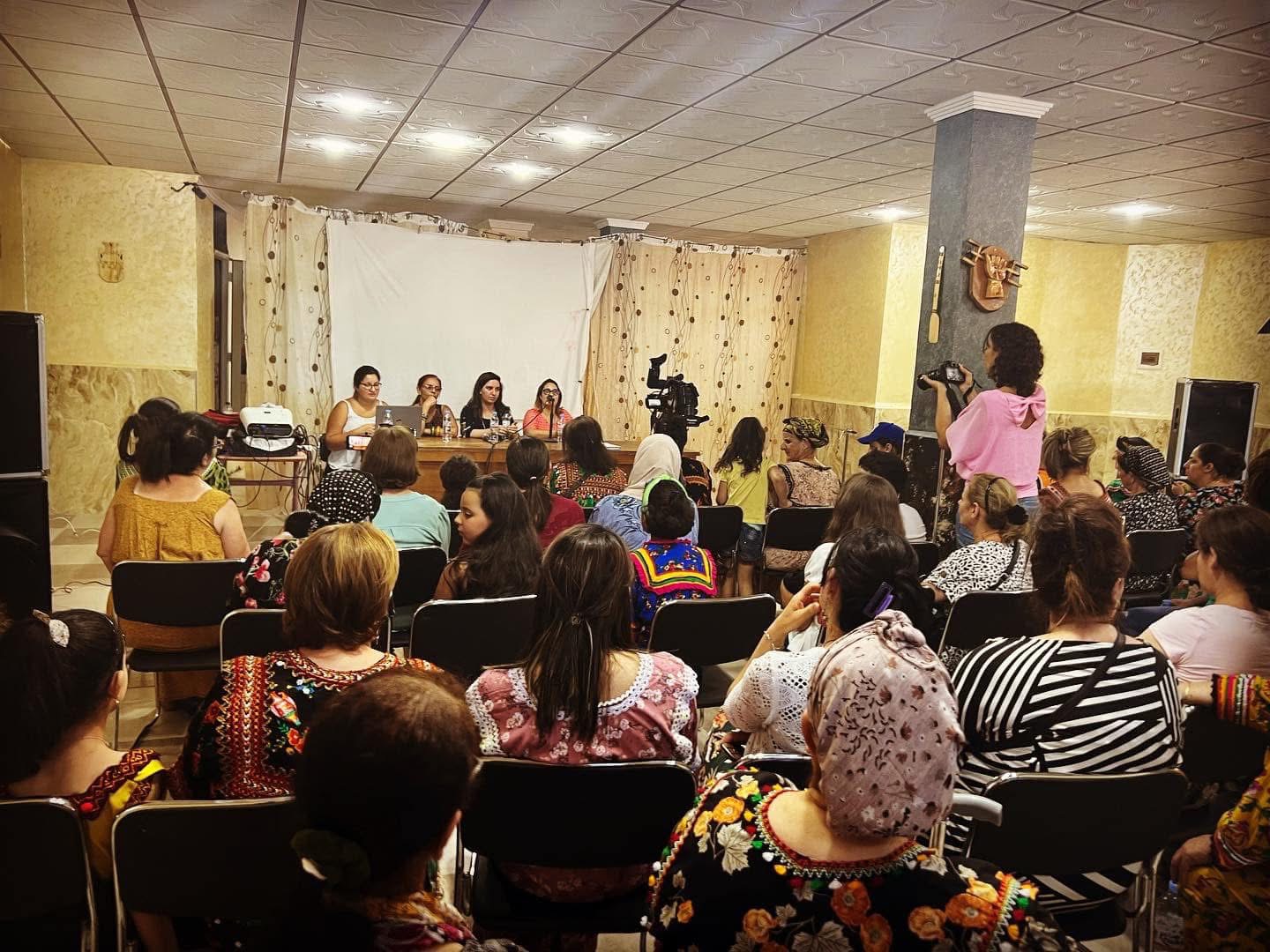
And there is a chosen separation, conceived as a tool for resistance and struggle. A temporary space that allows those who are usually marginalized to come together, build a collective voice, and develop strategies without having to constantly negotiate their legitimacy. Confusing these two realities amounts to erasing the power dynamics that distinguish them.
An autonomy that’s setting a precedent
In recent years, women-led, women-only initiatives have proliferated. These are not merely fleeting activist phenomena destined to fade away. They respond to a deep-seated need that has long been ignored: the need to claim space, forge connections, and explore other forms of collective freedom. Today, we’re seeing the emergence of women-only cafés, book clubs, bike rides, hikes, walking groups, art workshops, women-only trips, discussion groups, and even professional networking events.
Not all of these initiatives necessarily identify as feminist. They show us that the need for autonomous spaces extends beyond activist circles alone. This reflects a broader aspiration: the desire to come together and claim a place in society.
There is a chosen separation, conceived as a tool for resistance and struggle. A temporary space that allows those who are usually marginalized to come together, build a collective voice, and develop strategies without having to constantly negotiate their legitimacy.
These spaces also have another effect—more subtle but just as important. They filter out discourses that sometimes seek to reassure rather than make demands. They allow discussions to finally stem from the experiences of those most directly affected, without every demand being immediately rephrased to make it less disruptive, less radical, or more acceptable.
For a long time, part of our activist energy was spent explaining why our demands were legitimate. In these spaces, that energy can finally be channeled elsewhere: to developing our analyses, building our strategies, and addressing our needs. Our autonomy excludes no one; it simply shifts the center of gravity.
The real issue: Empowerment
Voluntary single-sex spaces are not a social project. They are a tool made necessary by our patriarchal societies. They will disappear the day that the power dynamics—which give rise to both imposed single-sex spaces and the need for autonomous spaces—disappear.
Until then, asking women to give up these spaces amounts, above all, to asking them to give up the tools they have created to finally be heard.