A propos
  • it VO
  • fr Français
  • en English
  • ar العربية
Pas de résultat
Afficher tous les résultats
Medfeminiswiya - Média féministe méditerranée
  • En mouvement
  • Explorations
  • Dossiers
  • Créations
  • Interviews
  • Opinions
  • Monde
Medfeminiswiya - Média féministe méditerranée
  • En mouvement
  • Explorations
  • Dossiers
  • Créations
  • Interviews
  • Opinions
  • Monde
Pas de résultat
Afficher tous les résultats
Medfeminiswiya - Média féministe méditerranée
Accueil Explorations

“Habibi”: Stories of Love and Resistance

Federica Araco Federica Araco
5 novembre 2022
“Habibi”: Stories of Love and Resistance

In order to preserve their reproductive rights, future Palestinian mothers use their husbands’ sperm hidden in makeshift test tubes. The Italian photographer Antonio Faccilongo told their stories in the “Habibi” project, winner of the World Press Photo of The Year 2021 and other important international awards.

More and more wives of Palestinian prisoners in Israeli jails are using their husbands’ sperm ‘smuggled’ in makeshift test tubes for in vitro fertilization (IVF). At first, many of them were reluctant to talk about this issue for fear of suspicion and criticism from neighbors and clerics, until an edict of the Palestinian Supreme Fatwa Council in 2017 authorized the practice in cases where men face long sentences.

According to Addameer, the prisoner support and human rights association, there are currently 4650 Palestinians locked up in Israeli prisons. Many have sentences of 20 or even 40 years and smuggling sperm is the only way to preserve their reproductive rights in a war that seems to have no end.

The heavy restrictions of the Israel Security Agency (ISA) indeed prohibit conjugal visits and only allow meetings through glass windows and telephone conversations. Children under the age of 10 are the only ones allowed to hug their fathers for a few minutes, who in these fleeting contacts give chocolate bars or sweets with makeshift test tubes, usually pen tubes, containing their hidden semen.

The figures released by Middle East Monitor in February 2021 revealed that 96 children have been born so far using this method, which local clinics offer free of charge to the wives of fighters because they are considered as ‘living martyrs’ for the collective good.
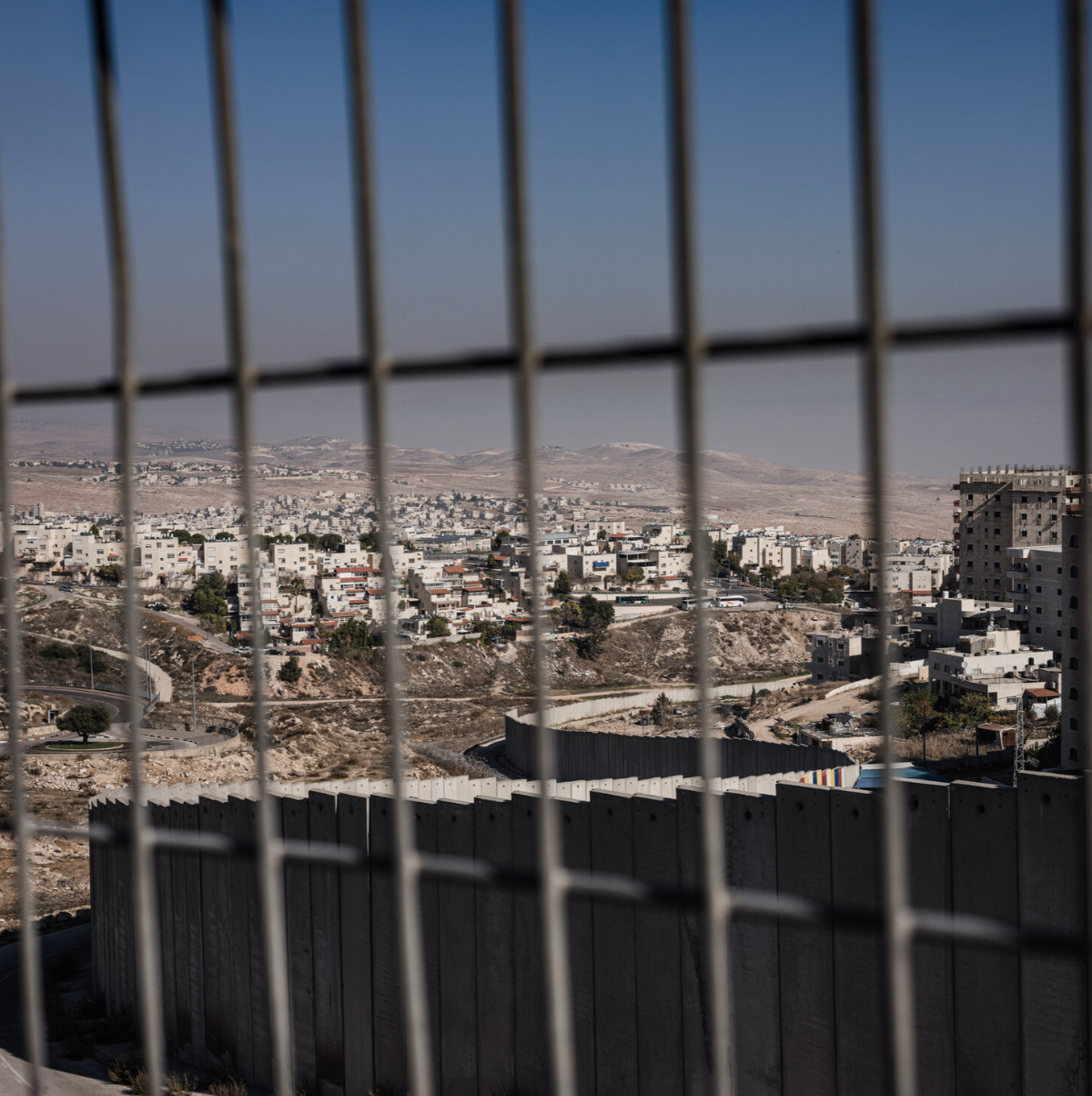
A separation barrier divides the Pisgat Zeev Israeli Settlement (left) from the Shuafat Refugee Camp, near Jerusalem. Palestinians complain of a feeling of being perpetually trapped behind the barrier, as if they lived in a large open-air prison. © Antonio Faccilongo, Italy, Getty Reportage, World Press Photo

Italian photographer Antonio Faccilongo (Rome, 1979) told their stories in the project ‘Habibi’, ‘my love’ in Arabic, winner of the World Press Photo “Story of the Year”, devoted to stories of international journalistic relevance, and of the ‘Long-Term project Award’ organized by the same organization.

“The photojournalistic perspective of the photographer, along with the uniqueness of the story, have created a masterpiece,” commented jury member Ahmed Najm, of the Iraqi Metrography Agency. “This is a story of human struggle in the 21st century: a story about those unheard voices that can reach the world if we, the jury, act as a medium.”

The figures released by Middle East Monitor in February 2021 revealed that 96 children have been born so far using this method

Instead of photographing the military occupation, the guerrilla actions, the injured and the destroyed houses, Faccilongo chose to tell the story of the impact war has on the lives of ordinary people and the difficulties faced daily by the families of political prisoners. Every day, the determination of the wives left alone reaffirms the power of love against abuse and violence: for some, this is the only possible form of resistance.

With a delicate, intimate and respectful gaze, the author captures the complex combination of presence and absence, hope and desperate waiting in empty bedrooms, in youth photos, in letters from prison, in the faces of children who grew up without a father and their mothers who are strong, courageous and deeply lonely women(1).

In order to counter the spread of the phenomenon, in 2013, the Israeli government imposed a drastic reduction in visits, punishing prisoners with even more extreme methods of imprisonment. Abdul Karim, who has been serving a 25-year sentence since 2001, had to pay around $1,500 for the in-vitro conception of baby Majd with his wife Lydia Rimawi, and was unable to receive visitors for two months.

Lydia Rimawi lies on her sofa in Beit Rima, near Ramallah, Palestine, in December 2018. Her husband Abdul Karim Rimawi was arrested in 2001 and sentenced to 25 years in prison for involvement in the assassination of Israeli tourism minister Rehavam Ze’evi. The couple have a son, Majd, who was born as a result of IVF in 2013. In 2014, Abdul Karim was fined around US$1,500 for smuggling his semen from prison and deprived of family visits for two months. © Antonio Faccilongo, Italy, Getty Reportage, World Press Photo

“At the award ceremony, the families I photographed were connected online, because it was their award,” Faccilongo said in an interview. “We talk every day, the children send me photos of their first day of school, as if I were their uncle from Rome. It baffles me when some colleagues tell me they don’t know what happened to the people they have photographed. I’m not saying it’s better to do as I do, but it seems impossible to me to do otherwise.”

Dating back to 2008, his first trip to Palestine was to bring medicine and humanitarian aid to Gaza, which was under embargo. “I was already a photographer during the second intifada and decided to document those clashes, but I returned home with a great burden for what I had seen and witnessed with my own eyes,” he recalls in a video interview. “I couldn’t not continue documenting that territory, but I wanted to tell something different from the war. I thought it was very important to talk about the daily difficulties these people face in order to restore their dignity. So, I started to follow the stories of the prisoners’ families.”

(1) The photographer also devoted another project called “(Single) women”, to mothers, spouses and sisters of Palestinian political prisoners locked up in Israel who live alone, struggling to support their families, “both economically and emotionally”.

Click here to read the original Italian version of the article.
Tags: Femmes et prison
Federica Araco

Federica Araco

Journaliste, Federica Araco a collaboré à la version italienne du magazine en ligne Babelmed pendant 9 ans comme rédactrice et traductrice du français et de l’anglais vers l’italien. Elle a été rédactrice en chef de la revue trimestrielle “The Trip Magazine” dédié au voyage et à la photographie. Elle a également collaboré à d’autres magazines italiens : LiMes, Internazionale, Left. Ses thèmes de prédilection sont les questions de genres, le féminisme, le multiculturalisme, l’exclusion sociale, les phénomènes migratoires, l’écologie et le développement durable. Depuis 2016, elle publie aussi des photo-reportages de voyage sur son blog.

Laisser un commentaire Annuler la réponse

Votre adresse e-mail ne sera pas publiée. Les champs obligatoires sont indiqués avec *

J'accepte les termes et conditions et la Politique de confidentialité .

Sur le même sujet

Related Posts

« Femmes Palestiniennes », au temps où elles ont pris les armes
Explorations

« Femmes Palestiniennes », au temps où elles ont pris les armes

Nathalie Galesne
6 février 2024

Related Posts

Le « syndrome méditerranéen » : ces femmes qui souffrent mais qu’on ne croit pas
Explorations

Le « syndrome méditerranéen » : ces femmes qui souffrent mais qu’on ne croit pas

Eugénie Ducher
17 avril 2026

DÉCOUVREZ NOTRE NEWSLETTER

Contenu original. Journalisme féministe. Livré à votre adresse email.

    Related Posts

    Derrière les projecteurs : Violence, persécution et sexisme à l’encontre des travailleuses du cinéma au Maroc
    Explorations

    Derrière les projecteurs : Violence, persécution et sexisme à l’encontre des travailleuses du cinéma au Maroc

    Salma Chatt
    27 février 2025

    Related Posts

    L’avortement en Turquie : légalement autorisé mais interdit dans les faits
    Explorations

    L’avortement en Turquie : légalement autorisé mais interdit dans les faits

    Contributrice Medfeminiswiya
    27 septembre 2021

    Les plus aimés de la semaine

    La Moudawana : une réforme qui divise
    Explorations

    La Moudawana : une réforme qui divise

    Lina M.
    23 janvier 2025
    Le rôle des femmes dans les mafias italiennes : Les « sœurs de l’omertà » 1/3
    Explorations

    Le rôle des femmes dans les mafias italiennes : Les « sœurs de l’omertà » 1/3

    Federica Araco
    5 novembre 2025
    Rome : le plus vieux métier du monde s’exerce-t-il encore dans la rue ?
    Explorations

    Rome : le plus vieux métier du monde s’exerce-t-il encore dans la rue ?

    Contributrice Medfeminiswiya
    9 octobre 2024
    En mouvement
    Explorations
    Dossiers
    Créations
    Interviews
    Opinions
    Monde
    En mouvement
    Explorations
    Dossiers
    Créations
    Interviews
    Opinions
    Monde

    Medfeminiswiya est un réseau féministe qui rassemble des femmes journalistes travaillant dans le domaine des médias et de la production de l’information dans la région méditerranéenne.

    • A propos
    • Contextes pays
    • Notre communauté
    • Devenir membre
    • Nos Partenaires
    • Charte Éditoriale
    • Mentions légales

    Suivez nous sur :

    Découvrez notre newsletter

    Contenu original. Journalisme féministe. Livré à votre adresse email.

      © 2026 Medfeminiswiya – Réseau méditerranéen pour l’information féministe

      Back to top

      Welcome Back!

      Login to your account below

      Forgotten Password?

      Retrieve your password

      Please enter your username or email address to reset your password.

      Log In

      Ajouter nouvelle playlist

      Pas de résultat
      Afficher tous les résultats
      • En mouvement
      • Explorations
      • Dossiers
      • Créations
      • Interviews
      • Opinions
      • Monde
      • it VO
      • fr Français
      • en English
      • ar العربية

      © 2026 Medfeminiswiya - Réseau méditerranéen pour l'information féministe

      Ce site n'utilise pas de cookies. This website does not use cookies. هذا الموقع لا يستخدم ملفات تعريف الارتباط.