About us
  • it VO
  • fr Français
  • en English
  • ar العربية
No Result
View All Result
Medfeminiswiya - Mediterranean feminist media
  • On the move
  • In-depth
  • Files
  • Artistic Creations
  • Interviews
  • Opinion
  • World
Medfeminiswiya - Mediterranean feminist media
  • On the move
  • In-depth
  • Files
  • Artistic Creations
  • Interviews
  • Opinion
  • World
No Result
View All Result
Medfeminiswiya - Mediterranean feminist media
Home Files

Women in Tunisian history textbooks: A story of rights granted, or rights won?

Amal Bint Nadiaby Amal Bint Nadia
2 November 2026
Women in Tunisian history textbooks: A story of rights granted, or rights won?

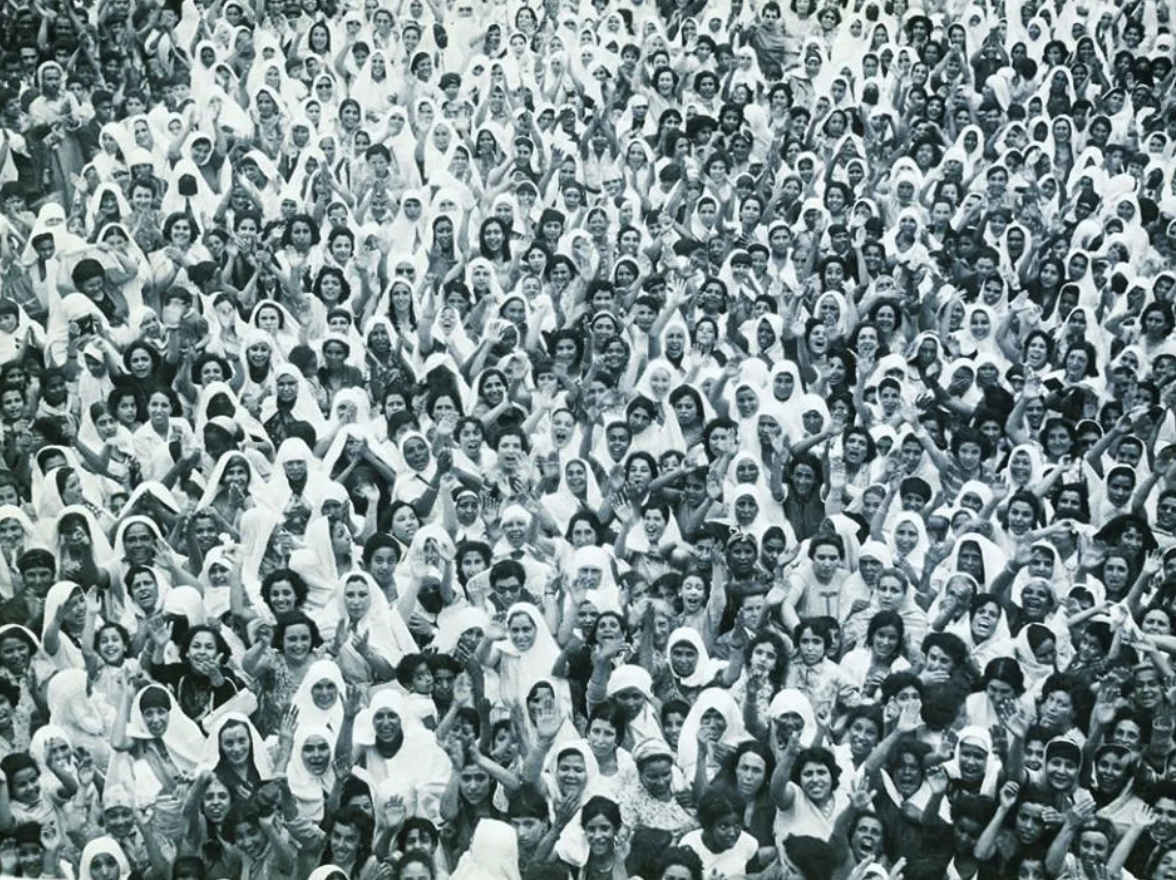
Tunisian women celebrating the Personal Status Code the day after its promulgation in 1956. Public archive.

From primary to secondary school, Tunisian students learn about the Code of Personal Status (CPS), the ban on polygamy, women’s political rights, and their entry into the workforce. It is a history of emancipation closely intertwined with that of independence and Tunisia’s first president, Habib Bourguiba. A narrative in which women remain spectators of history, even though, in reality, they were far from passive.

Cette publication est également disponible en : Français (French) العربية (Arabic)
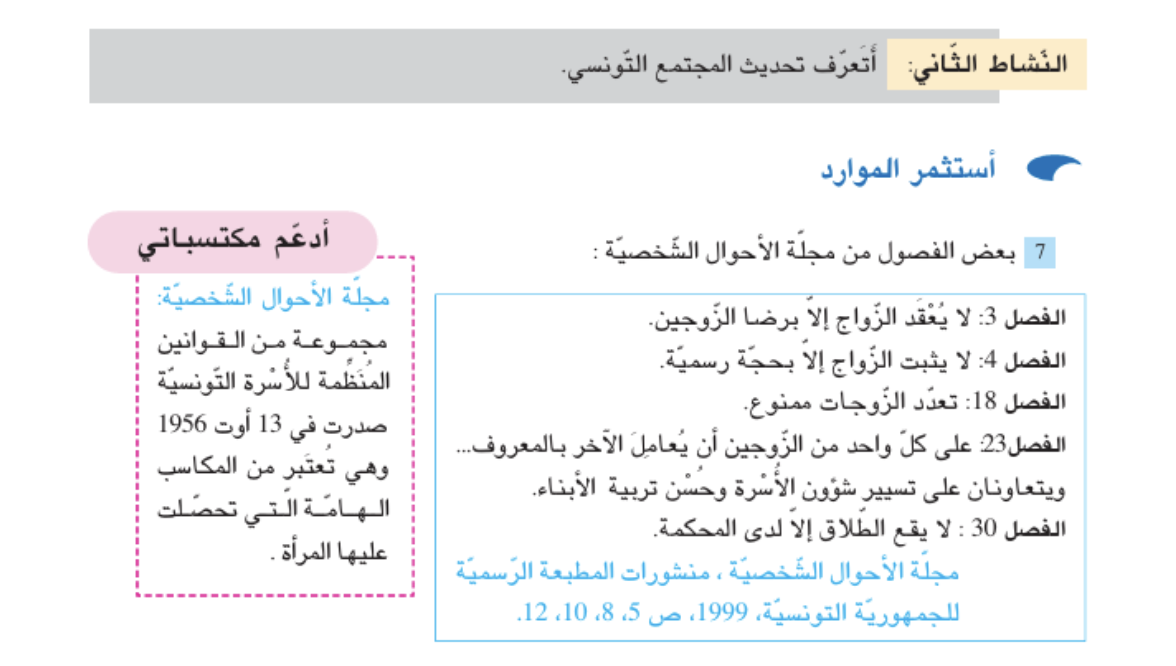
August 13, 1956, is a date that Tunisian students learn about early on. In the sixth-year primary school history textbook, Tunisia is building its new state: the monarchy is abolished, education expands, and the Central Bank is established. Among these transformations is the promulgation of the Code of Personal Status (CPS).

Promulgation of the Code of Personal Status (CPS). Source: Excerpt from the sixth-year primary school history textbook.

At this stage, women’s rights are not invisible. They are, in fact, considered important enough to feature in the birth of modern Tunisia.

“First women, then the law, then liberation”

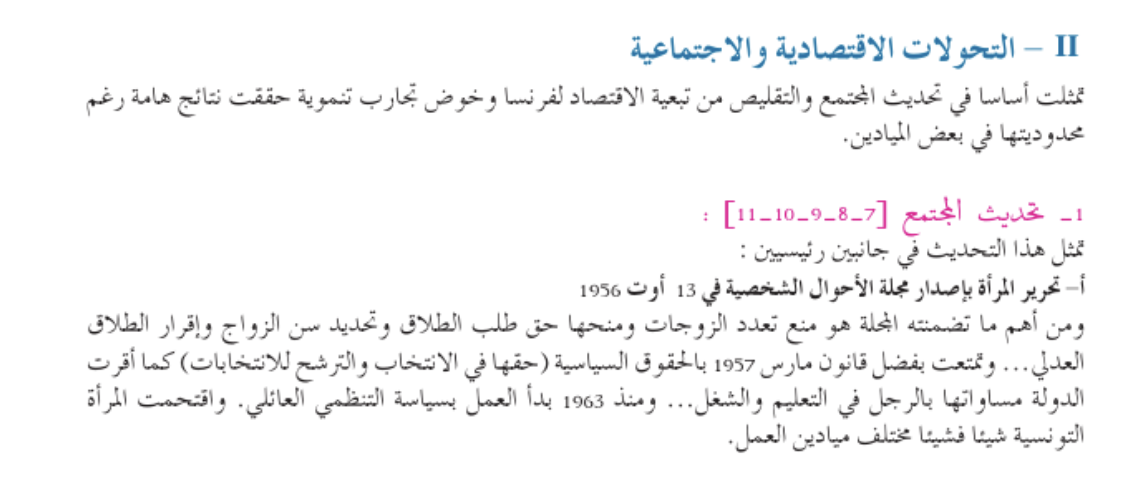
At the secondary school level, the national narrative becomes even more explicit. In the third-year secondary history textbook for science and technology students, the chapter entitled “Tunisia from 1956 to 1987” covers the first decades following independence. Under the heading “Modernization of Society” appears the subheading “Women’s Emancipation,” followed by “Women’s Emancipation through the Promulgation of the CPS.” The wording tells a chronological story in itself: first women, then the law, then liberation.

Chapter: Economic and Social Changes. Source: Excerpt from the third-year secondary history textbook for science and technology students.

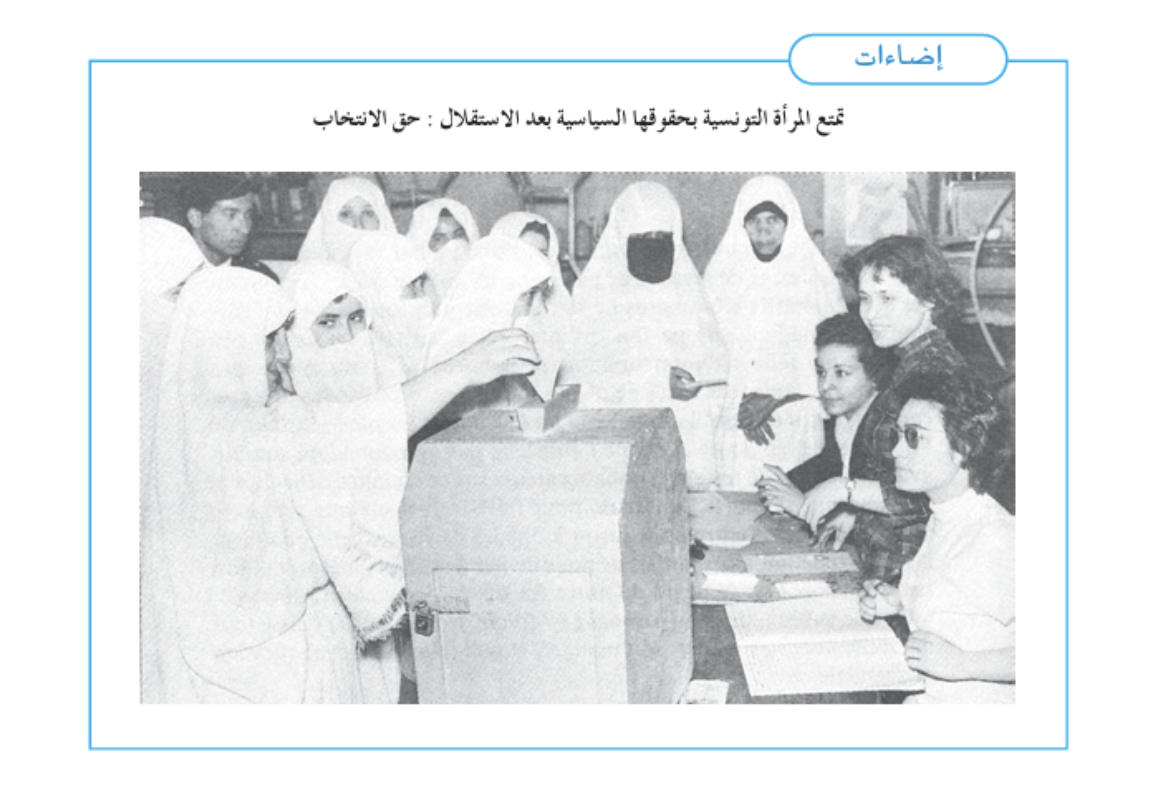
Another part is entitled “Tunisian Women’s Enjoyment of Their Political Rights after Independence: The Right to Vote.” The choice of verb is significant. The Arabic word tamattouʿa means “to enjoy” or “to benefit from.” It contains no active demanding, no struggling for, no wresting away of rights.

“Women enjoy their political rights after independence: the right to vote.” Source: Excerpt from the third-year secondary history textbook for science and technology students.

Further on, the narrative shifts: “The Tunisian woman gradually enters different sectors of employment.” This time, she is portrayed as active, but only after the law, after political rights, and after the state has granted equality in education and employment. In this chronology, women’s actions begin once their rights have been secured.

Najia (a pseudonym), who has taught history in Tunisia’s public secondary schools for 34 years, also points to the limitations of this narrative. Asked about the attention given to the struggles and demands that preceded the promulgation of the CPS, she replies, “The curriculum tells us nothing about any of that. All we learn is simply that the CPS was promulgated.” The CPS is thus presented as an established achievement, without tracing the historical process that made it possible.

“Selection is never entirely neutral”

Rahma Talmoudi goes beyond simply reading the textbooks. A trained teacher and researcher, she has studied the mechanisms through which Africa and Africans are represented and rendered invisible in Tunisian school textbooks. Her approach offers a way to examine not only what textbooks make visible, but also the roles they assign to historical figures.

“Once we have established the numbers, we need to take the analysis further: where women are placed and what they do, but also how sentences are constructed, the choice of words and verbs, the use of the active or passive voice, and the grammatical subject. All of this contributes to shaping the history passed on to students,” she explains.

This approach leads Talmoudi to the following question: “Who actually makes history?”

When it comes to the national movement, historical actors have names, organizations, and a clearly defined series of actions. Bourguiba leads and is arrested. The Neo-Destour resists. Activists and trade unionists appear. There are accounts of mobilization, arrests, negotiations, and fighting. Textbooks, then, know how to tell the story of a struggle. When the subject is national sovereignty, they construct a narrative of hard-won victory. But when the subject is women’s rights, they tell a story of reform.

According to Talmoudi, this difference does not necessarily mean that women are deliberately rendered invisible. The process of selection itself must be questioned: why are certain historical figures included while others are left out? Invisibility can be deliberate, unconscious, inherited, or reproduced. “But selection,” she reminds us, “is never entirely neutral.”

The researcher encourages us to look at what comes before the law. In a historical narrative, legislation can be presented either as a starting point or as the culmination of a much longer history: “Is this a story of rights granted, or rights won? Were women given their rights? Or did they fight for them? Who struggled to secure those rights?”

The process of selection itself must be questioned: why are certain historical figures included while others are left out? “Selection,” Talmoudi reminds us, “is never entirely neutral.”

During the Bourguiba era (1956–1987), schools played a role in constructing a national memory. Textbooks do not simply state that “Bourguiba gave women their rights.” Rather, they situate women’s emancipation within the modernizing project of the post-independence state. The underlying logic of the narrative thus resembles that of a gift: the state introduces reforms, and women reap the benefits.

Long before Bourguiba: Arwa of Kairouan

Yet more than a millennium before the CPS, in eighth-century Kairouan, a woman named Arwa married the man who would become the second Abbasid caliph, on the condition that he take no other wife or concubine. The historian Hassan Hosni Abdelwahab linked this clause to an older marriage custom in Kairouan, known as sadaq al qayrawani.

This practice was not equivalent to the general prohibition of polygamy introduced under Article 18 of the CPS. Nevertheless, it shows that women had already used the law to negotiate the terms of their marriages long before the reforms of 1956.

1924: Manoubia Ouertani takes the floor

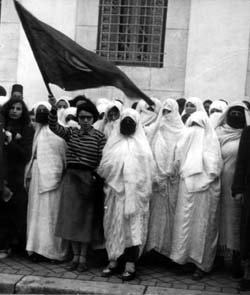
A group of Tunisian women demonstrators. Source: Wikimedia Commons.

There is no need to go as far back as the eighth century to find Tunisian women speaking out about their own rights.

On January 15, 1924, Manoubia Ouertani, then around 15 years old, took the floor at a debate on feminism organized by the arts and cultural association L’Essor in Tunis. She publicly called for women’s liberation, removed her veil, and addressed the restriction of polygamy, equality, and the need to revisit dominant legal interpretations.

It was only six years later that Tahar Haddad’s landmark book, Our Women in Sharia and Society, was published. The school textbook leaves Manoubia Ouertani out of the narrative, choosing instead to foreground a male figure.
From speaking out to organizing

In 1936, Bchira Ben Mrad founded the Muslim Women’s Union of Tunisia. Women were no longer simply making demands; they were organizing.

And their activism did not stop there. In 1947, activist Radhia Haddad became president of the Friends of the Scouts association and joined the Muslim Women’s Union of Tunisia. In 1952, she helped provide material and moral support to the families of nationalist political prisoners. She went on to lead the National Union of Tunisian Women in 1958 and became a member of Parliament in 1959. Under her leadership, the organization carried out literacy, healthcare, and family planning initiatives. Her trajectory, culminating in her conflict with the Bourguiba regime in the early 1970s, demonstrates that women were political actors both before and after independence. Yet neither Bchira Ben Mrad’s name nor her struggle appears in the textbooks.

“You can talk extensively about women without ever allowing them to speak.”

Tunisian women: Between visibility and agency

“You can talk extensively about women without ever allowing them to speak,” observes Rahma Talmoudi. Invisibility does not necessarily mean that women are never mentioned. Textbooks can devote considerable attention to “women”: teaching students about women’s rights, equality, their place within the family, their access to employment, and the gains they have made, while saying far less about women as the authors of this history. This is precisely the distinction between visibility and agency.*

Women are not absent from the national narrative. They occupy a symbolic place in the story of Tunisian modernity. But visibility alone is not enough to acknowledge their historical role.

Najia, the history teacher, reaches a similar conclusion based on the teaching materials she uses. She refers, in particular, to the first-year secondary school textbook, in which she says she found only one photograph of women, depicting a women’s demonstration during the national movement, probably in 1953. “They are not discussed. They are just there. It’s only a photograph,” she laments.

Najia also raises the issue of how much time is allocated to history in school timetables. She regrets that third-year secondary students have only one hour of history per week. With science subjects carrying greater weight in students’ overall grades, many prioritize rote memorization.

According to her, students are often encouraged to memorize lessons rather than discuss them. “Information is no longer the problem. Dates are no longer the problem. That’s not what matters most. Now you can search on the internet and find the information. […] But classroom discussions are what develop critical thinking about history. And we don’t have that. We don’t have the time.”

Compounding this lack of time, according to the teacher, is the difficulty of completing the curriculum. She explains that some chapters dealing with social transformations, particularly women’s status and their entry into the workforce, may not be covered at all during the school year. She attributes this situation to changes to the school calendar introduced after 2011.

It would therefore be too simplistic to conclude that women have been erased from Tunisian school textbooks. They are present, but even textbook analysis has its limitations. As Rahma Talmoudi points out, “The textbook is not the whole school experience. It cannot tell us what a teacher may have added orally, what discussions took place in the classroom, or what a student ultimately retained. But it does constitute a written record, an archive of what the institution chooses to transmit, prioritize, and turn into historical figures.”

An asymmetry nevertheless persists in school textbooks: the national movement is narrated as a struggle for sovereignty, while women’s rights are primarily associated with a reform and a date.

Notes
* Agency is a sociological concept referring to the capacity of an individual or group to act intentionally upon the world and their own environment, rather than passively experiencing events.
Further reading:
Ilhem Marzouki, Le Mouvement des femmes en Tunisie au XXe siècle : féminisme et politique [The Women’s Movement in Tunisia in the Twentieth Century: Feminism and Politics]. Tunis: Cérès Productions, 1993.
Kmar Bendana, Les droits fondamentaux en Tunisie : une histoire à éclaircir [Fundamental Rights in Tunisia: A History to Clarify], 2021. Available online.
Amy Aisen Kallander, Tunisia’s Modern Woman: Nation-Building and State Feminism in the Global 1960s. Cambridge University Press, 2021.
This article was produced with the support of the Tunis Office of the Rosa Luxemburg Foundation.
Tags: women's history and memory
Amal Bint Nadia

Amal Bint Nadia

Amal Amraoui, also known as Amal Bint Nadia, is a Tunisian artivist, writer, and independent curator. Trained in civil engineering, she became politically engaged in 2012 by coordinating the Youth Forum of the World Social Forum, before co-founding the collective Al Sajin 52 the following year. Her journey combines journalism — notably with Nawaat — feminist activism (Chaml, Chouftouhonna, Chouf), and artistic creation in support of struggles for bodily rights and individual freedoms. In 2019, she co-initiated the intersectional movement Falgatna and joined the moderation team of EnaZeda, the Tunisian version of the #MeToo movement. Through her writings, actions, and the spaces she creates, she crafts narratives of resistance, gives form and voice to forgotten anger, and weaves — through language and the body — bridges between memory, art, and insubordination.

Leave a Reply Cancel reply

Your email address will not be published. Required fields are marked *

J'accepte les termes et conditions et la Politique de confidentialité .

Related articles

Related posts

The history and memory of women in the Mediterranean: All against forgetting!
Women's history and memory

The history and memory of women in the Mediterranean: All against forgetting!

by Olfa Belhassine
2 November 2026
Stories of women from the South: Women and resistance in southern Lebanon
Files

Stories of women from the South: Women and resistance in southern Lebanon

by Nahla Salameh
2 November 2026
Stories of arbitrarily detained women: Two Palestinian sisters recount their detention
Files

Stories of arbitrarily detained women: Two Palestinian sisters recount their detention

by Lamis Al-Astal
2 November 2026
Fighting fascism, defying patriarchy: The women of the Italian Resistance
Files

Fighting fascism, defying patriarchy: The women of the Italian Resistance

by Federica Araco
2 November 2026

JOIN OUR NEWSLETTER

Original content. Feminist journalism. Straight to your inbox.

    Popular articles

    Thirty and single… so what?
    On the move

    Thirty and single… so what?

    by Pascale Sawma
    1 March 2022
    Israel to Palestinian journalists: Be silent… or else!
    In-depth

    Israel to Palestinian journalists: Be silent… or else!

    by Alaa Murrar
    29 November 2023
    Giving birth with an open womb or when Caesarean section becomes the norm in Egypt
    Abortion and SRHR

    Giving birth with an open womb or when Caesarean section becomes the norm in Egypt

    by Contributor with Medfeminiswiya
    27 September 2021
    On the move
    In-depth
    Files
    Artistic Creations
    Interviews
    Opinions
    World
    On the move
    In-depth
    Files
    Artistic Creations
    Interviews
    Opinions
    World

    Medfeminiswiya is a feminist network that brings together women journalists working in the fields of media and content production in the Mediterranean region.

    • About us
    • Country context
    • Our community
    • Become a member
    • Our partners
    • Editorial charter
    • Disclaimer

    Follow us :

    JOIN OUR NEWSLETTER

    Original content. Feminist journalism. Straight to your inbox.

      © 2026 Medfeminiswiya – Mediterranean Network for Feminist Information

      Back to top

      Welcome Back!

      Login to your account below

      Forgotten Password?

      Retrieve your password

      Please enter your username or email address to reset your password.

      Log In

      Add New Playlist

      No Result
      View All Result
      • On the move
      • In-depth
      • Files
      • Artistic Creations
      • Interviews
      • Opinion
      • World
      • it VO
      • fr Français
      • en English
      • ar العربية

      © 2026 Medfeminiswiya - Mediterranean Network for Feminist Information

      Ce site n'utilise pas de cookies. This website does not use cookies. هذا الموقع لا يستخدم ملفات تعريف الارتباط.