Cette publication est également disponible en : Français (French)
Maryam Jalloul
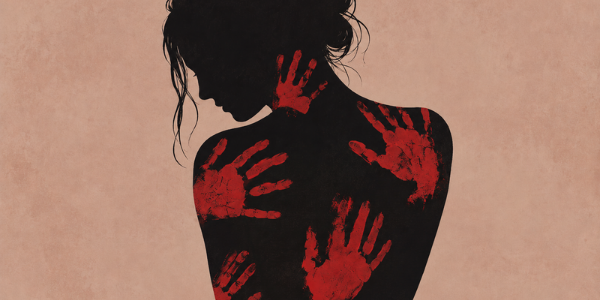
In the working-class neighborhood of Mellassine in Tunis, 15-year-old Yakine was the victim of a gang rape in late September after being held captive and possibly drugged. Hospitalized with severe trauma, the teenager is now at the center of an investigation that has led to around 15 arrests.
The case quickly gained national attention on social media, where the hashtag #JusticeForYakine helped create a widespread movement of solidarity. Through viral name-and-shame campaigns, young social media users circulated images of the alleged perpetrators in an effort to shift the shame traditionally placed on victims. “In cases like these, it’s important to go through this phase of making the case public,” says Loujain Khemiri, a lawyer based in Tunis, while cautioning that the backlash can also become “traumatizing for victims.”
A moral trial on social media
In fact, this surge of online solidarity quickly proved to be a double-edged sword. Alongside messages of support, a campaign of victim-blaming emerged. Social media users delved into Yakine’s private life, dissecting her photos and videos to put her on moral trial. A tattoo, a cigarette, or even just a particular choice of clothing was enough to shift responsibility for the crime onto the teenager and her mother.
“Social media may offer full support at first, but eventually it turns against the victim,” Khemiri explains. She points out that this excessive exposure, which has included the leaking of personal information such as the victim’s address, will have lasting consequences for the teenager’s future, particularly when it comes to finding work or housing.
For Monia Kari, a legal expert, activist, and former director of the National Observatory for Combating Violence Against Women, these reactions show that “society is still deeply shaped by rape culture.” She laments the lack of oversight on social media, where voices advocating for women’s rights are outnumbered by detractors. “The images being circulated only serve to place the blame on Yakine and her mother, never on the perpetrators.”
“The images being circulated only serve to place the blame on Yakine and her mother, never on the perpetrators.”
The trap of punitive demands
In her legal practice, Yosra Haddada, a lawyer based in Monastir, observes that complaints are still filed and subsequently withdrawn “under pressure from family members and even police officers.” Media coverage of such cases creates an additional layer of pressure. “It can influence families who want to protect their children from society.”
In light of these troubling practices, Haddada stresses that the justice system must “ignore media pressure, respect the victim’s right to control the use of her image, and uphold the presumption of innocence for underage suspects.” One mother has already filed a formal complaint after her son’s image was circulated among those identified as suspects.
The case has sparked a wave of indignation throughout Tunisian society, with anger giving way to debates over reinstating the death penalty. But legal experts argue that this punitive demand is a trap, one that diverts attention from the underlying problems surrounding gender-based and sexual violence. “The death penalty is only the legal surface of the problem. It is not the law that needs ‘healing,’ but people’s mindsets,” Khemiri argues.
Kari, meanwhile, recalls that it was feminist activists themselves who fought to replace the death penalty with life imprisonment in 2017, during the drafting of Law 58 on the Elimination of Violence Against Women. “Harsher sentences are not what fights impunity. What we need is prevention and a great deal of sex education.”
The absence of a debate on drug-facilitated sexual assault
The Yakine case also involves allegations of drug trafficking, drawing attention to drug use among minors, which is “very widespread in schools,” according to Haddada.
This problem does not stem from social media, “which is merely a window onto society,” Khemiri explains. She criticizes the online tendency to reduce the victim to her status as a drug user. “She is a 15-year-old girl who uses drugs, which makes her, once again, a victim, not a criminal.”
Monia Kari, who works with the Tunisian Association of Democratic Women (ATFD) and Aswat Nissa (Women’s Voices), reports a rise in the number of victims of gender-based and sexual violence seeking help at specialized centers. These include the Injad Centre at Charles Nicolle Hospital, which specializes in supporting victims of gender-based and sexual violence, and the day treatment center for drug rehabilitation at Razi Psychiatric Hospital, which serves women affected by voluntary or involuntary drug use.
She regrets that the issue of “drug-facilitated assault, which turns a woman’s body into a commodity or a trophy that the perpetrator claims as his own,” is entirely absent from public debate. Equally overlooked, she says, is “the sense of absolute power that comes from having subdued and possessed the body of a child incapable of defending herself.”
By focusing its response entirely on repression, the state continues to evade its fundamental responsibilities: education, prevention, and funding for facilities that support survivors.
Between repression and resistance
In response to this publicly exposed tragedy, the Tunisian state announced measures to monitor the presence of minors in bars and cafés. Shortly afterwards, on Monday, 12 October, a report was published in which the General Directorate of the National Guard touted the arrest of 1,515 people during an anti-drug operation carried out in September.
But by focusing its response entirely on repression, the state continues to evade its fundamental responsibilities: education, prevention, and funding for facilities that support survivors.
Despite the excesses of both social media and institutional responses, online spaces remain tools of empowerment and resistance. As Haddada concludes, “social media plays a very important role” in informing people about their rights and legal procedures.
“Gen Z youth today are fighting for their rights and freedoms. They are no longer ashamed of having been assaulted. That is what makes the future of Tunisia so promising.”