Cette publication est également disponible en : Français (French)
On February 27, 2018, around 5 PM, Fatma Boufenik went out to run an errand in the Karima-Senouci neighborhood, home to the Karima-Senouci Center—a support center for women victims of violence run by the FARD association (Femmes Algériennes Revendiquant leurs Droits—Algerian Women Claiming Their Rights), which the activist helped found in 1995 and which she runs on a volunteer basis. She lived just one street away. Shopkeepers and neighbors stopped her: the police had come by with a forensic team, and the center’s premises had been sealed off. “My first thoughts were for the women who might have been traumatized if this police operation had taken place in their presence, while they were in a space that was supposed to be safe and supportive,” she recalls.
Three days earlier, the governor of Oran had issued a decision ordering the closure of FARD’s offices on the grounds that the association had allegedly continued its activities without a valid registration certificate. FARD had received no prior notice. The premises would reopen on March 5, 2018, on a temporary basis, pending a return to normal operations—a move that FARD would challenge in administrative court. “The court ruled in our favor,” she notes.
Entering politics
Born on June 14, 1958, in El Bayadh, in the southwestern highlands, Fatma Boufenik grew up in an independent Algeria that was still finding its way. In the mid-1970s, as a student at the El Hayat high school in Oran, she joined the high school students’ collective: what prompted her to take this step was “injustice, social inequalities, and discrimination in educational guidance, all stemming from political decisions.”
Later, as a student at the Oran Graduate School of Economics, it was the 1976 National Charter that set off alarm bells for her. This founding document of the single-party regime affirmed equality under the law while reaffirming Arab-Islamic values as the foundation of society. “The debates revealed the dangers that lay in wait for us; the contours of a retrograde social project were taking shape,” she says. Her own experience, which was that of women in everyday life, and the influence of her elders would complete her political awakening.
Eight years later, her fears were confirmed. The Family Code was adopted behind closed doors by the People’s National Assembly and promulgated on June 9, 1984, under Chadli Bendjedid. Article 11 stipulated that “an adult woman concludes her marriage contract in the presence of her “wali” [guardian],” while Article 39 required her to “obey her husband and grant him respect as the head of the family.” Algerian women were effectively perpetual minors in the eyes of the law. Article 11 was partially reformed in 2005, allowing adult women to enter into their own marriage contracts, but the guardian remains present at the ceremony. This became Boufenik’s defining cause, the one she would never give up on.
After earning a degree in economics in June 1982, she became, that same year, general secretary of the union chapter at the Technical High School for Girls in Oran, a position she held for six years.
The great popular uprising of October 1988—with its riots, deaths, and acts of torture—propelled her elsewhere. She joined the Oran wilaya office of the Algerian League for the Defense of Human Rights (LADDH), where she served from 1988 to 1990. That same year, at the age of 32, she ran in the country’s first multi-party municipal elections on the independent El Bahia list in Oran. She ran again in 2007, this time for a seat in parliament. She had no illusions about the outcome, but she refused to give up on being active on the ground.
“The debates revealed the dangers that lay in wait for us; the contours of a retrograde social project were taking shape.”
From the field to knowledge production
On March 8, 1995, in the midst of the civil war, Boufenik co-founded the association Algerian Women Claiming Their Rights (FARD). The date was not chosen at random. She articulated three reasons with the precision of a researcher: “A duty to remember all the women murdered because they refused to submit to the dictates of the fundamentalist, extremist horde. A fight for a democratic, civil, and egalitarian society. A struggle for a republican, free, and democratic Algeria.”
The country was sinking into terror and a security crackdown. Intellectuals were falling. Targeted women were paying a particularly heavy price. Boufenik cites one name among thousands of other victims: the activist Nabila Djahnine. FARD is built around an approach that Boufenik, both academic and activist, will never cease to theorize: laws and actual opportunities, equality under the law and equality in practice.
From this same movement, the Karima-Senouci Center was born. Drop-in centers, lawyers, psychologists, social workers. The behind-the-scenes work that transforms individual lives. Alongside it was AFEPEC (Feminist Association for Personal Development and the Exercise of Citizenship), the other feminist association in Oran, of which she was a member since its founding on March 8, 1989, until 1994. The two organizations serve the same beneficiaries, sometimes share the same premises, and would soon face the same administrative hurdles. FARD submitted its documents to comply with Law No. 12-06 in January 2014, and AFEPEC had done the same as early as February 2012. Neither organization ever received an acknowledgment of receipt.
At the same time, Fatma Boufenik was building a career as an economist. As an associate professor at Mohamed-Benahmed University of Oran 2 and a researcher at the LAREGE laboratory in the Management, Governance, and Sustainable Development team, she specialized in institutional analysis, gender, and economic and social development. As a member of the Femise network, she has been publishing since the early 2000s on women in the Algerian labor market, local governance, and the integration of gender into civil society practices in the Maghreb. She has become an expert, trainer, and consultant for government and nongovernmental institutions and organizations.
The revolutionary uprising
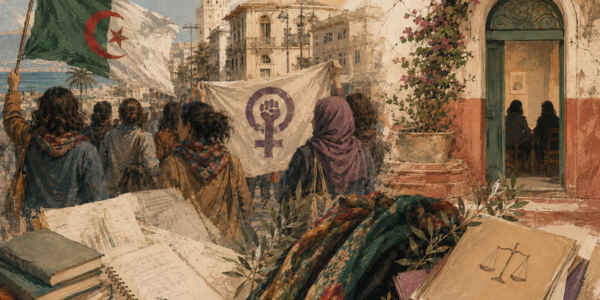
February 22, 2019. The Hirak movement swept the country. Women quickly took their place within it, but they were already being asked to give it up. On March 16, Fatma Boufenik, along with Saadia Gacem, Faïka Medjahed, Fatma Oussedik, Habiba Djahnine, and 16 other women, signed the founding declaration of the movement Algerian Women for Change Toward Equality. The text announced the creation of a “feminist square” to be held every Friday.
Why this text, why this weekly gathering? “Out of the realization that in the public sphere, even in such a context, women risk remaining on the margins. Out of vigilance, through visibility, to prevent history from repeating itself, by learning from our female mujahidat. Out of a need for solidarity and sisterhood to foster a strategic and feminist vision.” She notes that her presence at the Algiers square was occasional. She lives in Oran and “defends the principle of working locally within her community.”
On March 29, during the second protest at the square, demonstrators tore down banners, insulted the activists, accused them of “dividing the movement,” and invoked Islam against equality. Other demonstrators protected the women in the square. The police asked the activists to leave the area. The scene made headlines in international newsrooms. It also confirmed a conviction that Boufenik had held for 40 years—that no Algerian revolution would succeed without a direct confrontation on the issue of women.
Algerian feminism has never been an import. It has its own leading figures, its own lineage, its own schools of thought, its own scholarship, and its own infrastructure. It took shape during the civil war, under the Family Code, during the Hirak, and continues to take shape under association laws designed to stifle it.
The 2012 law on associations gives authorities considerable leeway to deny legal recognition to independent organizations without explanation. The criteria cited, referring to “national constants,” public order, and “public morals,” are vague enough to block any application. FARD and AFEPEC have been experiencing this for years. “We have exposed the ambivalence of local institutions’ practices and their failure to comply with their own legislation, starting with Law 12-06,” Boufenik summarizes. A permanent sword of Damocles.
Fatma Boufenik continues her activism. In November 2020, the Spanish foundation Mostra Viva del Mediterrani awarded her the Pont del Mediterrani Prize for her commitment to human rights. In 2023, the World Movement of Pan-African and Caribbean Women Leaders named her one of the 100 “Inspiring Women” of the year in Africa.
At 67, Boufenik has published neither an autobiography nor a manifesto. Her legacy is an association that endures despite everything, a functioning shelter, dozens of academic articles, and generations of trained activists. And there is this rare, almost anachronistic continuity between the high school student who fought against a Family Code then in the making and the academic who was evicted from her association’s premises one Tuesday in February. What would she say today to that high school girl in Oran? “The struggle continues, without regret or disappointment. There have been advances to which I’ve contributed, and gains that are not immune to being called into question. There are still many battles to be fought on all fronts.”
Algerian feminism has never been an import. It has its own leading figures, its own lineage, its own schools of thought, its own scholarship, and its own infrastructure. It took shape during the civil war, under the Family Code, during the Hirak, and continues to take shape under association laws designed to stifle it. Fatma Boufenik is one of its driving forces. Discreet, methodical, and unwavering.