Cette publication est également disponible en : Français (French) العربية (Arabic)
Walking through the streets of a city in Northern Kurdistan, you might hear a voice that transports you deep into the region’s history. It could be coming from the courtyard of a house, a gathering of neighbors, a wedding, or a mourning ceremony. These are some of the places where the tradition of dengbêjî has been passed down through generations.
In Kurdish, deng means “voice” and bêj means “to say” or “to tell.” Dengbêjî is a form of melodic storytelling performed primarily through the unaccompanied voice, using distinctive vocal techniques. On rare occasions, performances are accompanied by a bilûr (flute) or def (frame drum). The songs and narratives, known as klams, tell stories of love, migration, social events, and longing for one’s homeland. Those who perform them are called dengbêjs. The tradition is said to date back 5,000 years.
Although dengbêjî has long been associated with men, women have played a vital role in preserving and transmitting it. For centuries, religious and social restrictions prevented women from singing publicly or participating in dengbêj gatherings. Many continued to perform their klams within the walls of their homes, where their voices could not reach wider audiences. Some of their songs were later taken up by male dengbêjs, who performed them publicly as their own, further obscuring women’s contributions to the tradition.
Despite these restrictions, women continued to sing, sometimes at the cost of leaving their families or hometowns. Their struggle for recognition continues today, as women increasingly perform in dedicated dengbêj houses, village homes, and public squares.
Among them is Evin Sindi, from the Serhat region of Kurdistan. She first encountered dengbêjî through her family and continued learning by listening to other performers, dreaming of becoming a dengbêj herself. Like many women before her, she eventually had to leave her homeland to pursue that dream.
Now a member of the Dengbêjs’ Assembly, Evin emphasizes that women’s participation is about more than claiming a place in the present.
“Kurds are seen as a patriarchal society,” she explains. “And women have waged a tremendous struggle to establish their place within this society. Many of the works we perform today were originally sung by women. But over time, we began to see men’s names attached to these works. Women dengbêjs are no longer allowing this to happen. They are reclaiming and safeguarding their memory.”
Breaking free from the four walls
In Viranşehir, a district of Şanlıurfa home to Kurdish, Arab, and Turkish communities, as well as people of the Êzidî (Yazidi) faith, we meet young dengbêj Hediye Kalkan.
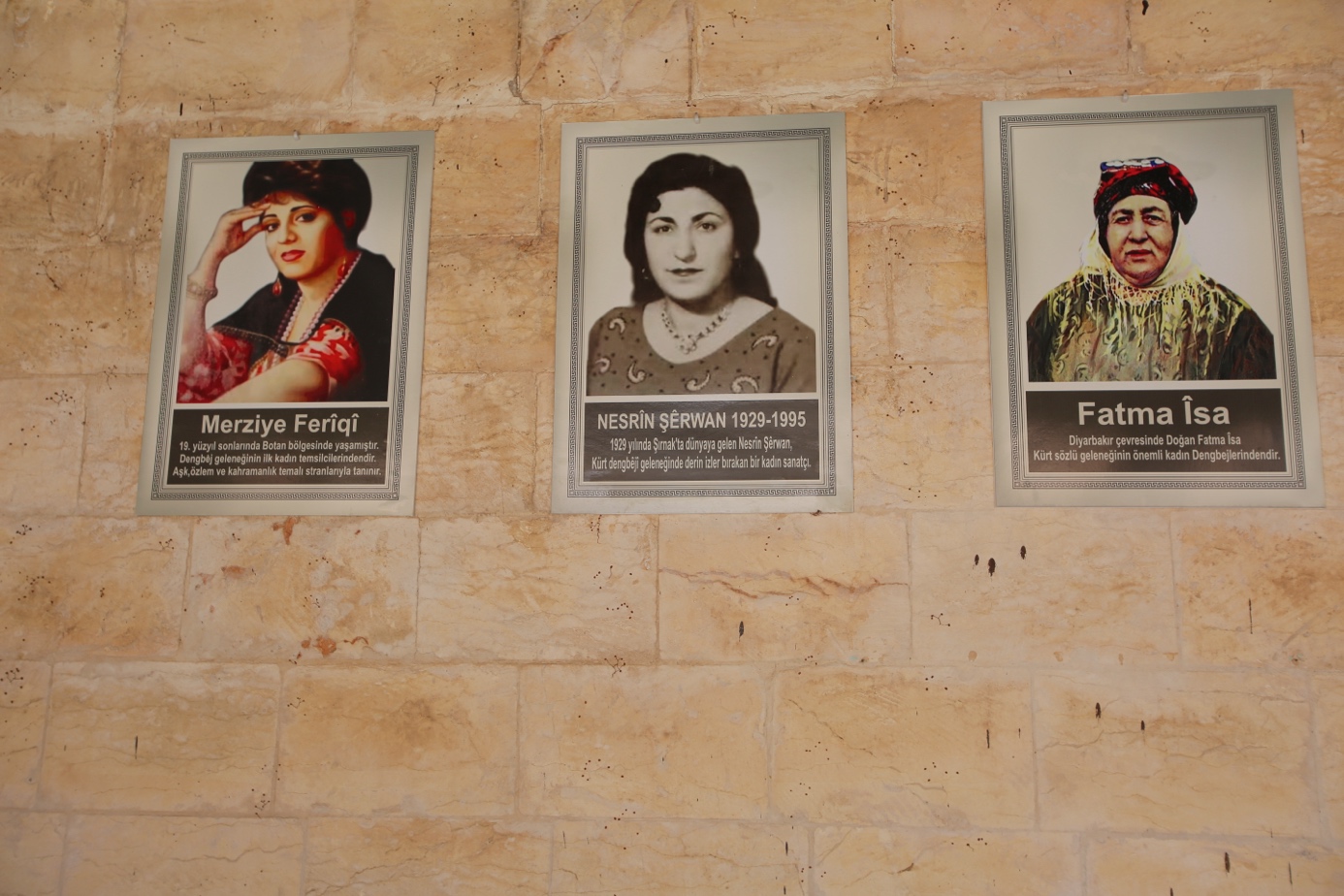
Our meeting takes place at the Dengbêj House, a historic mansion whose walls are lined with photographs of Kurdish and Armenian dengbêjs. Every week, local performers gather here to share their klams with the public.
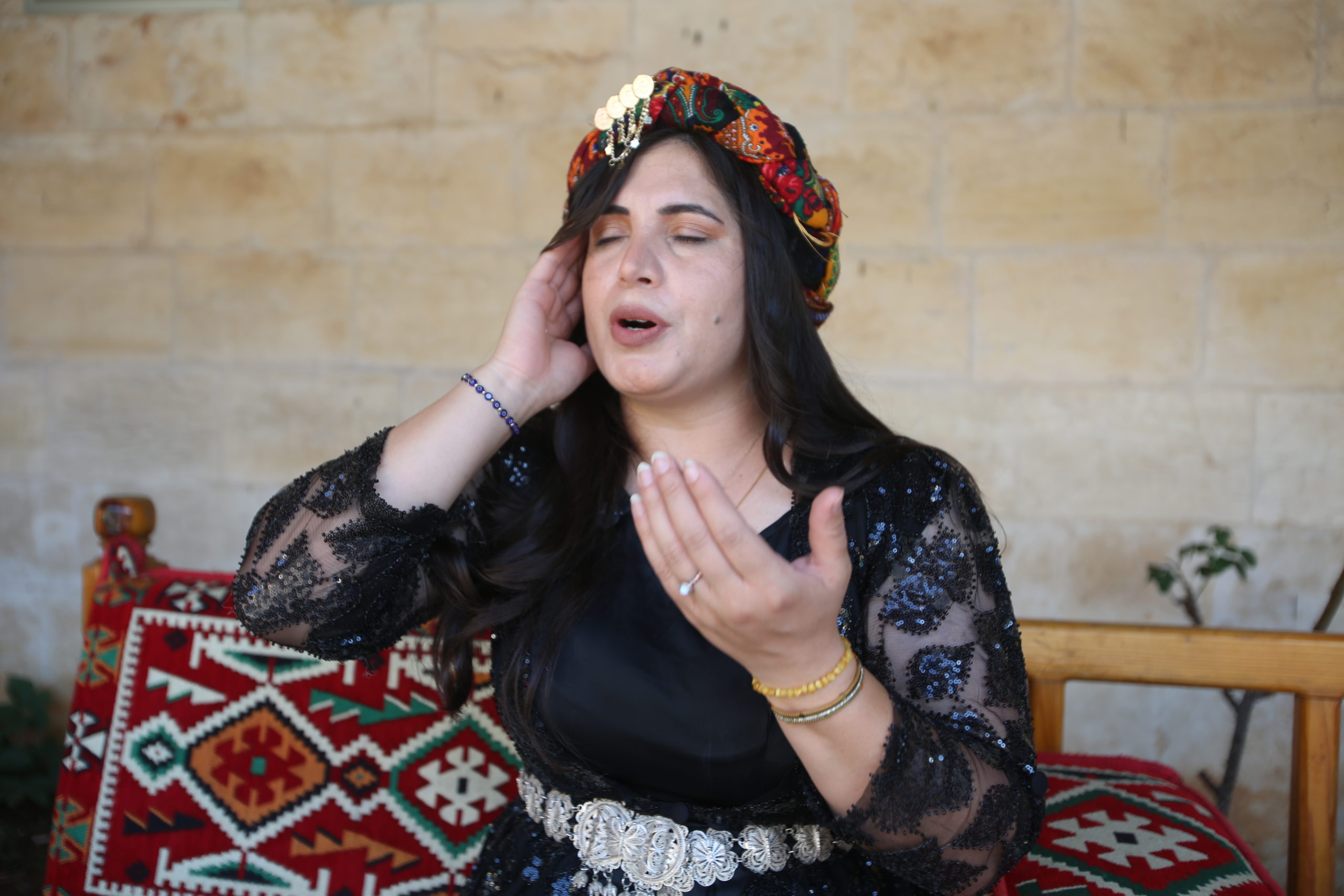
Wearing traditional Kurdish clothing, Hediye welcomes us and speaks about the women who inspired her. Among them are Nesrîn Şêrwan and Fatma İsa, from the mid-1900s, and Merziye Ferigi, who lived in the late nineteenth century. Her first inspiration, however, was her mother.
“My mother was a woman who had endured a great deal of suffering,” Hediye recalls. “She would hum about her pain as though she were singing. She did this within the four walls of her home. She had a beautiful voice. Over time, I began to sing like my mother, but I didn’t confine myself to the walls of my home.”
Like her mother, Hediye also experienced suffering that she would later express through song. As a child, she was forcibly married by her family to a man she had never met, in exchange for money.
“I became a bride in a place I didn’t know. My husband subjected me to violence every day. I had a son, but I could no longer endure the violence, so I returned to the land where I was born. Later, I took my son back from them.”
After leaving her marriage, Hediye rebuilt her life and has now been performing dengbêjî for approximately 14 years. Her determination echoes that of earlier women dengbêjs, many of whom faced family opposition, social exclusion, and exile to pursue their art.
“They wanted us to live our lives within four walls. I wanted to tear those walls down.”
The women who broke barriers
Among these women was Ayşe Şan, born in Diyarbakır in 1938 and known as the “Queen Without a Crown or Throne.” She began singing religious hymns at mourning gatherings and ceremonies, performing only in spaces where women were present. Her father opposed her desire to perform publicly, particularly in front of men.
After being married off and subsequently divorcing, Şan began singing on Antep Radio and recorded an album in Kurdish and Turkish. But singing in Kurdish exposed her to severe repression, eventually forcing her into exile in Germany in 1972. She later travelled to Baghdad and began singing in Kurdish on the radio, but her hopes of returning to Diyarbakır were thwarted by opposition from her relatives. She settled in İzmir, where she died in 1996. It was only in 2025, 29 years after her death, that her remains were brought back to Diyarbakır, where women carried her coffin to its final resting place.
Other women faced similarly difficult choices. Nesrîn Şêrwan, born in Şırnak in 1929, was forced to choose between her family and her art. Despite the prospect of isolation, she pursued a career that spanned more than three decades, recording over 500 works at Baghdad Radio and becoming a pioneer of Kurdish music. Sûsika Simo, born into an Êzidî family in Soviet Armenia in 1925, took a different path, leaving her medical career to devote herself to Kurdish culture and the arts. A composer of Kurdish songs, she challenged patriarchal restrictions and is considered the first woman dengbêj to perform on stage.
Though their paths differed, these women challenged the boundaries of who could perform dengbêjî and where their voices could be heard.
Carrying women’s stories forward
For Hediye Kalkan, their legacy is inseparable from the experiences of generations of women who turned to song to express what they could not always say publicly.
“They wanted us to live our lives within four walls. I wanted to tear those walls down,” she says. “I told myself that, no matter what happened, I would continue on my path as a woman dengbêj.”
“In Kurdish culture,” she continues, “women who could not read or write, women confined to their homes, found quiet ways to express their love, their longing for their homeland, their experiences of migration, or their rebellion against male violence. They passed down a history to us. Now we want to carry the present into the future. In Mesopotamia, dengbêjî is a form of women’s resistance. It is the living voice of a living history. It is women, it is mothers, who have carried this culture into the present.”
“They wanted us to live our lives within four walls. I wanted to tear those walls down.”
Following our conversation, Hediye performs two klams, originally composed by women, that illustrate how women’s stories have travelled across generations and borders. The first recounts the legendary story of Sinan and Sakine. In Kurdish tradition, children of families connected through kirvelik, a ceremonial godparent relationship, are forbidden to marry. The song expresses Sakine’s love for Sinan despite this prohibition.
The second klam tells the epic love story of Dewrêşê Evdî and Edûlê, recounting Edûlê’s love for Dewrêş in a society where relationships between Êzidîs and Muslims were forbidden.
Young dengbêj Hediye Kalkan performs Kirîvê Sînan (Kirvem Sinan) at the Dengbêj House in September 2026. Source: Arjin Dilek Öncel.
The spaces in which these stories are shared have also begun to change. Traditionally, dengbêj assemblies were largely reserved for men, who gathered on designated days in village homes to take turns performing klams. There were exceptions: some male dengbêjs brought their daughters to these gatherings, helping a small number of women enter the tradition.
Today, women are making their presence felt in spaces where they were once largely excluded. At the Dengbêj House in Viranşehir, Hediye performs before public audiences, while Evin’s participation in the Dengbêjs’ Assembly reflects women’s efforts to gain recognition within the tradition. In a practice where women’s songs were once performed under men’s names, these spaces now offer opportunities for women to be heard and recognized for their contributions to Kurdish cultural history.