Cette publication est également disponible en : Français (French) العربية (Arabic)
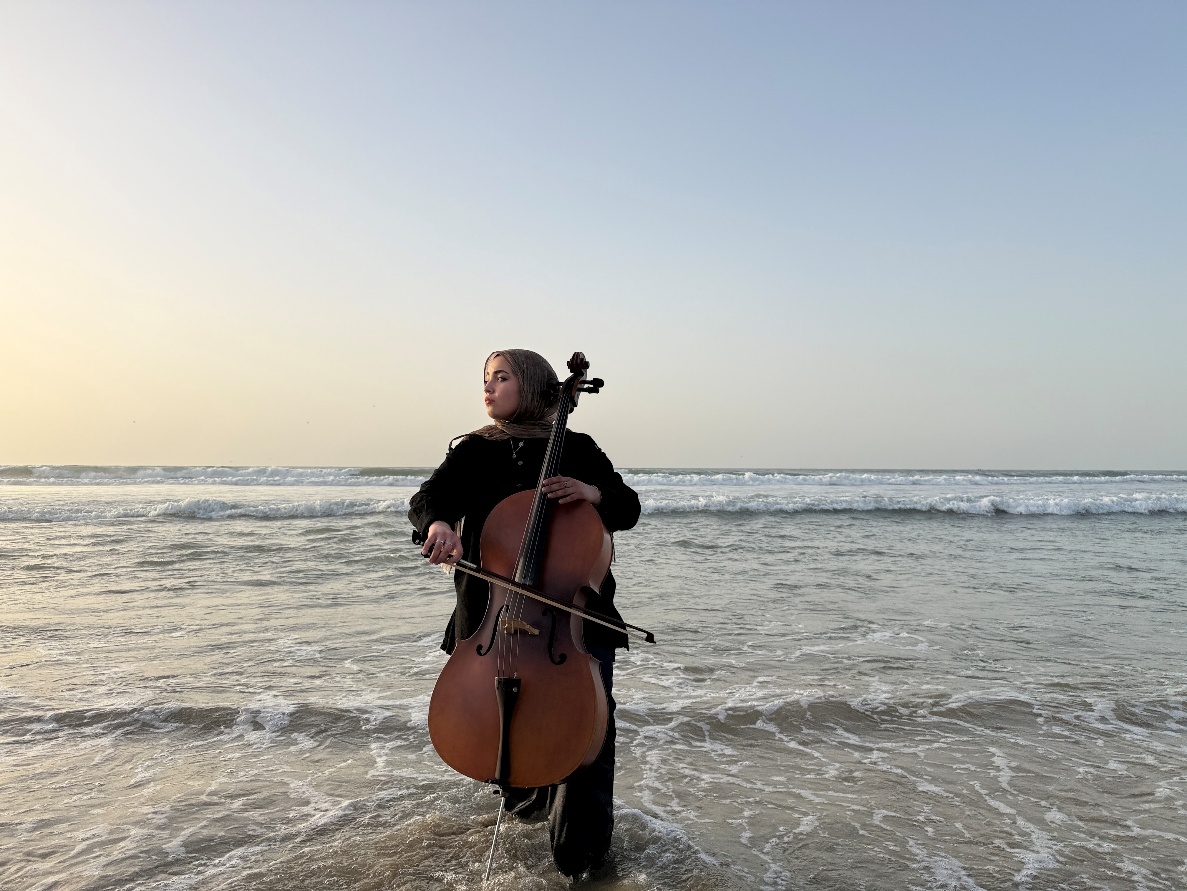
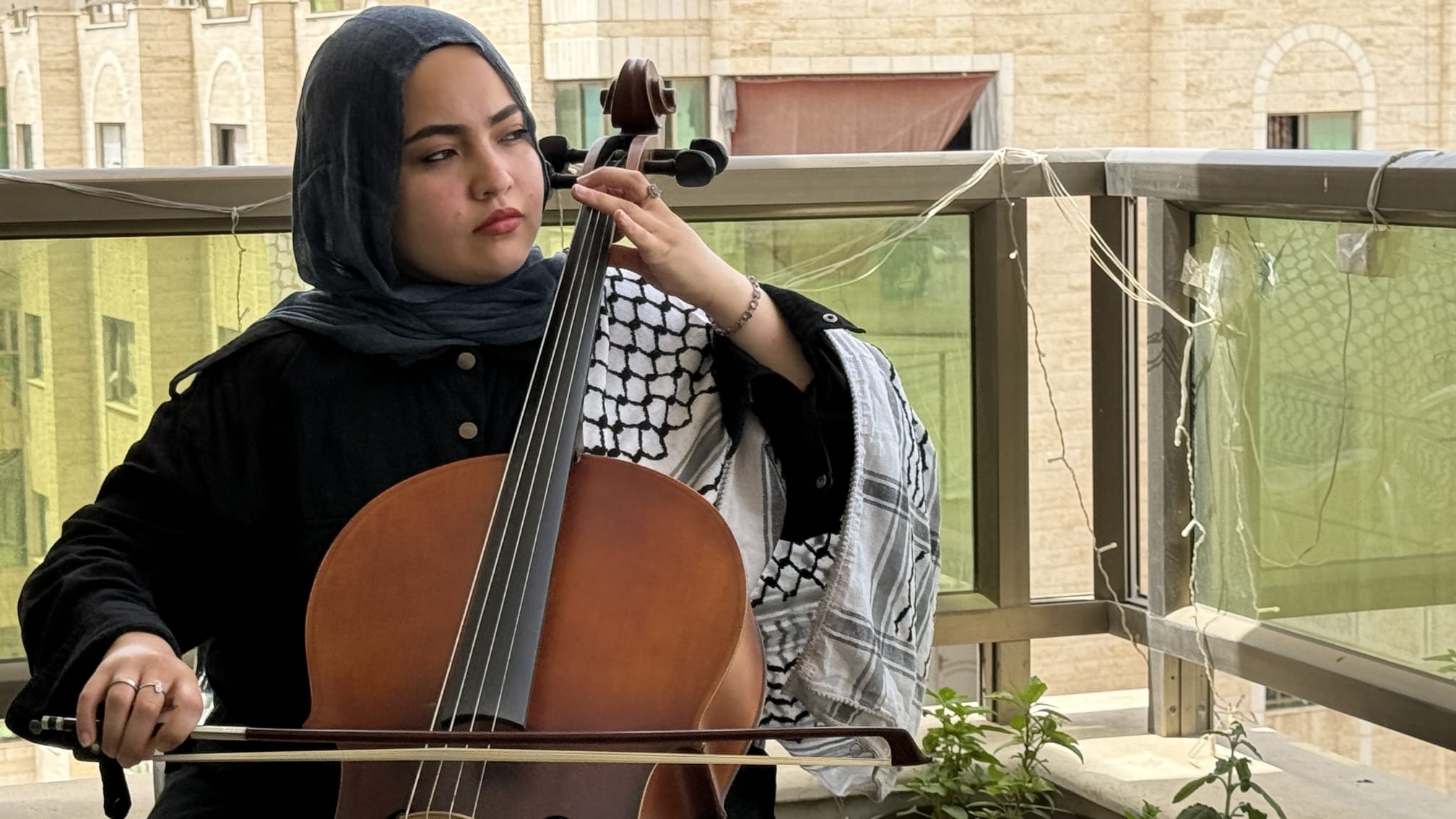
On Gaza’s beach, the sight of a young woman holding a cello might seem unusual. There, Haifa Abu Shamla plays, and her melodies drift along the shoreline, drawing in children and prompting some of the displaced to stop and listen. Music is not something one expects to hear on a beach now crowded with tents, misery, and fear.
Haifa begins with soft, mournful notes that echo the weight the people of Gaza carry on their shoulders. The music gradually rises, moving between tension, anger, and fear, as if telling a tale of destruction, loss, endless waiting, and dwindling patience. Interspersed throughout, a warm melody emerges, a symbol of hope and of those who continue to cling to life despite everything.
Three wars and one cello to survive it all
“When the Israeli army ordered us to evacuate our neighborhood, I couldn’t take my cello,” recalls Haifa, 22. “There wasn’t enough room for it in the car, which could barely hold our basic needs like clothes, bedding, and other essentials.”
Haifa, who grew up in the Zeitoun neighborhood in southeastern Gaza City, began playing the cello at the age of 11. Over the years, music became a means of survival and a path to healing after living through three wars and experiencing bombing, death, destruction, and displacement.
In 2015, she enrolled at the Edward Said National Conservatory of Music, hoping to learn to play the piano. But the conservatory only accepted piano students under the age of ten. She then turned to the cello after hearing one of the instructors perform. Captivated by its sound, she was encouraged by the teacher to learn how to play the instrument and pursue that path.
The conservatory itself now stands abandoned and damaged after being partially destroyed by Israeli bombardment. Its equipment and musical instruments were lost to fire, destruction, and looting.
When the war on Gaza began, Haifa’s family was forced to flee south in response to Israeli evacuation orders. She had no choice but to leave her cello behind in the family home. Forty-nine days after they fled, the house was bombed, and it later sustained additional damage when nearby areas were targeted and a major fire broke out.
According to Gaza’s Ministry of Health, the number of people killed in the Israeli aggression has surpassed 72,000, while more than 172,000 have been injured since October 7, 2023.
A year and two months later, Haifa was finally reunited with her cello. “It was an emotional, heartbreaking, and shocking reunion,” she says. “I found it badly damaged. The glue holding the wooden parts together had melted, and the soundboard had broken. The repair cost me $200, but now it’s functional again, and I can continue doing what I love.”
But then only three months after returning home, Haifa’s family was forced to flee once more, and she had to leave her cello behind again.
“That continued until our most recent displacement,” she says. “This time, there was room to take the one thing that gives me relief and helps me hold on to what’s left of myself. For the first time, my cello accompanied me on our journey into displacement.”
A month later, the family returned to find their home severely damaged. They rented an apartment near the fishermen’s port, leaving Haifa without the privacy and refuge she had lost for more than two and a half years.
Haifa turned to Gaza’s shore to play her cello, especially as it had become crowded with displaced families. She wanted to offer them a different sound from that of the rockets.
On the Gaza shore, music felt like breathing
Haifa turned to Gaza’s shore to play her cello, especially as it had become crowded with displaced families. She wanted to offer them a different sound from that of the rockets, surveillance drones, artillery fire, warships, and the relentless barrage of fire belts.
On the beach, Haifa performed a series of quiet and anguished pieces through which she sought to express the reality of genocide in Gaza. Among them was John Williams’ Schindler’s List, a piece long associated with the suffering of the Holocaust during World War II. Through it, she evoked the harrowing scenes that Gazans had endured and witnessed with their own eyes.
“If the cello isn’t one of the survivors of this genocide, then who is?!” Haifa asks. She explains that both she and her cello survived despite repeatedly coming close to death, clinging to hope in the face of Israeli propaganda that insisted Palestinians would never return to their homes or land, an attempt to force them into displacement.
According to preliminary figures in the Palestinian Ministry of Culture’s fifth report on the damage to Gaza’s cultural sector, 107 musicians were officially registered before the war, ten of whom have since been killed. Israel also killed eight people working in theater and the performing arts, while the rest continue to live in displacement with their families.
When wood became more precious than music
Recalling one of the moments that has stayed with her most vividly, Haifa says, “One of the children living in the tent camps, who has now been deprived of education for the third year in a row, was astonished to learn that there was an instrument called the cello. When he found out it was made of wood, he asked me to give it to him because it contained about five kilograms of wood. His family could use that wood as fuel for a fire, to cook food or even heat water. That was the greatest shock to me.”
Alongside the crushing financial and psychological conditions, Haifa says it is often difficult to continue creating when safety is nonexistent and every day revolves around survival and protecting loved ones. “The Israeli assault has robbed people of their voice and their space for expression,” she says. “But art takes on even greater importance in times like these. It preserves identity and memory and gives its creator space to escape the brutality of everyday life.”
“Music may not literally stop the war, but it confronts it in a human and symbolic way. It reminds us that behind this destruction are human beings with feelings, memories, and dreams. Songs, paintings, and artistic stories remain witnesses to what we have lived through, preserving a memory that destruction might try to erase,” she continues.
She concludes, “The cello is the instrument closest to the human voice. That is why it can express emotions that words cannot explain or communicate to the world. It is one of the most powerful voices through which we can call for this tragedy to end and ask the world to see us with compassion. How can a defenseless people, who have nothing but their faith and steadfastness, face a missile whose explosion temperature reaches four thousand degrees Celsius?”