Cette publication est également disponible en : Français (French) العربية (Arabic)
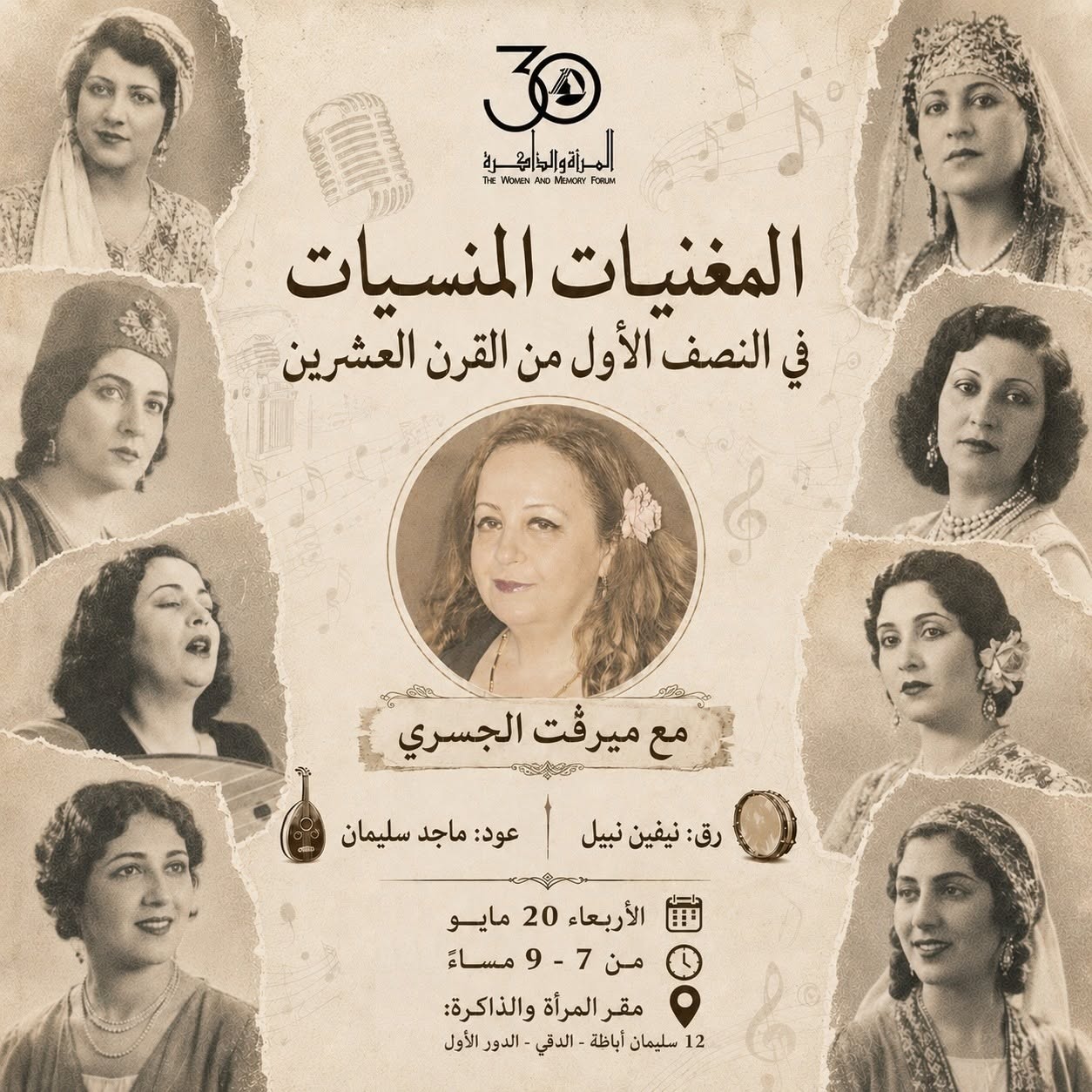
Egyptian-Lebanese artist Mervat El-Gesry wasn’t just performing old songs; she was reviving the stories that had faded alongside the women who sang them. Accompanied by oud player Magid Suleiman and riqq player Nevin Nabil, she reinterpreted the works of singers like Nazira El-Faransawiyya and Amina El-Iraqiyya, who achieved fame in the first half of the 20th century before gradually disappearing from public memory.
El-Gesry grew up in a family that loved the arts. Her grandfather sang on Lebanese radio, and her mother regularly took her to Fairouz concerts as a child. She later studied music at the Academy of Arts in Egypt and, five years ago, joined the El-Warsha Theater Troupe, where she began combining storytelling and singing in her artistic practice.
The evening, themed Forgotten Female Singers of the First Half of the 20th Century, organized by the Women and Memory Forum in Cairo last May, served as a reminder of women who had once been celebrated performers but were ultimately forgotten.
Since its establishment in 1995, the Women and Memory Forum has been working to reinterpret Egyptian and Arab history through a feminist lens, highlighting women’s contributions that have been marginalized by dominant historical narratives.
Among the singers featured during the evening was Bahiyya al-Mahallawiyya, whose records reached Europe, inspiring audiences to chant, “Oh Sitt Bahiyya, whose voice reached Europe!” Renowned for songs that addressed married life with remarkable boldness, she is now remembered only within limited circles.
But the evening did more than just revive these women’s songs; it raised a broader question: How did women who once occupied such a prominent place in the history of Arabic music disappear from collective memory?
How did women who once occupied such a prominent place in the history of Arabic music disappear from collective memory?
Erasing the musical legacy of the awalim
Singers like Naeema El-Misriyya and Fatima Shaarawi, among others, were known as al-awalim, a title originally used to refer to professional female singers. Over time, however, the term acquired negative social connotations that distorted both their public image and artistic roles. The term derives from the word ‘alima, meaning scholar, or learned woman, reflecting the extensive knowledge each possessed of the principles and techniques of classical Arabic singing and music.
The marginalization of the awalim was not merely symbolic; in some cases, it extended to the deliberate destruction of their artistic legacy. Naeema El-Misriyya, for example, was forced to flee her family and relocate to Aleppo, Syria, in order to pursue singing after her family refused to accept her professional career. She later retired from the stage after a 26-year career. During the evening, El-Gesry revived her story by performing the song Kiki Ya Kiki.
Fatima Shaarawi, one of the celebrated awalim of Cairo’s Mohamed Ali Street, met a different fate. After her husband forbade her from singing, he collected all the records featuring her voice from the markets and burned them in an attempt to erase her artistic output entirely.
El-Gesry also brought back the story of the singer Hayat Sabri, whose talent was discovered by Sayed Darwish when she was only 14 years old. He invited her to join his troupe, and El-Gesry honored her by performing the song Da Ba’af.
This evening was part of El-Gesry’s broader effort to recover the histories of Levantine and Egyptian female singers whose lives and careers are on the verge of disappearing from memory. “I have a passion for researching the lives of lost female voices like Asma El-Kamsariyya, Tira Hakim, and Badriyya Saada, whose musical careers were spread across Egypt, Lebanon, and Syria,” she said to Medfeminiswiya.
El-Gesry hopes to continue this project by performing songs by forgotten female singers from the 1940s.
“I had no idea that Egypt once had women composers. This is completely absent from contemporary media.”
Recovering the lives of women musicians
The evening did not stop at reviving the voices of forgotten female singers; it also prompted wider questions about women’s place in the history of Arabic music, particularly in the fields of composition and musical production.
Dr. Munira Suleiman, a member of the Women and Memory Forum, told Medfeminiswiya: “We are committed to re-examining and re-presenting the history of women in the Arab region from a feminist perspective.” She explained that the organization researches women’s intellectual and artistic production and reintroduces it to society as part of its cultural memory.
The Women and Memory Forum was established in 1995 by a group of researchers committed to challenging stereotypical representations of women in mainstream culture. Its work is grounded in a gender-based approach and focuses on reinterpreting historical sources that document women’s roles in both the past and the present.
The organization sustains its work through grants from international development agencies such as the Arab Fund for Arts and Culture (AFAC), UN Women, and the Gender Equality Fund, as well as income generated through paid workshops, book sales, and private donations.
“I had no idea that Egypt once had women composers,” Shireen Farouk, a sales manager who attended the event, told Medfeminiswiya. “This is completely absent from contemporary media.” She believes the near absence of women from the current composition scene raises important questions about the reasons this tradition was interrupted and whether contemporary women musicians are attempting to revive it.
Khaleda Alaa El-Din, a former employee of the Egyptian Ministry of Foreign Affairs, said she attended the event because she wanted to discover women’s voices that had been erased from artistic memory. “I loved learning about the singers’ lives and histories because they are part of Egypt’s artistic heritage and women’s legacy,” she added, stressing that introducing younger generations to these artists is essential if women’s cultural heritage is to be protected from disappearance.
Why is recovering women’s artistic history important?
For the organizers, recovering the histories of the awalim is more than an archival exercise. It is an effort to challenge historical narratives that excluded women and to dismantle the stereotypes that continue to shape public perceptions.
Dr. Hanan Sabaa, a member of the Board of Trustees of the Women and Memory Forum, explained: “The project of recovering women’s artistic history seeks to correct the distorted image that has been reinforced by television drama. The history of the awalim also demonstrates that women’s freedom is neither a recent idea nor one imported from abroad.”
She continued, “The misconceptions surrounding women have become embedded in laws that govern women’s lives. Creating artistic spaces like these engages directly with reality and helps restore more accurate understandings of women.”
Sabaa also emphasized that women’s spaces, in all their forms, challenge accepted assumptions about women and create opportunities to rethink social understandings of feminism, women, and lived reality. “Even when these spaces are modest, they have real influence and the capacity to change the way people think about women,” she said.
The Women and Memory Forum has undertaken numerous feminist initiatives, including the Oral History Archive documenting Egyptian women who were pioneers in their respective fields. The archive serves as a library of oral histories that recognizes women as makers of social and political history.
The forum also launched the podcast “Her Mark in History: A Podcast for Pioneer Women’s Voices,” which documents the voices of pioneering women in Egyptian history. In addition, it launched “The Camera and Her: Women Filmmakers of Contemporary Egyptian Cinema,” a collection of 19 documentaries produced by the forum that chronicles the artistic and professional journeys of contemporary Egyptian female filmmakers.
The forum has also established the “Who Is She in Egypt” project, a database highlighting distinguished Egyptian women experts across a wide range of professional fields.