
This post is also available in: العربية (Arabic)
“He would choose young women from humble backgrounds, who had limited experience, financial hardship, and family problems—because they were more likely to trust him easily,” explains art critic Manar Khaled in an interview with Medfeminiswiya. She describes how the man identified by the initials (A.G.), the writer of a well-known TV series, selected his victims in a pattern suggesting the exploitation of specific social and personal vulnerabilities.
The wave of accusations that exposed several harassers prompted Manar to repost a statement she had written last year, in which she accused (A.G.), who used to run theater workshops for students and benefited from his connections in artistic circles despite lacking a clearly defined professional role.

According to her account, Manar says, “He used his cultural connections to gain the trust of young women or newcomers to the field by offering gifts, asking about details of our personal lives, and then pressuring us to accept financial help or small job opportunities, creating a sense of dependency or gratitude toward him. Sometimes, if we refused his help, he would invent fake work opportunities as a pretext to pay us.”
Manar observes that this pattern has been repeated with multiple young women: it begins with building trust before progressing to attempts at one-on-one meetings that sometimes escalated into physical harassment, such as attempts to hug, kiss, or touch them without consent—acts made possible by the relationship of trust he had carefully cultivated beforehand, making some young women hesitant to object immediately.
This is what happened to Manar after (A.G.) lured her into visiting his home under the pretext of helping him pack before traveling.
According to the Ohio State University, grooming is a gradual process in which the perpetrator gains the victim’s trust by presenting himself as loving or supportive, assessing her needs and vulnerabilities, and offering gifts and attention to create emotional attachment and dependence. Over time, he encourages her to distance herself from family, making her isolated and psychologically or financially reliant on him, thus facilitating control and exploitation.
“He would approach younger women, most of whom were in psychologically vulnerable situations, dealing with family conflict, or lacking emotional support at home.”
Safe spaces: A cover for exploitation
Meanwhile, in late February of this year, several testimonies circulated against individuals in human rights and civil society circles, including lawyers and activists, most notably a man identified as (M.T.), under the hashtag #DidYouExposeAHarasserToday. (M.T.) is known for supporting young women seeking independence from abusive families and for collaborating with activists, lawyers, and mental health professionals to provide safe shelters and emotional support spaces. He is also the founder of a cultural initiative that offers psychological support to people who have experienced violence or emotional neglect.
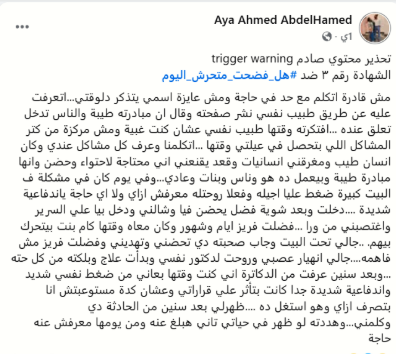
Feminist activist Aya AbdelHamed received dozens of testimonies from survivors who chose to share their stories anonymously, accusing (M.T.) of harassment and exploitation. Aya later published these testimonies on her personal account.
“These testimonies revealed a repeated and systematic pattern of grooming and exploitation,” Aya says. “He would approach younger women, most of whom were in psychologically vulnerable situations, dealing with family conflict, or lacking emotional support at home. According to these testimonies, he would enter their lives as a supportive friend and emotional confidant, someone they could trust and turn to in difficult times, before later luring some of them to his home during their moments of psychological vulnerability.”
The Did You Expose a Harasser Today? campaign is considered an extension of the global #MeToo movement, the feminist movement that swept across social media in 2017 and raised awareness about sexual harassment and assault, especially in workplaces. The movement sought to highlight the alarming prevalence of harassment, encourage survivors to break their silence and share their stories, and call for perpetrators to be held accountable.
According to psychological and academic studies, perpetrators in grooming processes build relationships of trust and psychological dependence with victims in order to facilitate control and sexual exploitation, through gradual steps that weaken resistance and blur personal boundaries while exploiting emotional vulnerability—a pattern repeatedly reflected in the circulating testimonies.
The testimonies were not limited to those received by Aya AbdelHamed. Other survivors anonymously shared their stories with activists, revealing that the incidents went beyond harassment and also included rape allegations, leading to the spread of the hashtag #DidYouExposeARapistToday alongside the testimonies.
Under Egyptian law, rape is defined as full sexual intercourse without the victim’s consent, through force, threats, or exploitations of vulnerability, while indecent assault refers to any act violating a person’s bodily integrity without full intercourse. These definitions are based on Penal Code No. 58 of 1937, where Article 267 criminalizes rape and Article 268 criminalizes indecent assault. Accordingly, some testimonies may legally qualify as rape while others may be classified as indecent assault, depending on the nature of the act.
According to the report on Violence Against Women and Girls in Egypt for the First Half of 2025, issued by the Edraak Foundation for Development and Equality, 122 cases of sexual harassment and 10 documented rape cases were recorded, in addition to attempted rape incidents and 62 cases of sexual assault against children, including the rape of underage girls. These figures reflect the broad scope and varied forms of sexual violence, indicating that the circulating testimonies are not isolated incidents but part of a wider context supported by documented data. The report also notes that some crimes were accompanied by attempts to pressure, threaten, or defame survivors in order to prevent them from reporting.
Where do women go? Alternative justice and safe havens
As many of the accused continue to shield themselves with legitimacy derived from their positions within human rights or cultural communities, one question repeatedly emerges in public discussions: Where do women go?
The circulating testimonies are not isolated incidents but part of a wider context supported by documented data.
The absence or limited availability of safe spaces pushes women and young girls toward human rights organizations and civil society groups in search of some form of alternative justice amid the lack of official protection. Yet this reality can also make some of them vulnerable to individuals who associate themselves with these circles and position themselves as their last resort or only refuge.
Rania Rashwan left her village in the Faiyum Governorate in 2021 to escape the violence she faced for refusing to wear the hijab. After arriving in Cairo, she says she was repeatedly exploited by people who either claimed affiliation with human rights work or were actively involved in it. “I didn’t know that when I left my struggles behind and went to Cairo, the city wouldn’t open its arms to me—that there would be another circle ready to exploit and harm you under the guise of helping,” Rania says. “Girls who escape violence end up facing even harsher violence within circles that are supposed to be safe havens for them.”
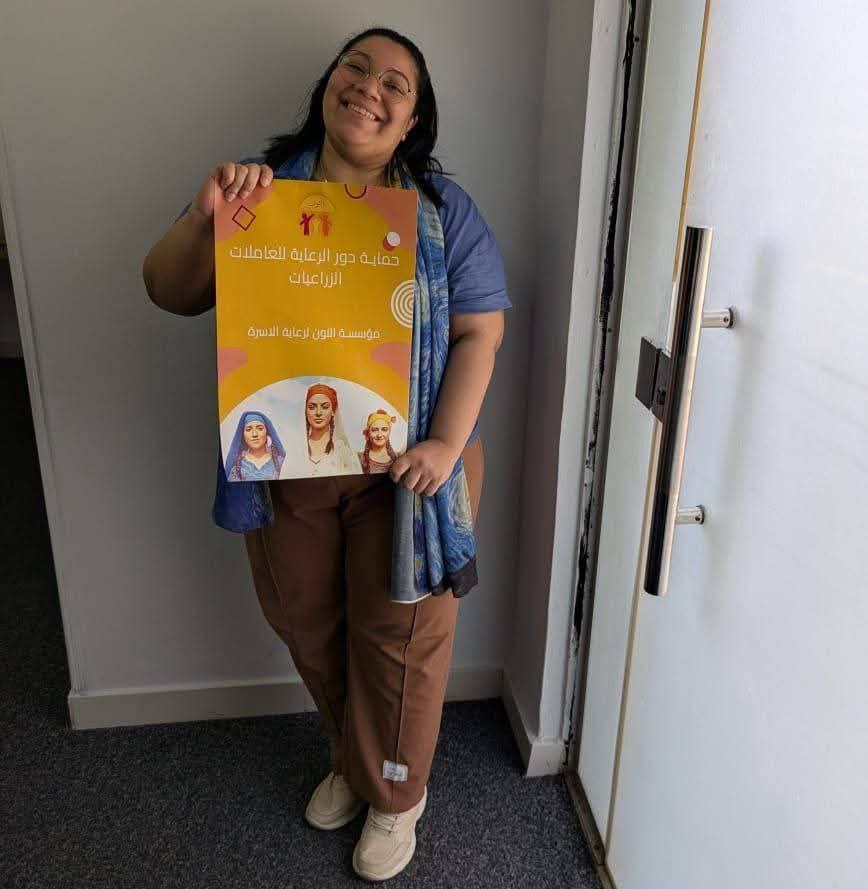
Lamia Lotfi, founder of the Rural Women’s Initiative, believes that these cases reflect a broader structural problem: the lack of safe and specialized institutional spaces capable of providing professional support. She explains that some individuals may become unofficial havens for survivors.
According to Lotfi, she was not personally close to (M.T.), and their first interaction occurred while following the case of a girl who had escaped a forced customary marriage. Lotfi says she went to assist the girl at the police station and found him there, offering support as well.
She adds that she noticed the girl had become deeply emotionally attached to him, so she advised him to stop interacting with her and allow the organization to handle the case, since he was not a trained specialist and his presence in such circumstances could lead to unhealthy emotional dependency on the part of the survivor.
In the same context, calls intensified for human rights organizations themselves to open investigations into the individuals accused in the recent hashtag campaign, in an attempt to achieve some sort of alternative justice for women within informal contexts.
It is worth noting that in September of last year, the Egyptian Centre for Women’s Rights (ECWR)—one of the country’s leading feminist human rights organizations—issued a statement announcing the results of an internal investigation committee formed after one woman accused one of the organization’s lawyers of harassing her.
The ECWR published the committee’s decision, which included the following statement:
“The committee concluded that the incident involving the sending of a sexually explicit image did indeed occur. However, the committee considers this to be an act that could have been committed accidentally. Since the act appears to lean toward being non-deliberate, an unintended mistake, the measures taken should not exceed the bounds appropriate for dealing with an unintentional act.”
The statement sparked widespread anger among activists and human rights advocates, who viewed it as dismissive of the complainant’s rights and unreflective of the responsibility expected from a leading feminist organization. It also disappointed many supporters of gender justice who had placed hope in informal investigative committees as alternative avenues for achieving justice for survivors outside conventional judicial systems.