About us
  • it VO
  • fr Français
  • en English
  • ar العربية
No Result
View All Result
Medfeminiswiya - Mediterranean feminist media
  • On the move
  • In-depth
  • Files
  • Artistic Creations
  • Interviews
  • Opinions
  • World
Medfeminiswiya - Mediterranean feminist media
  • On the move
  • In-depth
  • Files
  • Artistic Creations
  • Interviews
  • Opinions
  • World
No Result
View All Result
Medfeminiswiya - Mediterranean feminist media
Home In-depth

World Press Freedom Index 2026: A worrying situation in the Mediterranean

Olfa Belhassineby Olfa Belhassine
2 May 2026

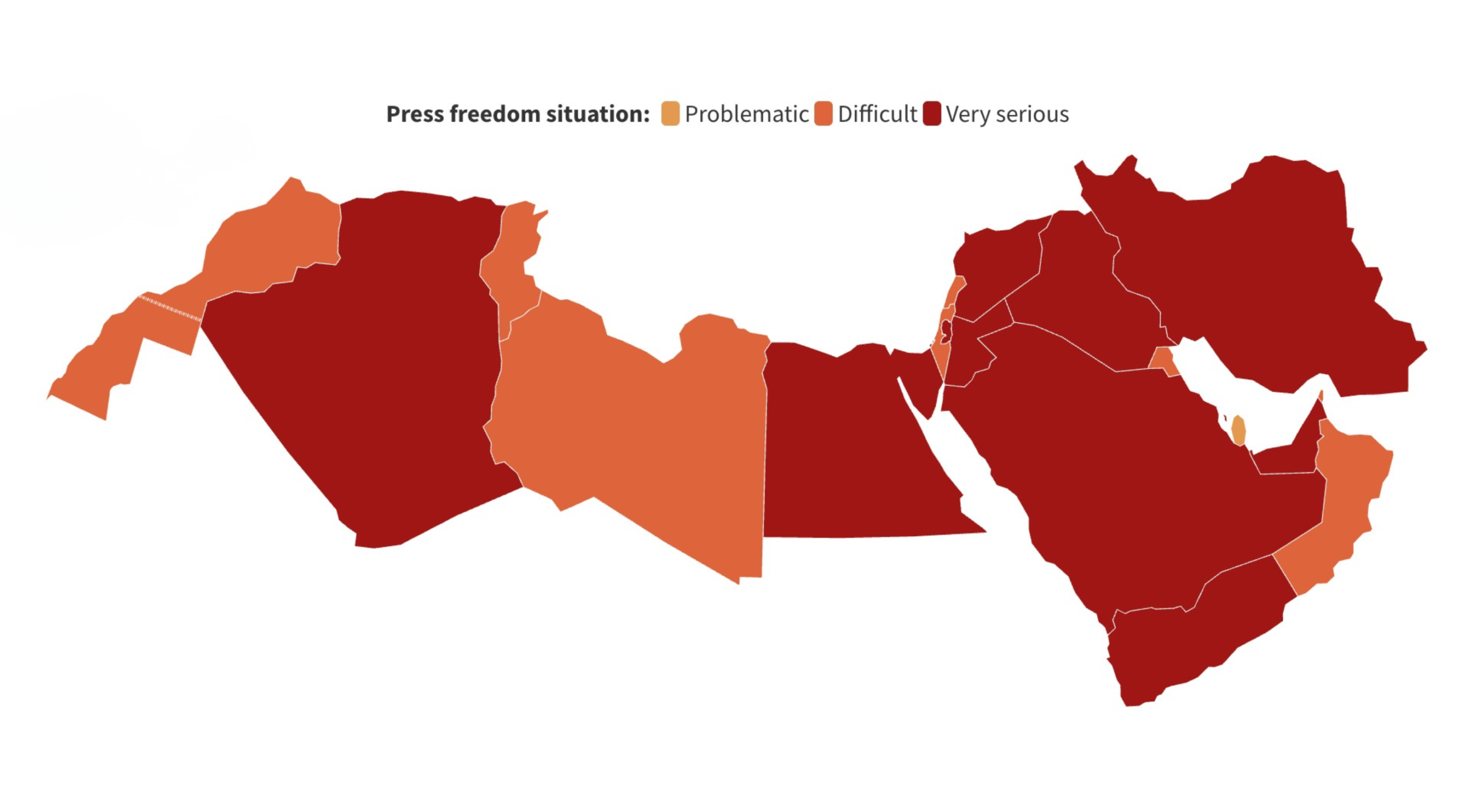
Source: World Press Freedom Index. ©Reporters Without Borders

The World Press Freedom Index is published annually by Reporters Without Borders (RSF), a few days before May 3, World Press Freedom Day. Here is a focus on the Mediterranean region, the area covered by our website.

This post is also available in: Français (French) العربية (Arabic)

The aim of the World Press Freedom Index published by Reporters Without Borders (RSF) is to measure the level of media freedom in 180 countries and territories.

“There are fewer and fewer countries today where press freedom is guaranteed,” warned Thibaut Bruttin, Director General of RSF, on FranceInfo a few days ago.

He was commenting on the 2026 index, which had just been published and in which more than half of the world’s countries fall into the “difficult” or “very serious” categories for press freedom. This means, according to the report’s findings, that “not only has the work of journalists never been so complicated and dangerous, but our collective right to be informed has never been so widely undermined. Journalism is being criminalized on a global scale, and the decline in the legal indicator is a clear illustration of this: the instrumentalization of increasingly restrictive laws is eroding the right to information, even within democracies.”

And even though the organization had shown in an October 2024 report that the MeToo era was considered a “feminist spring in the media,” violence against journalists has only increased, particularly in countries where right-wing forces, authoritarian regimes, and populist movements have gained ground in recent years.

Northern Mediterranean countries: Satisfactory, but room for improvement

For the region covered by Medfeminiswiya, namely the Mediterranean basin, the situation in the northern countries remains, as usual, far more satisfactory than in the south.

France, Italy, and Spain nevertheless face recurring tensions: political pressure, intimidation during demonstrations, judicial investigations targeting journalists, and economic difficulties affecting independent media, all of which weigh on the independence and quality of journalism.

Türkiye, on the other hand, is still considered among the worst in the region, with repressive laws, arrests of journalists, the closure of media outlets, and tight state control over the media landscape.

Middle East: Journalism under fire

As for the Middle East and North Africa (MENA) region, it remains, according to the report, the most dangerous in the world for journalists.

The factors highlighted by RSF include wars and the destruction of newsrooms—particularly in Gaza—along with restrictive laws, economic pressure and media closures, and the detention of or targeted violence against journalists. Lebanon falls into the lower range (around 130th place). With nearly 200 journalists killed in Gaza by the Israeli army since October 2023, including at least 35 women in the line of duty, the territory accounts for the highest number of journalists killed over the past two years.

In this challenging context, Syria (141st, up 36 places) stands out for its historic shift, one year after the fall of Bashar al-Assad. Although the situation remains “very serious,” indicators are improving, particularly the legal framework. While this indicator is declining across most of the region, in Syria it has become the main lever for improving working conditions in a country deeply scarred by years of the systematic destruction of journalism.

With nearly 200 journalists killed in Gaza by the Israeli army since October 2023, including at least 35 women in the line of duty, the territory accounts for the highest number of journalists killed over the past two years.

Press freedom under serious threat in North Africa

In North Africa, the erosion of press freedom is no longer a temporary phenomenon; “it has become structural, fueled by mutually reinforcing political, economic, and security dynamics,” the index states.

In Libya (138th, down 1 place), still deeply fractured, journalists are often forced to serve one side of the conflict and are also pushed toward self-censorship by an expanding legislative arsenal, strengthened by a new law on cybercrime. In countries without open warfare, constraints remain more diffuse but persistent: in Algeria (145th, down 19 places), detentions, censorship, and online harassment target independent media. Tunisia, which until 2019 held a relatively strong position (73rd), has fallen to 137th this year. The instrumentalization of the judiciary and political pressure are tightening the grip on critical journalism. While Morocco (105th, up 15 places) has seen some improvement thanks to the absence of new imprisonment of journalists, reporters there remain exposed to judicial and financial pressures.

And while this annual ranking serves as a key reference for assessing journalists’ working conditions across the globe, it is nevertheless regrettable to note that gender-inclusive language distinguishing between men and women is still not used. This seems at odds with other reports by the organization, which clearly state that, in the practice of this profession, women are significantly more likely to encounter all kinds of discrimination.

Read also

The hunt is on for journalists in Gaza
In-depth

The hunt is on for journalists in Gaza

by Patricia Simon
21 November 2023
Targeting female journalists in Lebanon: When the witness becomes a target
On the move

Targeting female journalists in Lebanon: When the witness becomes a target

by Pascale Sawma
21 April 2026
Olfa Belhassine

Olfa Belhassine

Olfa Belhassine is a Tunisian journalist who worked with the Tunisian daily “La Presse” since 1990. After the 2011 protests, her articles started appearing in “Libération”, “Le Monde” and “Courrier International”, a testament to her extensive experience as a journalist reporting from Tunisia during President Ben Ali's rule and after his fall. In 2013, Olfa was awarded the first journalism prize of the “Center of Arab Women” for her investigative work on customary marriage in Tunisia, published in “La Presse.” Olfa has also been corresponding since 2015 for the JusticeInfo.net, a website specializing in transitional justice around the world. Olfa Belhassone and Hedia Barkat have published a book titled 'Ces nouveaux mots qui font la Tunisie' (These new words that make Tunisia), providing an in-depth exploration of the political transition in Tunisia after the revolution.

Leave a Reply Cancel reply

Your email address will not be published. Required fields are marked *

J'accepte les termes et conditions et la Politique de confidentialité .

Related articles

Related posts

Cages without walls: The struggle of Afghan women in Spain and Europe
In-depth

Cages without walls: The struggle of Afghan women in Spain and Europe

by Dalila M. Olmo López
30 April 2026

Related posts

Cages without walls: The struggle of Afghan women in Spain and Europe
In-depth

Cages without walls: The struggle of Afghan women in Spain and Europe

by Dalila M. Olmo López
30 April 2026

JOIN OUR NEWSLETTER

Original content. Feminist journalism. Straight to your inbox.

    Related posts

    Croatia: Men Kneeling in Main Squares for Women’s Chastity
    In-depth

    Croatia: Men Kneeling in Main Squares for Women’s Chastity

    by Snježana Pavić
    25 September 2023

    Related posts

    Giving birth with an open womb or when Caesarean section becomes the norm in Egypt
    Abortion and SRHR

    Giving birth with an open womb or when Caesarean section becomes the norm in Egypt

    by Contributor with Medfeminiswiya
    27 September 2021

    Popular articles

    Thirty and single… so what?
    On the move

    Thirty and single… so what?

    by Pascale Sawma
    1 March 2022
    Israel to Palestinian journalists: Be silent… or else!
    In-depth

    Israel to Palestinian journalists: Be silent… or else!

    by Alaa Murrar
    29 November 2023
    Giving birth with an open womb or when Caesarean section becomes the norm in Egypt
    Abortion and SRHR

    Giving birth with an open womb or when Caesarean section becomes the norm in Egypt

    by Contributor with Medfeminiswiya
    27 September 2021
    On the move
    In-depth
    Files
    Artistic Creations
    Interviews
    Opinions
    World
    On the move
    In-depth
    Files
    Artistic Creations
    Interviews
    Opinions
    World

    Medfeminiswiya is a feminist network that brings together women journalists working in the fields of media and content production in the Mediterranean region.

    • About us
    • Country Context
    • Our community
    • Become a member
    • Our partners
    • Editorial charter
    • Disclaimer

    Follow us :

    JOIN OUR NEWSLETTER

    Original content. Feminist journalism. Straight to your inbox.

      © 2026 Medfeminiswiya – Mediterranean Network for Feminist Information

      Back to top

      Welcome Back!

      Login to your account below

      Forgotten Password?

      Retrieve your password

      Please enter your username or email address to reset your password.

      Log In

      Add New Playlist

      No Result
      View All Result
      • On the move
      • In-depth
      • Files
      • Artistic Creations
      • Interviews
      • Opinions
      • World
      • it VO
      • fr Français
      • en English
      • ar العربية

      © 2026 Medfeminiswiya - Mediterranean Network for Feminist Information

      Ce site n'utilise pas de cookies. This website does not use cookies. هذا الموقع لا يستخدم ملفات تعريف الارتباط.