Cette publication est également disponible en : Français (French) العربية (Arabic)
“My friend told me they were looking for new hires, but what I thought was going to be a job interview turned into a political discussion. The staff member in charge asked me about my views on everything going on, then about women, and specifically about women in Damascus. He said that there was moral decay, drugs, and prostitution in Damascus. I replied that this wasn’t true and suggested we return to discussing the job offer. But then he said that they actually didn’t need any new employees at the moment. I left, not knowing if the opportunity had vanished because I’m from the city of Sweida or because I’m Christian.”
These are the words of Maria (a pseudonym), 26, a freelance journalist based in Damascus. She had hoped to contribute to the official media landscape that she has long criticized. “We can’t just criticize without offering our own contribution or solution,” she says.
But her attempt was met with an unexpected and unjustified rejection. “The employee didn’t even look at my CV,” she tells us. “He asked me about my background and where I live, then went on and on about his views on everything happening in the country.”
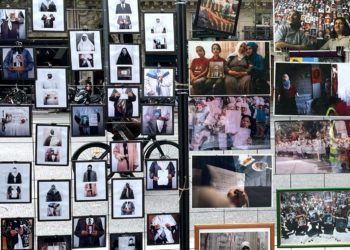
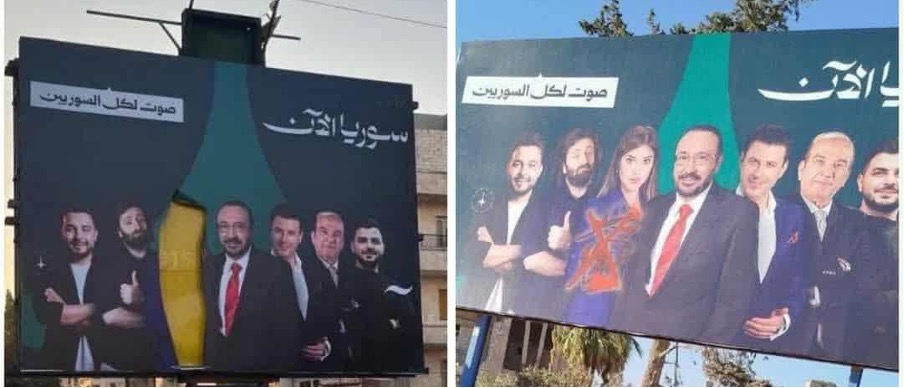
Maria’s exclusion—whether for being a woman or for coming from the predominantly Druze city of Sweida, which witnessed a massacre last July carried out by forces affiliated with the government—appears to be part of a recurring pattern since media and journalistic institutions began operating again in Syria. As photos of meetings and events—cultural, political, and media-related—circulate, a clear male dominance has emerged, raising a single question: Where have Syrian female journalists gone?
It is often said that women work behind the scenes, yet even in those spaces, they are rarely given roles with direct impact. Upon closer examination of personal and official statements, a pattern of discrimination emerges that does not always take the form of outright exclusion but rather manifests itself in the redistribution of opportunities and roles and in restricting the boundaries of of visibility and influence, under pretexts such as “restructuring,” “prioritizing operations,” or “protection.”
As photos of meetings and events circulate, a clear male dominance has emerged, raising a single question: Where have Syrian female journalists gone?
Marginalization under the pretext of safety
Maria’s story is not unique. Many of the female journalists we interviewed report facing similar forms of exclusion. Hanaa (a pseudonym), 22, works at the Aleppo Media Directorate and holds a press card from the Syrian Journalists Union (SJU). “Before the regime fell,” she says, “women journalists’ work in the north was limited and confined to a small number, no more than ten, within the institutions of the Salvation Government. We also faced threats from unknown individuals, incidents of harassment and violations, defamation, and even the possibility of physical harm.”
After the fall of the Assad regime on December 8, 2024, Hanaa observed that the overall working environment had improved somewhat, both in terms of safety and the recruitment of women. In Reporters Without Borders’ (RSF) annual ranking, published on April 30, 2026, Syria climbed 36 places to 141st, up from 177th before the fall of Bashar al-Assad’s regime. However, this improvement has not meant the disappearance of discrimination but a change in its forms. “In field coverage, men are often preferred over women. We’re brushed off as being ‘young ladies,’ along with other flimsy excuses,” Hanaa explains.
The patriarchal discourse of “protection,” framed as concern, is often used as a pretext to exclude women from sensitive field reporting. “While covering battles, we are pressured to withdraw under the pretext of our safety,” Hanaa adds. In practice, this confines women to less risky and less visible roles, imposing a form of guardianship that creates more space for men. This is despite the fact that Hanaa has previous experience in field reporting, was injured on assignment, and has considerable expertise in this area.
In Damascus, Reem (a pseudonym), 30, offers a parallel picture of the situation. A correspondent for an independent platform, she tells us, “I prefer to be present in hotspots to cover events, but male colleagues are often favored for this kind of reporting. Sometimes, women journalists are questioned about their ability to handle field assignments or obtain sensitive statements from guests.”
Reem believes that the essence of media work goes beyond simply reporting the news; it encompasses building a relationship of trust with the community. “The presence of women is essential to providing a more balanced and inclusive narrative,” she says.
She adds that after deciding to step away from political issues and move towards the less sensitive field of the arts, “working in arts journalism wasn’t as easy as it might seem. It was full of professional and ethical challenges.” Reem faced repeated unprofessional behavior, at times escalating to harassment from some colleagues, leaving her once again in a male-dominated environment that offered no safe working space.
In this context, although alternative media outlets have provided a relatively better environment for women compared to official institutions, the absence of legal protections and accountability mechanisms leaves them vulnerable in cases of abuse. In many instances, donor oversight remains the only safeguard.
Women are often treated as mere figureheads to meet funders’ requirements for gender representation, or to project a progressive image that satisfies Western governments monitoring the performance of new state institutions as they assess and position themselves toward them. Syrian women journalists have expressed frustration with this tokenistic use of their presence, which strips it of meaning and places them under constant pressure to prove that their roles are based on competence, not merely on fulfilling a “quota” of representation.
In general, the Syrian experience cannot be separated from the global context, as the representation gap is not unique to Syria. According to statistics from the Reuters Institute for the Study of Journalism, women hold only 27% of editorial positions across 240 major media organizations, even though they make up approximately 40% of the journalism workforce.
The patriarchal discourse of “protection,” framed as concern, is often used as a pretext to exclude women from sensitive field reporting.
Appearance and dress as a criterion
The crisis isn’t limited to gender preferences alone; it sometimes extends to appearance and clothing. “Because I wear the niqab,” Hanaa says, “I do face some challenges. I’m criticized and excluded from media appearances, even some meetings with other religious groups. Sometimes someone from the ministry comes and tells me that it would be better for me not to attend a particular meeting because my niqab projects an unfavorable image to the world and could harm civil peace.”
Ironically, a number of male media figures and official spokespersons appear with long beards and closely trimmed moustaches, raising further questions about why religious appearance is accepted in men but restricted in women.
It is worth noting that in the RSF World Press Freedom Index 2025, Syria ranked 177th out of 180 countries, placing it among the worst environments for press freedom globally. But the decline in press freedom does not affect men and women equally, as it intersects with the broader reality of women’s freedom in Syria, directly impacting their presence in the public sphere and their opportunities for professional development.
Regarding this marginalization, journalist Hadeel Arja, co-founder of Frontline in Focus, says, “Whether we’re talking about male or female journalists, we must address a fundamental issue facing Syrian journalism in general, which is the professional challenges this field is experiencing. Today, we see a large number of people working in media, but some of them lack basic professional standards, which negatively impacts the quality and credibility of journalistic coverage.”
“The mere fact that a woman is a journalist and appears in the public sphere is, in itself, a challenge,” she adds. “This challenge begins with society and the extent to which it accepts her presence in the public sphere. And seeing as officials and decision-makers are also part of this society, this challenge is ongoing.”
The presence of women is essential
The change in the ruling power has not necessarily led to a tangible improvement in the reality of women journalists, despite allowing for a broader margin of freedom. Instead, it has altered the nature of the challenges they face. As the overall conditions of journalistic work continue to deteriorate, the absence of genuine protection mechanisms for women journalists in conflict zones is often compensated for by restricting sensitive field coverage to male reporters.
On the other hand, the Syrian Journalists Association (SJA) documented a total of 21 violations against journalists in Syria in its 2024 annual report covering the period from January to September. Hay’at Tahrir al-Sham (HTS) topped the list of perpetrators. This is the same group that assumed power at the end of 2024 following the overthrow of Bashar al-Assad’s regime, raising serious questions about the future of media freedoms in this new phase.
In this context, journalist Maya Boty, from the Syrian Female Journalists Network, explains that “the absence of women’s participation, sometimes based on geographical or identity-based considerations, limits the media’s ability to play a unifying role. Women’s participation is crucial for promoting social peace and reducing hate speech, because they have a different way of communicating and engaging, and perspectives that broaden the scope of dialogue and offer angles often overlooked by the prevailing patriarchal discourse, especially in the harsh conditions the country is experiencing.”