• it VO
  • fr Français
  • en English
  • ar العربية
About us
  • In-depth
    • All
    • Features
    • Files
    • World
    Morocco: 600 abortions a day—Alarming figures and tragic stories

    Morocco: 600 abortions a day—Alarming figures and tragic stories

    In Spain, the right to abortion is not guaranteed for all

    In Spain, the right to abortion is not guaranteed for all

    Invisible and vulnerable: Migrant women at the frontlines of Spain’s prostitution debate

    Invisible and vulnerable: Migrant women at the frontlines of Spain’s prostitution debate

    Serbia: Is contraception a luxury or a basic human right?

    Serbia: Is contraception a luxury or a basic human right?

    Rebels, witnesses, victims: Women against the mafia (3/3)

    Rebels, witnesses, victims: Women against the mafia (3/3)

    Trending Tags

    • Women artists
    • Ecofeminism
    • Women living from and on the streets
    • Women and bodies
    • Women and sports
    • Women and cinema
    • Ramadan series
    • Women and war
    • Women Living at the Margins
    • Press Freedom from the Perspective of Women Journalists
    • Period poverty
    • Gynecological violence
    • Women and prison
    • Safe spaces
    • Abortion and SRHR
    • Transgenderism
    • Women in rural areas
  • On the move
    Spain: CEAR and the fight against human trafficking

    Spain: CEAR and the fight against human trafficking

    Gaza: How many journalists must be killed for the world to react?

    Gaza: How many journalists must be killed for the world to react?

    Moroccan activist Ibtissam Lachgar held in solitary confinement, health in crisis

    Moroccan activist Ibtissam Lachgar held in solitary confinement, health in crisis

    Three women for one man’s pay: The plight of female agricultural workers in Egypt

    Three women for one man’s pay: The plight of female agricultural workers in Egypt

  • Portraits
    Sophie Bessis: “The battle for the intimate will be long, especially in the Global South!”

    Sophie Bessis: “The battle for the intimate will be long, especially in the Global South!”

    “Mom, Dad, Can We Talk About Privacy?”—A Tunisian children’s book on protecting kids from sexual violence

    “Mom, Dad, Can We Talk About Privacy?”—A Tunisian children’s book on protecting kids from sexual violence

    Kurdish journalist killed in Turkish drone strike in northeastern Syria

    Kurdish journalist killed in Turkish drone strike in northeastern Syria

    A Filmmaker’s Journey: Inside the Creative World of Margarita Bareikyte

    A Filmmaker’s Journey: Inside the Creative World of Margarita Bareikyte

  • Creations
    • All
    • Reviews
    • Visual Arts
    “La Malédiction (1)”, a theatrical adaptation of King Kong Theory bursting with Tunisian rage

    “La Malédiction (1)”, a theatrical adaptation of King Kong Theory bursting with Tunisian rage

    “Mom, Dad, Can We Talk About Privacy?”—A Tunisian children’s book on protecting kids from sexual violence

    “Mom, Dad, Can We Talk About Privacy?”—A Tunisian children’s book on protecting kids from sexual violence

    The El’Sardines series, a delicate feminist manifesto centered around an ecological mystery

    The El’Sardines series, a delicate feminist manifesto centered around an ecological mystery

    Atlantics, a film by Mati Diop: Filming the embodied resistance of spirits

    Atlantics, a film by Mati Diop: Filming the embodied resistance of spirits

  • Opinion
    Women in Gaza are living their worst nightmares - “ I want to go back to my life before the war, to my privacy, my home ”

    Women in Gaza are living their worst nightmares - “ I want to go back to my life before the war, to my privacy, my home ”

    Messages from life under bombardment—Can a mother cope with losing her six children at once? (10)

    Messages from life under bombardment—Can a mother cope with losing her six children at once? (10)

    Messages from life under bombardment—No cake for my children on their birthdays (9)

    Messages from life under bombardment—No cake for my children on their birthdays (9)

    Messages from life under bombardment – No food or water in Gaza (8)

    Messages from life under bombardment – No food or water in Gaza (8)

  • Multimedia
    "I hope it doesn’t go viral: Journalism and sexist attacks in digital age". A video investigation by Çiçek Tahaoğlu

    "I hope it doesn’t go viral: Journalism and sexist attacks in digital age". A video investigation by Çiçek Tahaoğlu

    Period poverty in Montenegro

    Period poverty in Montenegro

    Period poverty in France (1)

    Period poverty in France (1)

    Period Poverty in Italy

    Period Poverty in Italy

  • Country context
No Result
View All Result
BLOGS
Medfeminiswiya
  • In-depth
    • All
    • Features
    • Files
    • World
    Morocco: 600 abortions a day—Alarming figures and tragic stories

    Morocco: 600 abortions a day—Alarming figures and tragic stories

    In Spain, the right to abortion is not guaranteed for all

    In Spain, the right to abortion is not guaranteed for all

    Invisible and vulnerable: Migrant women at the frontlines of Spain’s prostitution debate

    Invisible and vulnerable: Migrant women at the frontlines of Spain’s prostitution debate

    Serbia: Is contraception a luxury or a basic human right?

    Serbia: Is contraception a luxury or a basic human right?

    Rebels, witnesses, victims: Women against the mafia (3/3)

    Rebels, witnesses, victims: Women against the mafia (3/3)

    Trending Tags

    • Women artists
    • Ecofeminism
    • Women living from and on the streets
    • Women and bodies
    • Women and sports
    • Women and cinema
    • Ramadan series
    • Women and war
    • Women Living at the Margins
    • Press Freedom from the Perspective of Women Journalists
    • Period poverty
    • Gynecological violence
    • Women and prison
    • Safe spaces
    • Abortion and SRHR
    • Transgenderism
    • Women in rural areas
  • On the move
    Spain: CEAR and the fight against human trafficking

    Spain: CEAR and the fight against human trafficking

    Gaza: How many journalists must be killed for the world to react?

    Gaza: How many journalists must be killed for the world to react?

    Moroccan activist Ibtissam Lachgar held in solitary confinement, health in crisis

    Moroccan activist Ibtissam Lachgar held in solitary confinement, health in crisis

    Three women for one man’s pay: The plight of female agricultural workers in Egypt

    Three women for one man’s pay: The plight of female agricultural workers in Egypt

  • Portraits
    Sophie Bessis: “The battle for the intimate will be long, especially in the Global South!”

    Sophie Bessis: “The battle for the intimate will be long, especially in the Global South!”

    “Mom, Dad, Can We Talk About Privacy?”—A Tunisian children’s book on protecting kids from sexual violence

    “Mom, Dad, Can We Talk About Privacy?”—A Tunisian children’s book on protecting kids from sexual violence

    Kurdish journalist killed in Turkish drone strike in northeastern Syria

    Kurdish journalist killed in Turkish drone strike in northeastern Syria

    A Filmmaker’s Journey: Inside the Creative World of Margarita Bareikyte

    A Filmmaker’s Journey: Inside the Creative World of Margarita Bareikyte

  • Creations
    • All
    • Reviews
    • Visual Arts
    “La Malédiction (1)”, a theatrical adaptation of King Kong Theory bursting with Tunisian rage

    “La Malédiction (1)”, a theatrical adaptation of King Kong Theory bursting with Tunisian rage

    “Mom, Dad, Can We Talk About Privacy?”—A Tunisian children’s book on protecting kids from sexual violence

    “Mom, Dad, Can We Talk About Privacy?”—A Tunisian children’s book on protecting kids from sexual violence

    The El’Sardines series, a delicate feminist manifesto centered around an ecological mystery

    The El’Sardines series, a delicate feminist manifesto centered around an ecological mystery

    Atlantics, a film by Mati Diop: Filming the embodied resistance of spirits

    Atlantics, a film by Mati Diop: Filming the embodied resistance of spirits

  • Opinion
    Women in Gaza are living their worst nightmares - “ I want to go back to my life before the war, to my privacy, my home ”

    Women in Gaza are living their worst nightmares - “ I want to go back to my life before the war, to my privacy, my home ”

    Messages from life under bombardment—Can a mother cope with losing her six children at once? (10)

    Messages from life under bombardment—Can a mother cope with losing her six children at once? (10)

    Messages from life under bombardment—No cake for my children on their birthdays (9)

    Messages from life under bombardment—No cake for my children on their birthdays (9)

    Messages from life under bombardment – No food or water in Gaza (8)

    Messages from life under bombardment – No food or water in Gaza (8)

  • Multimedia
    "I hope it doesn’t go viral: Journalism and sexist attacks in digital age". A video investigation by Çiçek Tahaoğlu

    "I hope it doesn’t go viral: Journalism and sexist attacks in digital age". A video investigation by Çiçek Tahaoğlu

    Period poverty in Montenegro

    Period poverty in Montenegro

    Period poverty in France (1)

    Period poverty in France (1)

    Period Poverty in Italy

    Period Poverty in Italy

  • Country context
About us
Medfeminiswiya
About us

How did the electoral law transform Tunisian women from political actors into electoral springboards for men?

Feminists in Tunisia are frustrated with the decline in women’s participation in the new parliament, the result of the new electoral law which was introduced by President Kais Saied and does not guarantee a quota of women politicians, as was the custom in previous elections.

Sana Adouni by Sana Adouni
4 April 2023
in Features, In-depth
15 0
0
Share on FacebookShare on Twitter

This post is also available in: العربية (Arabic)

From a village in a southern oasis of Tunisia—specifically in the Mareth region of the Gabès Governorate—Sarah, a young Tunisian activist in her thirties, recounts her inability to run in the legislative elections because she couldn’t collect the 400 signatures required under the new electoral law. Half of these signatures need to be from women, and the other half from men.

“I got the women’s signatures, but I was unable to collect the other half from men. Most had already committed to backing male candidates, which meant I couldn’t get the required number of signatures to run; and so, I withdrew to make some room for the men in my country who’d secured their own signatures and endorsements and who dealt with us women like we were just a reservoir of votes,” Sarah explains to Medfeminiswiya.

Article 21 of decree-law 55 of 2022 introduces new barriers to the electoral law, stipulating that “voters can only vote for a single candidate.”

“It is only natural that men living in small towns prefer to back male candidates whose goals align with their own, and they do so at the expense of the women running for election,” Sarah elaborates.

“I was very disappointed and upset, to the point that I refused to endorse any other party. I didn’t vote at all,” Sarah says, commenting on her withdrawal from the elections. “How could I, a woman in a society that only views women as electoral springboards for men’s candidacy, have gotten the endorsement necessary to run? Without a clear legal text in that direction, patriarchal society would never voluntarily endorse me as a candidate.”

This negative change to candidates’ eligibility in the Tunisian electoral law was reflected in the number of women who qualified to participate in the 2023 legislative elections: only 24 women were elected to the new parliament, compared to 154 men. The electoral process also had its own share of problems, with seven constituencies in which not a single candidate ran, and eight governorates which did not have any woman run, let alone win, according to statements shared during the Conference for the Declaration of the Tunisian Women’s Council, organized by the Tunisian Association of Democratic Women (ATFD) during a public meeting attended by Medfeminiswiya in conjunction with International Women’s Day 2023.

Only 24 women were elected to the new parliament, compared to 154 men

Activists in the Women Against the Referendum coalition have called on Tunisian women to “reject the referendum and the entire electoral process, and even to go as far as boycotting the legislative elections and everything following the July 25 Referendum, in which the president deviated from his promises,” tells us Asma Fatima al-Mu’tamari, a feminist activist and member of the coalition.

“President Kais Saied removed all traces of equality from the electoral law, and this led to a decline in the representation of women in the new parliament,” al-Mu’tamari adds.

“The electoral law of 2011 established the principle of vertical parity, which positively impacted women’s representation in elected seats. The feminist movement continued to fight for the adoption of vertical and horizontal parity, and of total parity in elected office. But we’ve begun moving backwards now with the new system of voting for individuals—not to mention women’s reluctance to participate in politics because of the violence they are subjected to,” she continues.

“Women don’t evade the public sphere, but they do prefer not to expose themselves to violence,” al-Mu’tamari explains, emphasizing that “the majority of women who have gone into politics have been subjected to violence, especially online and on social media. And this is met with complete silence from the state—even before the era of the current president. There is a systematic, multi-pronged policy that excludes women from the political sphere, and the electoral system is part of this policy because it is not set up in a way that encourages the presence of women. It also undermines the principle of parity and has appointed a patriarchal electoral commission.”

Studies documenting and warning of the decline in women’s participation

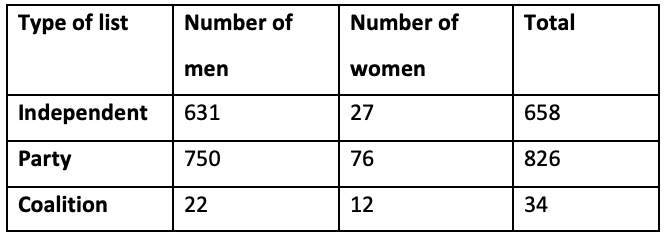
In this context, a study entitled “Tunisian Women’s Participation in Political Life and Voting” was published by the Arab Forum for Citizenship during the transitional period in September 2014. It states that out of the 1,518 electoral lists of the October 23, 2011 elections, only 115 had a woman at the head of the list—a mere 7% of the total number—and no political party actually committed to ensuring gender balance among the heads of lists except for the Democratic Modernist Pole (now the Social Democratic Path), which had 16 women and 17 men heading electoral lists. This is shown in the following table, extracted from the study:
This study also points out that the outcome of the October 2023 elections fell short of expectations of women’s representation, with only 60 women (27.69%) winning a seat in the Constituent Assembly. This number grew to 65 (29.95%) after 5 deputies who had been assigned roles in the presidency and the government backed out. This was out of a total of 217 members representing the deputies of the Constituent Assembly. The elected female deputies were distributed according to party affiliation at the time, as shown in the following table:

Despite the legal incentives approved by the electoral decree of 2011, other obstacles hindered women’s access to the public sphere, according to the above study. The most important of these obstacles is the country’s dominant conservative and patriarchal mentality and the traditional distribution of the population between urban and rural areas, as well as the control the Islamic Ennahda Movement has over coastal and industrial cities with considerable demographics like the coastal governorates and the city of Sfax. The latter was swept by the Islamic party, which may explain the failure to achieve acceptable female representation.

“Women don’t evade the public sphere, but they do prefer not to expose themselves to violence”

A study entitled “Exploring Women’s Participation in Political Life in Tunisia With a Focus on the 2019 Elections” published by the Carter Center states that “The results of the 2019 parliamentary elections highlighted the inadequacies of the gender parity provision as a guarantee of women’s representation.”

This study finds that existing parity provisions require vertical parity—alternation between genders for the heads of electoral lists—but they do not require horizontal parity, i.e. an equal number of women and men at the top of the lists. As a result, only 14% of these lists were headed by women in 2019, which is a minor increase from 11% in 2014 and 7% in 2011.

Because of the large number of political parties that operate in Tunisia and the list-based system adopted, there is significant emphasis on list order. This has led to a low number of female-headed lists, rendering women’s representation dependent on parties winning more than one seat per constituency.

Sana Adouni

Sana Adouni

Sana is a Tunisian journalist and political science researcher who majored in public and political communications from the Political Institute in Tunis. She has published tens of articles about women’s and human rights, corruption and social justice, and has experience drafting policy papers. Sana won the “Bachira Murad” prize organized by the “Friedrich Naumann” foundation and the “African Training Center for Journalists and Communications Professionals” for her article on corruption in Tunisia, and the “Lina Ben Mhenni” prize by the European Union for her article investigating the restriction of the right of single Tunisian women to freeze their eggs. Through her work, Sana is invested in defending women’s rights, gender equality, and social justice.

Related posts

“Palestinian Women,” the revived history of women militants for the liberation of Palestine
In-depth

“Palestinian Women,” the revived history of women militants for the liberation of Palestine

by Nathalie Galesne
6 February 2024
854

The documentary by Lebanese director Jocelyne Saab, screened at the 27/20 Festival in Tunis, shook the public. What do these...

Croatia: Men Kneeling in Main Squares for Women’s Chastity
In-depth

Croatia: Men Kneeling in Main Squares for Women’s Chastity

by Snježana Pavić
25 September 2023
771

On the first Saturday of every month, groups of men kneel in the main squares of many cities across Croatia...

Single moms in Lebanon: We fight alone

Single moms in Lebanon: We fight alone

8 June 2021
653
Tunisia: 10 years after 14 January 2011, women are still in Revolution

Tunisia: 10 years after 14 January 2011, women are still in Revolution

10 May 2021
562

Leave a Reply Cancel reply

Your email address will not be published. Required fields are marked *

J'accepte les termes et conditions et la Politique de confidentialité .

Medfeminiswiya

Medfeminiswiya is a feminist network that brings together women journalists working in the fields of media and content production in the Mediterranean region.

Newsletter


    Follow us

    Browse topics


    • In-depth
    • Files
    • Features
    • On the move
    • Portraits
    • Opinion

    • Creations
    • Visual Arts
    • Reviews
    • Multimedia
    • Country Context
    • Blogs
    • About us
    • Our community
    • Our partners
    • Become a member
    • Editorial charter
    • Disclaimer

    © 2025 Medfeminiswiya - Mediterranean Network for Feminist Information

    • it VO
    • fr Français
    • en English
    • ar العربية
    • In-depth
    • On the move
    • Portraits
    • Creations
    • Opinion
    • Multimedia
    • Country context
    • Blogs
    No Result
    View All Result

    © 2025 Medfeminiswiya - Mediterranean Network for Feminist Information

    Welcome Back!

    Login to your account below

    Forgotten Password?

    Retrieve your password

    Please enter your username or email address to reset your password.

    Log In

    Add New Playlist

    Ce site n'utilise pas de cookies. This website does not use cookies. هذا الموقع لا يستخدم ملفات تعريف الارتباط.