• it VO
  • fr Français
  • en English
  • ar العربية
About us
  • In-depth
    • All
    • Features
    • Files
    • World
    Morocco: 600 abortions a day—Alarming figures and tragic stories

    Morocco: 600 abortions a day—Alarming figures and tragic stories

    In Spain, the right to abortion is not guaranteed for all

    In Spain, the right to abortion is not guaranteed for all

    Invisible and vulnerable: Migrant women at the frontlines of Spain’s prostitution debate

    Invisible and vulnerable: Migrant women at the frontlines of Spain’s prostitution debate

    Serbia: Is contraception a luxury or a basic human right?

    Serbia: Is contraception a luxury or a basic human right?

    Rebels, witnesses, victims: Women against the mafia (3/3)

    Rebels, witnesses, victims: Women against the mafia (3/3)

    Trending Tags

    • Women artists
    • Ecofeminism
    • Women living from and on the streets
    • Women and bodies
    • Women and sports
    • Women and cinema
    • Ramadan series
    • Women and war
    • Women Living at the Margins
    • Press Freedom from the Perspective of Women Journalists
    • Period poverty
    • Gynecological violence
    • Women and prison
    • Safe spaces
    • Abortion and SRHR
    • Transgenderism
    • Women in rural areas
  • On the move
    Spain: CEAR and the fight against human trafficking

    Spain: CEAR and the fight against human trafficking

    Gaza: How many journalists must be killed for the world to react?

    Gaza: How many journalists must be killed for the world to react?

    Moroccan activist Ibtissam Lachgar held in solitary confinement, health in crisis

    Moroccan activist Ibtissam Lachgar held in solitary confinement, health in crisis

    Three women for one man’s pay: The plight of female agricultural workers in Egypt

    Three women for one man’s pay: The plight of female agricultural workers in Egypt

  • Portraits
    Sophie Bessis: “The battle for the intimate will be long, especially in the Global South!”

    Sophie Bessis: “The battle for the intimate will be long, especially in the Global South!”

    “Mom, Dad, Can We Talk About Privacy?”—A Tunisian children’s book on protecting kids from sexual violence

    “Mom, Dad, Can We Talk About Privacy?”—A Tunisian children’s book on protecting kids from sexual violence

    Kurdish journalist killed in Turkish drone strike in northeastern Syria

    Kurdish journalist killed in Turkish drone strike in northeastern Syria

    A Filmmaker’s Journey: Inside the Creative World of Margarita Bareikyte

    A Filmmaker’s Journey: Inside the Creative World of Margarita Bareikyte

  • Creations
    • All
    • Reviews
    • Visual Arts
    “La Malédiction (1)”, a theatrical adaptation of King Kong Theory bursting with Tunisian rage

    “La Malédiction (1)”, a theatrical adaptation of King Kong Theory bursting with Tunisian rage

    “Mom, Dad, Can We Talk About Privacy?”—A Tunisian children’s book on protecting kids from sexual violence

    “Mom, Dad, Can We Talk About Privacy?”—A Tunisian children’s book on protecting kids from sexual violence

    The El’Sardines series, a delicate feminist manifesto centered around an ecological mystery

    The El’Sardines series, a delicate feminist manifesto centered around an ecological mystery

    Atlantics, a film by Mati Diop: Filming the embodied resistance of spirits

    Atlantics, a film by Mati Diop: Filming the embodied resistance of spirits

  • Opinion
    Women in Gaza are living their worst nightmares - “ I want to go back to my life before the war, to my privacy, my home ”

    Women in Gaza are living their worst nightmares - “ I want to go back to my life before the war, to my privacy, my home ”

    Messages from life under bombardment—Can a mother cope with losing her six children at once? (10)

    Messages from life under bombardment—Can a mother cope with losing her six children at once? (10)

    Messages from life under bombardment—No cake for my children on their birthdays (9)

    Messages from life under bombardment—No cake for my children on their birthdays (9)

    Messages from life under bombardment – No food or water in Gaza (8)

    Messages from life under bombardment – No food or water in Gaza (8)

  • Multimedia
    "I hope it doesn’t go viral: Journalism and sexist attacks in digital age". A video investigation by Çiçek Tahaoğlu

    "I hope it doesn’t go viral: Journalism and sexist attacks in digital age". A video investigation by Çiçek Tahaoğlu

    Period poverty in Montenegro

    Period poverty in Montenegro

    Period poverty in France (1)

    Period poverty in France (1)

    Period Poverty in Italy

    Period Poverty in Italy

  • Country context
No Result
View All Result
BLOGS
Medfeminiswiya
  • In-depth
    • All
    • Features
    • Files
    • World
    Morocco: 600 abortions a day—Alarming figures and tragic stories

    Morocco: 600 abortions a day—Alarming figures and tragic stories

    In Spain, the right to abortion is not guaranteed for all

    In Spain, the right to abortion is not guaranteed for all

    Invisible and vulnerable: Migrant women at the frontlines of Spain’s prostitution debate

    Invisible and vulnerable: Migrant women at the frontlines of Spain’s prostitution debate

    Serbia: Is contraception a luxury or a basic human right?

    Serbia: Is contraception a luxury or a basic human right?

    Rebels, witnesses, victims: Women against the mafia (3/3)

    Rebels, witnesses, victims: Women against the mafia (3/3)

    Trending Tags

    • Women artists
    • Ecofeminism
    • Women living from and on the streets
    • Women and bodies
    • Women and sports
    • Women and cinema
    • Ramadan series
    • Women and war
    • Women Living at the Margins
    • Press Freedom from the Perspective of Women Journalists
    • Period poverty
    • Gynecological violence
    • Women and prison
    • Safe spaces
    • Abortion and SRHR
    • Transgenderism
    • Women in rural areas
  • On the move
    Spain: CEAR and the fight against human trafficking

    Spain: CEAR and the fight against human trafficking

    Gaza: How many journalists must be killed for the world to react?

    Gaza: How many journalists must be killed for the world to react?

    Moroccan activist Ibtissam Lachgar held in solitary confinement, health in crisis

    Moroccan activist Ibtissam Lachgar held in solitary confinement, health in crisis

    Three women for one man’s pay: The plight of female agricultural workers in Egypt

    Three women for one man’s pay: The plight of female agricultural workers in Egypt

  • Portraits
    Sophie Bessis: “The battle for the intimate will be long, especially in the Global South!”

    Sophie Bessis: “The battle for the intimate will be long, especially in the Global South!”

    “Mom, Dad, Can We Talk About Privacy?”—A Tunisian children’s book on protecting kids from sexual violence

    “Mom, Dad, Can We Talk About Privacy?”—A Tunisian children’s book on protecting kids from sexual violence

    Kurdish journalist killed in Turkish drone strike in northeastern Syria

    Kurdish journalist killed in Turkish drone strike in northeastern Syria

    A Filmmaker’s Journey: Inside the Creative World of Margarita Bareikyte

    A Filmmaker’s Journey: Inside the Creative World of Margarita Bareikyte

  • Creations
    • All
    • Reviews
    • Visual Arts
    “La Malédiction (1)”, a theatrical adaptation of King Kong Theory bursting with Tunisian rage

    “La Malédiction (1)”, a theatrical adaptation of King Kong Theory bursting with Tunisian rage

    “Mom, Dad, Can We Talk About Privacy?”—A Tunisian children’s book on protecting kids from sexual violence

    “Mom, Dad, Can We Talk About Privacy?”—A Tunisian children’s book on protecting kids from sexual violence

    The El’Sardines series, a delicate feminist manifesto centered around an ecological mystery

    The El’Sardines series, a delicate feminist manifesto centered around an ecological mystery

    Atlantics, a film by Mati Diop: Filming the embodied resistance of spirits

    Atlantics, a film by Mati Diop: Filming the embodied resistance of spirits

  • Opinion
    Women in Gaza are living their worst nightmares - “ I want to go back to my life before the war, to my privacy, my home ”

    Women in Gaza are living their worst nightmares - “ I want to go back to my life before the war, to my privacy, my home ”

    Messages from life under bombardment—Can a mother cope with losing her six children at once? (10)

    Messages from life under bombardment—Can a mother cope with losing her six children at once? (10)

    Messages from life under bombardment—No cake for my children on their birthdays (9)

    Messages from life under bombardment—No cake for my children on their birthdays (9)

    Messages from life under bombardment – No food or water in Gaza (8)

    Messages from life under bombardment – No food or water in Gaza (8)

  • Multimedia
    "I hope it doesn’t go viral: Journalism and sexist attacks in digital age". A video investigation by Çiçek Tahaoğlu

    "I hope it doesn’t go viral: Journalism and sexist attacks in digital age". A video investigation by Çiçek Tahaoğlu

    Period poverty in Montenegro

    Period poverty in Montenegro

    Period poverty in France (1)

    Period poverty in France (1)

    Period Poverty in Italy

    Period Poverty in Italy

  • Country context
About us
Medfeminiswiya
About us

Tunisia: 10 years after 14 January 2011, women are still in Revolution

For the past ten years, the struggle of Tunisian women has been incessantly making small steps towards greater equality. Boosted by the breath of a new Constitution and the expectations of women towards the acquisition of more rights and freedoms, the struggle is far from over.

Olfa Belhassine by Olfa Belhassine
10 May 2021
in Features, In-depth
111 1
0
Share on FacebookShare on Twitter

This post is also available in: Français (French) العربية (Arabic)

As from the outbreak of the Revolution in Sidi Bouzid on 17 December 2010 following the self-immolation of Mohamed Bouazizi, a young street vendor, bloggers such as Lina Ben Mhenni -who passed away at the age of 34 on 26 January 2020- Emna Ben Jomaâ, Amira Yahiaoui and Fatma Arabica have played a key role in the circulation of information on social networks about police repression against pacifist demonstrators. Despite police controls, courage, rage and determination have animated several other cyber-dissidents.

On 14 January 2011, women of all ages and professions took to the streets in Bourghiba Avenue in downtown Tunis to chant slogans claiming equality, freedom and dignity.

Protests, demands and achievements: a quick overview

A few days later, and in the wake of marches that swept over a city liberated from the yoke of dictator Ben Ali, exiled in Saudi Arabia, Tunisian women of the left-wing feminist movement demonstrated to demand total gender equality. On 19 February that year, another protest was organized. Women joined in mass. What they chanted then, in the wake of the slogans in force, goes beyond the outright feminist demand: “Secularism first! Secularism as a precondition for democracy and equality”, they shouted.

On 13 August 2012 -on this celebration day for Tunisian women coinciding with the promulgation of their Personal Status Code- another strong moment mobilized thousands of women and dozens of civil society groups. It was indeed a day of great anger: the Islamist party Ennahdha wanted to introduce an Article on the “complementarity” between men and women, which would replace the principle of gender equality in the new constitution being drafted.

“Taken aback by the strong mobilisation against this draft Article, the Islamist deputies are astonished and denounce a misunderstanding, disinformation and an unjustified political and media conspiracy.” The Article was removed from this first version of the Constitution. Female Islamist deputies defended it all the way. The atmosphere of the first three years following the 14 January events was marked by political and identity polarisation due to the governance of the Troika led by the Islamists. This has created an enabling environment for Tunisian women whose achievements were threatened, to struggle in public with all their strength to protect their rights and freedoms.
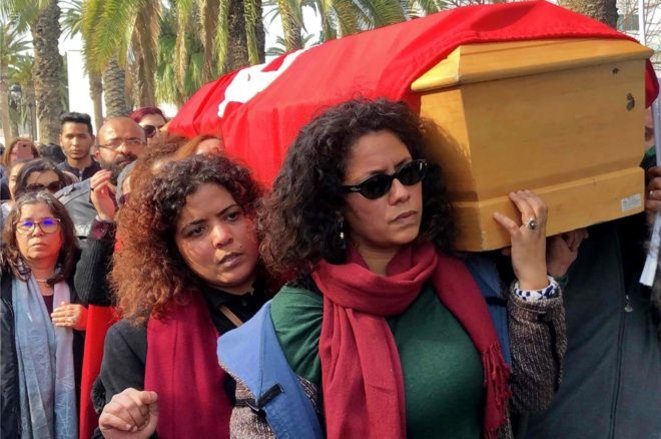
Funeral of blogger and activist Lina Ben Mhenni: the coffin carried on the shoulders of women.

On 27 January 2014, when the new Constitution was adopted, parity was enshrined in Article 46 of the Basic Law. Accompanying the country’s political transition process, this opportunity could open the doors for women, even if in the 2019 parliament there were less female representatives compared to the previous session.

Two battles opened over the past five years. The first one concerns the struggle against violence against women and the second one, that is even more difficult, is for equality of inheritance.

Tunisia, the first Arab country to adopt a law protecting women from violence

On 26 July 2017, the Tunisian Parliament adopted the Organic Law on the Elimination of Violence Against Women. This was the result of a long struggle initiated by the feminists of the autonomous movement more than twenty years ago. The Law was supported and defended by civil society all the way, including the Association tunisienne des femmes démocrates (ATFD) [1], which in 1993 opened a counselling centre for women victims of assault. This new legislation is indeed an application of the Constitution, particularly Article 46 that states: “The State must take all necessary measures to eradicate violence against women.”

Several jurists believe that the importance of this text lies, on the one hand in the fact that it incorporates the international criteria and instruments in the struggle against violence against women; and on the other hand, it is also based on the four pillars of the combat against this scourge: prevention, protection of victims, care for abused women and repression of violence perpetrators. The text incriminates the aggressor, protects the victims, restores them and makes the State responsible for their care (accommodation, care, legal and psychological support). It also repeals an “Article of Shame”, the 227 bis of the Penal code that provides for the dropping of legal proceedings against the perpetrator of an alleged sexual act without violence with a minor under the age of 15 of he marries his victim.

The Law increases the penalties for various forms of violence when committed within the family. It also penalises sexual harassment in public spaces, the employment of young girls as domestic workers and provides for fines for employers who intentionally discriminate against women in terms of salary. It stipulates that special units must be set up within the police force, and that there must be a special judge in charge of matters of violence. Henceforth, in courts, independent spaces will be set up to accommodate victims of all types of attacks. Tunisia is the only Arab country to pass a law on the elimination of violence against women.

Bill on inheritance equality: awaiting adoption

In continuation of this momentum towards total equality between men and women enshrined in the Constitution, on 13 August 2017, in his speech on the occasion of the Tunisian Women’s Day, President Béji Caied Essebsi launches a debate on equality in inheritance. Indeed, despite all their conquests and advances, Tunisian women still inherit half of the share of men.

“We cannot treat women as in 1956, sixty years ago. In reality, women have become equal to men. However, the whole problem is related to inheritance. Yet, inheritance is not a religious issue in its essence. This is an issue regarding everyday life and the relationships between human beings. Anyway, this is what I believe…” stated BCE in a long speech.

He revived the debate on the taboo subject of inheritance equality between women and men and announced the setting up of a commission to develop the Code of Individual Freedoms and Equality. On 13 August, the President also set up a Commission for Individual Freedoms and Equality responsible for considering, among other things, a bill relating to the abolition of inheritance inequality between men and women.

In reality, it was the Tunisian feminists of the years 1980 to 2000 who tried to defend this claim. Nevertheless, it was above all, the post revolutionary period, which, with the freedom of expression, allowed this claim to be addressed in debates and forums. In June 2016, the deputy Mehdi Ben Gharbia, submitted to Parliament, an Organic Law relating to the “determination of inheritance shares between the beneficiaries”, according to an optional regime making equality between men and women, a default rule. However, the mufti of the Republic, the highest religious authority, opposed this initiative.

The initiative of ECB together with his proposal to repeal Circular 73 that prohibits marriage between a Tunisian woman and a non-Muslim man (while the opposite is possible) also rapidly provoked widespread controversy. Always passionate, the debate travelled beyond Tunisian borders and spread across the Arab region.

On 12 June 2018, the Commission for Individual Freedoms and Equality published its report. BCE was inspired by this report and on 13 August 2018, proposed a bill establishing inheritance equality by default. “We will reverse the situation,” stated the President, making equality the rule and inequality a derogation.

Adopted by the Council of Ministers in November 2018, the bill was subsequently presented in the Assemblée des représentants du Peuple (ARP)[2]. In the meantime, the Nida Tounes Movement, which could carry the presidential initiative and defend it, fragmented widely.

BCE died on 25 July 2019 and a Parliament with a conservative majority was set up in autumn 2019. The equality project is waiting for better days to return to the ARP discussion table.
[1] Tunisian Association of Democratic Women
[2] Assembly of People's Representatives
Olfa Belhassine

Olfa Belhassine

Olfa Belhassine is a Tunisian journalist who worked with the Tunisian daily “La Presse” since 1990. After the 2011 protests, her articles started appearing in “Libération”, “Le Monde” and “Courrier International”, a testament to her extensive experience as a journalist reporting from Tunisia during President Ben Ali's rule and after his fall. In 2013, Olfa was awarded the first journalism prize of the “Center of Arab Women” for her investigative work on customary marriage in Tunisia, published in “La Presse.” Olfa has also been corresponding since 2015 for the JusticeInfo.net, a website specializing in transitional justice around the world. Olfa Belhassone and Hedia Barkat have published a book titled 'Ces nouveaux mots qui font la Tunisie' (These new words that make Tunisia), providing an in-depth exploration of the political transition in Tunisia after the revolution.

Related posts

“Palestinian Women,” the revived history of women militants for the liberation of Palestine
In-depth

“Palestinian Women,” the revived history of women militants for the liberation of Palestine

by Nathalie Galesne
6 February 2024
844

The documentary by Lebanese director Jocelyne Saab, screened at the 27/20 Festival in Tunis, shook the public. What do these...

Croatia: Men Kneeling in Main Squares for Women’s Chastity
In-depth

Croatia: Men Kneeling in Main Squares for Women’s Chastity

by Snježana Pavić
25 September 2023
765

On the first Saturday of every month, groups of men kneel in the main squares of many cities across Croatia...

Single moms in Lebanon: We fight alone

Single moms in Lebanon: We fight alone

8 June 2021
652
Tunisia: 10 years after 14 January 2011, women are still in Revolution

Tunisia: 10 years after 14 January 2011, women are still in Revolution

10 May 2021
562

Leave a Reply Cancel reply

Your email address will not be published. Required fields are marked *

J'accepte les termes et conditions et la Politique de confidentialité .

Medfeminiswiya

Medfeminiswiya is a feminist network that brings together women journalists working in the fields of media and content production in the Mediterranean region.

Newsletter


    Follow us

    Browse topics


    • In-depth
    • Files
    • Features
    • On the move
    • Portraits
    • Opinion

    • Creations
    • Visual Arts
    • Reviews
    • Multimedia
    • Country Context
    • Blogs
    • About us
    • Our community
    • Our partners
    • Become a member
    • Editorial charter
    • Disclaimer

    © 2025 Medfeminiswiya - Mediterranean Network for Feminist Information

    • it VO
    • fr Français
    • en English
    • ar العربية
    • In-depth
    • On the move
    • Portraits
    • Creations
    • Opinion
    • Multimedia
    • Country context
    • Blogs
    No Result
    View All Result

    © 2025 Medfeminiswiya - Mediterranean Network for Feminist Information

    Welcome Back!

    Login to your account below

    Forgotten Password?

    Retrieve your password

    Please enter your username or email address to reset your password.

    Log In

    Add New Playlist

    Ce site n'utilise pas de cookies. This website does not use cookies. هذا الموقع لا يستخدم ملفات تعريف الارتباط.