About us
  • it VO
  • fr Français
  • en English
  • ar العربية
No Result
View All Result
Medfeminiswiya - Mediterranean feminist media
  • On the move
  • In-depth
  • Files
  • Artistic Creations
  • Interviews
  • Opinions
  • World
Medfeminiswiya - Mediterranean feminist media
  • On the move
  • In-depth
  • Files
  • Artistic Creations
  • Interviews
  • Opinions
  • World
No Result
View All Result
Medfeminiswiya - Mediterranean feminist media
Home Country Context

Feminism in Lebanon: a brief overview

Maya El Ammarby Maya El Ammar
23 April 2021
Feminism in Lebanon: a brief overview

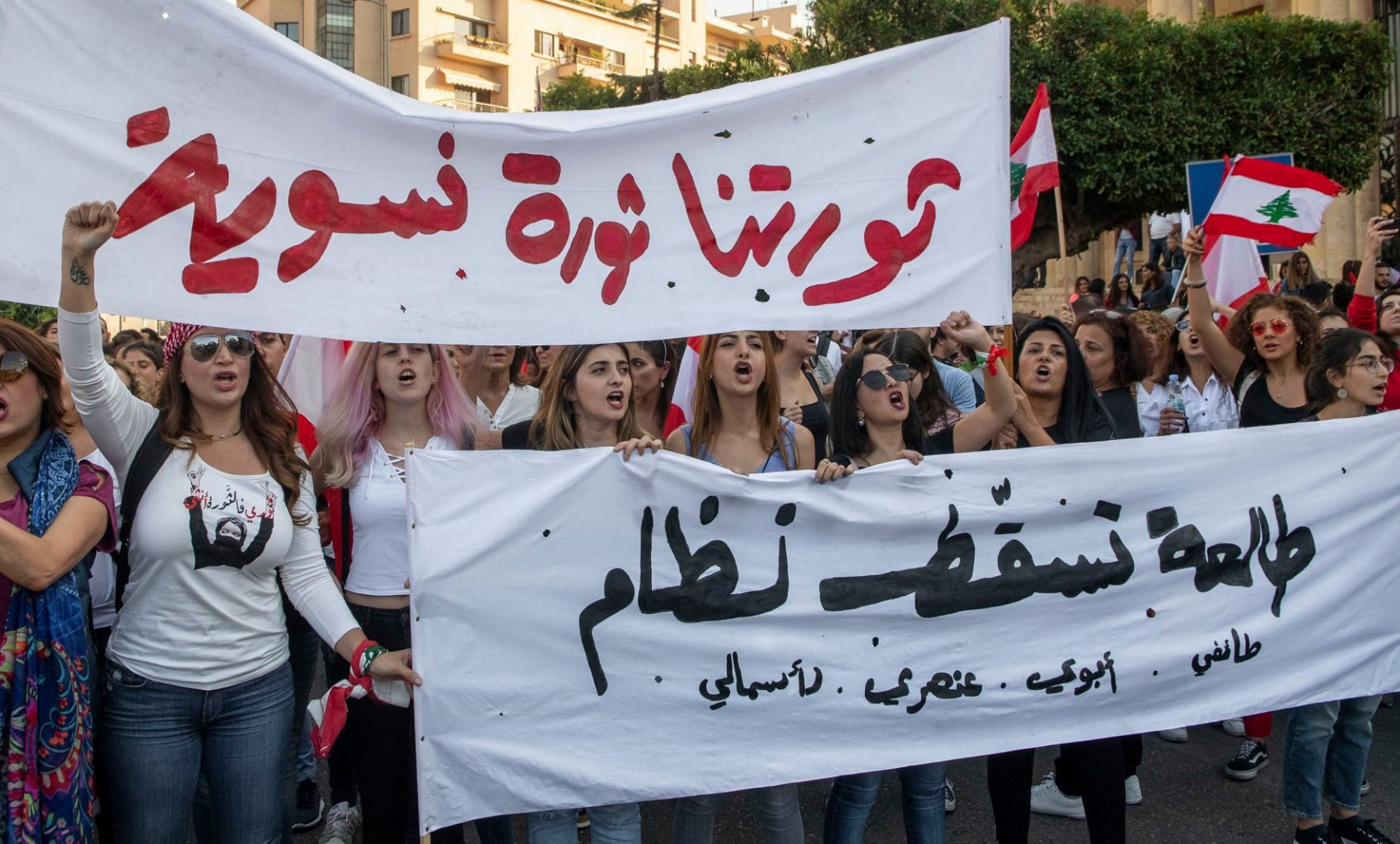
In Lebanon, unlike most Arab countries, the state follows no religion. While equality between citizens is a principle enshrined in the constitution, it is not reflected in many of the legislations, measures and practices impacting different aspects of citizens’ lives, especially the personal status sectarian laws which govern most personal family affairs in the country.

This post is also available in: Français (French) العربية (Arabic)

Women’s political representation in Lebanon 

Lebanon was the first country in the region to grant women the rights to vote and run for political candidacy in 1952. But after more than half a century of this progress, the Lebanese state is now in the lowest ranks of international indexes for women’s political participation. Following 6 May, 2018, which marks the date of the last round of parliamentary elections, the number of women in parliament increased from 4 to 6 out of a total number of 128 members of parliament. Furthermore, women do not make up more than 10 percent of the highest ranks of government administrations. In 2016, only one female minister was appointed out of 30 government ministers. The number of women ministers increased to six in 2020, one of the toughest and most ruthless years for both the Lebanese and non-Lebanese people residing in Lebanon, especially after the Beirut Port explosion on August 4, which only added insult to the injury caused by the financial collapse and the COVID-19 pandemic that were already underway.

The feminist movement in Lebanon

In comparison to many women in neighbouring countries, it can be said that women in Lebanon enjoy a considerable margin of freedom in terms of education, work, movement, socializing, entertainment and dress. The Lebanese state ratified the Convention for the Elimination of All Forms of Discrimination against Women (CEDAW) in 1997, while maintaining reservations on articles 9(2), 16(1), and 29(1).

Article 562 of the Penal Code, related to the so-called honour crimes, was cancelled in 2011, and the anti-human trafficking law was approved the same year, followed by the family violence law in 2014 –important amendments were introduced to this law in 2020. The Lebanese parliament also voted, for the first time ever, on a law criminalizing sexual harassment in 2020. With that being said, all of these laws that Lebanese women have long fought for, are marred by loopholes and gaps.

Forms of discrimination against women

In addition to the campaigns calling for amending newly approved and old laws or repealing them altogether to come up with a more equitable and just legal system that offers protection to the most vulnerable groups, the feminist struggle continues to raise its voice against the denial of women of their right to pass on their citizenship to their children and partners. This denial is attributable to a patriarchal law that dates back to 1925, one year before the announcement of the Lebanese Republic.

Feminist activists are also still fighting against sexual violence and the criminalization of women in prostitution and of LGBTQ+ individuals, still prosecuted by Lebanese law.

Furthermore, the exploitation of female domestic work has persisted in Lebanon for decades, with thousands of South Asian and African migrant workers still being employed as domestic household workers without the most basic legal protection while working under extremely difficult circumstances that are rooted in the kafala (sponsorship) system, which can only be described as a slavery system entrapping many migrant workers in the country. It is worth noting that the number of domestic workers has significantly dropped with the financial and economic collapse engulfing Lebanon in late 2019 and with the COVID-19 pandemic in 2020. Some of these women left the homes of their employers or were laid off, and some returned to their home countries. In this same year, many women lost their jobs and began facing the burden of childcare and household work, which are often treated as women’s responsibility. Despite that, the state did not offer any kind of welfare to them or their families.

One of the biggest priorities of non-governmental organizations and feminist groups today is the urgent need for approving a consolidated civil and personal status law based on the principles of equality and justice between marriage partners and the best interest of children, one that would replace the 15 sectarian and confessional laws, the majority of which discriminate against and between women, treat them as lesser human beings, deny them of their rights to a free and non-early marriage, safe separation, child custody, joint custody, independence and other pressing issues.

Maya El Ammar

Maya El Ammar

Maya El Ammar is one of the co-founders of MedFemiNiswiya. From January 2021 until January 2024, she edited both the Arabic and English versions of the platform. She remains an active member of the network, a feminist writer, an activist in Lebanon, and a communications professional who has led nationwide feminist media campaigns on issues related to family violence, child marriage, personal status laws and the kafala system, among other topics. She currently contributes to various independent media outlets as a journalist and translator. She produces short videos and podcasts covering a range of feminist issues, alongside her job as a media strategist for a non-profit organization. Maya also has experience training civil society organizations and young activists in the fields of gender and media. She has a BA in journalism and an MA in communication studies.

Leave a Reply Cancel reply

Your email address will not be published. Required fields are marked *

J'accepte les termes et conditions et la Politique de confidentialité .

Related articles

Related posts

Gaza’s Women and Girls are running out of time
Palestine

Gaza’s Women and Girls are running out of time

by Contributor with Medfeminiswiya
11 April 2025

Related posts

Mosa'ab Elshamy AP
Country Context

Feminism in Morocco: a brief overview

by Lina M.
10 April 2026

JOIN OUR NEWSLETTER

Original content. Feminist journalism. Straight to your inbox.

    Related posts

    Mosa'ab Elshamy AP
    Country Context

    Feminism in Morocco: a brief overview

    by Lina M.
    10 April 2026

    Related posts

    Feminism in Algeria: a brief overview
    Country Context

    Feminism in Algeria: a brief overview

    by Ghania Khelifi
    7 April 2026

    Popular articles

    Thirty and single… so what?
    On the move

    Thirty and single… so what?

    by Pascale Sawma
    17 February 2026
    All We Imagine as Light : three intertwined female stories
    Artistic Creations

    All We Imagine as Light : three intertwined female stories

    by Rabab El Mouadden
    9 May 2025
    Israel to Palestinian journalists: Be silent… or else!
    In-depth

    Israel to Palestinian journalists: Be silent… or else!

    by Alaa Murrar
    29 November 2023
    On the move
    In-depth
    Files
    Artistic Creations
    Interviews
    Opinions
    World
    On the move
    In-depth
    Files
    Artistic Creations
    Interviews
    Opinions
    World

    Medfeminiswiya is a feminist network that brings together women journalists working in the fields of media and content production in the Mediterranean region.

    • About us
    • Country Context
    • Our community
    • Become a member
    • Our partners
    • Editorial charter
    • Disclaimer

    Follow us :

    JOIN OUR NEWSLETTER

    Original content. Feminist journalism. Straight to your inbox.

      © 2026 Medfeminiswiya – Mediterranean Network for Feminist Information

      Back to top

      Welcome Back!

      Login to your account below

      Forgotten Password?

      Retrieve your password

      Please enter your username or email address to reset your password.

      Log In

      Add New Playlist

      No Result
      View All Result
      • On the move
      • In-depth
      • Files
      • Artistic Creations
      • Interviews
      • Opinions
      • World
      • it VO
      • fr Français
      • en English
      • ar العربية

      © 2026 Medfeminiswiya - Mediterranean Network for Feminist Information

      Ce site n'utilise pas de cookies. This website does not use cookies. هذا الموقع لا يستخدم ملفات تعريف الارتباط.