About us
  • it VO
  • fr Français
  • en English
  • ar العربية
No Result
View All Result
Medfeminiswiya - Mediterranean feminist media
  • On the move
  • In-depth
  • Files
  • Artistic Creations
  • Interviews
  • Opinion
  • World
Medfeminiswiya - Mediterranean feminist media
  • On the move
  • In-depth
  • Files
  • Artistic Creations
  • Interviews
  • Opinion
  • World
No Result
View All Result
Medfeminiswiya - Mediterranean feminist media
Home In-depth

“We’re afraid to protest, but that’s exactly why we have to show up”: Young women protestors speak out in France

Rania Hadjerby Rania Hadjer
13 November 2026
“We’re afraid to protest, but that’s exactly why we have to show up”: Young women protestors speak out in France

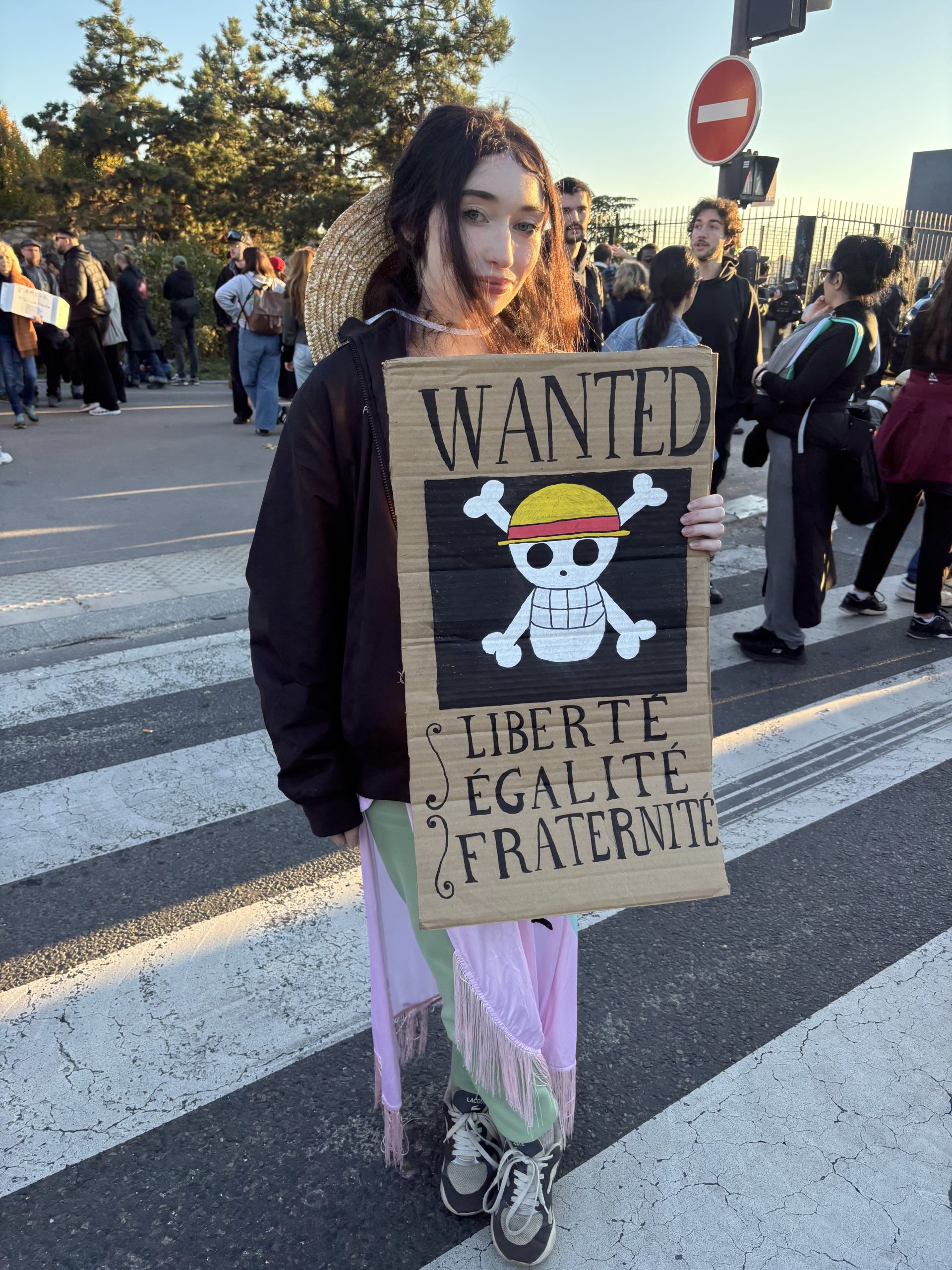
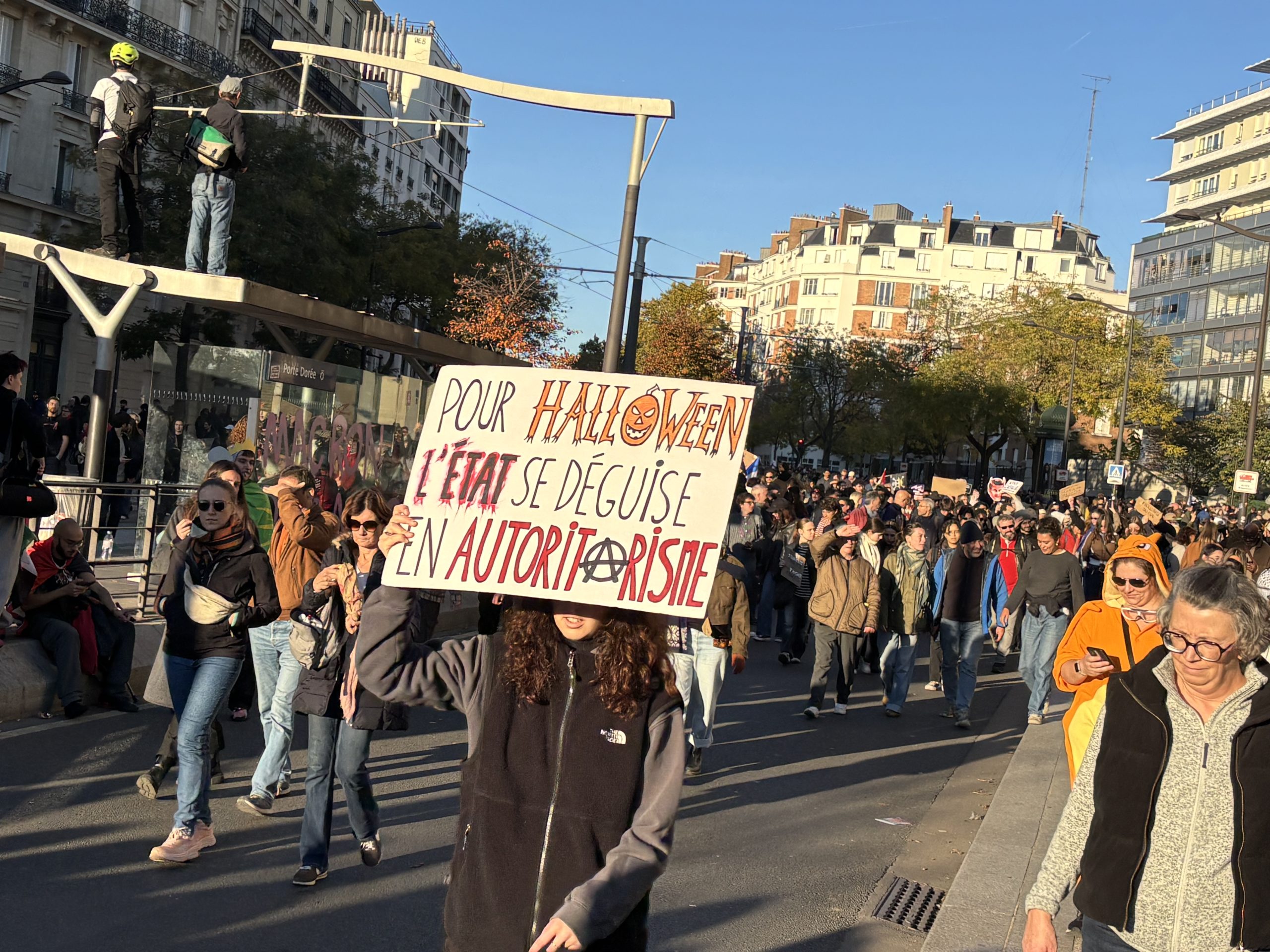
October 31, 2026. Paris. © Rania Hadjer

Since September, France has been swept by a protest movement of unprecedented scale, sparked by high school students mobilizing against deteriorating learning conditions. Beginning with high school blockades, the movement has gradually expanded into weekly demonstrations joined by Yellow Vest protestors, workers, and trade unions. On October 31, we followed a demonstration in Paris, from La Défense station to Porte de Charenton. Along the march, university and high school students spoke about their political engagement, their fears, and their refusal to give up their right to protest.

Cette publication est également disponible en : Français (French) العربية (Arabic)
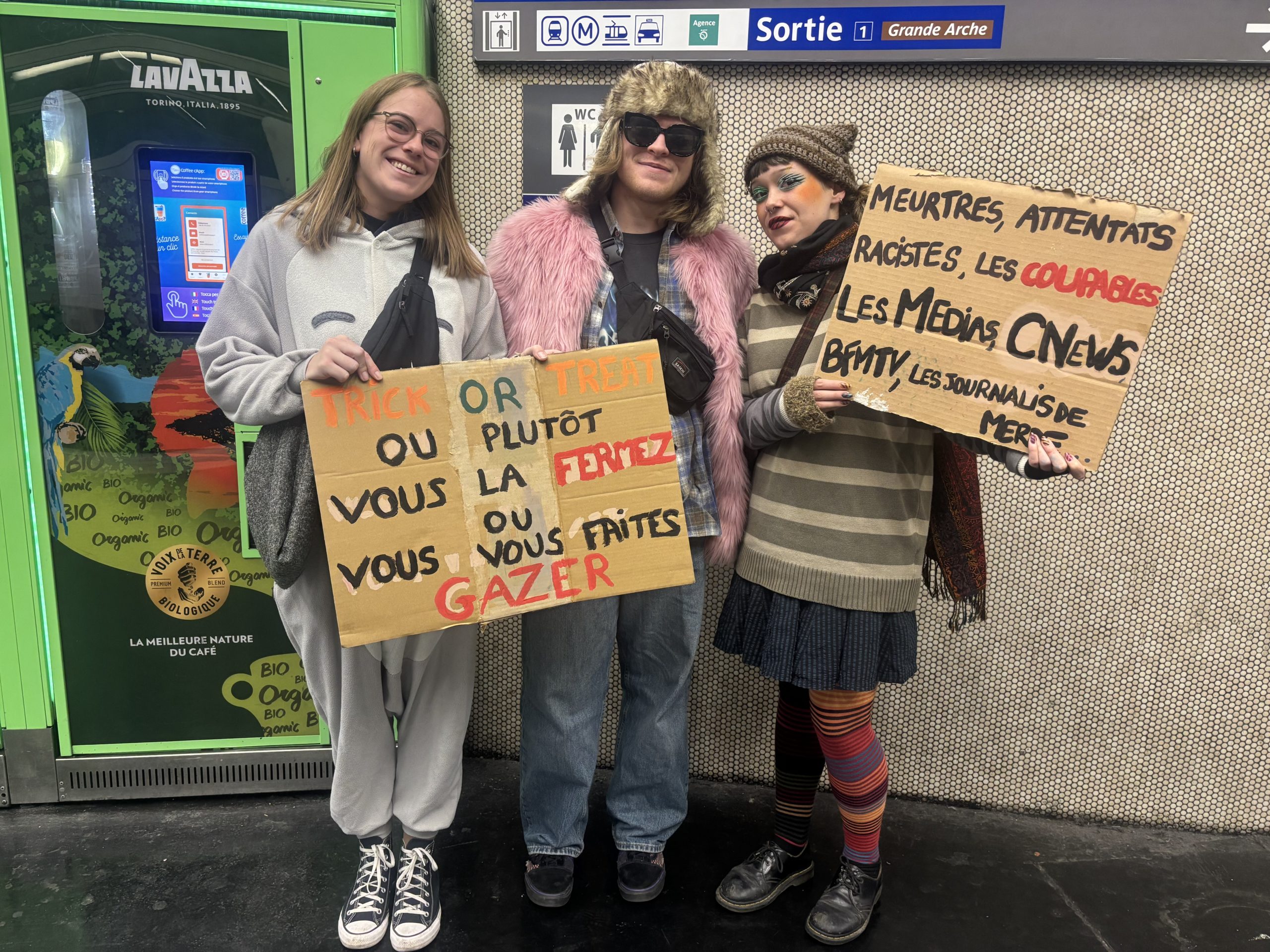
On Saturday, October 31, the day of Halloween, protest signs mingle with costumes, as some students have chosen to combine political demands with festive attire. Despite the tensions with police that have marked previous days of mobilization, large numbers of protestors have once again turned out to make their voices heard: 70,000 according to the Paris police prefecture, and 200,000 according to trade unions and student organizations.

Adèle, 22, a master’s student in occupational psychology, has been protesting since October 17. Her involvement is part of a broader context of economic precarity, which extends to her own professional field. Resources are scarce, she explains, particularly in disability services and access to healthcare: “The high school students’ movement has my full solidarity. These days, everyone struggles to put food in the fridge by the end of the month.”

Beside her is Inès, soon to turn 25, who recently graduated in occupational psychology and is currently looking for work. This is her first time attending a demonstration. Although she has previously participated in student mobilizations, taking to the streets marks a new stage in her political engagement.

“It’s becoming increasingly difficult to find work. But beyond that, there’s a general sense of frustration. Taking to the streets to make our voices heard has become a necessity. Remaining silent today is a political choice, and I don’t want to be part of that choice.”

© Rania Hadjer

The two young women share the same outrage at police repression and the way the protests are portrayed in the media. In their view, clashes and property damage receive disproportionate coverage, overshadowing the protestors’ demands. “We feel like we have no value,” they say, arguing that this portrayal only fuels tensions.

Inès stresses the need to acknowledge and compensate victims of police violence: 215 students had been injured as of October 5, according to the French Ministry of National Education. “We’re calling for a genuinely transparent investigation into the young people who have been maimed by grenades and projectiles fired from less-lethal launchers (LBDs).”

Yet fear does not seem to have persuaded them to stay off the streets. Protestors now attend demonstrations in groups to ensure that no one is left isolated in the event of police intervention. “If something happens to one of us, the others will be there to do whatever is necessary,” Adèle explains. “Protesting is a right, and we will continue to exercise it despite the repression and the climate of fear that is taking hold.”

A right to protest under increasing restrictions

As we make our way back toward the starting point of the march at Porte de Bagnolet, we meet Tess, 22, an engineering student. This is the first time she has participated in a movement of this scale, and she says she feels a certain pride in being there. “It’s important to show up, given all the restrictions being imposed on us to obstruct our right to freedom of expression. I’m here above all to support the younger generation. We need to make our rights heard.”

Her concerns center on the changing nature of protest policing and the growing priority given to protecting property over people. “I encourage everyone reading this publication to look into the movements and protests that took place before the 2000s. It will help them understand the direction our country is taking. In the past, the priority was protecting protestors rather than street furniture and property. That says a lot about the consequences of capitalism.”

On October 8, the independent news outlet Mediapart documented the confiscation of protest signs during a high school student demonstration in Paris. Several police officers had inspected and screened slogans, particularly those deemed “anti-police” or “anti-state.” Some protestors were consequently prevented from marching with certain messages.

On October 31, even the route of the Paris demonstration became the subject of an administrative and legal battle. While the organizing groups had wanted to march between Bastille and Nation, the police prefecture imposed an alternative route, from Porte de Bagnolet to Porte de Charenton. Following an initial appeal before the administrative court, the Council of State ultimately reinstated the route imposed by the authorities.

For Lucie, 33, a young working woman we meet in the middle of the march, these developments are part of an even more worrying political climate. “It’s terrifying! We’re taking a pretty extreme authoritarian and racist turn. In the wake of the racist crime in Trappes [editor’s note: October 23], it’s all the more important for us to be here at this demonstration. We’re afraid to protest, but that’s exactly why we have to show up.”

This fear runs through all the conversations we are having. But it does not necessarily mean giving up. On the contrary, it sometimes becomes one more reason to take to the streets.

“We’re afraid to protest, but that’s exactly why we have to show up.”

“Our ancestors stood up for our future”

© Rania Hadjer

When we arrive at Porte de Charenton, at the end of the march route, police officers are standing in columns near the exits. One passage remains open toward Liberté metro station.

We meet a 28-year-old student who has come to defend students’ learning conditions and support the mobilized high school students. For her, student precarity has become an increasingly unavoidable reality: finding housing, buying food, and financing an education are turning into a growing obstacle course. Part-time jobs, often essential for survival, are difficult to balance with university workloads. Financial assistance remains inadequate, and families are not always in a position to provide support.

At 28, she is still pursuing her master’s degree after being forced to interrupt her studies during the COVID-19 lockdown. Without internet access, she had been unable to continue her coursework as usual. When she tried to resume her studies, the Parcoursup admissions platform did not allow her to return to her original program. “It’s unfair. I just want to be able to finish my studies under decent conditions. That’s why I’m here,” she explains. When asked whether financial difficulties were the reason she had no internet access, she silently nods.

She is also there to show solidarity with high school students injured by the police. In her view, the violence could have been avoided if the protestors’ demands had been heard from the very beginning.

She admits having hesitated to attend the demonstration for fear of clashes with the police. “I thought about 1789, 1936, 1964, and all the women’s and feminist protests, particularly those for the right to vote. None of them happened without a struggle. Rights had to be fought for. If our ancestors stood up for our future, then it’s also our duty to do the same for the generations that come after us.”
5 PM: Tear gas engulfs the march

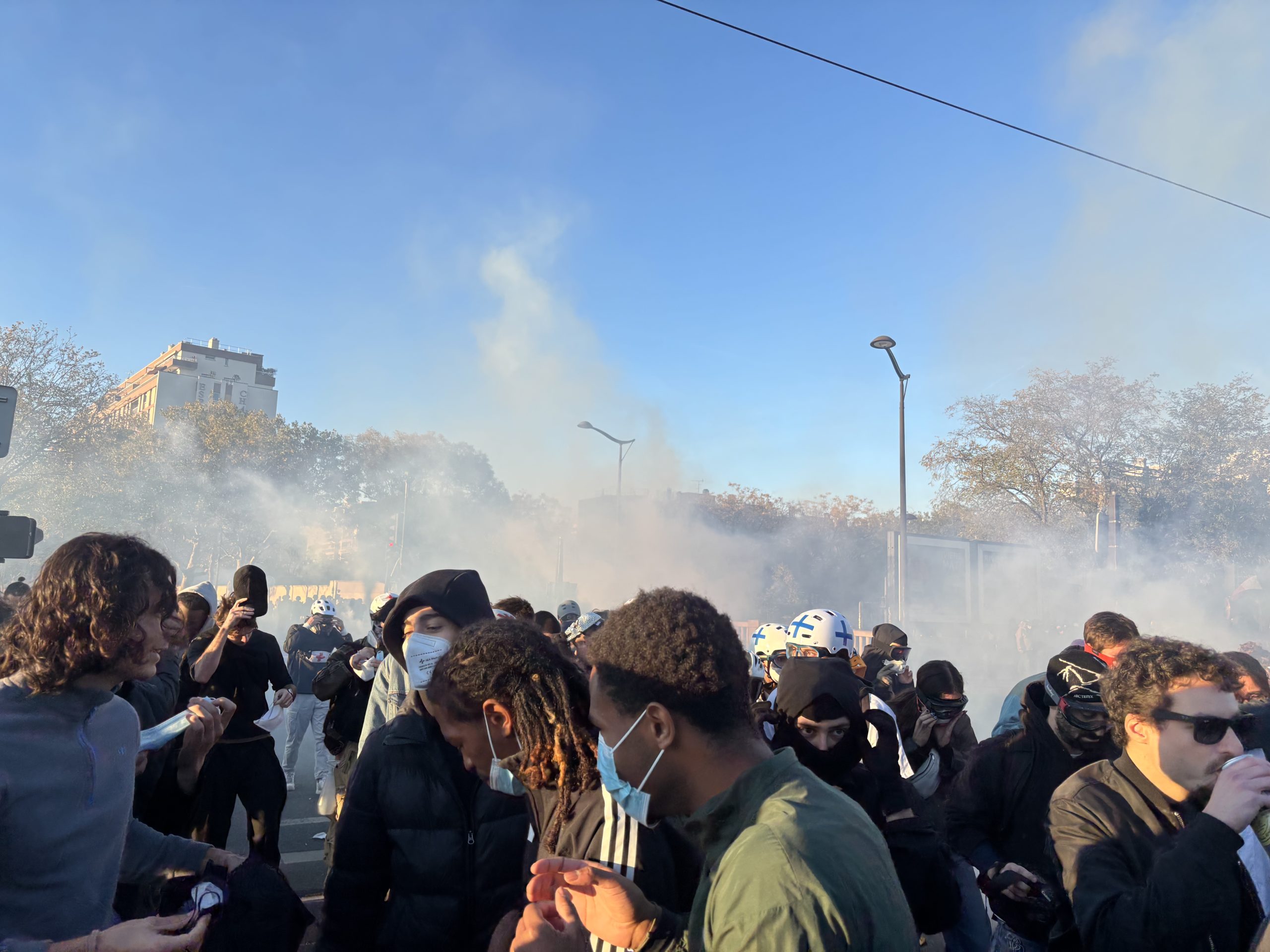
Until now, the demonstration has remained entirely peaceful. At around 5 PM, white smoke rises a few meters away. The crowd begins to surge. Tear gas has just been fired.

The cloud reaches us. Our eyes burn, and so do our throats. Protestors try to escape toward areas where the air is still breathable. Some take out saline solution to rinse their eyes, sharing it with those who have none.

A group of young people, angered by the tear gas, boo the police and throw projectiles. Police officers charge. Within minutes, the atmosphere changes dramatically. Smoke fills the area, and the sound of exploding firework mortars and crowd-control grenades rings out. Police call for evacuation over loudspeakers. A narrow passage is left open to reach Liberté metro station.

Protestors are also instructed to leave their signs at the foot of a tree. The explanation given at the scene is that this is intended to prevent spontaneous gatherings from forming elsewhere.

A few meters from the metro entrance, we meet a group of four high school students who have just witnessed these events.

In their view, demonstrations now end according to a predictable script: groups are surrounded, protestors are arrested, and crowds are dispersed with tear gas. “We’ve understood perfectly well that the goal is to frighten people and discourage them from coming to future demonstrations,” explain Giulia, Sonia, Selena, Maya, and Milan.

Maya and Giulia, however, are careful to point out that their experience does not reflect that of all high school students. “We’re white, and we attend high schools within Paris itself. We’re privileged compared with students in the suburbs, where conditions are catastrophic.”

Their observation draws attention to the inequalities underlying the mobilization. School facilities, family resources, and exposure to violence are not the same for all young people.

© Rania Hadjer

The toll on the body

For these high school students, repression does not end when they leave the march. Giulia, 16, describes the anxiety attacks that now accompany her participation in demonstrations. “All it takes is for a police officer to approach me, even outside a demonstration, for my heart to start racing and for me to begin trembling. I even have nightmares about it. Unfortunately, repression through fear is starting to work.”

She, too, admits having hesitated to attend the October 31 demonstration. She recalls having already been exposed to tear gas during high school blockades, sometimes without understanding what justified its use. But this anxiety has also strengthened her determination. “It’s not normal to be afraid to come out and speak up for your rights.”

Maya comes from a politically active family. She first encountered demonstrations at the age of ten, when she accompanied her parents to a protest by healthcare workers. Yet even within her family, which is accustomed to social movements, there is a sense that the violence is intensifying.

This violence also has a less visible dimension: its effects on the body and reproductive health. For several years, women have reported menstrual disturbances after exposure to tear gas. Early periods, unusual bleeding, and severe cramps have been reported in several countries, but these symptoms remain insufficiently documented by scientific research.

In France, the issue resurfaced during the October 2026 mobilizations. The collective Lacrymos de sang (Bloody Tear Gas), founded on October 8, collected more than 8,000 testimonies from people reporting menstrual disturbances following exposure to tear gas.

At Porte de Charenton, the demonstration ends amid tear gas, police charges, and orders to evacuate. Protest signs have been abandoned, groups dispersed, and access points controlled by the police. Yet the testimonies gathered throughout the day tell a story that goes beyond a succession of confrontations. From the age of 16 to 33, protesting remains, for all these young women, a way of claiming their place in public space and making their political voices heard. It is a freedom that, with each passing week, they feel is becoming increasingly difficult to exercise.


This article was produced with the support of OROF (Our Rights Our Future).

Rania Hadjer

Rania Hadjer

Rania Hadjer is a committed Algerian journalist and author. She has collaborated with media outlets such as HuffPost Maghreb, El Watan, Mondafrique, and Twala.info. In 2023, she co-wrote the novel Hirak. Revolution, Love and Couscous (L’Harmattan Publishing). In November 2024, she won the TANDEM Media Award in the Art category, alongside Lina Meskine, for their article “In the Maghreb, Culture Reclaims Public Space,” published on Medfeminiswiya.In July 2023, she achieved a new milestone in her career by publishing her first novel, co-authored with K. Smaili, titled "Hirak: Revolution, Love, and Couscous." The book was published by L'Harmattan.

Leave a Reply Cancel reply

Your email address will not be published. Required fields are marked *

J'accepte les termes et conditions et la Politique de confidentialité .

Related articles

Related posts

Between longing and reality: Why are Syrian women in Türkiye delaying their return home?
In-depth

Between longing and reality: Why are Syrian women in Türkiye delaying their return home?

by Mayson Mohammad
12 October 2026
Enforced disappearances: A struggle led primarily by women
In-depth

Enforced disappearances: A struggle led primarily by women

by Contributor with Medfeminiswiya
16 September 2026
From her parents’ home to her husband’s – and back again: Divorced women and housing in Algeria
In-depth

From her parents’ home to her husband’s – and back again: Divorced women and housing in Algeria

by Leila Zaimi
10 September 2026
Syria: How Alawite women rebuilt their worlds inside their homes and through their phones
Files

Syria: How Alawite women rebuilt their worlds inside their homes and through their phones

by Sara Khazem
15 July 2026

JOIN OUR NEWSLETTER

Original content. Feminist journalism. Straight to your inbox.

    Popular articles

    Thirty and single… so what?
    On the move

    Thirty and single… so what?

    by Pascale Sawma
    1 March 2022
    Israel to Palestinian journalists: Be silent… or else!
    In-depth

    Israel to Palestinian journalists: Be silent… or else!

    by Alaa Murrar
    29 November 2023
    Giving birth with an open womb or when Caesarean section becomes the norm in Egypt
    Abortion and SRHR

    Giving birth with an open womb or when Caesarean section becomes the norm in Egypt

    by Contributor with Medfeminiswiya
    27 September 2021
    On the move
    In-depth
    Files
    Artistic Creations
    Interviews
    Opinions
    World
    On the move
    In-depth
    Files
    Artistic Creations
    Interviews
    Opinions
    World

    Medfeminiswiya is a feminist network that brings together women journalists working in the fields of media and content production in the Mediterranean region.

    • About us
    • Country context
    • Our community
    • Become a member
    • Our partners
    • Editorial charter
    • Disclaimer

    Follow us :

    JOIN OUR NEWSLETTER

    Original content. Feminist journalism. Straight to your inbox.

      © 2026 Medfeminiswiya – Mediterranean Network for Feminist Information

      Back to top

      Welcome Back!

      Login to your account below

      Forgotten Password?

      Retrieve your password

      Please enter your username or email address to reset your password.

      Log In

      Add New Playlist

      No Result
      View All Result
      • On the move
      • In-depth
      • Files
      • Artistic Creations
      • Interviews
      • Opinion
      • World
      • it VO
      • fr Français
      • en English
      • ar العربية

      © 2026 Medfeminiswiya - Mediterranean Network for Feminist Information

      Ce site n'utilise pas de cookies. This website does not use cookies. هذا الموقع لا يستخدم ملفات تعريف الارتباط.