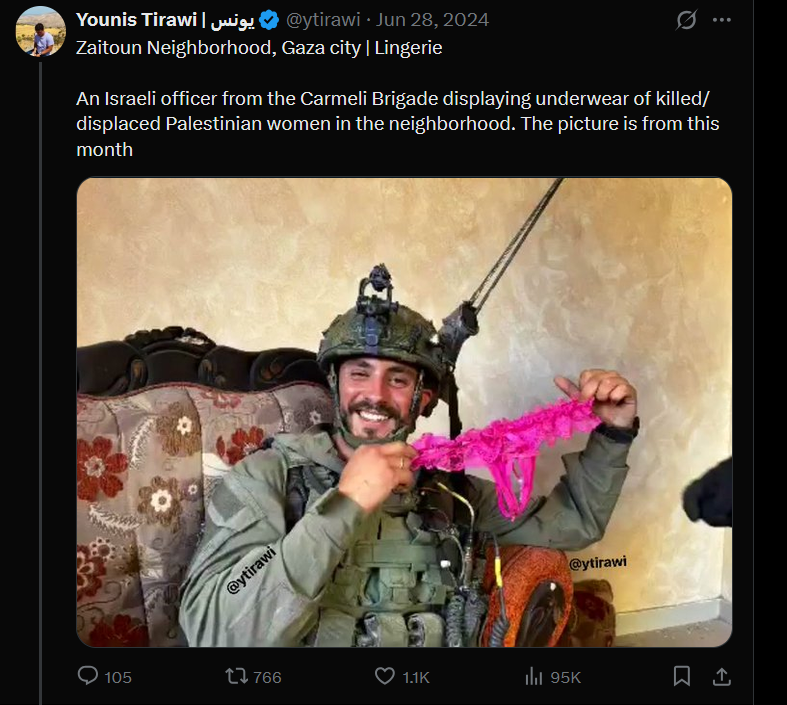
It is not uncommon for Zionist soldiers to share images of themselves online, posing in front of the destruction they have caused. Such images, which have proliferated since the genocide in Gaza, serve both to intimidate Palestinians and generate momentum for Zionist ideology on social media. One specific trend showcases the intertwining of Israel’s patriarchal oppression and colonialism: male IOF soldiers displaying and wearing underwear they stole from Palestinian women.
These posts often include captions containing racist hate speech, slut-shaming Palestinian women whom Israel has displaced and possibly killed, while mocking their intimate belongings in their pillaged homes.
Sexual violence, dispossession, and digital intimidation
A central aspect of this behavior is the double violation of privacy and intimacy: first, through the intrusion into private spaces, and second, through sexual intimidation.
Sexual intimidation and rape as weapons of genocide are defining features of Israel’s colonization, as they are of other colonial regimes. Israel’s colonization of Palestinians is often described through the word dispossession. This perpetual dispossession encompasses culture, identity, and land, and extends even deeper into sexual sovereignty and bodily autonomy.
In Israel, one of the most militarized countries in the world, the use of sexual violence as a military weapon of intimidation is both a violent reality and a widely studied phenomenon.
Sexualized imagery as colonial violence
Beyond the immediate violence visible in these kinds of underwear posts, there are also visible elements of Islamophobia, as the sexual shaming in the captions is directed against Muslim women.
In her PhD thesis, feminist researcher Kathryn Medien analyzes a popular 2014 post widely shared in Jewish Israeli media. The illustration exemplifies the use of sexual assault imagery as a driving force for military attacks. It depicts a Muslim woman with the word “Gaza” written on her chest, wearing a niqab and an abaya covering only her upper body, her legs bare and her feet in red stilettos, in a sexualized pose. The Hebrew text reads: “Bibi, finish inside this time! Signed, citizens in favor of a ground assault.” This refers to Israel’s “invasion and bombing of Gaza” in 2014. The word “assault” carries two meanings here: the invasion of the land and the attack on a Muslim woman’s body.
Digital violence thus appears as a staple of Israeli colonialism. It takes many forms, including surveillance, the erasure of Palestinian expression and, as in this case, intimidation.
Alongside images of soldiers posing amid the destruction they have caused, other common practices include photographing kidnapped Palestinians; filming themselves pillaging houses, killing, and/or inflicting violence; and, more broadly, boasting about the atrocities they have committed, turning them into a “public spectacle.”
“Digital war trophies” and the normalization of violence
A report published by 7amleh – The Arab Center for the Advancement of Social Media in April 2026, titled Visual Violence as a Tool of Humiliation and Domination over Palestinian Youth, documents this use of visual violence. It uses the expression “digital war trophies” to describe such imagery and emphasizes that this is systemic behavior, ingrained in Israel’s political strategy, rather than a series of isolated cases. Further illustrating the systematic nature of this behavior, IOF troops have replicated it in Lebanon.
In an interview with Medfeminiswiya, Ahmad Qadi, researcher and documentation manager at 7amleh, identifies normalization as the first function of this behavior: “This type of violence – occupation and destruction, humiliation and gender humiliation of Palestinians, is turned into entertainment once it’s posted or intended to be posted on social media platforms.” This, he adds, “normalizes this type of violence.”
Such behavior in a colonial context is also intended to instill fear. As Qadi explains, “[…] the message is to deter Palestinians when they see soldiers entering their houses and doing these shameful acts of gender violence. Also, again, the context here matters because we’re talking about genocide.”
Qadi also discusses the position of power occupied by IOF soldiers within Israeli society. “The Israeli soldiers are powerful actors who can enter any space and desecrate the most intimate and the most secret and, let’s say, safest places. They are the ones who are powerful. They control everything in Gaza, and they even turn this type of content into entertainment. So there is a kind of internal message to the Israeli community.” He adds, “Internally, it’s propaganda.”
“Again, the context here matters because we’re talking about genocide.”
From social media trend to disappearing evidence
Perhaps because of the backlash this trend has received, we are seeing less of this specific content. This does not mean that the behavior has stopped, or even that it is no longer being shown online, but that it is being posted less frequently on public profiles.
Some users who previously participated in this trend have now made their social media accounts private or deleted the content. Yet other content, including images of soldiers posing in invaded homes, displaying military weapons and using racist speech, remains widely available. This demonstrates the impunity IOF soldiers enjoy and the importance of such content in sustaining Zionist ideology.
Nonetheless, journalists and researchers have archived the posts. Among the most prominent is Younis Tirawi, whose documentation is widely available on social media platforms such as X and helps counter Israel’s denial of these practices.
Another possible explanation for the reduced visibility of this content is that, for the Israeli army, it is simply another trend: something that becomes popular for a time before something new comes along to take its place.
Qadi draws a comparison with an earlier trend involving a popular Israeli children’s song. “Before that, there was a trend at the beginning of the war, where the Israeli soldiers were also posting content from Gaza, […] destroyed buildings, destroyed rooms, and with that type of song. So that song was a trend at the beginning. Then we turn to this type of trend, with posing in women’s underwear, for example.”
He adds, “It was a trend, a social media trend. War criminals are doing a genocide in Gaza, and they have these types of trends.”
Social media platforms’ complicity in this digital violence is also crucial. Palestinian content is suppressed on Meta’s platforms.
From social media trend to disappearing evidence
Social media platforms’ complicity in this digital violence is also crucial. Palestinian content is suppressed on Meta’s platforms, as documented in 7amleh’s report The Platformicide of Palestine. Yet, when it comes to Israeli content, Qadi says, “the systems do not detect this type of clear and blatant gender violation.”
This digital violence also warrants examination alongside one of the most common forms of Zionist propaganda: the presentation of Israel as a feminist safe haven, as seen, for example, on the official IOF account on X. This image is typically constructed through anti-Palestinian rhetoric and, more broadly, anti-Arab and Islamophobic talking points, seeking to justify occupation through the claim that it will “bring women’s rights” to the countries being colonized. Like Israel’s pinkwashing, this is used to make Israel more appealing to Western liberalism.