Cette publication est également disponible en : Français (French) العربية (Arabic)
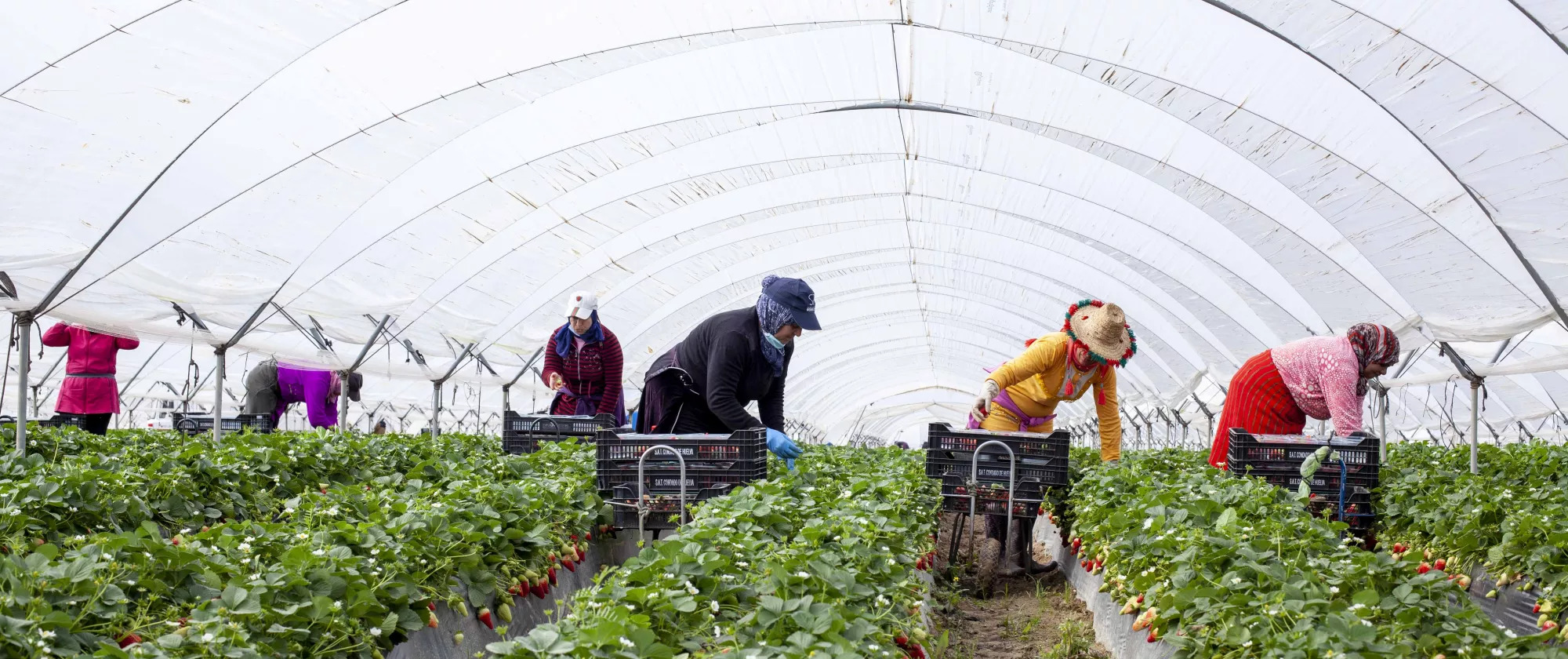
Cover image: Moroccan female agricultural workers in a strawberry field on the outskirts of Huelva, Spain © International Labour Organization (ILO)
Maryam, 40, never imagined she would one day become a business owner in her small village of Sidi el-Yamani in northern Morocco. As an agricultural worker, she lived solely off the income from her seasonal work in southern Spain during the strawberry harvest. At the end of her contract, she’d return to subsist on her savings, with no other source of income.
Maryam is one of the beneficiaries of GECCO (Collective Management of Hiring in the Country of Origin), the circular migration agreement between Morocco and Spain which allows temporary workers to work legally in Spain while enjoying the same rights as Spanish workers, such as contracts, wages, and social security. This is done through collective tenders from farm owners in response to the growing demand for labor, particularly in the agricultural sector.
This bilateral agreement began in July 2001, bringing several thousand female seasonal workers to the fields of Huelva for the red fruit harvest. By 2024, this number would have gradually increased to 18,000, with additional female workers required depending on the size of the crop each year.
Under this agreement, female workers are recruited to Spain on a seasonal basis for no more than nine months of the year, after which they return to their home countries. The program, implemented through official institutions, targets rural women with agricultural experience who are aged between 25 and 40 and who meet other social conditions.
The work of these seasonal migrant women in strawberry fields has long been associated with harsh working conditions, long hours, and overcrowded housing. There have been cases of exploitation and sexual assault against women who were unable to report them for fear of retaliation and job loss, according to several journalistic investigations and human rights reports.
The program aims to empower female seasonal workers in Spain and train them to launch income-generating initiatives by providing them with technical and financial support.
Empowering female seasonal strawberry workers
An International Organization for Migration (IOM) study revealed that approximately 15,000 seasonal female workers migrate to Spain annually to work during the harvest season on contracts lasting from three to six months and which do not exceed a maximum duration of nine months. The study also revealed that more than 83% of these women financially support their families in Morocco after their stay in Spain ends. Half of the workers earn between €1,000 and €1,500 per month, and 95% are satisfied with their salaries.
According to the same study, the majority of female seasonal workers return to Morocco with varying amounts estimated at €2,500 or more, and 97% of beneficiaries feel more confident and empowered from a professional perspective.
With this in mind, the WAFIRA program was launched in March 2022—a joint project of the International Labour Organization (ILO) and Moroccan and Spanish authorities, co-funded by the European Union—to empower female seasonal workers with entrepreneurship training and leverage the positive impact of circular migration and labor mobility on social and economic development in Morocco.

The program aims to empower female seasonal workers in Spain and train them to launch income-generating initiatives by providing them with technical and financial support. The goal is to improve their economic situation and contribute to the social and economic development of their communities after their seasonal work contracts in the Spanish fields of Huelva come to an end.
“We found that Moroccan female seasonal migrants, who constitute the vast majority of the agricultural labor force in the Huelva region, live in extremely precarious conditions. Upon their return to Morocco, they often find themselves in difficult economic, social, and institutional situations, lacking sustainable integration prospects,” says Jeanne Schmitt, Project Manager of ILO WAFIRA at the Morocco Office, about the reasons behind launching the WAFIRA program.
“Faced with this situation, we had to consider a realistic alternative by focusing on their economic and social empowerment. This approach is in line with the organization’s goal of establishing a more just, inclusive, and respectful circular migration model for fundamental rights,” she adds.
In its first edition, the program raised awareness among 600 rural women before their departure to Spain. 287 of them were selected to participate in the training program alongside their work in strawberry and red fruit harvesting, and 231 of these women benefited from full support. 209 workers were ultimately able to implement their projects on the ground in two regions of Morocco: Rabat-Salé-Kénitra and Tangier-Tetouan-Al Hoceima, in diverse fields such as agriculture, food industries, textiles, and livestock breeding.
From seasonal workers to entrepreneurs
Maryam was among the lucky ones who benefited from a series of training workshops on business management, financial education, marketing and sales, savings, sustainable agriculture, and personal development. Videos, podcasts, and educational and entertainment tools were produced, and the training and support program was developed from scratch to suit the target group, the majority of whom were illiterate women living in remote areas.
As such, Maryam launched her own rabbit-breeding project, which she personally supervises while in Morocco, until her return to Spain. “I always dreamed of becoming financially independent and a business owner,” she says. “This training changed my life for the better, and other women in the village are also aspiring to launch their own projects.”
Maryam and other female seasonal workers received €2,500 and were able to register with the National Social Security Fund as self-employed entrepreneurs, which allowed them to benefit from social coverage which was previously beyond the reach of many of them. They were also able to start their own income-generating activities through a seed fund, without resorting to bank loans which are often inappropriate or difficult for them to access.
“The most significant impact this program has had,” Jeanne Schmitt believes, “is the profound transformation these women have experienced, from self-confidence and independence in decision-making to pride in contributing to the family income. These are true signs of the program’s impact on their lives. They now view the future differently, and some have expressed, for the first time, that they have a newfound purpose in their lives.”
The goal of WAFIRA is to make migration a choice, not a necessity, by empowering female agricultural workers and supporting them as they launch their own businesses.
Migration: By choice, not necessity
To improve their working conditions, the Spanish government decided this year to amend some of the terms of permanent and intermittent employment contracts for female seasonal workers. This includes the possibility of obtaining a renewable four-year residency permit instead of having to go through visa applications every year—applications which seasonal workers pay for out of their own pocket.
Still, the goal of WAFIRA is to make migration a choice, not a necessity, by empowering female agricultural workers and supporting them as they launch their own businesses. Naima al-Omari, the national coordinator of the WAFIRA project, says, “We want to create a real economic alternative for women when they are in Morocco, both for those who will return to Spain next season and those who may not be recruited again.”
The success of WAFIRA will prompt the governments of both countries to launch its second edition, expanding the beneficiary base. “This year, we will work to increase the number of beneficiaries to 3,000, including male seasonal workers in French fields, specifically in Corsica and the Provence region,” al-Omari tells us.
“Priority will be given to women who have reached retirement age, and the cooperative model will be piloted alongside the self-employment system, with training courses tailored to suit the men who will be joining us for the first time,” she adds.
Only 300 beneficiaries are expected to receive financial support from the WAFIRA program fund, while the rest will receive the same training and education to become project holders and therefore benefit from other funding programs offered by national or regional official institutions under agreements.
“This year, Mauritania, Portugal, and Cape Verde will be involved with us in the various stages of implementing WAFIRA 2,” al-Omari explains. “They are interested in the cooperation model between Morocco and Spain and want to benefit from the GECCO and WAFIRA programs for future implementation.”
“Women launching income-generating activities in their local communities will allow them to have a sustainable source of income throughout the year and build a stable professional future in Morocco. Thus, migration will become a choice for them, not an economic necessity,” the ILO official concludes.