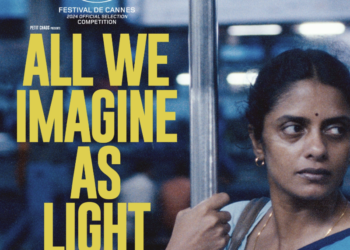

All We Imagine As Light (2024) is the most recent film of Payal Kapadia and narrates the story of Prabha (Kani Kusruti), Anu (Divya Prabha) and Parvati (Chhaya Kadam) working in a hospital in Mumbai. As the filmmaker herself has mentioned, her stories “deal with that which is not easily visible, hidden somewhere”. In the bustling and chaotic city of Mumbai, the focus is shed on the three protagonists dealing with universal but also specific to their context, concepts of alienation, conservatism and gentrification.
Prabha and Anu live together and work as nurses while Parvati is a widowed cook in the same hospital as the other two. Prabha had an arranged wedding and her husband is currently living in Germany. Their contact is rare, almost non-existent except for that one time her husband sent her a rice-cooker anonymously. She is always distant and reserved and never participates in the leisure activities the other nurses organise nor she accepts the connection she has with her colleague, Dr. Manoj (Azees Nedumangad). The first time she appears more expressive is when she passionately embraces the rice-cooker she seemingly received from her husband. Her timidness comes into contrast with the outgoingness and restlessness of her roommate. Anu is in love with her Muslim boyfriend Shiaz (Hridhu Haroon), given that she is coming from a Hindu background. Regardless of her parents’ persisting attempt to arrange a good suitor, Anu insistently follows her heart. The third woman is Prabha’s widow friend, Parvaty, who was evicted from the apartment she has been living in for years. The lack of any proof of ownership could not protect her from the developers’ threat aiming to replace her place with high-rise apartments. That leads her back to her countryside. In a moment of defiance and as an act of rebellion and with a hint of comicality, Parvati and Prabha throw stones at the developers billboard stating “Class is a privilege reserved for the privileged”.

A bright and tender film
Although all three stories are intertwined, for each one of them there is a prevalent axis. Prabha represents the alienation a person can experience in a metropolis like Mumbai. All of the characters come from somewhere else pursuing work and money. Throughout the film, there is an interesting contrast between the crowded full-of-light city life and the emotional isolation. It doesn’t matter how many people surround you, at the end you always feel alone. Drowning inside of her longing and pain, the quest for connection for Prabha seems unachievable. On the other hand, Anu deals with the conservatism and the patriarchal elements of her society. Her relationship with Shiaz is a topic of gossip among her colleagues who warn Prabha about her roommate’s immoral decisions. Along with that, she is also confronting her parents who keep sending her photos of men among whom she needs to choose in order to marry. Anu’s free-spirited strength reflects on the financial freedom and autonomy of the women that come to the big city to work and live. Finally, Parvati who is the eldest among the three, finds herself opposite to the changes of the city linked to its gentrification. These changes kick her out of her house and lead her to return to her place of origin.
A bright and tender film that resonates with a wide range of audience due to its universal themes but especially to the ones struggling with emotional isolation or displacement or even the ones seeking for connection and healing.
All We Imagine As Light is a critical response to the rapid socio-economic transformation in Mumbai at the expense of its working-class residents. At the same time, the film insinuates the love jihad conspiracy theory which is embraced by right-wing Hindu nationalists who see Muslim men as threats that forcefully marry or convert Hindu women, while at the same time ignores the women’s self-determination. Although Anu, Prabha, and Parvaty’s romantic and domestic struggles may seem intensely personal, they are inherently linked to the various ways that Indian women’s lives are politicized. Female intergenerational friendship appears to be a breath of fresh air in all situations personified as a coastal serene village towards the end of the film. There, all that they dream and imagine is closer to the light.

Following its victory among others (BAFTA, Golden Globe, Asia Pacific Screen etc.) at the Cannes Film Festival, where it became the first Indian film directed by a woman to be selected, All We Imagine As Light emerged as a strong candidate for an Oscar nomination in the foreign film category. However, despite several months of campaigning, it did not manage to get that spot.
A bright and tender film that resonates with a wide range of audience due to its universal themes but especially to the ones struggling with emotional isolation or displacement or even the ones seeking for connection and healing.