




Cette publication est également disponible en :
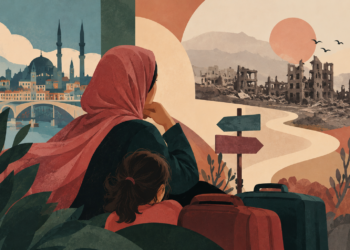
Italy, once famous for its waves of emigrants, has witnessed the tables turn in recent decades and become a popular destination for international migrants. Starting in the 1970s and continuing into the 1990s, the country saw a growing influx of people from all over the world. Today, about 8.7% of Italy’s population is made up of foreign nationals, showing just how much things have changed.
When people hear the word “migrant,” economic reasons usually come to mind. Italy has long been an attractive destination for people seeking better job opportunities thanks to relatively lenient immigration controls, a large informal economy, frequent amnesties for undocumented immigrants, and limited deportation enforcement. But not everyone comes just for a paycheck—some move for love, education, or other opportunities that Italy offers. By exploring the stories of three women who’ve made Italy their home, we get a glimpse into the ups and downs of being an immigrant in a country known for its culture but also for its bureaucracy, complex job market, and unique way of life.
Personal relationships

Evgeniya, 31, originally from Omsk, Russia, moved to Rome from Saint Petersburg, where she completed her bachelor’s and master’s degrees in History of Art. But it wasn’t her career that brought her to Italy. “I chose to prioritize my relationship over my career back then. My husband lives here in Rome,” she shares. “That is the only reason I moved.”
But after settling in Rome, she soon found that the Italian job market, especially in the arts, wasn’t as open as she had hoped. “I was pretty naive. I thought being a historian who speaks English and Russian would make me an attractive candidate for art galleries,” she says. “But the market is tough—and not just in Italy.” Without opportunities in the field, Evgeniya tried her luck elsewhere. “I printed my CV and went to different shops, but they never called me back.” Eventually, she was offered a waitressing job at a restaurant, leveraging her Russian skills to attract tourists. “I wanted to work, so I said yes.”
She soon discovered the challenges of Italy’s informal labor sector. “Of course I didn’t have a contract. No one wants to make a contract if they can avoid it. It was all cash-in-hand, but since it was temporary, it was ok.”
Over time, Evgeniya worked as a sales assistant, a freelance makeup artist for weddings and photoshoots, and, later, as an office worker. Yet each role brought its difficulties. “Contracts were ridiculous—two or three-week gigs—and the atmosphere was toxic. Overall, there is a lot of gossiping, passive-aggressiveness, and micromanaging. I enjoyed the makeup thing because I did not have to deal with any toxicity, but COVID put an end to it.” After navigating various jobs, she has finally found some stability as a wardrobe manager for Fendi. “It’s not my dream job, but I have a contract, good work-life balance, and a positive environment. Plus, the pay is good.”
Reflecting on her experience, she adds, “Italians are generally closed-minded, especially about foreigners. To land a job, you need to know the right people; it’s about contacts. The job market is tough, salaries are low, and the cost of living keeps rising.”
“To land a job, you need to know the right people; it’s about contacts. The job market is tough, salaries are low, and the cost of living keeps rising.”
Educational opportunities
Not all individuals who move to Italy face the same challenges. Although international students make up a small percentage of the total number of students in tertiary education in the country, there are some state-initiated transnational student mobility programs and scholarships foreign students can benefit from.
This is the case of Zahra [name changed for privacy], a 34-year-old architecture student from Arak, Iran, who came to Italy for educational opportunities she couldn’t access in her home country. Born to a Baha’i family, she explains, “As a Baha’i in a country with Islam as the official religion, my family and I face a lot of problems. Baha’is can’t attend official universities in Iran, so I earned my Bachelor of Architecture from the underground Baha’i Institute for Higher Education (BIHE).” Zahra hoped to pursue her master’s abroad, but her non-recognized BIHE degree posed a hurdle. “I applied to many universities, but I was rejected. Through one of my friends, I heard Italy accepted BIHE. Luckily, I found out that two universities in Italy—Pisa and Sapienza—accept BIHE degrees. So I applied at Sapienza for a master’s in restoration.”
Even after arriving in Rome, Zahra encountered bureaucratic challenges. “The university wanted to cancel my application because the Italian Embassy in Iran does not provide us with the standard DOV—Declaration of Value—like other students. But the Baha’i community in Rome intervened, and they finally accepted me.” Despite the initial hurdles, everything worked out well. “I got a regional scholarship, the Lazio Disco scholarship. I first heard about it in Iran through various immigration groups, mainly Iranian students who were studying in Italy or planning to go there. Over the past three years, my family has supported me financially, but the scholarship has been very helpful.”
Zahra’s future plans now include a PhD, but she remains cautious about the Italian labor market. “I wanted to work, but the salaries are low, and many offices only accept Italian-speaking applicants. I’ve been accepted into a PhD program at Sapienza University, so I’ll continue my education instead.”
Her experience sheds light on the limitations of the Italian job market, especially for foreigners. Highly stratified, it has a strong demand for low- and semi-skilled workers, confining mostly non-Western immigrants to lower-level jobs. This means they struggle to improve their socioeconomic status over time, even if they have good qualifications.
Another important factor is the language barrier Zahra mentions. Due to Italy’s short colonial history and limited immigration from former colonies, immigrants in Italy tend to face more language barriers compared to immigrants in other European countries.
In love with Italy

Nonetheless, some newcomers find that speaking multiple languages can be highly beneficial for their careers, allowing them to navigate diverse job markets more easily. This is the case for Karina, a 26-year-old from rural Transylvania, Romania.
With the benefit of EU mobility, Karina’s move to Italy was less about struggle and more about opportunity. After completing her acting studies in London, she spent a summer teaching English and acting in the north of Italy, which sparked her interest in living there. “I always loved Italy’s beauty,” she says. “After Verona, I decided to settle here.” Finding job opportunities as an English teacher, and later in tourism and marketing in Rome wasn’t too difficult for her. “In both fields, the English level has to be really good. So I haven’t really felt like my lack of knowledge of the Italian language has been an issue. Overall, I don’t think finding a job here is that hard. A good job, yes, but a paying job is fairly easy to find.”
Although Karina hasn’t encountered significant language barriers, she acknowledges the barriers foreigners might face, and shares Evgeniya’s opinion about the importance of networking. “The job market here is about who you know. A CV isn’t enough; you need connections.”
Karina also criticizes Italy’s notorious bureaucracy. “Getting any sort of documentation done here is a nightmare. And I don’t even need a visa, so I can’t even imagine what non-EU citizens go through.” She also points to the inefficiencies in public transport and the housing market. “Landlords don’t want to pay taxes, so getting a rental contract is a hassle. Buying an apartment in Rome is my next goal, but I know it’ll be tough.”
Despite these obstacles, Karina remains optimistic. “Rome has a way of just letting things happen naturally and slowly, in its own time. So I am learning that too.”
This investigation was carried out with the support of the AGEE – Alliance for Gender Equality in Europe.






Congratulations Tabata, your article is interesting and well written. You use three real people as examples for the problems faced by female immigrants. I share your assessment of the current situation for immigrants and foreigbers living in Italy.
You can see from the three fates that people are obviously leaving their home country without knowing the conditions in the country they want to move to. This says something about the fact that the pressure to leave one’s home country is possibly so great that one accepts disadvantages in the new country. But it also shows a lack of preparation in terms of gathering realistic information about life in the country they want to move to. This is astonishing in the age of the internet and forums, communities and networks.
When it comes to paymebts, wages, jobs, administrative transparency/functionality and rental contracts, for someone who knows Italy, it’s more like the classics: this is Italy, this is how it was.
In Milan in the 70s, it was difficult to find someone who spoke English, Even in the Main and central trainstations.
Tabata’s article is all the more interesting because it uses concrete examples to illustrate the problems faced by immigrants. Many thanks for that. It’s been a pleasure Reading it.
W Johann